


Why Quantum States Are More Like Waves Than Particles
Quantum states are more like waves than particles because they carry amplitudes, phase, spreading, and interference rather than fixed classical labels.

How Superposition Leads to Interference Patterns
Superposition leads to interference patterns when coherent alternatives recombine, allowing amplitudes to reinforce or cancel before detection.

Why Quantum Superposition Makes Quantum Computing So Powerful
Superposition gives quantum computers their raw state space, but power comes from controlling amplitudes, interference, and measurement.

Quantum Amplitudes Explained Without the Math
Quantum amplitudes are the hidden calculation ingredients that combine before probabilities appear, explaining interference without heavy math.

Visualizing Superposition: How to Picture the Unseen
Superposition can be pictured carefully by thinking in terms of alternatives, amplitudes, phase, and measurement records rather than ordinary hidden images.

How Quantum States Evolve Over Time
Quantum states evolve over time according to precise rules, changing probabilities, phases, and correlations before any measurement produces a record.

The Birth of Superposition: From Schrodinger to Modern Physics
Superposition developed from wave mechanics and Schrodinger’s challenge into a central idea behind atoms, measurement, qubits, and modern quantum physics.

What Quantum States Tell Us About the Nature of the Universe
Quantum states tell us that the universe is described by amplitudes, probabilities, correlations, and measurement contexts deeper than classical pictures.

The Role of Superposition in Quantum Teleportation
Superposition is central to quantum teleportation because the unknown state being transferred can contain amplitudes that must be reconstructed elsewhere.

Can Big Objects Be in Superposition Too?
Big objects can be in superposition in principle, but decoherence makes macroscopic superpositions extremely hard to preserve and observe.
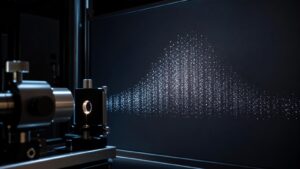
Quantum Probability: How a Particle Decides Where It Is
Quantum probability does not mean a particle personally decides where it is; it means the quantum state assigns structured chances for detection.

Quantum Collapse Explained Simply: Why States ‘Choose’ When Observed
Quantum collapse is the simple rule that a state with several possible outcomes becomes a definite recorded result when measured.