


Quantum Decoherence: Why Superposition Breaks Down
Decoherence explains why superposition breaks down in practice when a quantum system leaks information into its environment.

How Quantum States Store Information in Qubits
Qubits store information in quantum states by using amplitudes, phase, measurement bases, and sometimes entanglement rather than simple bit values.

The Hidden Structure of Quantum States Explained Simply
Quantum states have hidden structure in their amplitudes, phase, basis, correlations, and measurement context, even when outcomes look simple.
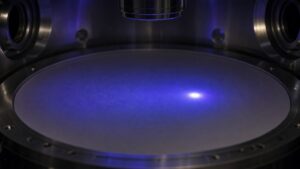
Why Electrons Don’t Have a Single Location Until Measured
Electrons do not have a single ordinary location before measurement because their quantum state gives position probabilities, not a hidden dot path.

Energy States in Quantum Mechanics: A Simple Guide
Energy states are the allowed quantum conditions a system can occupy, explaining spectra, transitions, stability, and superposition of levels.

Is Superposition Real or Just a Mathematical Trick?
Superposition is mathematical, but it is not an empty trick: its phase-sensitive effects show up in interference, qubits, atoms, and experiments.

What the Latest Experiments Reveal About Superposition
Recent superposition experiments show larger systems, better control, and sharper tests of whether quantum behavior survives beyond familiar scales.

How Scientists Create Superposition in the Lab
Scientists create superposition by preparing quantum systems carefully, isolating them, and using controlled pulses or beam splitters before measurement.

Quantum Entanglement vs Superposition: What’s the Difference?
Superposition describes one state combining alternatives, while entanglement describes correlations in a shared state that cannot be split into independent parts.

Can We Control Quantum States? What Scientists Are Learning
Scientists can control quantum states with pulses, fields, cooling, isolation, feedback, and error correction, though coherence remains fragile.

What Happens to Superposition During Measurement?
During measurement, superposition becomes tied to a physical record, changing which alternatives can still interfere and which state predicts the next result.

The Difference Between Pure States and Mixed States (Simple Version)
Pure states and mixed states differ in whether a system has one coherent quantum description or a statistical blend of possible preparations.