
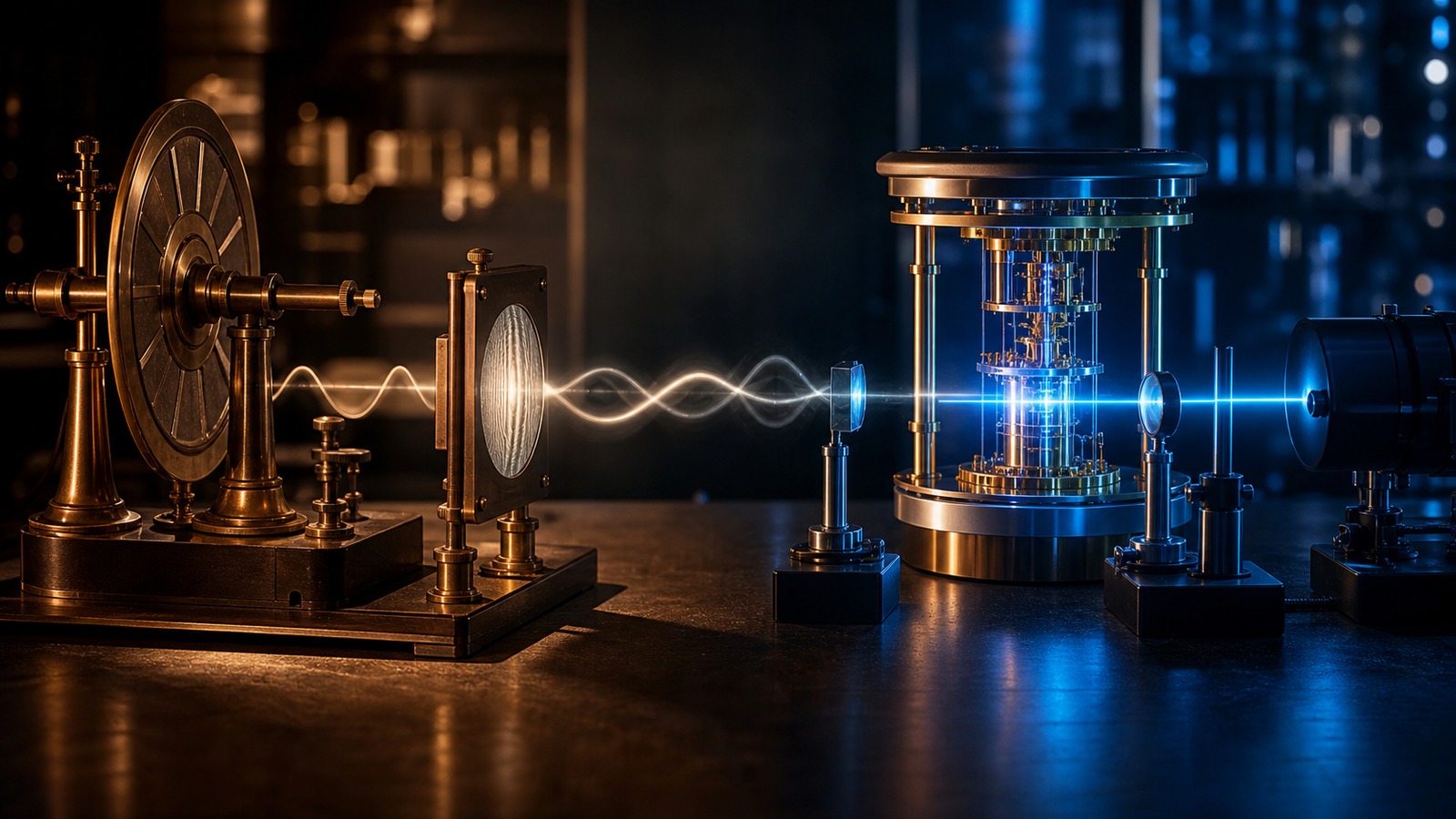
Superposition Became the Language of Quantum Possibility
The birth of superposition came from the realization that quantum states can combine in ways classical states cannot. In wave mechanics, a system can be described by a wavefunction, and wavefunctions can be added together to form new valid states. This mathematical fact became physically profound. An electron in an atom could be described by state patterns. A photon polarization could be a combination of basis directions. A spin could be in a superposition relative to a chosen measurement. Schrodinger helped build wave mechanics, then famously used the cat thought experiment to expose how strange superposition becomes when applied to ordinary objects. The idea was not meant to make quantum physics cute. It was meant to show that the rules of microscopic states and the definiteness of macroscopic outcomes needed careful explanation. In modern physics, superposition is no longer just a paradox. It is a working resource. Qubits use superposition. Interferometers use superposed paths. Quantum sensors exploit phase. Teleportation and entanglement protocols depend on state structure. The concept began as part of a new mathematical language and became one of the most important features of the quantum world.
A: It emerged naturally from wave mechanics and quantum state mathematics.
A: It gave quantum superposition a mathematical home and highlighted measurement problems.
A: It shows the tension between microscopic superposition and macroscopic outcomes.
A: No. Coherent components can interfere.
A: A state can be definite in one basis and superposed in another.
A: Through interference, spin, polarization, tomography, and qubit experiments.
A: It explains why macroscopic alternatives become effectively separated in realistic environments.
A: They manipulate amplitudes and phase for computation.
A: No. It became a practical resource in modern physics.
A: Superposition is precise quantum state structure, not a vague paradox.
Why Wave Mechanics Made Superposition Natural
Superposition feels strange when described with everyday objects, but it is natural in wave mathematics. If two wave patterns are possible solutions, combinations of them can also be possible. Schrodinger’s wave mechanics brought that structure into quantum theory.
This mattered because particles were no longer described only by points and paths. They were described by wavefunctions. Those wavefunctions could overlap, combine, and evolve. The mathematics allowed states that did not fit one classical alternative at a time.
The result was a new language of possibility. A quantum system could have a state that was a combination of basis states. Measurement would later produce one recorded outcome, but before measurement the state could carry several amplitudes.
This was not just abstract beauty. It explained real phenomena such as atomic energy states, interference, and polarization behavior. Superposition became useful because it matched experiments.
The idea began with equations, but it did not stay there.
What Schrodinger Contributed
Schrodinger developed wave mechanics as a powerful way to describe quantum systems. His equation gave physicists a method for calculating how wavefunctions evolve and what states are allowed. It turned matter waves into a working theory.
In that framework, superposition follows naturally. A system’s state can be expressed as a combination of possible basis states. Which basis is useful depends on the question being asked. This flexibility became central to quantum physics.
Schrodinger also understood the discomfort. His cat thought experiment was designed to show how strange it would be to apply microscopic superposition language directly to a macroscopic living system. The point was critique and clarification, not a cute mascot.
That combination makes Schrodinger important in two ways. He helped build the mathematics that made superposition central, and he highlighted the measurement problem that superposition creates.
Why the Cat Became Famous
The cat thought experiment links a microscopic quantum event to a macroscopic outcome. If the quantum event is in superposition, the setup seems to imply a cat superposed between alive and dead. That image is memorable because it pushes quantum rules into ordinary language.
Schrodinger’s point was not that cats literally stroll around in visible half-states. The point was that the transition from quantum superposition to definite macroscopic outcome needed explanation. Where does the ordinary record emerge?
Modern discussions often bring in decoherence. The cat, box, detector, and environment would become entangled extremely quickly, making interference between macroscopic alternatives practically inaccessible. The observed outcome would look definite.
The thought experiment remains useful because it keeps the problem honest. Superposition works beautifully in microscopic predictions, but measurement and macroscopic definiteness still demand careful interpretation.
The cat became famous because it makes that demand impossible to ignore.
How Superposition Appears in Experiments
Superposition appears whenever quantum alternatives remain coherent. A photon can be in a superposition of polarization states. An electron can be in a superposition of paths. A spin can be in a superposition relative to a measurement axis.
Interference is one of the clearest signatures. If alternatives combine and affect probabilities, the state was not merely an ordinary classical mixture. The relative phase between components matters.
Laboratories test superposition through interferometry, spin measurements, spectroscopy, qubit operations, and state tomography. The details differ, but the core pattern is the same. Quantum states can contain coherent combinations.
Measurement then produces an outcome. That outcome is definite for a run, but repeated runs reveal the probabilities encoded in the original state.
Why Superposition Is Not Just Uncertainty
Ordinary uncertainty means we do not know which definite classical situation already exists. Superposition is deeper because its components can interfere. A classical mixture of alternatives cannot produce the same phase-sensitive effects.
This distinction is crucial for qubits. A qubit in superposition is not simply a hidden 0 or hidden 1. Its amplitudes and phase can be manipulated, allowing interference and quantum algorithms.
Superposition also depends on basis. A state may be definite for one kind of measurement and a superposition for another. That is why the phrase in two states at once should always be tied to a specific measurement question.
The idea becomes less mysterious when treated as state structure rather than fog. Superposition is a precise feature of the quantum description.
It is strange, but it is not vague.
How Modern Physics Uses Superposition
Modern quantum physics uses superposition as a resource. Quantum computers manipulate qubit superpositions. Quantum sensors use phase-sensitive states to detect tiny changes. Atomic clocks depend on controlled quantum transitions.
Quantum communication and teleportation also rely on state structure. Transferring or protecting a quantum state requires preserving amplitudes and phases. Superposition is not only something to explain; it is something to engineer.
Experimentalists now create, control, and measure superpositions in systems Schrodinger could not have imagined. Superconducting circuits, trapped ions, photons, cold atoms, and mechanical resonators all extend the idea into modern technology.
This practical success changes the tone. What began as a conceptual puzzle has become a laboratory tool.
What the History Teaches
The history of superposition teaches that quantum ideas often begin as mathematical necessities, then become experimental realities, then become technologies. The concept survived because it kept explaining patterns that classical physics could not.
It also teaches caution. Superposition is powerful, but popular language can distort it. The cat is a warning about measurement, not permission to say anything can be half-real in any ordinary sense.
The best modern view keeps both parts: superposition is mathematically precise and physically useful, while macroscopic outcomes still require careful explanation.
Why The Idea Survived Its Weirdness
Superposition survived because it kept working. It explained interference, atomic states, spin behavior, polarization, and later quantum information. A strange idea can become central when it repeatedly predicts what experiments show.
The weirdness also became more manageable as physicists learned to control the phenomenon. A qubit in superposition is not just a philosophical headache. It is a laboratory object that can be prepared, rotated, entangled, and measured.
That control changes the historical story. Early superposition raised questions about what quantum states mean. Modern superposition still raises those questions, but it also powers devices. The concept moved from problem to resource.
Interference remains the strongest evidence that superposition is not ordinary uncertainty. Components of a state can combine with phase. That phase can change probabilities. Classical mixtures cannot do the same thing.
The cat paradox remains useful because it keeps the measurement problem visible. But it should not overshadow the many ordinary laboratory cases where superposition is controlled cleanly. The idea is broader than one famous image.
Superposition survived because it became woven into the working grammar of quantum physics. Remove it, and too many successful explanations disappear.
This is why modern students meet the concept early. It is not optional decoration. It is one of the basic ways quantum states are built.
The challenge is to teach it without making it either mystical or trivial.
History helps with that balance because it shows both the shock and the success.
How Modern Examples Reframe The History
Modern qubits reframe superposition by making it operational. A state can be prepared as a controlled combination, manipulated by gates, and measured repeatedly. The concept becomes something engineers must calibrate.
Atom interferometers reframe it as precision measurement. Superposed paths accumulate phase differences that reveal acceleration, rotation, or fields. The same idea that puzzled early physicists becomes a sensitive measuring strategy.
Quantum communication reframes it as information. A superposition cannot be copied like a classical message, and that limitation shapes teleportation, cryptography, and network protocols.
Large-system experiments reframe it as a boundary question. How far can coherent alternatives be preserved? How quickly does decoherence create classical appearance? These questions connect Schrodinger’s concern to active research.
Seen this way, the birth of superposition is not a finished historical episode. It is the beginning of a concept that keeps finding new forms.
Schrodinger’s era gave the mathematics and the paradox. Modern physics gives the control, applications, and continuing tests.
Why History Makes The Concept Easier
History makes superposition easier because it shows that the idea was not invented as a riddle. It grew from a mathematical framework that solved real problems. The strangeness came with success, not instead of it.
Following the history also separates the equation from the cat image. Schrodinger’s wave mechanics made superposition useful, while the cat exposed a problem about measurement. Both parts matter, but they play different roles.
Modern examples then show why the concept endured. Qubits, interferometers, and quantum sensors use superposition as a resource. The idea is not trapped in a 1930s paradox.
This timeline helps beginners trust the concept without flattening it. Superposition is strange, historically contested, experimentally tested, and technologically useful all at once.
That combination is exactly what makes it central to quantum physics.
It also shows why the history should not stop with the cat. The thought experiment made the measurement problem famous, but later work turned superposition into something that could be prepared, protected, manipulated, and verified. The concept moved from puzzle to tool without losing its depth. That shift is easy to miss when the cat image dominates the story.
That movement is the real arc. Schrodinger gave physicists a wave equation, the cat exposed a conceptual wound, and modern laboratories learned to use coherent alternatives in devices. Each stage changes the reader’s sense of what superposition is for. It helps readers see continuity instead of a list of strange episodes.
Seen this way, the birth of superposition is not a single moment. It is a growing recognition that quantum possibility has structure, consequences, and practical power. The timeline keeps the concept specific, testable, and historically alive inside modern physics today for beginners.
The Modern Takeaway
Superposition was born from wave mechanics and became a central language for quantum possibility, interference, measurement, and technology.
From Schrodinger’s equation to modern qubits, it remains one of the clearest signs that quantum states are not classical pictures in disguise.


