The Possibility Weights Behind Quantum Predictions
Quantum amplitudes are easiest to understand without math if we start with what they are not. They are not ordinary probabilities. A probability is the final kind of number we use when saying how likely a result is. An amplitude is a deeper ingredient used before that final probability is produced. Amplitudes can combine, and the way they combine depends on phase. When alternatives line up, they can strengthen an outcome. When they oppose one another, they can weaken or even cancel an outcome. This is why quantum mechanics can produce interference patterns from individual particles. The final detector record is definite, but the possibilities leading to it are organized by amplitudes that may add or cancel before the probability is calculated. You do not need equations to grasp the central idea: quantum theory does not simply list possible outcomes with ordinary odds attached. It gives each alternative a richer kind of contribution. Those contributions can interact with each other before measurement. That richer contribution is what physicists call an amplitude. The word may sound technical, but it names the feature that makes quantum probability so different from coin flips, dice rolls, or ordinary ignorance. Amplitudes are possibility weights with direction-like structure, and that structure is what lets nature make dark bands as well as bright ones.
A: A structured contribution used before final probabilities are obtained.
A: Probabilities do not carry phase or cancel in the same way.
A: It controls whether contributions reinforce or oppose one another.
A: Their combined effects appear in repeated measurement statistics.
A: Amplitude contributions cancel there.
A: No. Many trials and settings are usually needed.
A: Yes. Algorithms reshape amplitudes before measurement.
A: They are mathematical state ingredients with physical consequences.
A: Direction-like contributions that combine before chances appear.
A: They explain interference better than ordinary probability alone.
Why Probability Alone Is Not Enough
Ordinary probability works well when possibilities do not combine. If a die can land on one side, each outcome has a chance. The possibilities are alternatives, but they do not cancel one another. One possible die face does not erase another.
Quantum experiments show something stranger. In a double-slit setup, allowing two alternatives can make some outcomes less likely than either alternative alone would suggest. That is the clue that ordinary probability is not the whole story.
Amplitudes explain this difference. Each alternative contributes an amplitude, and amplitudes combine before probabilities are obtained. Depending on their relationship, the combined result may be larger, smaller, or zero.
This is why dark interference bands are so important. They are not places where nothing could have happened in a simple sense. They are places where contributions cancel after alternatives are combined.
Probability alone describes the final pattern. Amplitudes explain how the pattern is shaped.
The Direction-Like Part
A helpful non-math image is to think of an amplitude as having size and direction-like orientation. The size affects how strongly it contributes. The orientation, called phase, affects how it combines with other amplitudes.
If two contributions point in compatible directions, they reinforce. If they point in opposite directions, they can cancel. The exact mathematical version is more precise, but the everyday idea is enough for a first explanation.
This direction-like feature is what ordinary probabilities lack. Probabilities are positive final numbers. They can be added in classical cases, but they do not carry the same phase structure.
That is why amplitudes feel odd. They are not final chances; they are ingredients that still have to be combined and converted into chances.
Why Amplitudes Can Cancel
Cancellation is one of the clearest signs that amplitudes are not probabilities. If two ordinary chances are both possible, adding them should not produce zero. But two amplitude contributions can oppose one another.
Think of two waves meeting with opposite crests and troughs. That picture is not perfect, but it captures the idea of cancellation. The contributions are real in the calculation, yet their combination can reduce the final probability.
This explains why interference patterns have bright and dark regions. Bright regions come from reinforcement. Dark regions come from cancellation. The detector still records individual events, but the distribution across many events reflects amplitude combination.
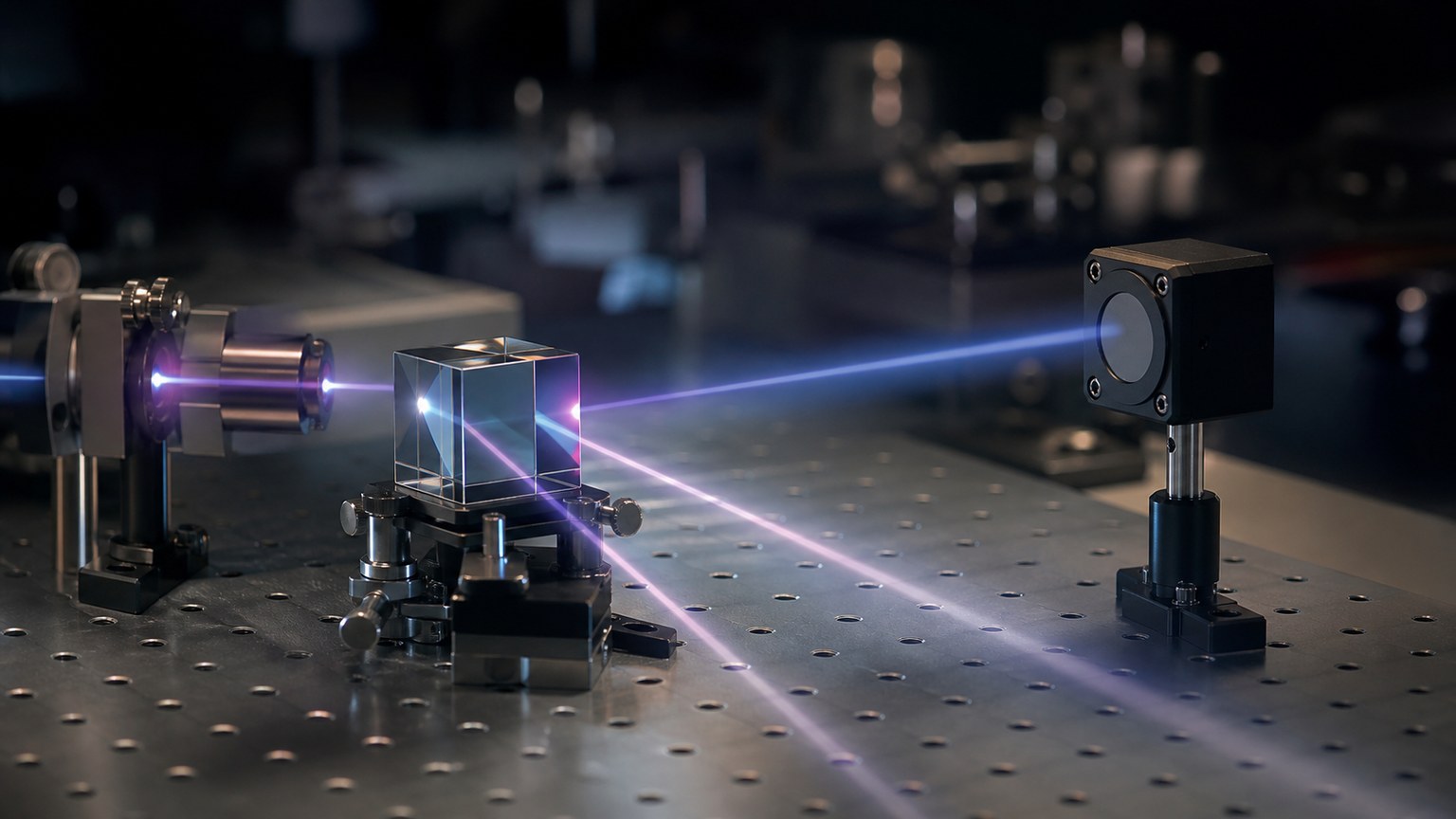
Cancellation also shows why changing the setup matters. Move a mirror, change a path length, rotate a polarizer, or add which-path information, and the relationships among amplitudes change. The final pattern changes with them.
In quantum mechanics, possibility is not passive. It has structure, and that structure can remove outcomes as well as support them.
How Measurement Turns Amplitudes Into Outcomes
Before measurement, amplitudes help organize what could happen. During measurement, the experiment produces one recorded result. The final probability for that result comes from the combined amplitude associated with it.
This is why an individual detector click does not show the full amplitude structure by itself. One click is one outcome. The amplitude pattern appears through many repeated trials prepared in the same way.
That repeated-trial pattern can be extremely precise. It shows where outcomes are likely, where they are rare, and where cancellation has made them nearly absent. The amplitude structure is inferred from that distribution.
The measurement does not reveal a visible amplitude floating in space. It reveals the consequences of amplitudes after the experiment has converted them into recorded events.
Why Phase Is the Quiet Star
Phase is often the part beginners hear about last, but it is central. Two alternatives can have the same size of contribution and still combine differently if their phases differ. Phase controls the relationship among amplitudes.
In an interferometer, a small phase shift can move the bright and dark bands. In a qubit, phase affects later measurement probabilities after additional operations. In atoms and molecules, phase relationships help determine allowed quantum behavior.
This makes phase a quiet star of quantum theory. It is not always visible in a single measurement, yet it can dominate what happens after alternatives are brought together.
Ignoring phase turns amplitudes into ordinary weights, which misses the essential feature. Amplitudes are powerful because they carry relationship, not just amount.
That relationship is why quantum probability can be engineered.
Why Paths Are Not Counted Classically
In some classical situations, you can count routes separately. If one road brings traffic to a town and another road brings traffic too, opening both roads increases traffic. Quantum alternatives do not always work that way.
If the alternatives remain coherent, their amplitudes combine. That combination may increase some results and decrease others. The alternatives are not merely counted as separate hidden routes.
This is why asking which path the particle really took can be dangerous. If the experiment has no path record, treating the paths as ordinary alternatives may destroy the very feature that explains the pattern.
Amplitudes help replace that classical counting habit with a better question: how do the allowed alternatives combine before detection?
How Amplitudes Power Technology
Quantum technology works by controlling amplitudes. A quantum computer uses operations that change amplitudes so useful outcomes become more likely after measurement. The machine does not simply try every answer in a classical sense.
Interferometers use phase-sensitive amplitudes to measure tiny changes in distance, acceleration, rotation, or fields. The final signal comes from how amplitudes recombine.
Quantum communication and sensing also depend on amplitude relationships. The details differ, but the core idea repeats: prepare a state, transform amplitudes, and measure the resulting probabilities.
How to Avoid Bad Shortcuts
A bad shortcut is to say amplitudes are just probabilities with a fancy name. That loses cancellation, phase, and interference. Another bad shortcut is to treat amplitudes as physical waves in ordinary space in every case.
A better shortcut is this: amplitudes are pre-probability contributions that can combine. They carry size and phase. After they combine, quantum theory turns the result into measurable probabilities.
This description is not the full mathematics, but it keeps the right shape of the idea. It explains why two alternatives can make an outcome less likely, why phase matters, and why measurement statistics reveal hidden structure.
It also prepares readers for the math later. Complex numbers, wavefunctions, and Hilbert spaces become less intimidating when the job of amplitudes is already clear.
Plain language cannot replace the equations, but it can tell you what the equations are trying to do.
That is enough for a first confident step.
A second useful step is to notice where amplitudes are hiding inside familiar explanations. When a teacher says alternatives interfere, the unstated mechanism is amplitude combination. When a qubit gate is described as rotating a state, the gate is changing amplitudes and phase. When a dark band appears, the final probability has been reduced by cancellation.
This language also helps with measurement. A detector does not choose among ordinary prewritten tickets. It samples probabilities produced from amplitudes after the setup has done its work. That is why the same source can give different statistics when the apparatus is changed.
Amplitudes are therefore a bridge between intuition and formalism. They tell the reader why quantum probability is not just uncertainty with a new name. They also prepare the reader to understand why complex numbers enter the theory: the mathematics needs a way to represent size and phase together.
Without that bridge, interference seems like a magic trick. With it, the trick becomes a rule about how possibilities combine before they become observed frequencies.
The non-math version is not childish. It is the conceptual skeleton of the math.
How Amplitudes Change During an Experiment
Amplitudes usually change before measurement. A magnetic pulse can rotate a spin state, an optical element can shift a photon’s path amplitudes, and a barrier can reshape a particle’s wave packet. The state evolves, so the later probabilities are not frozen at preparation.
This changing structure is one reason timing matters in quantum experiments. If two alternatives accumulate different phase for a little longer, the final pattern may move. If a pulse lasts too long, a qubit can overshoot the intended state. Small controlled changes can become large readout differences.
Amplitudes can also become linked across systems. When two particles interact, the meaningful alternatives may belong to the pair rather than to either system alone. That is how amplitude language connects naturally to entanglement.
Measurement changes the calculation again. Once a definite result is recorded, predictions must begin from the state compatible with that record. The earlier amplitudes were not useless; they set the probabilities that governed which record appeared.
So amplitudes are not static labels. They are the moving bookkeeping of quantum possibility.
Why the No-Math Version Still Has Rules
A no-math explanation should not make amplitudes sound casual. They are not feelings, hints, or loose guesses. They obey strict rules about addition, phase, evolution, and measurement.
That strictness is why the concept survives outside metaphor. Experiments can change one part of the setup and predict how the distribution shifts. If amplitudes were only poetic language, that precision would disappear.
Beginners do not need the equations first, but they do need respect for the structure. The plain-language version should point toward the real rule: combine amplitudes first when alternatives remain coherent, then convert the result into probabilities. That order is the difference between quantum prediction and ordinary guessing.
That rule is the quiet backbone of the subject.
The Everyday Translation
If probabilities are final chances, amplitudes are the structured contributions that create those chances. They are combined before the outcome odds are read.
That one difference explains why quantum mechanics can make alternatives reinforce, cancel, and produce patterns no ordinary probability list can match.