

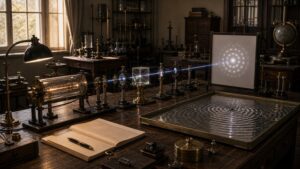
Louis de Broglie and the Idea That Matter Behaves Like Waves
Louis de Broglie’s matter-wave idea changed quantum theory by proposing that particles such as electrons have wave-like behavior.
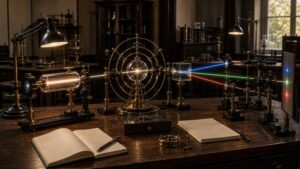
The Quantum Leap: How Electrons Puzzled Early Physicists
The quantum leap puzzled early physicists because electrons seemed to change atomic energy states without following classical paths between them.

The Story Behind Schrodinger’s Cat and Quantum Paradoxes
Schrodinger’s cat was created to expose the strange consequences of quantum superposition, measurement, and the boundary between microscopic and everyday reality.

How Niels Bohr Built the Foundation of Quantum Theory
Niels Bohr built the foundation of quantum theory by connecting atomic structure, spectral lines, complementarity, and measurement context.

How the Double-Slit Experiment Became a Landmark Discovery
The double-slit experiment became a landmark because it revealed interference, wave-particle duality, measurement effects, and the strangeness of quantum states.

The Golden Age of Quantum Theory: 1900-1935
The golden age of quantum theory from 1900 to 1935 transformed physics through quanta, photons, atomic models, wave mechanics, uncertainty, and EPR.

How Quantum Mechanics Challenged Old Ideas About the Universe
Quantum mechanics challenged old ideas about the universe by changing assumptions about certainty, separability, measurement, and reality.
Why the Early 1900s Became the Century of Quantum Theory
The early 1900s became the century of quantum theory because classical physics met a cluster of experiments it could not explain.

How Quantum Physics Emerged from Classical Physics
Quantum physics emerged from classical physics when experiments with heat, light, atoms, and matter exposed limits that old theories could not solve.
A Beginner’s Guide to the Key Discoveries in Quantum History
Key discoveries in quantum history include quanta, light particles, atomic spectra, matter waves, wave mechanics, uncertainty, spin, and entanglement.

Heisenberg’s Uncertainty Principle: The Idea That Redefined Physics
Heisenberg’s uncertainty principle redefined physics by showing that some properties cannot be made simultaneously sharp in the classical way.
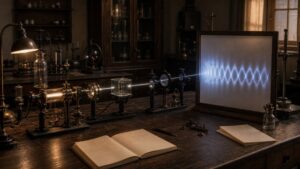
The Birth of the Wavefunction: How Schrodinger Changed Everything
Schrodinger’s wavefunction changed quantum physics by giving the new theory a powerful equation, a new language, and a lasting mystery.