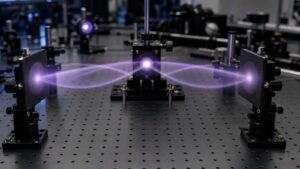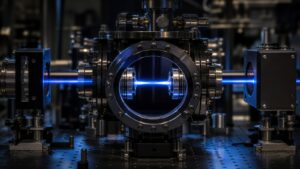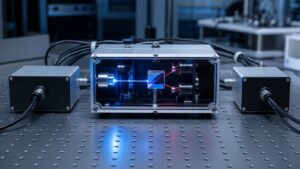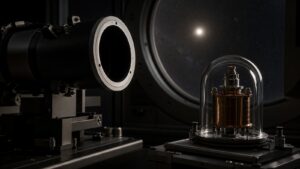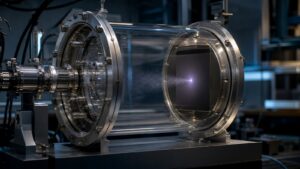
Welcome to the mysterious heart of quantum physics—Uncertainty & Probability, where the universe stops pretending to be predictable. On Quantum Mechanics Street, we explore the strange truth that at the smallest scales, nature doesn’t deal in certainties—it deals in chances. Imagine trying to catch a firefly in the dark: the more precisely you know where it is, the less certain you are about where it’s going. That’s the essence of Heisenberg’s Uncertainty Principle. In the quantum world, particles don’t have fixed paths or positions until we measure them—they exist as clouds of possibilities, guided by probability waves that reveal what might happen rather than what will. It’s a world where randomness is real, and prediction means calculating odds, not outcomes. Yet out of this uncertainty comes incredible power—the foundation for quantum computers, tunneling, and the very structure of atoms. So step inside and embrace the unknown—where every measurement is a gamble, and every mystery unfolds in probabilities.
A: No—it’s a fundamental limit, even with perfect tools.
A: You can cut technical noise, but quantum limits remain.
A: Confining position forces a wider range of momenta.
A: Any measuring interaction counts—human optional.
A: Stable phase relationships that allow clear interference patterns.
A: Secure cryptography and unbiased random numbers.
A: Atomic clocks, MRI, precision sensors, quantum computing.
A: Cool things down, isolate vibrations, and use averaging.
A: Re-shaping uncertainty to be smaller in one property and larger in its partner.
A: Try single-slit/double-slit basics, then spin, squeezing, and entanglement.

Why Quantum Physics Says the Future Is Never Set in Stone
Quantum physics reveals a universe where the future is not a locked script but a field of possibilities. This beginner-friendly guide explores uncertainty, probability, measurement, and why tiny particles make reality feel more open, flexible, and fascinating than everyday experience suggests.

How Scientists Predict Particle Behavior Using Probabilities
Discover how scientists use probability, not certainty, to predict particle behavior in the strange and fascinating world of quantum physics.

What Quantum Uncertainty Tells Us About Reality
Quantum uncertainty reveals a universe built not on perfect certainty, but on probability, connection, and astonishing hidden depth.

Why Even Perfect Instruments Can’t Beat Quantum Uncertainty
Even flawless instruments cannot escape quantum uncertainty. Discover why nature itself limits perfect measurement at the smallest scales.

Wavefunctions and Probability: How Physics Predicts the Unknown
What if reality doesn’t choose a single outcome until it’s observed? This article explores how wavefunctions and probability guide the hidden rules of the universe, revealing why uncertainty isn’t a flaw in physics—but its greatest strength.

Is Quantum Uncertainty Real or Just a Calculation Trick?
Is quantum uncertainty a deep truth of nature or just a clever mathematical shortcut? This engaging exploration unpacks why particles defy certainty, how probability shapes reality, and what modern physics really tells us about the limits of knowledge at the smallest scales.

How Measurement Creates Uncertainty in Quantum Physics
Measurement doesn’t just reveal the quantum world—it reshapes it. Discover how observing particles creates uncertainty, why outcomes shift when we look closer, and what this means for reality itself. This accessible guide unpacks one of quantum physics’ most fascinating mysteries, showing how knowledge and uncertainty are forever intertwined at the smallest scales of the universe.

What Heisenberg Really Meant: The Story Behind the Uncertainty Principle
The uncertainty principle is often reduced to a catchy slogan, but its true meaning is far deeper. Step into the story of Werner Heisenberg and discover how quantum mechanics rewrote reality, challenged determinism, and revealed a universe built on probabilities rather than certainties.

Why the Universe Runs on Probability, Not Certainty
Nothing in the universe is truly certain—not even reality itself. From quantum particles to galaxies, probability governs what happens and when. This article explores why chance isn’t a flaw in physics, but the hidden engine that shapes matter, time, and existence itself.

The Strange Rules of Quantum Probability, Explained for Beginners
Quantum physics rewrites the rules of chance. Step into a world where particles exist as possibilities, outcomes emerge only when measured, and probability shapes reality itself. This beginner-friendly guide unpacks the strange logic of quantum probability and reveals why uncertainty isn’t confusion—it’s how the universe truly works.

Why Particles Don’t Have Exact Positions Until Measured
Nothing in the quantum world is guaranteed. From wandering electrons to mysterious measurements, reality unfolds as probabilities, not certainties. This article explores why uncertainty isn’t a flaw in physics—but a fundamental rule of the universe that reshapes how we understand matter, motion, and reality itself.

Probability in Quantum Physics: Why Nothing Is Certain
Nothing in the quantum world is guaranteed. From wandering electrons to mysterious measurements, reality unfolds as probabilities, not certainties. This article explores why uncertainty isn’t a flaw in physics—but a fundamental rule of the universe that reshapes how we understand matter, motion, and reality itself.