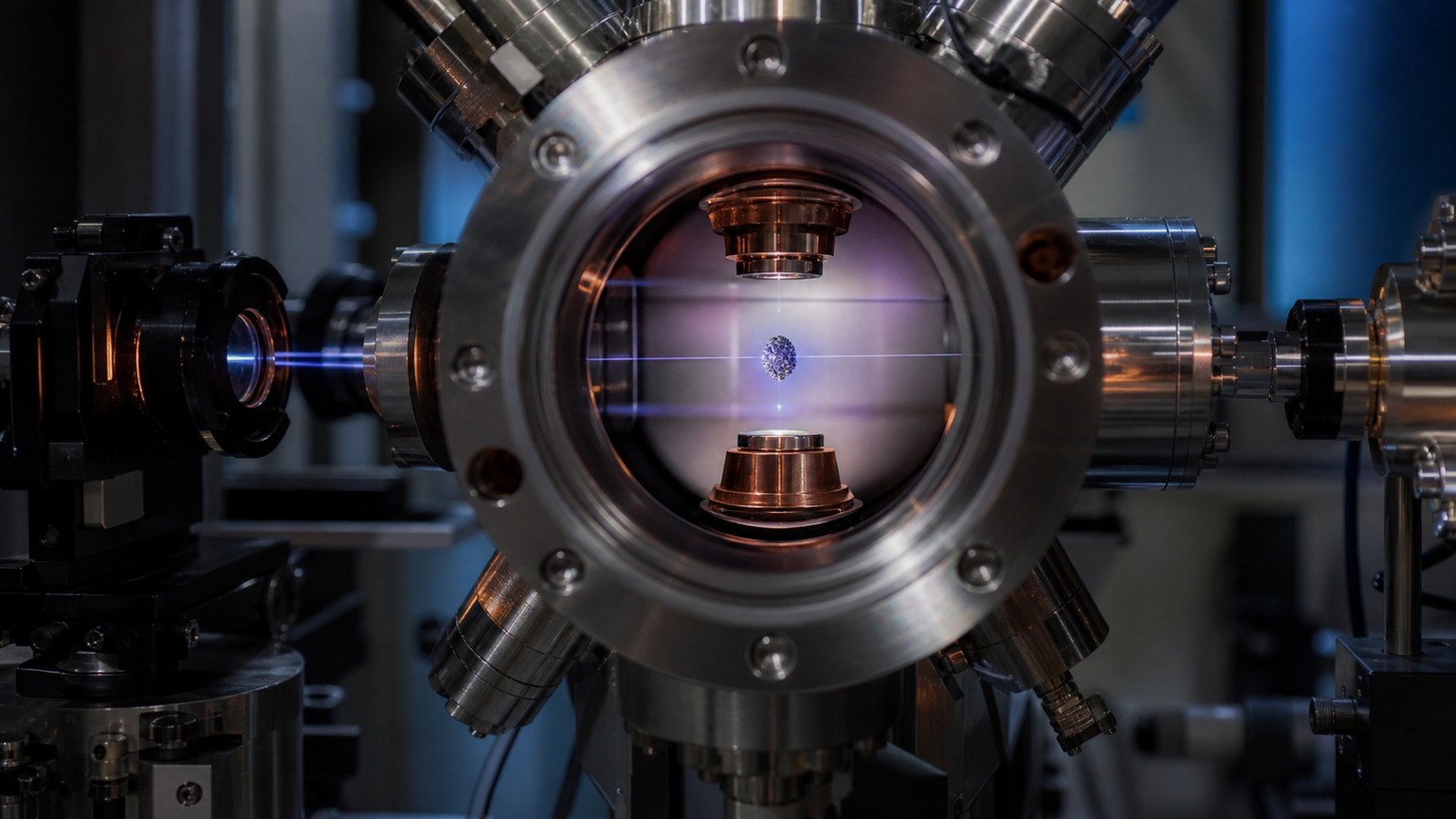
When Alternatives Meet Again
Superposition leads to interference patterns when several coherent alternatives remain part of one quantum state and are later recombined. The pattern is not produced by a particle splitting into tiny classical copies that bump into one another. It comes from amplitudes. In a superposition, alternatives can carry amplitude and phase. If the experimental setup lets those alternatives meet again without a record marking which one occurred, the amplitudes combine. In some places they reinforce, making detections more likely. In other places they oppose, making detections less likely. Across many repeated trials, those changes in probability become a bright-and-dark interference pattern. The detector still records individual events, but the distribution of events carries the signature of the earlier superposition. This is why the double-slit experiment, interferometers, electron diffraction, and matter-wave experiments are so powerful. They reveal that quantum alternatives are not just ordinary unknowns. They can cooperate or cancel before measurement. The essential requirements are preparation, coherence, phase difference, recombination, and a measurement that records the final outcome rather than the path. Change any of those requirements, and the pattern changes. Superposition is the source of the alternatives; interference is what happens when the alternatives are allowed to act together.
A: Coherent alternatives recombine and change detection probabilities.
A: No. Individual detections are localized.
A: It appears in the long-run distribution.
A: Amplitude contributions cancel there.
A: Which-path records or environmental leakage can remove coherence.
A: No. Physical distinguishability is enough.
A: Yes. Electrons, atoms, and molecules can show it.
A: It decides how alternatives combine.
A: Alternatives contribute again to shared final outcomes.
A: They reveal coherent alternatives meeting before detection.
Why Superposition Creates Alternatives
Superposition means a quantum state can include more than one alternative for a later measurement. In a path experiment, the alternatives may correspond to different routes. In a spin experiment, they may correspond to different possible spin readouts.
These alternatives are not merely a list of hidden classical options. They belong to one state, and each contribution can carry phase. That shared state structure is why the alternatives can later combine.
If the alternatives were only ordinary ignorance, opening another route would simply add another chance. Quantum superposition can do more. It can make some results less likely through cancellation.
This is the first step toward interference. The state must carry alternatives that remain coherent enough to affect the same final outcome.
Without superposition, there is no quantum interference pattern to explain.
Why Coherence Keeps Alternatives Related
Coherence means the phase relationship among alternatives is preserved. If coherence is lost, the alternatives behave more like a mixture for practical purposes. They no longer recombine in a clean phase-sensitive way.
Coherence can be damaged by path detectors, environmental interactions, vibrations, heat, or any process that leaves distinguishing information. The alternatives do not need to be violently disturbed. They only need to become distinguishable in a physical record.
This is why interference experiments require careful isolation. The apparatus must allow alternatives to exist together without leaking the information that would separate them.
The pattern is therefore a sign of preserved relationship. It tells us that the alternatives were not merely independent classical cases.
How Phase Shapes the Pattern
Phase determines whether alternatives reinforce or cancel at a given place. If the phases line up, the probability for detection can increase. If the phases oppose, the probability can decrease.
In a double-slit experiment, different points on the screen correspond to different path differences. Those path differences create different phase relationships. That is why the screen shows bands rather than a uniform smear.
Interferometers make the same principle adjustable. Move a mirror slightly, change a path length, or shift the medium in one path, and the phase relationship changes. The interference pattern moves with it.
Phase turns geometry into probability. The apparatus does not simply guide particles; it shapes how amplitudes combine.
This is why interference patterns can be used for precision measurement. Tiny phase changes can produce visible shifts in the final pattern.
Why Recombination Is Essential
Superposition alone does not always create a visible interference pattern. Alternatives must be brought into a situation where their amplitudes contribute to the same possible outcomes. That is recombination.
In a two-path interferometer, mirrors and beam splitters guide alternatives back together. In a double-slit experiment, waves from the two openings overlap at the detection screen. In diffraction, many scattering alternatives combine.
If alternatives never meet in the relevant measurement, their phase relationship may not show up as interference. The state can still be quantum, but the chosen readout may not reveal that feature.
This is why experimental design matters. The apparatus must be built to let the superposed alternatives speak through the same final record.
Why Individual Detections Still Appear
An interference pattern does not require each particle to land as a spread-out smear. Individual detections can be localized. One photon, electron, atom, or molecule can register at one place.
The wave-like pattern emerges after many trials. Each trial gives one record, but the collection of records follows probabilities shaped by amplitude interference. The pattern is statistical and physical at the same time.
This combination is what makes quantum interference so striking. The single event looks particle-like. The long-run distribution reveals wave-like amplitude behavior.
Beginners often want one side to be the real one. Interference teaches that the two descriptions answer different parts of the experiment.
The detection is local; the probability structure is quantum.
What Which-Path Records Remove
If a detector records which alternative occurred, the interference pattern usually fades or disappears. The reason is not that knowledge has magical power. The reason is that the physical record changes the state relationships.
Once alternatives are marked, their amplitudes do not combine in the same way for the final screen. The setup has become a path-information experiment instead of an interference experiment.
This is why the word observed needs care. An environment can carry which-path information even if no person ever reads it. The loss of interference belongs to physical distinguishability.
That distinction keeps the explanation scientific. The pattern depends on records, not curiosity.
Why Diffraction Belongs Here
Diffraction is another route from superposition to interference. When a wave-like quantum state encounters a narrow opening, edge, or crystal lattice, many alternatives contribute to the final distribution. Their amplitudes combine across directions.
Electron diffraction and molecule diffraction show that the principle is not limited to light. Matter can produce interference patterns when prepared coherently and measured carefully.
These experiments extend the lesson. Superposition and interference are not attached to one famous apparatus. They are general features of quantum states under the right conditions.
How the Pattern Becomes Evidence
An interference pattern becomes evidence because it has structure that ordinary particle counting cannot explain. Bright and dark bands depend on wavelength, phase, geometry, and coherence. Change the setup, and the pattern changes predictably.
Scientists compare those changes with quantum predictions. If the band spacing, visibility, or phase shift matches the state calculation, the pattern confirms the role of amplitudes. The evidence is not a vague visual resemblance to waves.
The pattern also reveals what the apparatus preserved. High visibility suggests good coherence. Reduced visibility suggests leakage, mixed preparation, or environmental disturbance. The bands diagnose the experiment.
This makes interference more than a classroom image. It is a precision tool. The same principle supports sensors, atomic clocks, quantum optics, and matter-wave measurements.
Superposition becomes visible through disciplined repetition.
That visibility is indirect, but it is strong.
The strength comes from how many details the pattern carries at once. Its spacing can reveal wavelength. Its contrast can reveal coherence. Its movement can reveal a phase shift. Its disappearance can reveal path information or environmental leakage. A single pattern can therefore diagnose the entire experimental arrangement.
This is why superposition and interference should be taught together. Superposition supplies alternatives, but the evidence for those alternatives often appears only after interference. Without the pattern, the word superposition can sound like an abstract claim. With the pattern, it becomes something tied to laboratory records.
That does not make every interference pattern quantum. Classical waves interfere too. The quantum point is that individual particles can build the pattern one event at a time when the state remains coherent. The pattern then links localized detection with amplitude structure.
Reading the pattern carefully also prevents overstatement. It does not prove that a particle followed two little classical paths. It proves that the experiment must account for coherent alternatives whose amplitudes combined before detection.
That careful reading is more powerful than the slogan.
Why Visibility Is a Measurement Tool
Physicists often describe the sharpness of an interference pattern in terms of visibility. High visibility means the bright and dark regions are clearly separated. Low visibility means the contrast has faded, even if detections still occur.
Visibility is useful because it turns a visual impression into a measurable quantity. A weak pattern can signal partial path information, imperfect preparation, thermal motion, detector limits, or environmental coupling. The bands become a diagnostic instrument.
This is why interference experiments are not just demonstrations for students. In precision labs, the pattern can reveal extremely small changes in path length, acceleration, magnetic field, gravity, or refractive index. Superposition supplies the sensitivity through phase.
Visibility also helps explain the transition toward classical behavior. As systems interact with their surroundings, coherent alternatives become harder to recombine. The fading pattern shows that change before any philosophical conclusion is added.
A strong pattern therefore says more than “waves were involved.” It says the experiment preserved the relationships that superposition needs.
Visibility is also a bridge between beginner explanation and advanced practice. It lets the same image answer several questions at once: how coherent the source was, how stable the apparatus remained, and how much information leaked into the surroundings.
Because visibility can be compared across setups, it also prevents one famous experiment from carrying the whole subject. The same idea can be tested with light, electrons, atoms, molecules, or engineered qubits, each with its own sources of noise and control. That range is why interference remains a living research tool. It connects classroom evidence to modern instruments and shows why careful repetition matters in real laboratories today, not just in textbooks.
How to Read the Pattern Carefully
A careful reader asks what alternatives were superposed, how they were kept coherent, where they recombined, and what the detector actually measured. Those questions turn the image from a mystery poster into an experimental argument.
The reader should also notice what the pattern does not say. It does not show the particle drawing a visible wave on the screen during one trial. It shows a long-run distribution shaped by amplitude interference.
That distinction keeps the explanation clean. Individual events and statistical structure are both part of the evidence.
Once those pieces are separated, interference becomes less mystical and more impressive. It shows how disciplined control of superposition can make invisible phase relationships leave visible records.
The same caution applies when comparing different experiments. Double slits, beam splitters, crystal diffraction, and atom interferometers arrange alternatives in different ways. The pattern is the common clue, but the physical route to that clue changes from case to case.
The Pattern Takeaway
Superposition supplies coherent alternatives. Interference patterns appear when those alternatives recombine and their amplitudes reinforce or cancel.
The pattern is built from individual detections, but its shape records the phase relationships that survived before measurement.