Particles Do Not Decide Like People
Quantum probability explains how a particle can produce definite measurement results even when the theory predicts only chances for each outcome. Saying a particle decides where it is can be useful as a casual phrase, but it is not literal. A particle is not weighing options. Its quantum state contains amplitudes for possible measurement results. When a measurement is made, one result is recorded, and repeated measurements under the same preparation reveal a stable probability pattern. The probabilities are not random in the sense of lawless chaos. They are calculated from the quantum state, often by the Born rule, which connects amplitude size with outcome likelihood. This is why a single electron may hit one place on a detector, while many similarly prepared electrons form a predictable distribution. Quantum probability is deeper than ordinary ignorance because some experiments cannot be explained as merely revealing a hidden preexisting value. The act of measurement and the choice of measurement basis matter. Still, the theory is not vague. It gives precise statistical predictions. The particle does not decide like a person; the experiment samples a structured probability rule built into the quantum state.
A: No. The state assigns probabilities, and measurement records one outcome.
A: A quantum quantity whose size and phase help determine probabilities.
A: It connects amplitudes with measurement probabilities.
A: Repeated events reveal the probability distribution.
A: Not always; quantum amplitudes can interfere.
A: The set of outcomes a particular measurement can distinguish.
A: Amplitudes can cancel before probabilities are formed.
A: No. Many repeated trials are needed.
A: No. Quantum randomness is statistically structured.
A: Quantum probability is chance governed by amplitudes and measurement context.
Why Quantum Chance Is Structured
Quantum probability is not a confession that physics has given up. It is a structured part of the theory. The quantum state provides amplitudes, and those amplitudes determine probabilities for possible measurement outcomes.
In many cases, the Born rule tells us to take the squared size of an amplitude to find the probability. This rule is simple to use and extraordinarily successful. It turns the abstract quantum state into predictions that can be tested.
The individual outcome may be unpredictable. The long-run distribution is not. If the same preparation is repeated many times, the pattern of results should match the probabilities assigned by the state.
This is why quantum probability is both strange and disciplined. It denies a guaranteed outcome for every single trial, yet it gives precise expectations for many trials.
The uncertainty is mathematical, not careless.
How Amplitudes Differ From Ordinary Chances
Ordinary probabilities are usually positive numbers that add. Quantum amplitudes are more subtle. They can carry phase, which means alternatives can reinforce or cancel before probabilities are calculated.
This is why interference exists. In a double-slit experiment, amplitudes associated with alternatives combine first. Only after that combination do probabilities determine where detections are likely. Classical probability would simply add route chances.
Phase makes quantum probability feel wave-like. Two alternatives can both be possible, yet their amplitudes can reduce the chance of detection in a region. This is how dark interference bands appear.
So quantum probability is not just ignorance plus randomness. It is probability built from amplitudes, and amplitudes can interfere.
Why One Result Appears
A quantum state may assign probabilities to several possible outcomes, but a measurement records one result in a single run. That is the particle-like side of the story. The detector does not print a whole probability distribution for one event.
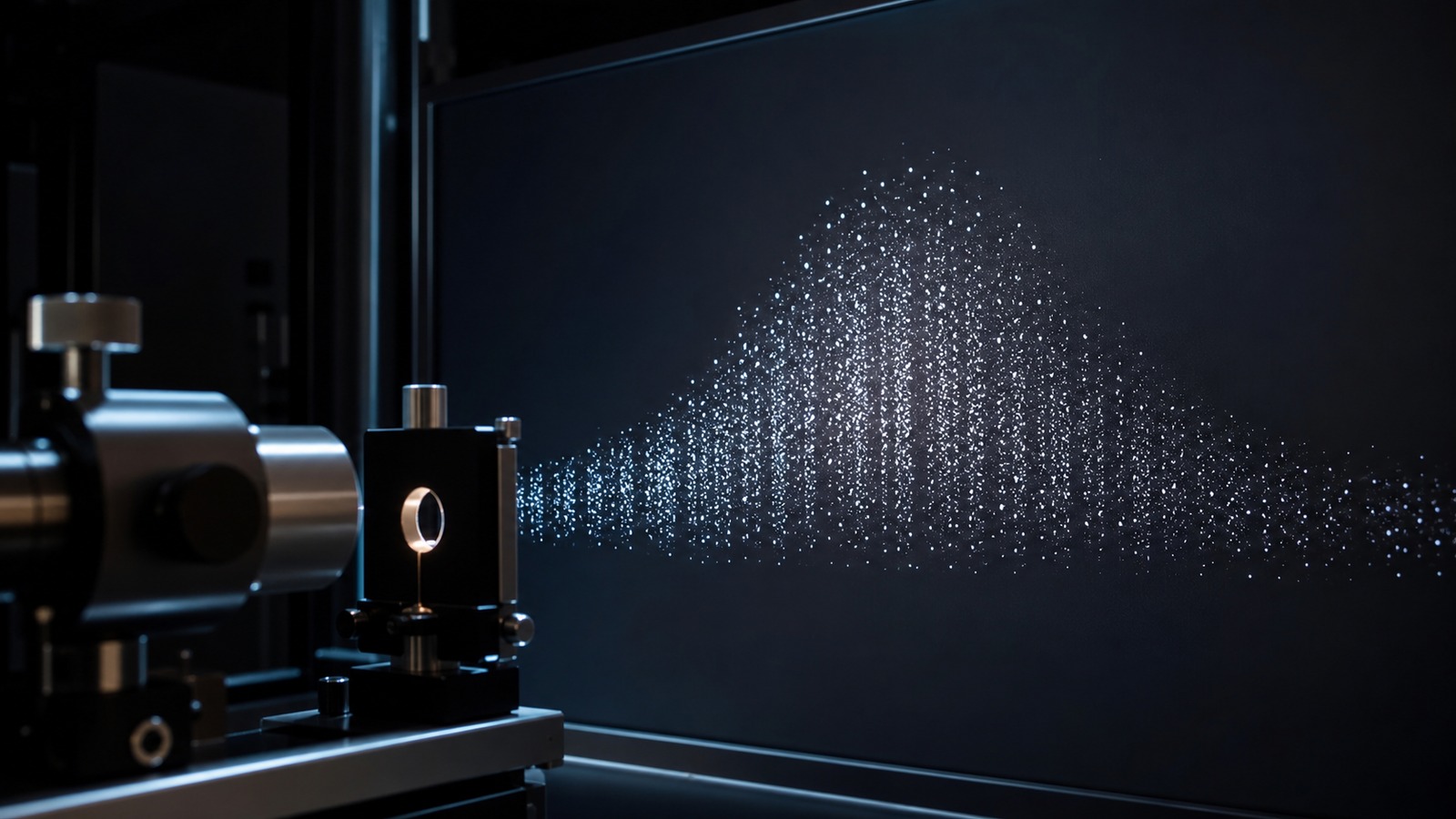
The distribution appears through repetition. Prepare the same state, perform the same measurement, and collect many outcomes. The results form a pattern. That pattern is what the quantum probabilities predicted.
This separation between one result and many results is essential. A single event can look surprising or arbitrary. A large set of events reveals the structure. Quantum mechanics is a theory of those structured statistics.
The measurement context also matters. Change the measurement basis, and the probabilities can change. The state does not carry one simple answer to every possible question at once.
This is why asking where the particle really was can be too blunt. The answer depends on which measurement is performed and how the state was prepared.
Why Hidden Answers Are Not Enough
In everyday probability, uncertainty often means we lack information. A coin is already heads or tails after it lands, even if we have not looked. Quantum probability cannot always be understood that way.
Experiments involving interference, incompatible measurements, and Bell-type correlations show that simple hidden-value stories fail. The quantum state is not merely a box of unknown classical facts. It has a structure that affects what can be measured.
This does not mean reality is fake. It means reality is not organized like a complete classical spreadsheet waiting to be opened. The state and measurement context matter together.
Quantum probability therefore asks for a different kind of humility. We can predict distributions very accurately without assuming every possible measurement had a prewritten classical value.
How Measurement Basis Changes the Question
A measurement basis defines the kind of question being asked. For spin, measuring along one axis is not the same as measuring along another. For polarization, one polarizer direction is not the same as another. The probabilities depend on that choice.
A state can be definite in one basis and a superposition in another. This is why quantum probability is tied to how the experiment is arranged. The particle does not carry the same kind of answer for every possible measuring device.
Measurement can also prepare a new state. After one result is recorded, future probabilities may change. A second measurement in the same basis may be predictable, while a different basis may produce uncertainty again.
That sequence is not a failure of knowledge. It is the way quantum states relate to possible measurements.
Once this is understood, quantum probability becomes less like a mystery fog and more like a precise grammar for experimental questions.
Why Probability Patterns Are Evidence
Because single events are probabilistic, quantum evidence often lives in patterns. Interference bands, scattering distributions, decay statistics, and detector counts reveal the state through many events. The pattern is not secondary; it is the main evidence.
This is different from expecting every trial to prove the theory alone. One electron impact cannot show the full wavefunction. Many impacts under controlled preparation can show the distribution predicted by the state.
Statistical evidence can be extremely strong. If repeated experiments match the predicted distribution, the probability rule has been tested. Quantum mechanics has earned its confidence through these patterns.
Probability does not make the theory weak. It makes the theory statistical in a highly precise way.
How to Use Decision Language Carefully
Decision language can help beginners picture a definite outcome emerging from several possibilities. It becomes misleading when it gives the particle intention. A particle does not consider options, prefer locations, or react to being asked.
A better phrase is that measurement samples the probabilities assigned by the state. That sounds less dramatic, but it connects directly to the experiment. It also avoids confusing quantum physics with personality.
Use the decision metaphor only as a temporary bridge. Then replace it with amplitude, probability, measurement basis, and recorded outcome.
Why Probability Is Still a Strong Prediction
Probability can sound weak because people often associate it with guessing. In quantum mechanics, probability is not a shrug. It is a precise prediction about what will happen across repeated preparations and measurements.
A well-tested probability rule can be as scientifically strong as a deterministic rule. If the predicted distribution appears again and again, the theory has succeeded. The fact that single events remain unpredictable does not erase the structure.
This is familiar in a loose way from ordinary statistics, but quantum probability is deeper because amplitudes interfere. The state predicts not only how likely outcomes are, but how alternatives combine before those likelihoods are formed.
That is why experiments often compare distributions rather than single events. One detection may not be meaningful alone. Thousands of detections can reveal interference, scattering, decay rates, or spin statistics with great precision.
The strength of the prediction lies in the pattern. Quantum mechanics says where the pattern should be, how it should shift when the apparatus changes, and how uncertainty should behave for different measurements.
Calling this mere chance misses the point. Quantum probability is chance with a highly specific architecture.
That architecture is what makes the theory useful in laboratories and technologies.
It is also what makes the decision metaphor unnecessary once the real rule is understood.
How Repetition Reveals the State
Because one measurement produces one outcome, repetition is essential. Scientists prepare the same state many times and measure it under controlled conditions. The collection of outcomes reveals the probability distribution.
This is why quantum experiments are often statistical by design. The goal is not to watch one particle confess its whole state. The goal is to build enough records to infer the structure of the state that produced them.
State tomography takes this idea further by measuring many copies in different bases. No single copy gives the full state. The full picture emerges from many prepared systems and many measurement settings.
Quantum computers use a similar idea when they run circuits repeatedly. A circuit produces samples, and the distribution of samples carries the answer. Probability is not an afterthought; it is the output format.
For beginners, this explains why quantum evidence can be indirect and still strong. The state is not seen all at once. It is reconstructed through disciplined repetition.
The particle does not decide where it is. The experiment gradually reveals the probability structure that governs where records appear.
Why The Word Where Needs Context
The word where sounds simple, but in quantum mechanics it depends on the measurement. A position detector asks one kind of question. A momentum measurement asks another. The same state can answer those questions with different probability structures.
This is why a particle’s location should not always be imagined as a hidden dot waiting to be revealed. In some experiments, position becomes definite only through the detecting interaction. Before that, the state gives probabilities for possible position records.
Context does not make the result arbitrary. It defines which observable is being sampled and what distribution the state predicts. The apparatus supplies the question; the state supplies the probabilities.
That is the disciplined replacement for decision language.
The same caution applies to probability maps. A wide distribution does not mean the particle is lazily spread out in an ordinary fog. It means the state assigns amplitudes across possible outcomes, and those amplitudes produce a pattern when the experiment is repeated. The useful object is the distribution, not an imagined snapshot behind it.
One detection can feel like a decision because it produces a single mark. The deeper evidence comes from preparing the same state again and again. The distribution that emerges is too organized to be treated as guesswork. That repetition is where chance becomes evidence.
This is why quantum probability is both humbling and reliable. It refuses to give a hidden classical path, yet it gives numerical predictions that experiments can check with extraordinary care. It lets physicists be honest about uncertainty without giving up measurement discipline or the ability to compare theory with data.
The Simple Answer
A particle does not decide where it is like a person. Its quantum state assigns probabilities for possible measurement outcomes.
When measured, one outcome is recorded. Repeating the same preparation reveals the structured probability pattern behind those outcomes.