


Wave Behavior in Matter: Why Your Body Is Made of Waves Too
Your body is made of waves in the quantum sense because its particles have matter-wave states, though macroscopic wave behavior is hidden by scale and decoherence.
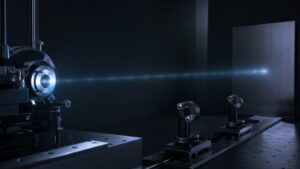
What Happens to a Particle When It Isn’t Being Observed?
When a particle is not being observed, quantum mechanics describes its state evolving according to amplitudes until an interaction creates a record.
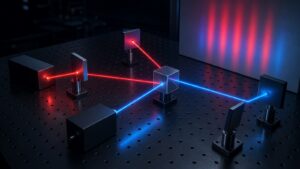
How Lasers Demonstrate Wave-Particle Duality
Lasers demonstrate wave-particle duality by producing coherent wave-like light while still being made of photons detected one event at a time.

Why Light Sometimes Behaves Like Water
Light sometimes behaves like water because both can show wave effects such as interference, diffraction, and reflection, though photons are quantum.

Do Particles ‘Know’ They’re Being Watched? Duality Insights
Particles do not know they are being watched; quantum measurement changes duality through physical records, not awareness.

Can Wave-Particle Duality Be Broken? What Experiments Suggest
Experiments have not broken wave-particle duality; they have refined it through complementarity, decoherence, and information tradeoffs.

The Science Behind Light Interference Patterns
Light interference patterns form when coherent light alternatives combine, creating bright and dark regions shaped by phase and path difference.

What the Famous Experiments Really Show About Quantum Waves
Famous quantum experiments show that quantum waves are probability-amplitude patterns revealed through diffraction, interference, and measurement.

Exploring the Quantum World: How Duality Shapes Every Particle
Duality shapes every particle because quantum objects have wave-like states and particle-like detections across light, matter, atoms, and molecules.

Why Wave-Particle Duality Makes Quantum Computing Possible
Wave-particle duality makes quantum computing possible because qubits rely on superposition, interference, and measured outcomes.

The Hidden Structure of Light: From Waves to Photons
Light has hidden quantum structure: it spreads and interferes like a wave, yet exchanges energy in photon-sized events.

Particles That Interfere With Themselves: How Is That Possible?
Particles interfere with themselves when a quantum state contains coherent alternatives that combine before one localized detection occurs.