When Quantum Possibility Leaks Into the World
Quantum decoherence is the process that makes superposition break down in practice when a system becomes entangled with its surroundings. A superposition depends on coherent alternatives. Those alternatives must retain phase relationships if they are going to interfere later. The environment can ruin that by picking up information about which alternative occurred. A stray photon, a gas molecule, a vibration, a thermal fluctuation, or an uncontrolled field can become correlated with the system. Once that information has leaked outward, the alternatives no longer recombine cleanly from the viewpoint of the system alone. Interference fades, and the system begins to behave more like an ordinary statistical mixture. Decoherence does not usually mean a person looked at the system, and it does not require consciousness. It is a physical process of information spreading into many degrees of freedom. It also does not by itself settle every interpretation of measurement, because it explains why interference disappears more clearly than it explains why one outcome is experienced. Still, decoherence is one of the most important ideas in modern quantum physics. It explains why everyday objects look classical and why quantum technologies must fight so hard to preserve coherence.
A: As the loss of accessible coherence through environmental correlations.
A: No. Physical records in the environment are enough.
A: It fades when alternatives become distinguishable.
A: Not exactly. It explains lost interference more than outcome selection.
A: They interact constantly with their surroundings.
A: In principle sometimes, but usually not in complex environments.
A: Their information depends on fragile phase relationships.
A: How long useful relationships survive.
A: Studying it reveals the channels that damage quantum states.
A: Superposition survives only while distinguishing records are controlled.
Superposition Needs Coherence
A superposition is useful only when its alternatives remain coherently related. The state must preserve amplitude and phase relationships long enough for later operations or measurements to use them.
If those relationships survive, alternatives can recombine and interfere. If they are lost, the state may still produce probabilities, but the distinctive quantum pattern fades.
Coherence is therefore not an extra decoration. It is the condition that lets superposition behave like superposition rather than like ordinary uncertainty.
This is why quantum experiments put so much effort into isolation and control.
The state needs privacy from the environment.
It also needs precise contact with the apparatus.
The Environment Records Alternatives
The environment causes decoherence by becoming correlated with the alternatives in the superposition. If a molecule scatters differently depending on the system’s path, the environment now carries path information.
No person has to read that information. The physical record is enough. Once alternatives are distinguishable in the wider world, their amplitudes do not combine in the same accessible way.
This is why the word observation can be misleading. Decoherence is not about human awareness. It is about interactions that mark alternatives.
The record can be tiny, dispersed, and impossible to collect again.
That is what makes the process so hard to undo.
Interference Visibility Fades
The practical sign of decoherence is often fading interference. Bright and dark regions become less contrasted. A qubit’s phase-sensitive response weakens. A matter-wave pattern becomes washed out.
Visibility gives scientists a way to measure the damage. If coherence is partly preserved, some interference may remain. If the environment has marked alternatives strongly, the pattern can disappear.
This graded behavior is important. Decoherence is not always an instant cliff. It can be a continuous loss of accessible phase relationships.
Researchers can study how fast the visibility decays and which noise sources control the rate.
That turns breakdown into data.
The failure itself becomes informative.
Mixtures Replace Useful Superpositions
From the perspective of the system alone, decoherence can make a superposition behave like a mixture. The alternatives are still part of a larger quantum description, but the smaller system no longer shows usable interference between them.
A mixture is not the same as a coherent superposition. It is a statistical blend from the viewpoint being used. The off-diagonal coherence that would allow recombination has effectively vanished.
This language is why density matrices are useful. They can describe how coherence fades as the system becomes correlated with the environment.
The result feels classical because the alternatives no longer act together in the measurements available to us.
Decoherence is the bridge from delicate quantum structure to ordinary-looking statistics.
Why Everyday Objects Look Classical
Everyday objects interact constantly with light, air, heat, surfaces, and internal vibrations. Those interactions spread information about position, motion, temperature, and shape into the environment.
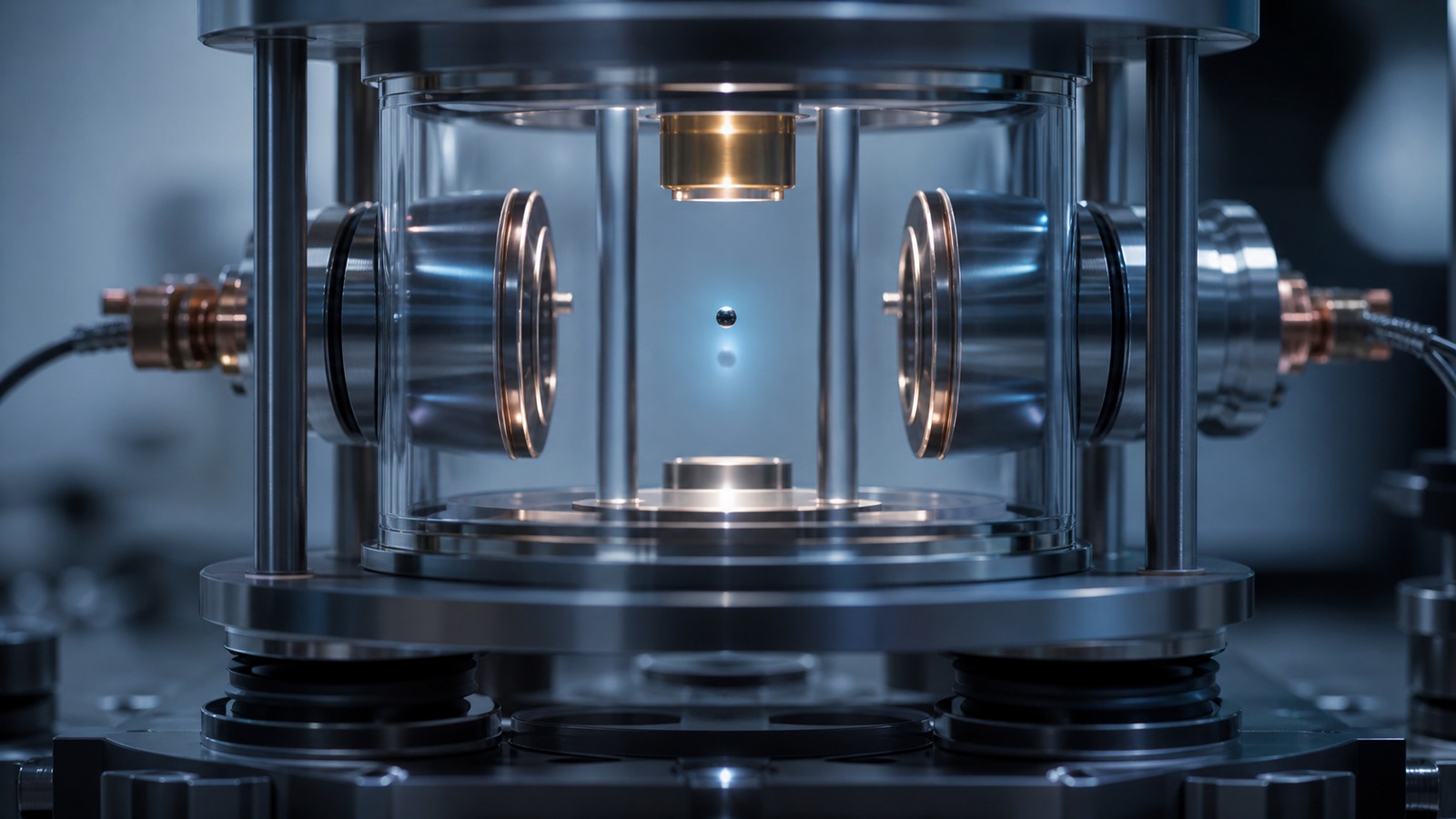
A dust grain, chair, or cat is not isolated like a trapped ion in a vacuum chamber. Its would-be alternatives are marked unimaginably fast by countless surroundings.
This is why macroscopic superpositions are not seen in daily life. Quantum rules still underlie matter, but coherence between ordinary alternatives becomes inaccessible almost immediately.
The classical world is not produced by ignorance alone. It is stabilized by physical records that spread everywhere.
Decoherence explains why classical behavior is so robust.
It also explains why laboratories must be so extreme.
Why Decoherence Is Not Full Collapse
Decoherence explains why interference between alternatives becomes unavailable, but many physicists argue that it does not by itself explain why one actual outcome is experienced. It turns a coherent problem into a mixture-like one.
In other words, decoherence explains why branches stop interacting for practical purposes. It does not force every interpretation to agree about what happens ontologically.
This is why the measurement problem does not vanish completely. Decoherence is a major piece of the story, but collapse, branching, hidden variables, or relational facts are interpreted differently.
For working physics, decoherence is often enough to predict why interference disappears. For foundations, deeper questions remain.
That distinction keeps the concept powerful without overselling it.
Quantum Devices Fight Decoherence
Quantum devices fight decoherence because their advantage depends on preserving state structure. Qubits need phase. Interferometers need path coherence. Sensors need delicate evolution. Clocks need stable transitions.
Engineers use low temperatures, vacuum, shielding, material improvements, pulse shaping, dynamical decoupling, and error correction to slow the loss.
No method makes a device perfectly isolated from everything. The goal is to keep decoherence slow enough that useful operations finish before the quantum information is damaged.
This is why coherence time is a central performance number. It tells how long the relevant state relationships can remain usable.
Better coherence means more room to compute, sense, or test foundations.
The battle is practical and conceptual at once.
Decoherence Can Be Controlled and Studied
Scientists do not only avoid decoherence; they also study it. By adding controlled noise or changing the environment, they can watch how interference fades and compare the result with theory.
This helps identify which interactions matter most. A device may be limited by material defects, magnetic noise, photon scattering, thermal motion, or readout back-action.
Understanding the channel makes improvement possible. If the source of decoherence is known, engineers can redesign the apparatus or develop better correction strategies.
In this sense, decoherence is not merely an enemy. It is a diagnostic window into how quantum systems become classical-looking.
The breakdown teaches the rules of survival.
Different Environments Damage Different Features
Decoherence is not one uniform effect. Some environments mainly damage phase, while others leak position information, cause energy relaxation, or create unwanted correlations with nearby systems.
A qubit may lose phase without immediately changing its measured energy. Another system may relax from an excited state to a lower state. A matter-wave experiment may lose path coherence through scattering.
These differences matter because protection strategies must match the damage. Shielding a magnetic field problem will not fix every material defect. Cooling may help one platform and leave another limited by control noise.
Scientists therefore identify decoherence channels rather than treating noise as a single fog. The details point toward better hardware and better experiments.
Knowing the enemy is part of preserving superposition.
That diagnosis can be surprisingly specific. A measured decay curve may point to dephasing, relaxation, heating, scattering, or a particular control imperfection.
How Decoherence Sets Time Limits
Every coherent quantum operation competes with time. The state must be prepared, transformed, and measured before unwanted interactions erase the relationships being used.
This is why coherence time is measured so carefully. It sets the window in which a qubit gate, interferometer sequence, clock comparison, or sensing protocol can work.
Longer coherence time is not automatically enough. The operations inside that time must also be accurate. A long-lived state with poor control may still fail.
The useful question is how many reliable operations fit before decoherence dominates. Quantum computing often frames this in terms of gate errors, circuit depth, and error-correction thresholds.
For sensors and clocks, the timing question becomes a balance between longer phase accumulation and greater exposure to noise.
The clock is always ticking for coherence.
That balance makes optimization different from simple isolation. Sometimes the best experiment is not the longest one, but the one that gathers phase before decoherence erases contrast.
Why Macroscopic Tests Are Difficult
Macroscopic superposition tests are hard because larger systems have more ways to leave records. They scatter more light, radiate heat, vibrate internally, and interact with surrounding fields in more complex ways.
That does not make such tests pointless. It makes them informative. If a larger object keeps coherence under strict isolation, the experiment expands the confirmed range of quantum behavior.
The difficulty also explains why everyday objects appear classical. Their environments are constantly monitoring them in the physical sense, even when no person is watching.
Large-system experiments therefore sit at the boundary between foundations and engineering. They test quantum rules while teaching scientists how to suppress decoherence.
The breakdown is hard to beat because the world is an excellent recorder.
Why Decoherence Is Platform-Specific
Decoherence looks different in different hardware. A superconducting qubit may be limited by material defects, microwave loss, stray photons, or flux noise. A trapped ion may face motional heating, laser noise, or unwanted coupling to neighboring modes.
Neutral atoms, photons, spins, molecules, and levitated particles each have their own weak points. The word environment can mean a cryogenic package, a vacuum chamber, a substrate, a background gas, a control laser, or the internal motion of the system itself.
This is why there is no single cure. Engineers match their protection methods to the platform. Better vacuum helps collisions, but not every source of phase noise. Better materials help circuits, but not necessarily optical alignment. Better pulse design helps control errors, but not all thermal effects.
The platform-specific view also explains why progress can look uneven. One technology may have long coherence but slow gates. Another may have fast gates but difficult scaling. The right comparison depends on what the device is trying to do before decoherence wins.
For readers, this detail keeps the topic realistic. Decoherence is a general concept, but every laboratory fights a local version of it.
That local fight is where much of modern quantum engineering happens, through measurement, redesign, and repeated testing under demanding conditions. The best devices improve by turning each decoherence channel into a concrete design problem with measurable targets and tradeoffs. Progress often comes from understanding one damaging channel well enough to suppress it without worsening another. That is slow work, but it is exactly how coherence improves in real devices over time for researchers.
The Decoherence Takeaway
Decoherence breaks down useful superposition by letting the environment carry information about the alternatives.
It explains fading interference and classical appearance, while leaving deeper interpretation questions about outcomes still open.