One Coherent Description or a Statistical Blend
The simple difference between pure states and mixed states is that a pure state is described by one coherent quantum state, while a mixed state represents a statistical blend of possible states. That may sound like a small technical detail, but it changes how the system can behave. A pure state can carry well-defined amplitude and phase relationships. If the right experiment recombines its alternatives, interference may appear. A mixed state, by contrast, reflects uncertainty about which state was prepared or the fact that the system has become entangled with an environment we are not tracking. The mixture can still produce probabilities, but it generally lacks the same usable coherence as a pure superposition. A beginner can think of a pure state as a single complete quantum recipe for the system. A mixed state is more like a recipe chosen from a set, with only the statistical blend available to us. The distinction is not about whether the system is real or whether scientists are confused. It is about what kind of description correctly predicts measurements. Pure states are central to ideal examples, qubits, and interference. Mixed states are central to real laboratories, noise, heat, imperfect preparation, and decoherence. Understanding the difference helps explain why superposition is not the same as ordinary ignorance.
A: One coherent quantum state description.
A: A statistical blend of possible state descriptions.
A: Yes. Pure does not mean definite in every property.
A: Mixtures lack the same coherent phase relationship.
A: Imperfect preparation, heat, noise, or environmental entanglement.
A: They describe blends and remaining coherence.
A: Often no. Different settings may be required.
A: Gates need coherent amplitudes to work reliably.
A: Yes, for the system considered alone.
A: Pure means one coherent description; mixed means statistical blending.
Why the Distinction Exists
The distinction exists because quantum states can represent different kinds of knowledge and physical preparation. Sometimes a system is prepared in one well-defined coherent state. Sometimes a lab produces a blend of possibilities, or the system becomes correlated with an environment.
If those cases were treated the same, predictions would become sloppy. A coherent superposition can interfere. A statistical mixture may give the same simple outcome probabilities for one measurement but behave differently in another experiment.
This is why physicists need separate language. Pure and mixed are not labels of purity in a moral or material sense. They describe whether one state is enough or whether a statistical description is required.
The difference becomes especially important when discussing qubits, thermal systems, and decoherence. Real devices rarely behave like perfect textbook examples for long.
Beginners who learn this distinction early avoid many later confusions about superposition.
What a Pure State Means
A pure state means the system is described by one complete quantum state. That state may itself be a superposition. Pure does not mean simple, classical, or definite in every ordinary property.
For example, a qubit can be in a pure superposition of zero and one. The state has amplitudes and phase. A suitable sequence of operations can reveal interference effects that depend on that coherence.
Pure states are idealized but not imaginary. Laboratories can prepare very clean states in photons, ions, atoms, spins, and superconducting circuits. The better the isolation and control, the closer the system may be to a pure description.
Pure-state language is useful because it shows the sharpest form of quantum behavior. It lets the role of amplitude, phase, and measurement appear without extra noise.
What a Mixed State Means
A mixed state means the system is described by a statistical blend of possible states. The blend may come from imperfect preparation, ordinary lack of information, thermal variation, or entanglement with an environment that is not being tracked.
A simple classical analogy is a shuffled deck where one card was selected but not shown. The description is a mixture because we do not know which card is present. Quantum mixtures can be more subtle, but the analogy helps show the statistical flavor.
The key is that a mixed state is not the same as a coherent superposition. In a mixture, the alternatives are not available to interfere in the same way. The phase relationship needed for interference is absent or inaccessible.
This is why a mixed state can look less quantum in practice. It may still require quantum rules, but its behavior can be closer to ordinary statistical uncertainty.
Mixed states are common because real systems are open, warm, noisy, and imperfectly controlled.
Why Superposition Is Not Mixture
Superposition and mixture are often confused because both involve more than one possible outcome. The difference is coherence. In a superposition, alternatives belong to one state and can have phase relationships. In a mixture, the description averages over possible states.
A coherent superposition can produce interference when alternatives are recombined. A mixture usually cannot. That is the practical test hiding behind the language.
Imagine a qubit prepared in a balanced pure superposition. A later gate can convert its phase into a measurable preference. If the qubit is instead in a fifty-fifty mixture, the same gate may not reveal that phase because the coherent relationship is missing.
This difference is why quantum computing cares so much about coherence. A register that becomes mixed through noise may still produce outcomes, but it loses the structured amplitude relationships algorithms need.
How Decoherence Creates Mixture-Like Behavior
Decoherence happens when a system becomes entangled with its environment in a way that spreads information about its alternatives. From the viewpoint of the system alone, the state can begin to behave like a mixture.
The full combined system may still be quantum, but the smaller part we can conveniently describe has lost accessible coherence. Alternatives no longer recombine cleanly because the environment carries distinguishing traces.
This is why decoherence is central to the classical appearance of the world. Everyday objects interact constantly with air, light, heat, and surrounding matter. Their would-be macroscopic superpositions become mixture-like extremely quickly.
In the laboratory, decoherence is an enemy of qubits and interference experiments. It turns pure-state control into noisy statistics. Researchers fight it with isolation, cooling, shielding, and error correction.
Decoherence does not mean quantum mechanics failed. It explains why the cleanest quantum features become hard to observe.
How Scientists Represent Mixed States
Mathematically, physicists often represent mixed states using density matrices. A beginner does not need that formalism right away, but it helps to know why it exists. A wavefunction is enough for a pure state, but a mixture needs a tool that can describe statistical blends.
The density-matrix language can include both quantum coherence and classical uncertainty. It shows which off-diagonal coherence terms remain and which have faded. That makes it useful for real experiments.
Even without the math, the message is clear. Scientists need a representation that distinguishes a coherent superposition from a blend that merely shares some outcome probabilities.
The formalism is not extra complication for its own sake. It is the accounting system for imperfect, open, and noisy quantum systems.
Why One Measurement May Not Tell the Difference
One measurement setting may not distinguish a pure superposition from a mixture. Two preparations can sometimes give the same probabilities for one question while giving different probabilities for another.
This is why quantum state knowledge usually requires repeated measurements in different settings. Researchers do tomography, interference tests, or other comparisons to see whether coherence remains.
A single detector outcome is only a clue. The distinction between pure and mixed belongs to the pattern across preparations and measurements.
Why the Difference Matters in Technology
Quantum technology depends on keeping track of purity and mixture. In quantum computing, pure coherent states are valuable because gates can transform their amplitudes predictably. Mixed states often represent noise, loss, or incomplete control.
In quantum communication, mixedness can reveal unwanted interaction with an environment or eavesdropping-like disturbance. In quantum sensing, lost coherence can reduce sensitivity. In thermodynamics, mixed states are unavoidable because heat and statistical ensembles matter.
The distinction therefore has practical consequences. It tells engineers whether a device is preserving the quantum relationships it needs or drifting toward ordinary noise.
It also helps interpret experiments. If interference disappears, the system may not have become classical in some absolute sense, but its accessible description may have become mixed enough to hide the effect.
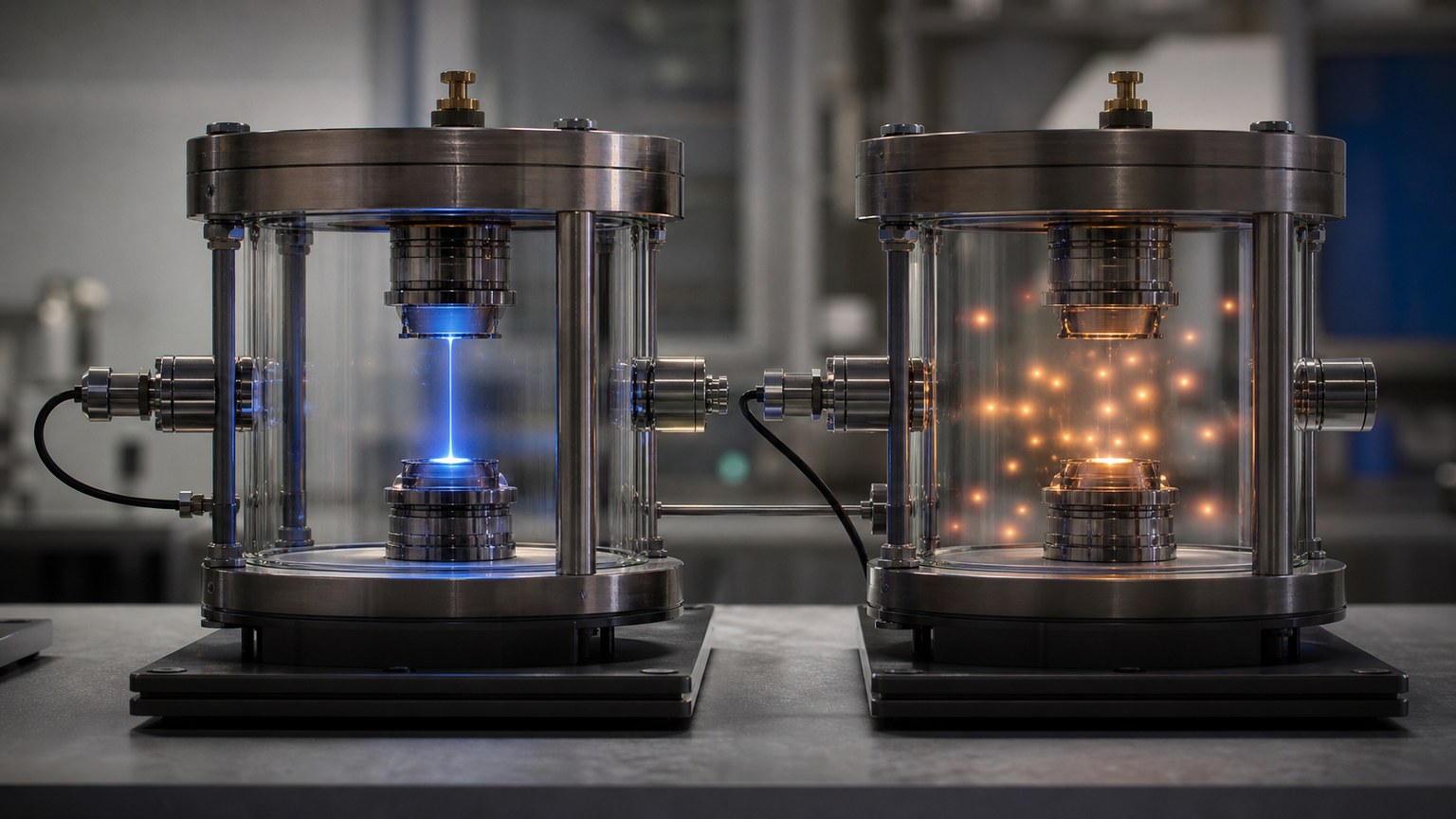
The same distinction guides comparisons between devices that look similar from the outside. A sensor, qubit, or light source may produce the right average signal while still losing the coherence that would make it useful for harder quantum tasks.
Pure and mixed are not classroom labels only. They are diagnostic categories for real hardware.
That is why the simple version is worth learning.
Why Preparation History Matters
The difference between pure and mixed states often begins before the measurement. A carefully prepared atom, photon, or qubit can be placed in one coherent state. A less controlled source may produce a statistical blend of preparations from the start.
That history matters because two sources can look similar under one test and different under another. A clean superposition and a fifty-fifty mixture may share one set of probabilities, then separate when the experiment asks a phase-sensitive question.
Preparation also determines how much trust scientists place in later claims. If the source drifts, heats, or couples to its surroundings, the state description may become mixed even before the main experiment begins. The issue is not only what happens during measurement.
This is why laboratories spend so much effort on cooling, filtering, trapping, timing, and calibration. Those steps are not decorative setup rituals. They decide whether the state begins as a coherent resource or as noisy uncertainty.
For readers, the useful habit is to ask how the state was made. Pure and mixed are not labels pasted on at the end. They describe the whole preparation story.
Why Density Matrices Enter Later
The simple version can be learned without matrices, but the next formal tool has a clear purpose. Density matrices let physicists represent both coherent superpositions and statistical mixtures in one language.
That matters for real devices because no apparatus is perfectly isolated. A qubit may be mostly pure with a little noise, or mostly mixed with a small amount of remaining coherence. The tool can describe those gray areas instead of forcing a yes-or-no answer.
Density matrices also make partial information easier to handle. If two systems are entangled and one part is ignored, the remaining part can look mixed even though the combined state is still quantum. This is one reason mixed states are not merely sloppy preparation.
The math may come later, but the reason for it can be understood now: real quantum systems need a way to describe both coherence and ignorance at once.
How to Test the Difference
The difference between a pure state and a mixed state is tested through patterns, not through one dramatic glance. Scientists prepare the same state many times, choose different measurement settings, and compare the resulting statistics.
If a state is genuinely coherent, changing the measurement basis can reveal phase-sensitive effects. If the description is only a mixture, the same recombination may fail to recover interference. The contrast often appears across several carefully chosen tests.
Tomography is one formal version of this idea. It uses many measurement settings to reconstruct enough of the state description to see whether coherence remains. Other experiments use interference visibility, contrast loss, or benchmarking instead.
The method depends on the system, but the logic is the same. A pure state keeps relationships that a mixture has lost or never had. The evidence must be gathered in a way that can see those relationships.
This is why the simple distinction is more than vocabulary. It tells researchers what kind of evidence to look for.
The Simple Takeaway
A pure state is one coherent quantum description. A mixed state is a statistical blend of possible descriptions.
The difference matters because coherent superpositions can interfere, while mixtures usually behave more like averaged uncertainty.