Information Stored as a Controllable Quantum State
Quantum states store information in qubits by using more structure than an ordinary bit. A classical bit is read as zero or one, and for most everyday computing we can treat it as holding one definite value at a time. A qubit also has readout outcomes such as zero and one, but before measurement its state can contain amplitudes for both outcomes along with a phase relationship between them. That extra structure is where quantum information lives. It does not mean a qubit simply stores two classical bits or secretly contains every answer. A single measurement still returns limited classical data. The useful information is in how the qubit state can be prepared, rotated, combined with other qubits, protected from noise, and finally measured in a chosen basis. Multi-qubit states can add entanglement, where information belongs to the joint state rather than to separate qubits alone. Quantum computing is built from this controlled state structure. Gates change amplitudes and phases. Error correction protects encoded information without directly copying unknown states. Measurement turns the final quantum state into classical output. The heart of the subject is that a qubit stores information as a physical quantum condition, not as a tiny classical switch in disguise.
A: No. One measurement still returns one classical result.
A: In amplitudes, phase, and basis-dependent structure.
A: It changes later probabilities after gates.
A: No. It must be inferred from many preparations.
A: They transform the qubit state before measurement.
A: It stores information in relationships among qubits.
A: It must detect errors without copying unknown states.
A: Yes. The state is always physically embodied.
A: It leaks useful state relationships into the environment.
A: Qubits store quantum information as controllable state structure.
A Qubit Still Has Two Readout Outcomes
A qubit is often introduced as a quantum version of a bit. That is useful, but only if the comparison is handled carefully. When measured in the standard basis, a qubit gives one of two results.
Those results are usually called zero and one. They may correspond to current directions, energy states, spin directions, ion levels, photon polarizations, or other physical alternatives.
The readout outcomes are classical after measurement. The device reports a result that can be stored in ordinary electronics and processed like other data.
The quantum part is the state before that readout. It can carry amplitudes, phase, and relationships that are not equivalent to a hidden classical bit value.
This is why a qubit is not magic, but it is not just a smaller transistor either.
Its information is physical and fragile.
Amplitudes Store the Readout Weights
A qubit state assigns amplitudes to the two readout alternatives. The sizes of those amplitudes determine the probabilities of getting zero or one after measurement.
The amplitudes must follow a normalization rule, so the total probability is one. That rule keeps predictions meaningful and links the two alternatives in a single state.
Changing an amplitude changes what the measurement is likely to show. Gates are designed to transform these amplitudes in controlled ways.
The amplitudes are not simply hidden percentages. They can combine with phase and interfere after additional operations.
That makes qubit information richer than a weighted coin.
Phase Stores Relationship
Phase is the part of qubit information that beginners often miss. Two qubit states can give the same zero-one probabilities in one measurement and still behave differently after another gate because their phase differs.
This means the state contains relationship information, not just outcome weights. A gate can turn phase into a measurable probability change, which is why phase control is essential.
On a Bloch sphere, phase corresponds to direction around the equator. The picture is only a tool, but it helps show that a qubit has more structure than a line from zero to one.
Quantum algorithms use this structure to make useful outcomes more likely through interference.
Without phase, many quantum advantages would disappear.
The state would look much more like ordinary randomness.
Gates Change the State
Quantum gates are controlled physical operations that change qubit states. A gate may rotate a single qubit, shift a phase, or link two qubits through an entangling interaction.
The gate does not read the state in the ordinary sense. It transforms the amplitudes and phases before the final measurement. That is why gate accuracy is so important.
A small rotation error can change later probabilities. A phase error can spoil interference. A two-qubit gate error can damage correlations across the system.
Quantum information is therefore processed by state evolution, not by copying and inspecting each hidden value.
This is a very different style of computation.
Measurement Extracts Limited Information
When a qubit is measured, the result is one classical bit in the chosen basis. The measurement does not reveal the whole quantum state. It samples the state and changes what can be predicted next.
This limitation is crucial. If measurement could reveal all amplitudes and phases directly, quantum computing would be a very different subject. Instead, algorithms must arrange the final state so that useful results are likely.
Repeated runs can estimate probabilities, but they still do not let one copy of an unknown qubit be fully read without disturbance.
The final readout is therefore both necessary and restrictive. It gives usable data, but it closes the quantum part of that run.
Good algorithms are designed around this bottleneck.
They make the measurement count.
Entanglement Stores Joint Information
With several qubits, information can live in the joint state. Entanglement means the state cannot be described as independent states for each qubit. The correlations belong to the whole.
This is one reason multi-qubit systems become powerful and difficult. The number of possible joint amplitudes grows quickly, and controlling them requires precise gates.
Entanglement is not the same as simple correlation. It can produce relationships that classical hidden-label stories cannot reproduce.
Quantum algorithms, error correction, teleportation, and simulation all use joint-state structure in different ways.
The information is distributed across the state.
Error Correction Encodes the State
Quantum error correction protects information by encoding a logical qubit across several physical qubits. This is necessary because individual qubits are noisy and unknown quantum states cannot be copied directly.
Special measurements can reveal error patterns without measuring the logical information itself. That allows corrections while preserving the encoded state.
This is a subtle form of storage. The information is not sitting in one fragile object. It is spread across a structured quantum code.
Error correction shows that quantum information is not just about one qubit in isolation. It is about relationships, redundancy, and carefully chosen measurements.
The code stores information by respecting quantum rules rather than avoiding them.
That is why it is so central to scalable devices.
Hardware Gives the State a Body
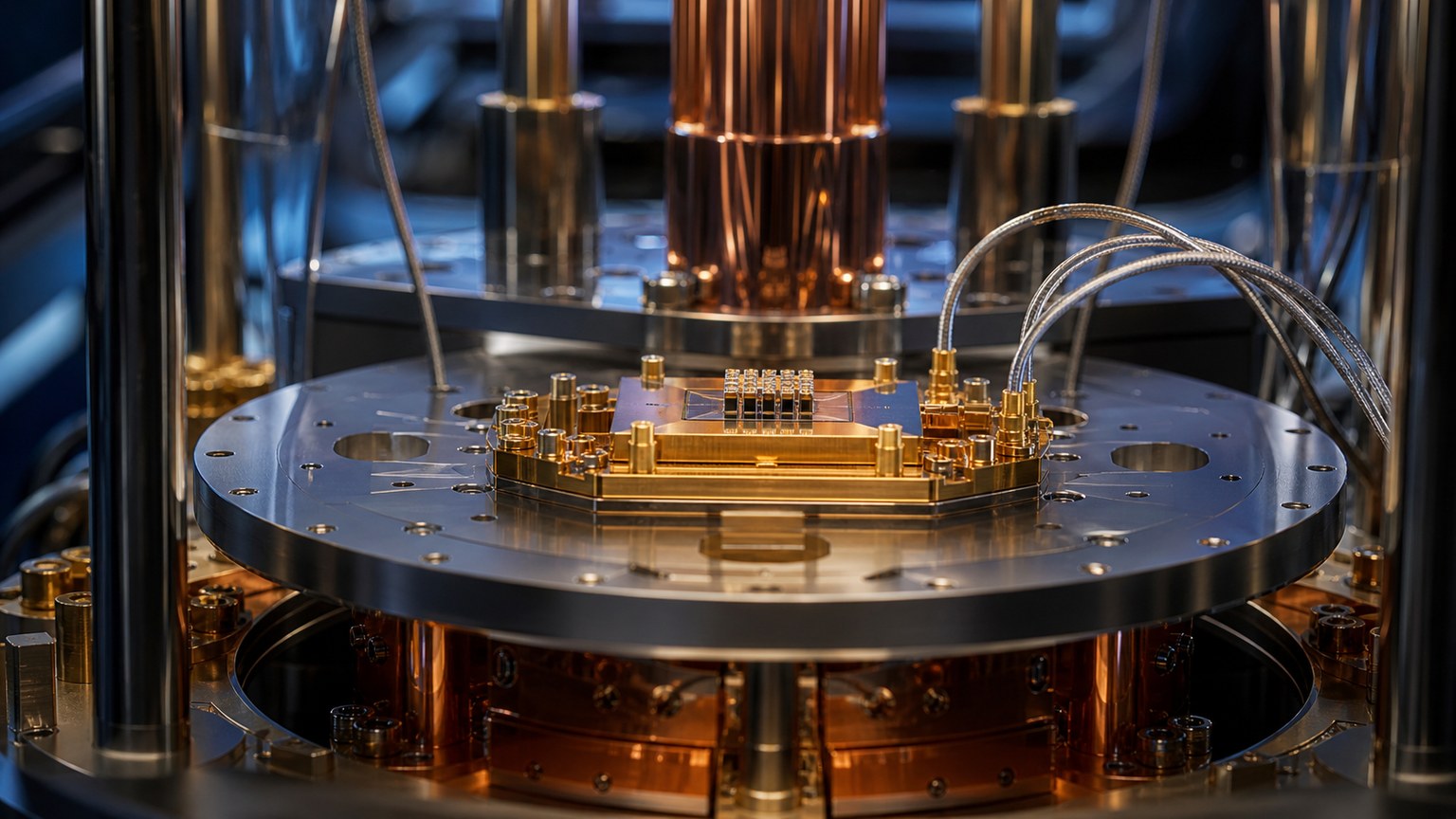
A qubit is always physical. It may be a superconducting circuit, trapped ion, neutral atom, photon, electron spin, or defect in a solid. The state needs hardware to exist.
Different platforms store qubit states in different physical degrees of freedom. Each has strengths and weaknesses in coherence time, gate speed, connectivity, fabrication, and readout.
The abstract language of amplitudes and phase is shared, but the engineering details decide how well the state can be controlled.
This is why quantum computers are not one single technology. They are several attempts to protect and manipulate the same kind of information in different physical bodies.
The state is abstract in description and concrete in hardware.
Decoherence Damages Stored Information
Decoherence damages qubit information by leaking state relationships into the environment. A stray field, thermal fluctuation, material defect, or unwanted interaction can scramble phase or reveal partial information.
When coherence is lost, the qubit may behave more like ordinary randomness. The amplitudes and phase no longer remain available for the algorithm or protocol.
This is why qubits are shielded, cooled, calibrated, and measured carefully. Protecting information means protecting the physical state structure that carries it.
Error rates, coherence times, and fidelities are not mere engineering footnotes. They tell us whether the stored quantum information remains usable.
Better qubits are better state keepers.
That is the quiet core of the hardware race.
Why Algorithms Need Arrangement
A qubit state becomes computationally useful only when an algorithm arranges it. Superposition by itself can produce many possible outcomes, but measurement will still return one sampled result.
The algorithm has to transform amplitudes so useful outcomes are amplified and unhelpful outcomes are suppressed. That is why interference is central. It lets the circuit reshape the final probability distribution.
Different algorithms arrange the state in different ways. Some use periodic structure, some use search amplification, some simulate quantum systems, and some create samples from distributions that are hard to reproduce classically.
The information is therefore not just stored passively. It is stored in a form that can be evolved by gates before readout.
This is the difference between a qubit as a physical object and a qubit as a computational resource.
The resource appears only when state structure is organized toward a task.
That task-centered view also explains why idle qubits are not enough. A device must preserve the stored state while arranging it through a circuit that makes the final measurement meaningful.
Why Readout Shapes the Storage Problem
Because readout is limited, the stored state must be designed with the final measurement in mind. A beautifully complex state is not useful if the measurement cannot extract the relevant pattern.
This is why algorithms are often judged by output distributions rather than by one impressive state description. The final classical data must carry the answer, a sample, or evidence that the computation worked.
Readout also affects hardware design. Detectors must distinguish outcomes accurately without causing unnecessary disturbance before the intended final step.
In error correction, readout is even more delicate because some measurements should reveal errors while preserving logical information. The storage and the measurement are designed together.
A qubit stores information successfully only when it can eventually be read in a useful way.
Why Classical Descriptions Struggle
A classical description of many qubits can grow extremely large because it has to track amplitudes for many joint alternatives. Even representing the state can become difficult as the number of qubits increases.
This does not mean quantum computers automatically solve every large problem. It means the state space they use is naturally different from the state space of ordinary bits.
The challenge is to control that large state without losing it to noise or reading it too early. The useful information must survive until the final measurement extracts something meaningful.
That is why qubit storage is both powerful and demanding.
Why State Preparation Matters
Storage begins before the algorithm runs. A qubit has to be initialized into a known state, or the later gates will transform the wrong starting information. Preparation is therefore part of storage, not a separate housekeeping step.
Reset quality matters because leftover excitation, drift, or thermal population can contaminate the computation. A device may have excellent gates and still fail if the starting states are unreliable.
Preparation also affects multi-qubit work. Entangling gates assume that the participating qubits begin in states the circuit expects. Hidden preparation errors can spread through the joint state and become harder to diagnose later.
That is why real machines report state-preparation and measurement errors together with gate fidelities. The stored information is judged across the whole workflow.
A qubit stores useful information only when preparation, control, protection, and readout all cooperate.
The Qubit Takeaway
A qubit stores information in amplitudes, phase, basis relationships, and sometimes entanglement with other qubits.
Measurement returns limited classical data, so quantum algorithms must shape the state before that final readout.