Turning Quantum Possibility Into a Testable State
Scientists create superposition in the lab by preparing a quantum system so that more than one possible outcome remains coherently available before measurement. The exact method depends on the system. A photon may be sent toward a beam splitter so its path state includes two alternatives. An atom may be driven by a laser pulse so its internal energy state becomes a combination of levels. A trapped ion or superconducting qubit may receive a carefully timed pulse that rotates its state between the readout possibilities. In every case, the goal is not to make a tiny object perform a visual magic trick. The goal is to create a state with amplitudes and phase relationships that can later be tested through interference, tomography, or repeated measurements. That requires preparation, isolation, control, and verification. The laboratory must suppress random environmental records, define the measurement question, and prove that the observed statistics could not be explained by ordinary ignorance alone. Creating superposition is therefore both delicate and routine in modern quantum science. It is delicate because coherence can be destroyed by heat, vibration, stray fields, or bad timing. It is routine because lasers, traps, cavities, cryogenic circuits, and optical components now let researchers make and test superposed states with remarkable precision.
A: Yes. Many platforms now prepare and verify coherent states.
A: Only if coherence is preserved and the result is verified.
A: They let researchers rotate amplitudes in a controlled way.
A: Cooling prepares cleaner conditions, but an operation usually creates the superposition.
A: They look for phase-sensitive interference or reconstruct state features.
A: Yes, but larger systems are harder to isolate.
A: It reduces collisions that would leave environmental records.
A: Which-path information or uncontrolled interactions can remove interference.
A: Not necessarily. They may combine abstract readout states.
A: Prepare, control, protect, measure, and verify.
Start With a Clean System
The first step is choosing a system that can be prepared reliably. Scientists often use photons, atoms, ions, spins, molecules, or superconducting circuits because their relevant quantum states can be controlled with known tools.
Clean preparation does not mean the system is large or simple. It means the starting condition is known well enough that later results can be interpreted. If the source is noisy from the beginning, a claimed superposition may only be a messy mixture.
For atoms and ions, preparation may involve cooling, trapping, optical pumping, and selecting a narrow range of motion or internal state. For photons, it may involve a stable source, filtering, and a well-defined path or polarization.
The whole experiment rests on this opening move. A superposition cannot be diagnosed cleanly if the initial state is poorly known.
Use a Device That Splits Alternatives Coherently
One common route is to split alternatives without recording which one occurred. A beam splitter can place a photon into a path superposition. A diffraction grating can let matter-wave alternatives spread and recombine. A radio-frequency or laser pulse can mix two internal states.
The word split can be misleading if it suggests two classical copies. The laboratory operation changes amplitudes in one state. The alternatives remain coherent only if no physical record distinguishes them too early.
That is why beam splitters and pulses are so important. They do not merely divide traffic. They preserve phase relationships that later experiments can use.
The operation must also be calibrated. A half-strength pulse, a mistimed gate, or an unstable optical element may create a different state from the one intended. Superposition is controllable, but the control has to be measured.
Good experiments therefore pair every state-making operation with tests that confirm what the operation actually did.
Protect the Phase Relationship
Creating a superposition is not enough. The phase relationship among alternatives must survive long enough to matter. If the environment learns which alternative is present, interference can disappear.
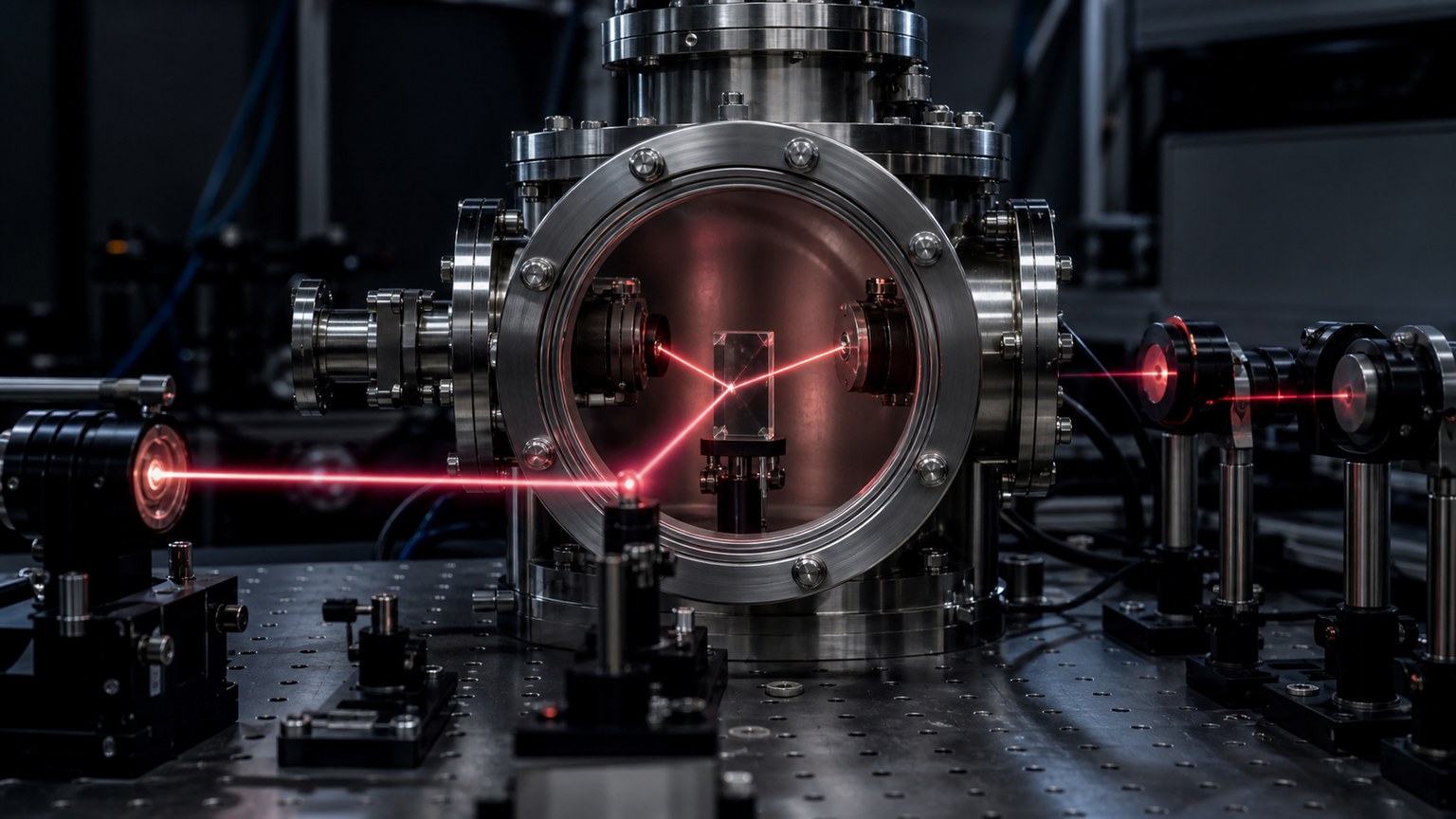
Protection can mean vacuum chambers, low temperatures, shielding, stable lasers, quiet electronics, vibration isolation, or very short experimental times. The method depends on the platform, but the purpose is the same.
The difficulty is that a quantum system must be isolated and controlled at the same time. Too much isolation makes the system hard to manipulate. Too much manipulation can leak information to the surroundings.
Drive Internal States With Pulses
Many laboratory superpositions are made by driving a system between two internal states. A trapped ion can be placed into a combination of energy levels. A superconducting qubit can be rotated by a microwave pulse. A spin can be tipped by a magnetic resonance pulse.
The pulse has duration, strength, frequency, and phase. Change any of those, and the final state changes. This is why superposition in a qubit is often described as a rotation rather than a cloudy location.
A calibrated pi-over-two pulse is a familiar example. It can take a system that would read as one outcome and put it halfway between two readout possibilities. Later operations can reveal the phase by turning it into a measurable probability difference.
Pulses make superposition feel less mystical. They show that the state is something scientists can steer by applying a known physical interaction.
The steering is still quantum. It works because amplitudes are transformed, not because a hidden classical switch is halfway flipped.
That distinction is the reason pulse control can support interference and computation.
Create Path Superpositions With Interferometers
Interferometers create superposition by arranging alternatives that can later meet again. Light, atoms, neutrons, and molecules can be sent through setups where more than one route contributes to a final outcome.
The key requirement is indistinguishability. If the apparatus marks the path, the setup becomes a path-measurement experiment. If the routes stay coherent, their amplitudes can recombine and form interference.
Path superpositions are powerful because they turn phase into a visible or countable signal. A tiny change in length, gravity, rotation, or field can shift the final pattern.
This is why interferometers are both foundational tools and precision instruments. They test the meaning of superposition while also measuring small physical effects.
Verify the State Instead of Assuming It
After a superposition is prepared, scientists must prove that it behaved coherently. They may look for interference, perform state tomography, vary the phase, or run control experiments with the alternative paths deliberately marked.
Verification separates a true superposition from an ordinary mixture. If two alternatives merely represent ignorance, recombination should not produce the same phase-sensitive signatures.
One measurement is not enough. Researchers repeat the experiment many times and compare distributions. The evidence lives in statistics built from carefully matched trials.
The strongest verification usually changes the setup and predicts how the results should change. That makes the claim more than a pretty pattern.
Superposition is accepted when the controls rule out the simpler classical explanation.
Why Scale Makes the Work Harder
Making one small superposition is very different from making a large or long-lived one. Larger systems have more ways to interact with the environment. Longer experiments give noise more time to accumulate.
This is why matter-wave tests with large molecules or nanoparticles are difficult. The object must remain coherent while moving, spreading, or being recombined. A single stray interaction can reduce the visibility of the result.
The same scaling problem appears in quantum computing. One qubit can be controlled with impressive accuracy, but many qubits require coordination, shielding, error correction, and stable calibration across the device.
How Superposition Becomes Useful
Once created and verified, superposition can be used rather than merely admired. A sensor can let two alternatives accumulate different phase and then read out a tiny shift. A qubit circuit can transform amplitudes through gates. A clock transition can compare exquisitely small energy differences.
The useful part is not that the state is strange. The useful part is that coherent alternatives respond to the physical world in measurable ways. Superposition turns phase and amplitude into an instrument.
That is why the same core idea appears in laboratories that look very different. Optical tables, ion traps, dilution refrigerators, and atom interferometers all use distinct hardware, but they all protect and manipulate coherence.
The shared pattern is preparation, controlled evolution, and careful readout.
That pattern is the practical recipe behind the mystery.
It also explains why the field keeps improving. Better isolation and better control let scientists ask questions that were once only thought experiments.
Why Control Experiments Matter
A superposition claim is strongest when the laboratory also shows what happens when coherence is deliberately removed. Researchers may mark a path, detune a pulse, warm the source, or add controlled noise. The resulting loss of interference becomes part of the proof.
This comparison keeps the experiment from becoming a single beautiful trace on a screen. The point is not just that a pattern appeared. The point is that the pattern responded to the right physical changes in the right way.
Control experiments also catch ordinary explanations. If a detector bias, vibration, or source fluctuation could create the same pattern, the claim is weaker. A good setup tests those possibilities instead of assuming them away.
That is why superposition in the lab is a disciplined claim. It depends on preparation and readout, but it also depends on showing what breaks the effect.
The negative cases make the positive case sharper.
How to Read a Laboratory Claim
When reading about a new superposition experiment, ask what was actually placed in superposition. Was it path, spin, polarization, energy, motion, or a joint state of several systems? The answer determines what the evidence should look like.
Then ask how long coherence lasted and how it was checked. A short but clean superposition may be more convincing than a dramatic claim with weak controls. Duration matters only when the state remains usable.
It also helps to ask what measurement closed the experiment. Did the apparatus recombine alternatives, scan a phase, read a qubit basis, or reconstruct a state? The measurement turns the invisible state into evidence.
Finally, notice whether the result is a demonstration, a tool, or a technology milestone. Those categories overlap, but they do not mean the same thing. A foundational test may be profound even if it never becomes a device, while a practical qubit operation may be valuable without sounding philosophical.
Careful reading makes the achievement clearer. It lets the real experiment be impressive without inflating it into a slogan.
That habit is useful across the whole field.
What Makes the Result Reproducible
Reproducibility is central because a superposition claim is statistical. One successful-looking run cannot carry the evidence. The same preparation must produce compatible distributions across many trials.
Labs improve reproducibility by locking lasers, monitoring temperatures, stabilizing timing, and comparing the apparatus against known references. Those details may sound mundane, but they decide whether the state can be trusted.
A reproducible result also lets other groups test the method. If the claim depends on a fragile accident, it will not become a reliable part of quantum science. If it survives replication, it becomes a platform for harder questions.
This is why the practical side of superposition is so detailed. The state is invisible, so the procedure has to be unusually transparent.
The repeated method gives the invisible state a public form. Other researchers can inspect the settings, rerun the sequence, and compare their distributions with the original claim. That shared check turns coherence into community evidence that can be tested independently by another apparatus.
The Lab Takeaway
Scientists create superposition by preparing a clean quantum system, applying a coherent operation, and protecting phase until the chosen measurement.
The claim is confirmed through interference, repeated statistics, and controls that separate true coherence from ordinary uncertainty.