The Analogy Works Until It Starts Lying
Light sometimes behaves like water because light can show wave effects that are easy to see in water: reflection, refraction, diffraction, interference, and spreading. Drop two pebbles into a pond, and overlapping ripples create regions where waves reinforce and cancel. Send coherent light through two slits, and a screen can show bright and dark bands from a similar wave principle. That comparison is useful because water waves give the eye a familiar model for phase, wavelength, and interference. But the analogy has limits. Light is not water, and photons are not tiny droplets riding a ripple. Light is an electromagnetic quantum phenomenon. It can propagate with wave-like structure and still be absorbed in discrete photon events. A water wave spreads energy continuously across a surface, while a dim light experiment can register one photon at a time. The same interference pattern can build from many localized detections. So the water analogy is a bridge, not a destination. It helps explain why patterns form, but it must step aside when the photon side appears. Light behaves like water only in selected wave features, not in its full identity. The comparison is most helpful when it teaches phase and interference, then makes room for photons and quantum measurement.
A: Water waves make interference and diffraction easy to see.
A: No. Light is electromagnetic and quantum.
A: It works well for phase, wavelength, and interference patterns.
A: It fails for photons, quantum detection, and field behavior.
A: One photon makes one event; many single photons build the pattern.
A: Interference between reflected light paths changes which colors reinforce.
A: No. Light can travel through vacuum.
A: No. Photons are quantum excitations, not tiny drops.
A: It gives beginners a useful first picture of wave effects.
A: Use water for wave patterns, then switch to photons for quantum detection.
Where the Water Comparison Helps
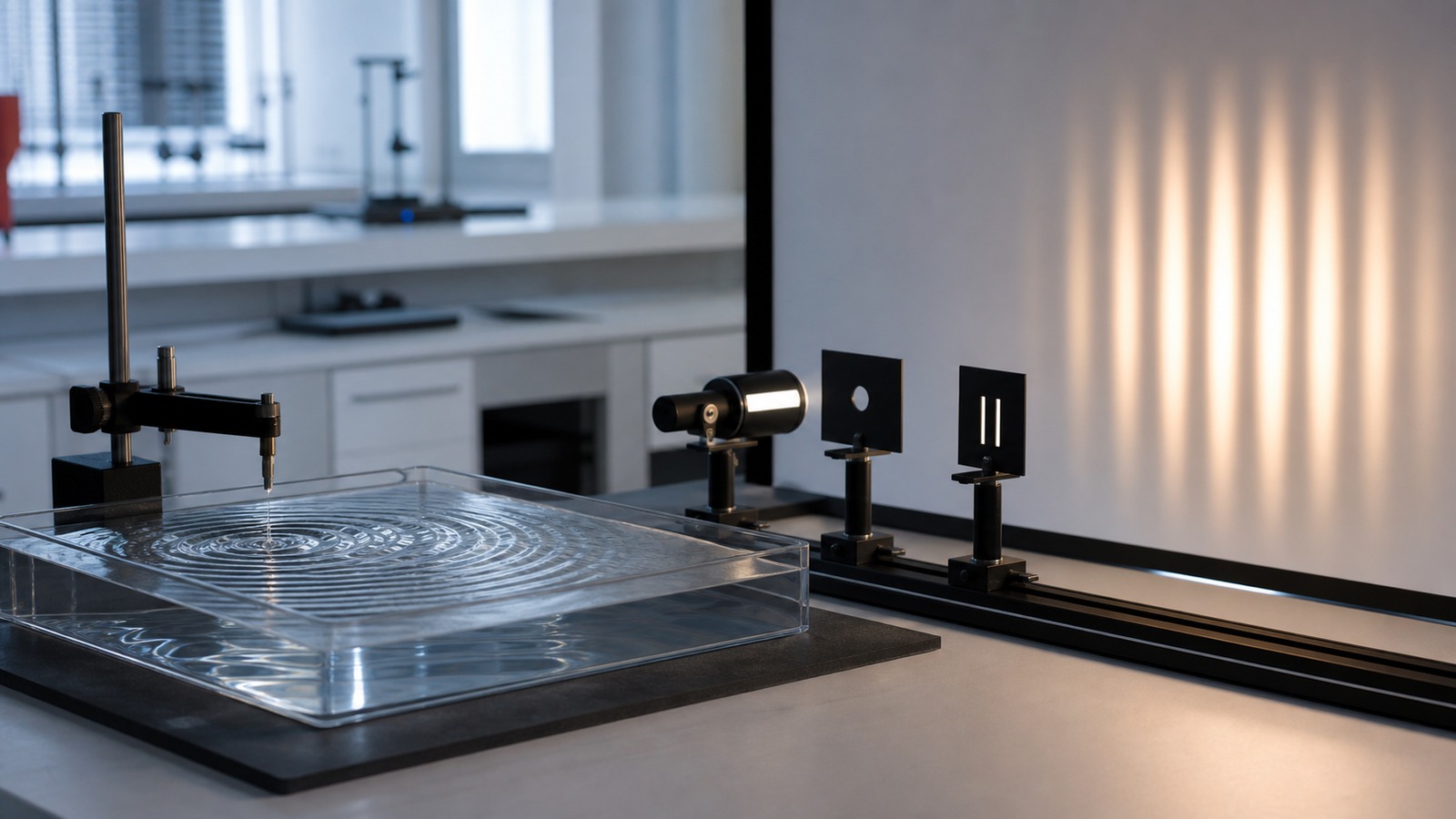
Water waves make interference visible. When two sets of ripples meet, some regions rise higher and others flatten. This gives beginners an immediate picture of constructive and destructive interference. Light can produce analogous bright and dark regions.
Water waves also show wavelength. The distance between ripple crests is easy to see. Light has wavelength too, though it is far smaller than ordinary water ripples. Wavelength helps determine color and interference spacing.
Diffraction is another useful comparison. Water waves spread when they pass through an opening or around an obstacle. Light can also spread and bend around edges, especially when the opening is comparable to the wavelength.
Reflection and refraction complete the first bridge. Water waves can reflect from barriers and change direction when they enter regions where their speed changes. Light reflects from mirrors and refracts through materials for related wave reasons.
The analogy helps because it makes wave behavior feel less mysterious before the quantum complications arrive.
Why Interference Is the Strongest Link
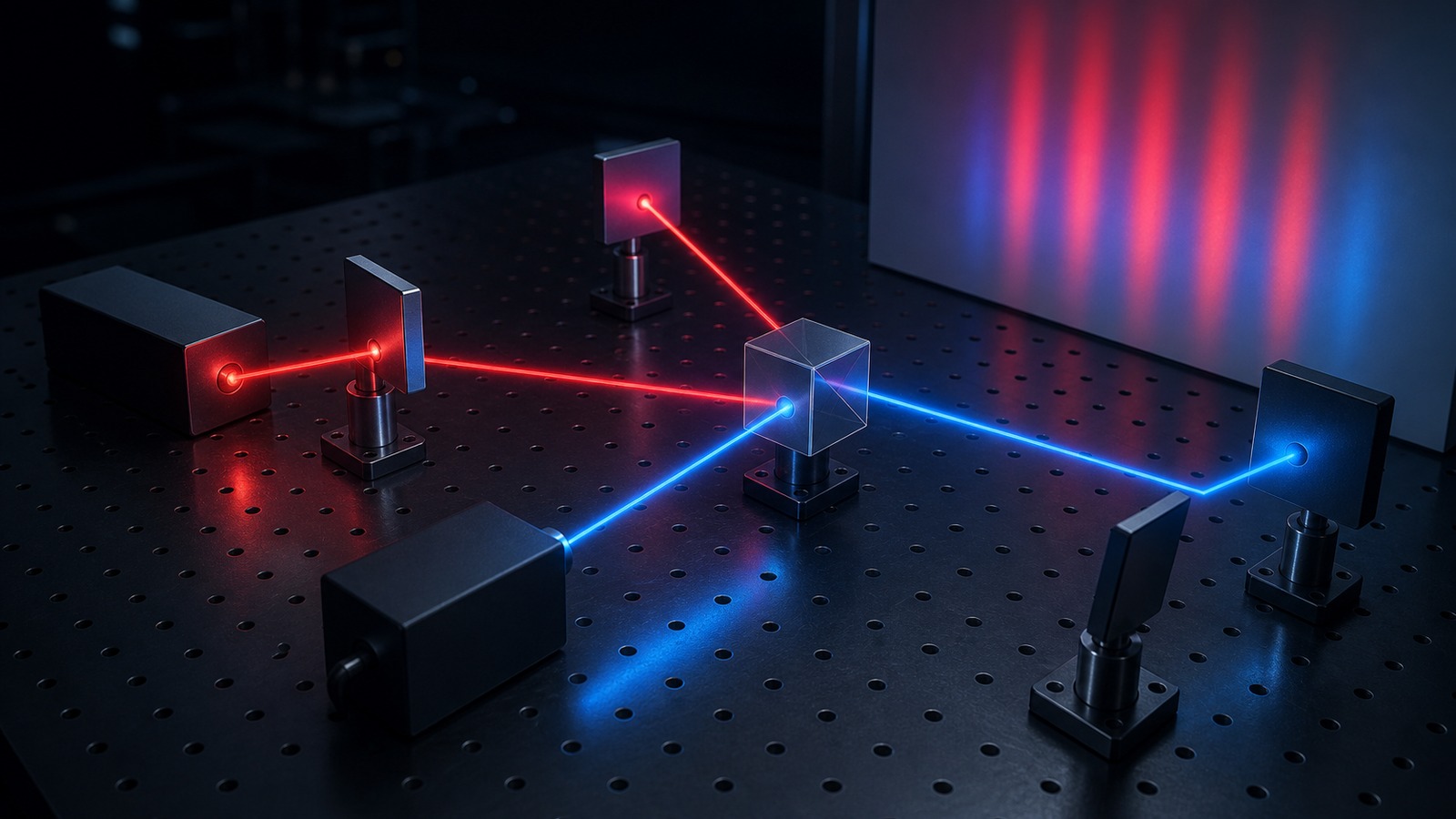
Interference is where the water analogy becomes especially powerful. Two coherent light paths can meet at a screen with different phase relationships. Where the phases align, light is more likely to be detected. Where they oppose, detection is suppressed.
This mirrors the water-wave idea of reinforcement and cancellation. The same basic pattern logic appears in ripple tanks, double-slit optics, thin films, and diffraction gratings. The geometry decides which points receive in-step contributions.
Thin soap films are a familiar example. Their colors come partly from interference between light reflected from different surfaces of the film. Oil slick colors and anti-reflective coatings rely on similar phase effects.
These examples show why light can seem water-like. The visible pattern is organized by wavelength and phase, not by independent pellets traveling in straight lines.
Where the Analogy Breaks
Water waves need a medium: water. Light does not need water, air, or ether to travel through empty space. It is an electromagnetic field, and in modern physics that field is quantum. This already makes light different from surface ripples.
Water waves also spread energy continuously over the wavefront. Light can be detected as individual photons. A very dim interference experiment may record one event at a time, even though the accumulated pattern is wave-like.
The analogy also fails for polarization, photon counting, entanglement, and quantum measurement. Water ripples can introduce phase and interference, but they do not capture the full structure of quantum light.
This does not make the analogy bad. It makes it local. Use water waves to understand certain pattern behaviors, then stop before pretending the comparison explains photons completely.
A good analogy should point toward the right question. It should not replace the experiment it was meant to illuminate.
Why Photons Complicate the Picture
Photons are the particle-like side of light’s quantum behavior. Detectors absorb light in discrete events. A camera sensor registers individual interactions, and a single-photon detector clicks one event at a time. Water waves do not behave that way.
Yet photons can still build interference patterns. This is the key quantum twist. The photon is detected locally, but the probability of detection is shaped by wave-like amplitudes. The result is not ordinary water and not ordinary particles.
This is why saying light behaves like water is helpful but incomplete. It describes propagation and interference, not the full measurement story. Photon detection forces the analogy to become quantum.
The best beginner view is to treat water as a phase-and-pattern model. It can show how reinforcement and cancellation work. It cannot show why one photon arrives at one detector location.
Why Color Also Fits the Wave Side
Color is tied to frequency and wavelength. Red light has a longer wavelength than blue light, and that difference affects diffraction and interference. Water waves can help illustrate how different wavelengths produce different spacing.
But color also connects to photon energy. Higher-frequency light carries more energy per photon. This is where the analogy bends again. A water wave’s color is not set by a photon energy relation.
Light therefore links wave and particle descriptions through the same frequency. The wave side uses frequency and wavelength to describe propagation. The photon side uses frequency to describe energy exchange.
This shared quantity is one reason light is such a good teacher of duality. The same physical light can require wave language in one question and photon language in another.
The water analogy can introduce wavelength, but quantum theory explains why wavelength and energy are tied so deeply.
How Teachers Can Use the Comparison
The safest teaching use is to begin with visible ripples and then name the limit clearly. Show reinforcement, cancellation, wavelength, and diffraction with water. Then explain that light has similar pattern rules but a different physical nature.
Students should be warned that photons are not droplets. They should also be warned that a light wave is not a material surface rising and falling. The analogy describes mathematical behavior, not identity.
Used this way, water waves prepare the mind without trapping it. They make interference intuitive enough that the quantum version can be approached with less fear.
The comparison also helps explain why dark bands are real evidence. In both water and light patterns, cancellation is not a mistake. It is a meaningful result of phase.
Where the Quantum Lesson Begins
The quantum lesson begins when the light is dim enough for individual detections. If the pattern still builds one photon at a time, the water analogy no longer carries the full story. The experiment now shows wave-like probabilities and particle-like events together.
This is where duality becomes unavoidable. The water model explains why bands can form. Photon detection explains why those bands are built from countable events. Quantum mechanics is needed to hold both facts at once.
Light behaves like water only up to the point where the discrete detector record matters. That boundary is exactly what makes the topic interesting.
How to Use the Analogy Without Getting Stuck
The water analogy works best when it is treated as a first model. It can show how waves spread, overlap, reinforce, and cancel. It can make wavelength and phase feel visible before the mathematics becomes abstract.
The next step is to name the transfer. In the light experiment, the pattern is not made by a water surface. It is made by electromagnetic fields and, at the quantum level, by probability amplitudes. The analogy has carried only part of the structure.
Teachers can make this explicit by asking which features survived the comparison. Interference survived. Diffraction survived. Wavelength survived. Photon counting did not. That list keeps the analogy honest.
It also helps to compare what the detector sees. In a water tank, many points on the surface move together. In a single-photon experiment, one detector event occurs at a time. The accumulated pattern is wave-like, but the event is discrete.
Another useful distinction is energy transfer. A water wave can deliver energy continuously to a floating object. Light interacting with atoms and detectors often transfers energy in photon-sized events. That is a quantum difference.
The analogy can still prepare readers for thin-film colors, diffraction gratings, and double-slit patterns. It gives a physical feeling for why geometry and wavelength matter. That preparation is valuable.
The danger comes when the analogy becomes identity. If light is treated as literal water, then vacuum propagation, polarization, photon statistics, and quantum fields become confusing. The model starts blocking the subject it was meant to open.
A better habit is to use analogies with expiration dates. Let the water picture do one job, then replace it when the next question demands quantum language.
This habit is useful across quantum mechanics. Many beginner pictures are bridges. Bridges are good when crossed and bad when mistaken for the destination.
Light sometimes behaves like water because certain wave rules are shared. It stops behaving like water when quantum measurement and photon energy enter the question.
That careful boundary makes the analogy stronger, not weaker. A limited model is more trustworthy than an overextended one.
Readers who keep the boundary in mind can enjoy the ripple picture without being trapped by it.
The result is a cleaner path from everyday waves to quantum light.
That path is exactly what a good analogy should provide.
Why The Boundary Makes Wonder Stronger
The boundary between analogy and identity makes the wonder stronger because it prevents disappointment. Water waves are beautiful, but quantum light is not merely a smaller pond. It has its own deeper rules.
Once readers know the boundary, they can appreciate both sides. The ripple picture makes interference approachable. Photon detection shows why light is stranger than the ripple picture.
This also makes the analogy more reusable. A reader can carry the wave idea into diffraction and phase, then switch to photon language for absorption and counting. That switching is the real duality skill.
The strongest explanation does not throw away the simple picture. It places the picture where it belongs.
That placement turns a classroom comparison into a reliable stepping stone.
The analogy also works best when it stays visual instead of total. Water can suggest spreading fronts, meeting crests, and cancellation, but it cannot explain why a detector absorbs a photon as one event. Keeping that limit clear lets the comparison help without quietly replacing quantum theory. The limit is not a flaw; it is the handoff point where quantum language must take over for the next step.
The Careful Answer
Light behaves like water when wave features such as interference, diffraction, phase, and wavelength dominate the question.
It stops behaving like water when quantum detection matters. Photons make light deeper than the analogy, even when the visible pattern looks ripple-like.