


Why the Double-Slit Experiment Still Confuses Scientists Today
The double-slit experiment still confuses scientists because it reveals real quantum predictions while resisting one simple classical story.

Can Humans Ever See Wave-Particle Duality Directly?
Humans cannot see wave-particle duality directly with unaided eyes, but experiments amplify quantum behavior into visible patterns and detector records.

Why Matter Waves Changed Everything We Thought About Atoms
Matter waves changed atomic physics by replacing tiny-planet orbits with wave-like quantum states that explain stability, spectra, and chemical structure.

The Wave That Guides a Particle: A Beginner’s Guide
The idea of a wave guiding a particle comes from pilot-wave thinking, where a definite particle follows a path shaped by a quantum wave.

Does Observation Change Particles? The Duality Connection
Observation changes particles in quantum experiments because measurement is a physical interaction that changes which wave-particle possibilities remain available.
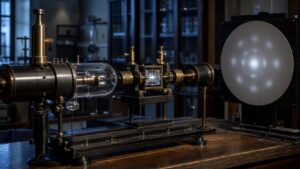
How Scientists Proved Electrons Behave Like Waves
Scientists proved electrons behave like waves by showing that electron beams can diffract and interfere, producing patterns no classical particle picture could explain.

Wavefunctions Explained: What a Particle’s ‘Wave’ Really Means
What if particles aren’t just tiny dots, but waves of possibility? Discover what a wavefunction really means and how quantum physics reshapes reality, probability, and the technology powering our world.

Why Quantum Objects Don’t Behave Like Anything We Know
At the smallest scales, reality stops playing by familiar rules. Particles exist in multiple states, tunnel through barriers, and connect across space. Discover why quantum objects don’t behave like anything we know—and how this strange world is shaping the future of technology.

What the Double-Slit Experiment Reveals About Reality
A simple experiment with two tiny slits shattered classical physics and revealed a universe built on probability, superposition, and mystery.

Why Wave–Particle Duality Is the Heart of Quantum Physics
Light acts like a wave. Electrons behave like ripples. Particles pass through two places at once. Wave–particle duality is the stunning truth at the heart of quantum physics—and it changes everything we thought we knew about reality.

Can Particle Waves Explain Reality Itself?
What if reality isn’t made of solid matter—but of ripples? Discover how particle waves, quantum fields, and entanglement may reveal a universe built from vibration, probability, and profound interconnectedness.

The Mystery of Quantum Behavior: Why Duality Matters
Light that acts like a particle. Electrons that spread like waves. Step into the mystery of quantum duality and discover how this strange behavior shapes atoms, technology, and the very fabric of reality.