
Lasers Make Light’s Wave Side Easy to Control
Lasers demonstrate wave-particle duality because they make light’s wave-like behavior highly organized while still producing photon-based interactions. A laser beam can be narrow, coherent, and stable, which makes it excellent for interference, diffraction, holography, and precision measurement. Those are wave-like behaviors. At the same time, laser light is still absorbed and emitted in quantum events. A detector counts photons, a material absorbs energy in discrete interactions, and the laser itself works through stimulated emission between quantum states. The laser does not prove that light is only a wave or only a particle. It shows how the two descriptions cooperate. The coherent beam behaves like a smooth electromagnetic wave when many photons occupy a well-organized state. Reduce the light level and use sensitive detectors, and photon discreteness becomes visible. This is why lasers are so useful in teaching duality. They show clear wave patterns while pointing toward the quantum structure underneath. A laser is not just a bright flashlight. It is a controlled quantum light source whose coherence lets us see interference with unusual clarity and whose photons remind us that detection happens in countable events. The same device can therefore make wave behavior visible at the bench and photon behavior measurable at the detector.
A: Their coherence produces strong interference and diffraction patterns.
A: They emit and are detected through photon-based quantum events.
A: A quantum process where an excited system emits matching light.
A: No. Classical wave optics is often an approximation.
A: Yes, especially at low intensity with sensitive detectors.
A: Their emission process organizes phase, direction, and frequency.
A: A quantum fluctuation from discrete photon arrivals.
A: Yes, some platforms use lasers to control and read quantum states.
A: Stable phase relationships preserve high visibility.
A: Lasers engineer wave-like light while keeping photon physics present.
Why Laser Light Is Special
Laser light is special because its photons are emitted in a coordinated way. The beam often has a narrow range of wavelengths, a stable direction, and strong coherence. These features make laser light far more organized than light from many ordinary lamps.
Coherence is the key for wave demonstrations. When phase relationships remain stable, interference patterns can be sharp and steady. A laser beam can therefore produce clean fringes in setups that would look messy with incoherent light.
The beam’s directionality also helps. Laser light can travel in a narrow path and be guided through mirrors, beam splitters, lenses, and interferometers. That makes it easy to create controlled alternatives and recombine them.
None of this removes the photon side. Laser light is still quantum light. Its smooth-looking beam emerges from many discrete quantum events arranged into a highly coherent field state.
That combination is exactly why lasers are such good duality teachers.
Stimulated Emission Is Quantum
A laser works through stimulated emission. Atoms, ions, molecules, or semiconductor structures are prepared so that excited states can emit light in a coordinated way. An incoming photon can stimulate another photon to be emitted with matching properties.
This process is quantum from the start. It depends on allowed energy levels and transitions. The emitted light has a frequency tied to the energy difference between states. The beam is not produced by ordinary classical vibration alone.
Stimulated emission helps create coherence because the emitted photons can share phase, direction, and frequency relationships. That organization is what makes laser beams so useful for interference experiments.
So a laser’s wave-like clarity is born from quantum emission. The technology itself is a bridge between photon events and organized field behavior.
How Lasers Show Interference
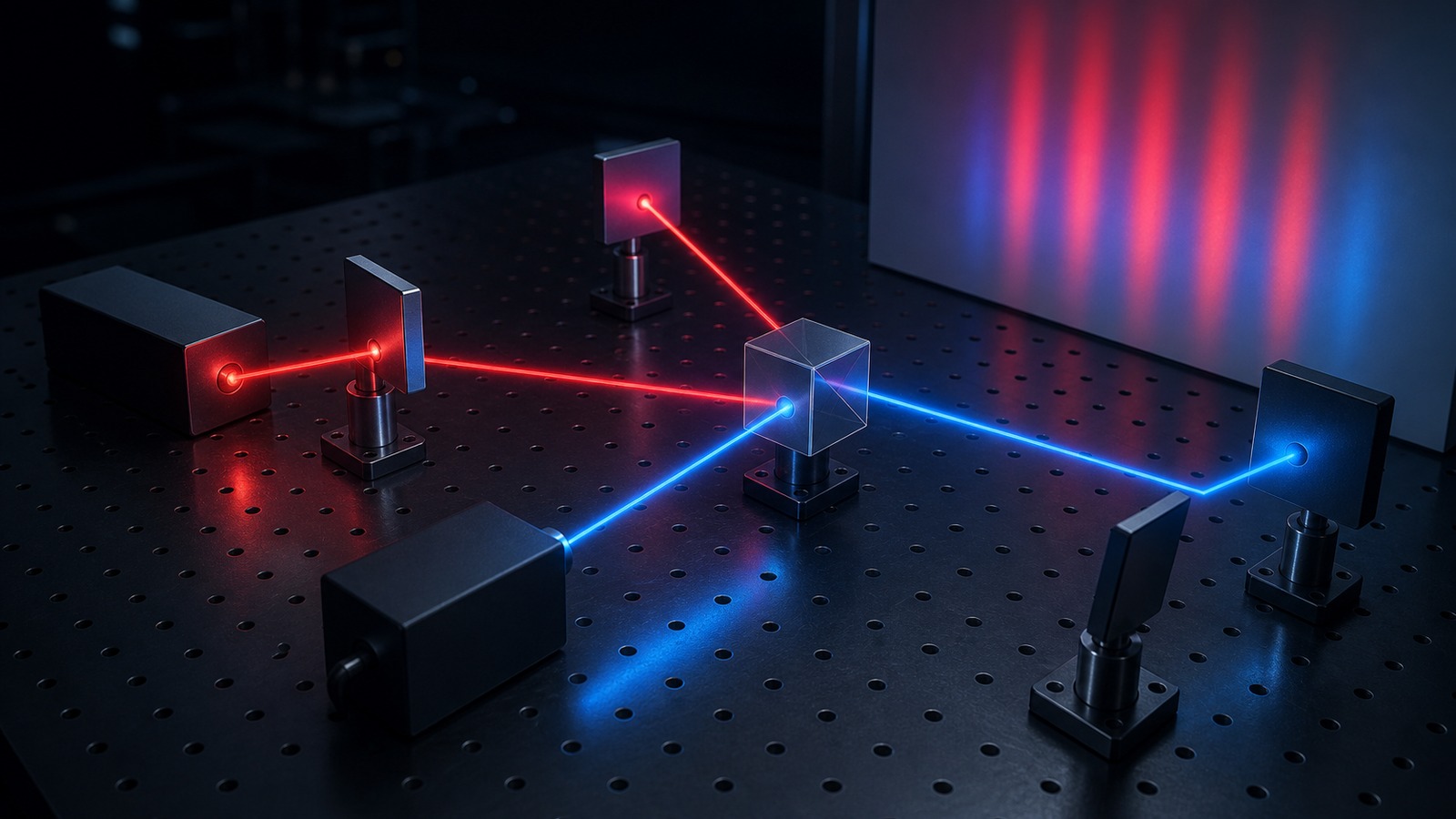
Send a laser through two slits or an interferometer, and bright and dark bands can appear with striking contrast. The pattern is stable because the laser maintains coherent phase relationships across the relevant paths. This is the wave-like side made visible.
Interference demonstrations with lasers are often easier to set up than similar demonstrations with ordinary light. The beam is intense, directional, and organized. Small path differences can produce readable fringe shifts.
These patterns are not decorative. They reveal phase, wavelength, path length, and alignment. A slight change in mirror position or optical path can move the fringes. That sensitivity makes lasers powerful measuring tools.
In quantum terms, the same interference logic can be understood through amplitudes associated with light modes. Many-photon laser light may look classical on average, but the underlying field still obeys quantum rules.
This is why a laser can feel both familiar and deep. It makes wave behavior visible while quietly depending on quantum structure.
Where the Photon Side Appears
The photon side appears when laser light is absorbed, emitted, or counted. A detector does not absorb an arbitrary fraction of light with infinite smoothness at the smallest scale. It registers discrete interactions. Sensitive devices can count photon arrivals.
Even a laser beam that looks continuous can be described in terms of a quantum state of the electromagnetic field. Depending on the state and measurement, photon number fluctuations and shot noise can become important.
Shot noise is a practical reminder that light comes with quantum discreteness. In precision measurements, the statistical arrival of photons can limit sensitivity. Engineers must account for this particle-like aspect even when using wave optics.
Photon discreteness also matters in low-light laser experiments. Reduce the intensity enough, and individual detector clicks replace the impression of a smooth beam.
Why Coherence Does Not Mean Classical
Laser coherence can make light behave so wave-like that it feels classical. That is useful but potentially misleading. A coherent laser beam can be approximated by classical electromagnetic waves in many everyday calculations, yet its source and detection remain quantum.
This is a pattern found throughout physics. Classical behavior can emerge from quantum systems under certain conditions. The emergence does not erase the deeper layer. It tells us which approximation is practical for the question being asked.
Laser light is therefore a good example of context. Use wave optics to design lenses and interference setups. Use photon language to understand emission, absorption, counting statistics, and quantum limits.
Both descriptions can be valid when used in the right place. Duality is not a conflict to be settled by choosing one side forever. It is a guide to which description is doing useful work.
The laser keeps that guide visible because it is coherent enough to look classical and quantum enough to reveal photons.
How Lasers Support Quantum Technology
Lasers are central to many quantum technologies. They cool atoms, trap ions, control qubits, drive transitions, read out states, and build interferometers. Their coherence makes them precise tools for manipulating quantum systems.
In atom interferometry, lasers can split and recombine matter-wave paths. In trapped-ion computing, laser pulses can control internal states. In quantum optics, lasers help prepare and measure light fields. The same wave-particle duality sits behind these uses.
Laser precision also makes quantum limits visible. When measurements become sensitive enough, photon statistics, shot noise, and quantum back-action can matter. The tool that reveals wave behavior also exposes particle-like constraints.
That practical role prevents laser duality from being only a classroom topic. It is part of how modern laboratories control the quantum world.
What Lasers Do Not Prove
Lasers do not prove that light is simply a classical wave. Their coherence can make that approximation excellent, but the beam is still quantum light. Lasers also do not prove that photons are tiny hard pellets. Photon language describes quantized field interactions, not miniature beads.
The real proof is more nuanced. Lasers show that a quantum light source can produce highly wave-like behavior while retaining discrete emission and detection. That is stronger than either simplified picture alone.
Using lasers well means respecting both sides. The wave side explains interference and phase control. The photon side explains quantum emission, absorption, and counting.
Why Laser Examples Feel So Convincing
Laser demonstrations feel convincing because the patterns are stable enough for people to inspect. A double-slit pattern made with a laser can sit on a screen instead of flickering away. That stability gives beginners time to connect the bands with wavelength and phase.
The beam also makes alignment visible. Mirrors, lenses, and slits can be arranged so the path is easy to follow. This gives the experiment a practical clarity that many quantum demonstrations lack.
That clarity should not be mistaken for classical simplicity. The same beam that makes beautiful wave patterns is produced through quantum emission. The source is already telling a photon story before the screen tells a wave story.
Laser examples are therefore persuasive because they are layered. The surface pattern is readable, the apparatus is controllable, and the underlying physics remains quantum. Few tools bridge those levels so cleanly.
This is why lasers appear in so many physics labs. They are not only convenient light sources. They are disciplined ways to make phase, coherence, and photon behavior experimentally accessible.
For duality, that accessibility matters. A good laser setup lets students see the wave side first, then learn why the photon side was there all along.
What Changes at Very Low Intensity
At high intensity, a laser beam can look smooth because enormous numbers of photons are involved. Detectors average over many events, and classical wave optics works extremely well. Nothing about that usefulness proves light is only classical.
Lower the intensity enough, and the discreteness becomes harder to ignore. Sensitive detectors begin to register individual arrivals. The same optical path that once looked like a continuous beam becomes a sequence of quantum events.
If the setup preserves coherence, the long-run distribution can still show interference. This is the key duality lesson in laser-based optics: wave-like pattern rules can survive even when the light is detected in photon-sized pieces.
Shot noise also becomes more noticeable when photon numbers are limited. Precision measurements must treat photon arrival statistics as a real limit, not a measurement inconvenience. Particle-like discreteness becomes an engineering fact.
Low-intensity laser experiments therefore reveal the hidden quantum floor underneath smooth wave behavior. The beam does not change identity. The measurement reveals a different aspect of the same light.
How Lasers Keep The Story Concrete
Lasers keep duality concrete because the same source can be used in several demonstrations. One setup shows interference. Another shows diffraction. A low-light version shows photon counting. The reader can see continuity instead of disconnected examples.
This continuity matters for beginners. It shows that wave and particle descriptions are not separate chapters about different kinds of light. They are different readings of one quantum field under different measurement conditions.
The laser also reminds us that quantum theory can be engineered. Coherence is not only a mysterious property to admire. It is something laboratories generate, protect, and use.
That engineering view keeps the lesson practical and grounded.
That practicality is especially important because lasers can seem too familiar to feel quantum. A red pointer, scanner, or optical drive looks like ordinary technology, yet each depends on controlled emission between energy levels. The everyday device carries a deep quantum rule in plain sight. It also keeps lessons concrete for new readers.
Low-intensity demonstrations add another layer. When the beam is dimmed until detections arrive one by one, the same source still builds wave patterns over time. The lesson becomes concrete because the smooth beam and the individual click are not separate stories.
The Bright Lesson
Lasers demonstrate wave-particle duality by making coherent light easy to control while preserving photon-based emission and detection.
They show that light’s wave behavior can be engineered, measured, and used, even though the underlying interactions remain quantum.


