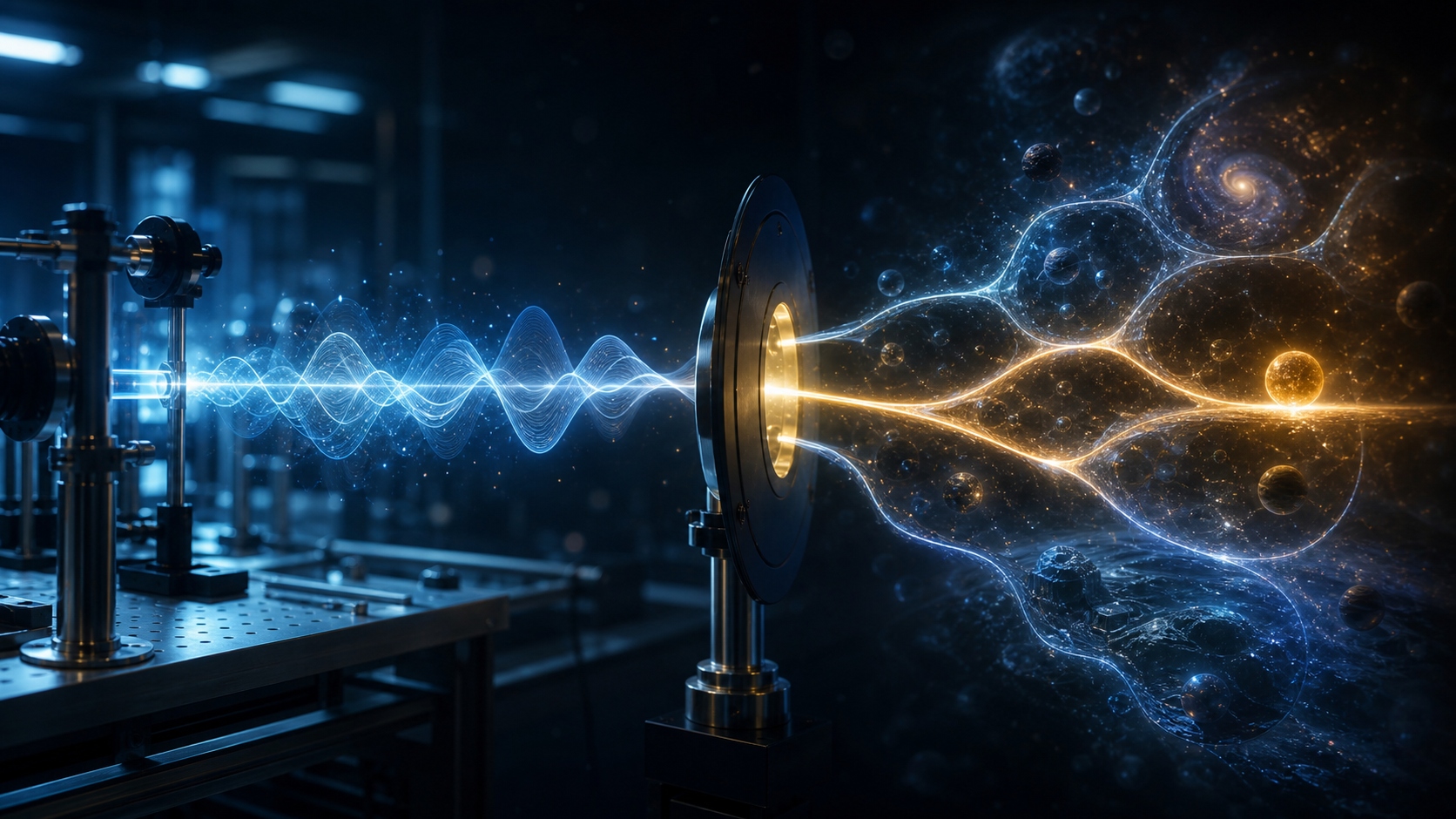
The measurement problem in quantum physics is the puzzle of why a theory built from possibilities gives us a world of definite results. Before measurement, a wavefunction may describe several outcomes with precise probabilities. After measurement, the lab records one result. The equations work beautifully, but the meaning of that transition remains one of the deepest questions in science.
A: No. Quantum predictions are extremely accurate.
A: The update from a many-possibility state to the observed result.
A: It explains loss of interference, but debate remains about single outcomes.
A: Most modern views do not require it.
A: That all outcomes persist in branching structure.
A: The idea that collapse is a real physical process.
A: Because experiments record one fact, not a visible menu.
A: Yes. The rules work operationally.
A: It reveals what is strange about quantum reality.
A: The math gives possibilities; measurement gives a fact.
The Puzzle Is Inside a Successful Theory
Quantum mechanics is not struggling because it fails. It is famous because it succeeds. It explains atoms, lasers, semiconductors, chemistry, and modern electronics. The measurement problem exists because the theory works so well that physicists take its strange rules seriously. The puzzle is not whether measurements produce results. The puzzle is what kind of physical story connects quantum possibility to a single recorded fact.
Two Rules Seem to Be in Play
In ordinary textbook quantum mechanics, a system evolves smoothly when it is not being measured. The wavefunction changes according to a precise equation. During measurement, however, the state is updated to match the observed result. That update is often called collapse. The measurement problem asks whether this second rule is a real physical event, a practical shortcut, or a sign that the theory is incomplete.
Why One Outcome Is Hard to Explain
If the wavefunction contains several possible outcomes, why do we experience only one? A detector does not show a faint menu of all possibilities. It clicks in one place. A qubit does not display every blend of 0 and 1. It returns a readout. The measurement problem lives in that contrast: the mathematical description can be broad, but the recorded world is specific.
Decoherence Clears the Fog, Not the Whole Mystery
Decoherence explains how interaction with the environment suppresses interference between alternatives. It shows why quantum mixtures begin to look classical when information leaks into surroundings. This is a major part of the story. Still, many physicists argue that decoherence explains why alternatives stop interfering, not why one particular result is the one experienced. The fog clears, but the final selection remains debated.
Interpretations Offer Different Pictures
Copenhagen-style views emphasize the limits of what can be said before measurement. Many-worlds says the wavefunction never collapses and outcomes branch. Objective-collapse theories propose a real physical collapse. Pilot-wave theories add definite particle configurations guided by a wave. These interpretations often agree on laboratory predictions while disagreeing about the underlying reality.
Why the Measurement Problem Matters
The measurement problem matters because it marks the boundary between using quantum mechanics and understanding it. Engineers can build quantum devices without solving every philosophical question, but the question remains powerful: how does a universe described by probabilities become the definite world in which experiments are read, remembered, and compared?