Inside the Proton and Neutron
Quarks are elementary matter particles that never appear as isolated specimens in ordinary experiments. Instead, the strong interaction binds them into composite particles, including the protons and neutrons at the heart of every atom. The familiar summary—two up quarks and one down quark make a proton, while one up and two down make a neutron—is correct but incomplete. A nucleon is a restless quantum system filled with gluon fields, moving quarks, and transient quark-antiquark pairs. Understanding quarks therefore requires both a clean inventory of six flavors and a more dynamic picture of how quantum chromodynamics builds the matter we touch.
A: Their fractional values combine into the whole charges of observed hadrons.
A: Added field energy creates new hadrons before isolation occurs.
A: The gluon-mediated strong interaction described by quantum chromodynamics.
A: Yes. Gluon fields bind the quarks in every nucleon.
A: Confined motion and strong-field energy provide most of its mass.
A: It lists the proton’s two up and one down valence quarks.
A: Transient strange pairs can contribute, although nuclei use up and down valence quarks.
A: Scientists infer them from scattering, jets, decays, and consistent quantum predictions.
A: Current experiments find no structure, so the Standard Model treats them as elementary.
A: Strong low-energy coupling makes exact analytical calculations exceptionally difficult.
Six Flavors, Three Generations
The Standard Model contains six quark flavors: up, down, charm, strange, top, and bottom. They are arranged in three generations, with an up-type quark and a down-type quark in each. Up and down form the light first generation; charm and strange occupy the second; top and bottom make the third. Heavier quarks can be created when collisions concentrate enough energy, but they are unstable and eventually decay into lighter particles.
Quarks carry electric charge in fractions of the proton’s charge. Up, charm, and top each have charge positive two-thirds, while down, strange, and bottom each have charge negative one-third. Those fractions combine to give familiar whole charges. Two up quarks plus one down quark produce the proton’s positive charge. One up plus two downs add to zero for the neutron. Fractional charge was once a startling proposal; scattering and collider evidence now makes quarks central to particle physics.
Flavor is a quantum identity, not a taste or a miniature internal ingredient. The weak interaction can change one quark flavor into another, provided all relevant conservation rules are satisfied. In neutron beta decay, for example, a down quark changes into an up quark while the process produces an electron and an electron antineutrino. That change converts the neutron’s quark recipe into the proton’s.
Color Charge and the Strong Interaction
Quarks also carry color charge, the source charge of the strong interaction. The names red, green, and blue are bookkeeping labels and have nothing to do with visible color. Antiquarks carry corresponding anticolors. Observable hadrons combine these charges into color-neutral states: three differently colored quarks can form a baryon, while a color and matching anticolor can form a meson.
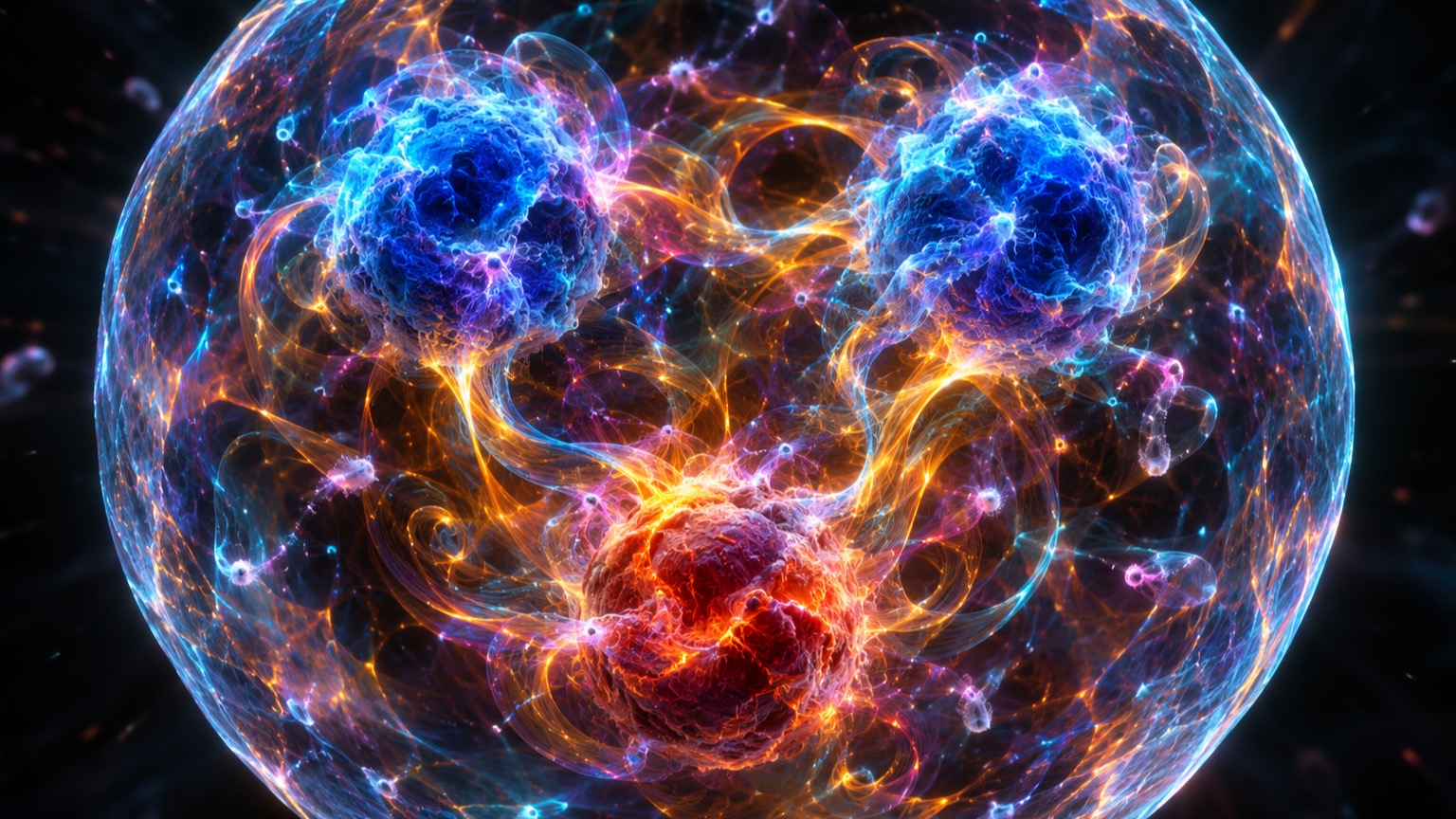
Gluons mediate the strong interaction. Unlike photons, which carry no electric charge, gluons themselves carry color information and therefore interact with one another. This self-interaction gives quantum chromodynamics, or QCD, much of its unusual behavior. The gluon field inside a proton is not a set of static strings linking three beads. It is a fluctuating, nonlinear field that can split, recombine, and generate temporary quark-antiquark pairs.
At very short distances or high momentum transfers, quarks can behave almost as if they are weakly coupled, a property called asymptotic freedom. At larger separations, the effective strong interaction grows. Trying to pull a quark out does not yield a free quark; the energy placed in the field eventually creates new quark-antiquark pairs, producing color-neutral hadrons. This confinement is why detectors record jets of hadrons rather than solitary quarks.
The word color was chosen because three distinct charges combine neutrally, somewhat as three primary colors were once imagined to combine, but the analogy ends there. Color cannot be viewed with light, and a quark’s color state can change whenever it emits or absorbs a gluon. What remains fixed in an isolated observable particle is overall color neutrality.
The Valence Recipe Is Only the Beginning
Calling a proton “uud” identifies its valence quarks and explains its enduring quantum numbers, including electric charge. It does not mean a proton contains exactly three little objects at every instant. High-energy probes reveal a much richer population of gluons and sea quarks. The number and momentum distribution of these constituents depend on the resolution scale used to examine the proton.
A useful analogy is a rapidly changing crowd viewed at different shutter speeds, though even that remains classical and limited. In QCD, the proton is a quantum state. Gluons carry a large share of its momentum at high energies, and brief quark-antiquark fluctuations contribute to measurable properties. Physicists call the quarks and gluons resolved inside a fast-moving hadron partons. Parton distribution functions summarize the probabilities of encountering them with particular momentum fractions during a hard collision.
Where Nucleon Mass Really Comes From
The up and down quarks receive small masses through their coupling to the Higgs field, but simply adding those masses accounts for only a small fraction of a proton’s or neutron’s total mass. Most nucleon mass emerges from QCD energy: the motion of confined quarks, the energy stored in gluon fields, and the strong interaction’s quantum dynamics. Through the equivalence of mass and energy, that internal energy contributes to the mass measured for the nucleon.
This fact corrects the simplified claim that the Higgs mechanism directly supplies all the mass in ordinary objects. The Higgs field is essential because it gives elementary quarks their intrinsic masses and sets important conditions for stable matter. Yet the bulk of the mass in a chair, mountain, or person comes from protons and neutrons, and the bulk of each nucleon’s mass is emergent strong-interaction energy.
The proton and neutron differ slightly in mass. That small difference reflects a competition between the unequal masses of up and down quarks and electromagnetic effects within the nucleons. The neutron is just heavy enough to decay when free, while neutrons bound inside stable nuclei can persist. A subtle QCD balance therefore helps determine which atoms can exist.
Changing the light-quark masses even modestly would alter that balance and could destabilize familiar nuclei. Nucleon mass is therefore both robustly generated by strong dynamics and delicately connected to the Higgs-supplied quark masses. Ordinary matter depends on the combination, not on either contribution considered alone.
From Quarks to Hadrons
Hadrons fall broadly into baryons and mesons. Conventional baryons contain three valence quarks; protons and neutrons are the lightest familiar examples. Conventional mesons contain a quark and an antiquark. Pions and kaons play important roles in nuclear and particle processes, even though they are unstable. Many excited hadrons live for only tiny fractions of a second before transforming into lighter products.
Nature also permits more unusual color-neutral combinations. Experiments have identified tetraquark and pentaquark candidates whose minimum valence content involves four or five quarks and antiquarks. Researchers continue to study whether particular states are compact multiquark objects, molecule-like pairs of conventional hadrons, or mixtures of configurations. Their spectra provide demanding tests of how QCD assembles matter.
When an energetic quark or gluon is produced, confinement converts its energy into a spray of hadrons called a jet. Detectors measure the jet’s tracks and energy deposits, then physicists compare their statistical patterns with QCD calculations and simulations. The initiating quark is never photographed in isolation; its presence is inferred from the organized aftermath of hadronization.
How Deep-Inelastic Scattering Revealed Quarks
The decisive evidence for pointlike constituents inside protons came from high-energy scattering. Researchers fired electrons at protons and examined how the electrons deflected. Low-energy probes saw the proton as an extended object. At higher energies and shorter wavelengths, the scattering pattern indicated compact charged constituents inside, much as Rutherford’s earlier scattering experiment had exposed the atomic nucleus.
These constituents matched the quark picture, while later experiments established gluons and mapped increasingly detailed parton distributions. Modern colliders use proton beams partly because their composite structure provides many possible quark and gluon collisions. That richness is useful but complicates reconstruction: the energy of the whole proton is shared among partons, so each event must be interpreted probabilistically.
Neutrino scattering supplied another penetrating view because weak interactions select quark flavors differently from electromagnetic probes. Comparing electron, muon, and neutrino results helped separate the proton’s internal contributions. Today, global analyses combine many experiments rather than relying on one machine to determine parton distributions.
Polarized scattering adds sensitivity to spin. By aligning target spins and comparing collision rates, experiments separate how quarks and gluons contribute to the nucleon’s total angular momentum. The original expectation that quark spins would explain nearly everything gave way to a more complex balance involving gluon spin and orbital motion.
Why the Top Quark Is an Exception
The top quark is extraordinarily massive and decays through the weak interaction before it has time to hadronize. That makes it the only quark whose properties can be studied without first being hidden inside a long-lived bound state. Its decay products still form jets and other detector signatures, but the top’s rapid decay preserves information about its spin and production process in a distinctive way.
Charm and bottom quarks do form hadrons before decaying. Their relatively long-lived hadrons can travel a measurable distance within a modern detector, leaving displaced decay vertices. Identifying those vertices allows experiments to tag heavy-flavor jets and study rare processes, including Higgs boson decays and possible signs of new physics.
Heavy quarks serve as controlled probes because their large masses introduce a scale that theorists can use in calculations. Comparing the production and decay of charm, bottom, and top tests whether one QCD framework remains consistent across very different regimes.
Bottom hadrons also provide access to subtle differences between matter and antimatter. Their decay rates and oscillations test the quark-mixing framework, and any persistent deviation could expose particles too heavy to create directly.
Because heavy flavors are absent from stable nuclei, every tagged charm or bottom particle also records a recent high-energy production process. Their abundance and motion can diagnose the hot medium formed in heavy-ion collisions.
Questions QCD Has Not Finished Answering
QCD’s equations are known, yet calculating their low-energy consequences can be extremely difficult because the coupling becomes strong. Lattice QCD tackles the problem by representing spacetime on a computational grid and evaluating quantum fields numerically. These calculations reproduce hadron masses and address nucleon structure, but precision work demands immense computing resources and careful control of approximations.
Researchers still investigate how the proton’s spin arises from quark spins, gluon spins, and orbital motion; how quarks and gluons turn into hadrons; and how dense gluon populations behave at high energy. Heavy-ion collisions briefly create quark-gluon plasma, a state in which quarks and gluons move through a hot medium rather than remaining confined inside individual nucleons. Quarks may be elementary in the Standard Model, but the systems they build remain among physics’ richest unsolved problems.
Another frontier concerns the distribution of pressure and shear inside a proton. Specialized scattering measurements can constrain gravitational form factors, quantities related mathematically to the proton’s energy-momentum structure even though gravity is not being measured directly. The emerging picture tests how QCD holds a compact, stable object together.
Why Quarks Matter Beyond Collider Physics
Quark physics determines the properties of every atomic nucleus. Nuclear forces are residual consequences of QCD, so nuclear binding, radioactivity, and the elements synthesized in stars inherit rules from quarks and gluons. The connection is not usually calculated by following every gluon in a large nucleus; physicists build effective theories suited to the lower-energy scale while requiring consistency with the underlying interaction. Dense quark-containing matter also shapes astrophysics. Neutron stars compress nucleons far beyond ordinary nuclear densities, raising questions about superfluid phases, exotic hadrons, or forms of deconfined quark matter in their cores. Observations of stellar masses, radii, cooling, and gravitational waves can therefore constrain strong-interaction physics that is difficult to reproduce on Earth.
The quark model began as a way to organize a growing zoo of hadrons. It matured into QCD, a field theory that explains why the organization works and predicts new phenomena. Its most humbling lesson is that knowing the elementary ingredients does not make the composite system simple. Three valence quarks can build a proton whose mass, spin, and internal motion still demand the combined work of experiment, theory, and computation.