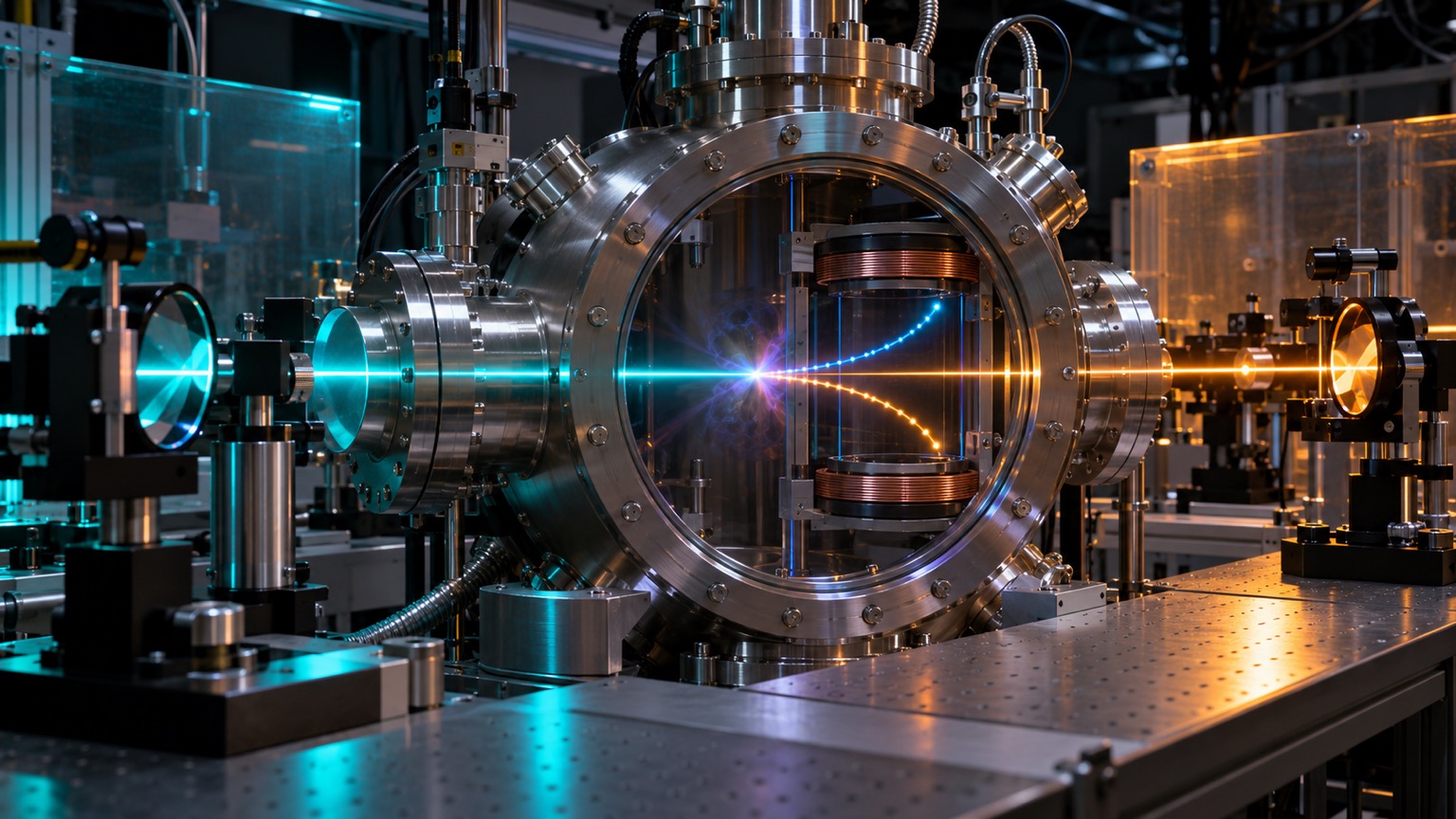
Reality Described as Fields Before Particles
Quantum fields are physical entities defined throughout space and time whose quantized excitations appear as particles. The electron field is present even where no electron is detected; creating an electron means exciting that field by one quantum. Photons are excitations of the electromagnetic field, quarks belong to quark fields, and the Higgs boson is an excitation of the Higgs field. This framework combines quantum mechanics with special relativity, permits particles to be created and destroyed, and explains why identical particles are truly indistinguishable. It also replaces the image of empty space as a blank container with a vacuum that has structure and measurable consequences.
A: The field is primary; particles are its quantized excitations.
A: Every electron is a quantum of the same electron field.
A: Yes. Vacuum is a field state even with no detected excitations.
A: Not generally; they are internal elements of calculation methods.
A: Concentrated field energy can become allowed excitations while conserving quantities.
A: It lacks ordinary particles but retains quantum fields and correlations.
A: It connects scale-dependent calculations with finite measured masses and couplings.
A: In curved or accelerated settings, particle definitions can depend on the observer.
A: No complete tested quantum field theory of gravity is established.
A: Electronics, light, chemistry, and materials all depend on its consequences.
Why Ordinary Quantum Mechanics Needed Fields
Introductory quantum mechanics often starts with a fixed number of particles and a wavefunction that assigns probabilities to possible measurements. That approach works beautifully for atoms and many laboratory systems. Relativity introduces a challenge: enough concentrated energy can create particle-antiparticle pairs, and particles can annihilate into other species. A theory that assumes particle number never changes cannot be fundamental at high energy.
Quantum field theory makes fields the primary objects and lets their excitations change in number. Energy and momentum remain conserved while an electron and positron can turn into photons or a heavy unstable particle can decay into lighter products. Creation and annihilation are normal field processes rather than exceptions added to particle mechanics.
From a Classical Field to a Quantum Field
A classical field assigns a value to every point. Temperature across a room is a scalar field, while wind velocity is a vector field. The electromagnetic field assigns electric and magnetic vectors throughout space. These examples can vary smoothly and carry waves and energy.
Quantization changes the allowed states and measurement outcomes. A field can be decomposed into modes, much as a musical string has possible vibration patterns. Each quantum mode behaves mathematically like an oscillator whose energy comes in discrete steps. One excitation of an electromagnetic mode is a photon.
The musical analogy has limits. Fundamental quantum fields are not vibrations of a hidden material substrate. Their modes exist in three-dimensional space, respect relativity, and can interact. The field description is the substrate supplied by the theory; physics has found no deeper mechanical medium underneath it.
One Field, Many Identical Particles
Every electron is an excitation of the same electron field. This explains why electrons have exactly the same mass, charge, and spin wherever they appear. They are not separately manufactured objects that happen to match. They are repeated quanta of one field with fixed properties.
Identical-particle statistics follow from the kind of field involved. Fermionic fields use anticommuting operators and produce exclusion, while bosonic fields use commuting operators and permit shared occupation. The language sounds mathematical because the distinction is mathematical at its foundation, yet it generates visible consequences such as atomic shells and laser coherence.
Antiparticles also arise naturally. A relativistic charged field contains excitations with opposite charge. The positron is not an unrelated addition to the electron theory; it is the electron field’s antiparticle excitation. Neutral fields may have particles identical to their antiparticles, depending on their quantum structure.
This common origin also explains why creating an electron never produces a slightly different charge or mass. Local conditions can alter an excitation’s effective behavior inside a material, but the underlying field parameters remain universal. Precision comparisons of particles in distant places therefore test the consistency of field theory itself.
Interactions Are Couplings Between Fields
Fields influence one another through interaction terms. The electron field couples to the electromagnetic field because electrons carry electric charge. Quantum electrodynamics calculates processes such as electrons scattering by expanding the interaction into contributions represented by Feynman diagrams.
Diagrams are bookkeeping tools for amplitudes, not literal movies. Internal lines are often called virtual particles, but they are not directly detected objects traveling along hidden paths. Different diagram sets or mathematical techniques can describe the same measurable process. Observable predictions come from the combined amplitude.
Gauge symmetries organize the Standard Model’s interactions. They determine the photon, gluon, W, and Z fields and constrain how matter fields couple to them. The Higgs field changes the electroweak vacuum and permits masses while preserving the theory’s consistency. The Standard Model is therefore a tightly linked network of fields rather than a box of independent particles.
Coupling strengths can change with energy scale because quantum fluctuations modify the effective interaction. Electromagnetic charge appears slightly different when probed at short distances, and the strong interaction becomes weaker at high momentum. Running couplings are a characteristic prediction of quantum field theory.
Locality is another central principle. Interaction terms connect fields at the same spacetime point, while influences propagate consistently with relativity. Quantum entanglement creates correlations across distance, but it does not turn the field theory into a faster-than-light signaling mechanism.
The Vacuum Is a Quantum State
The vacuum is the lowest-energy state of all the fields, not the absence of fields. A detector at rest in an ideal vacuum does not continuously click from unlimited free energy, but the ground state still has correlations and quantum uncertainty. Field values cannot all be simultaneously fixed with perfect precision.
“Virtual particles popping in and out” is a popular shorthand for calculations, yet it can be misleading. Vacuum fluctuations are properties of quantum fields and correlation functions, not necessarily a swarm of detectable temporary objects borrowing energy. Energy conservation is not suspended for brief intervals.
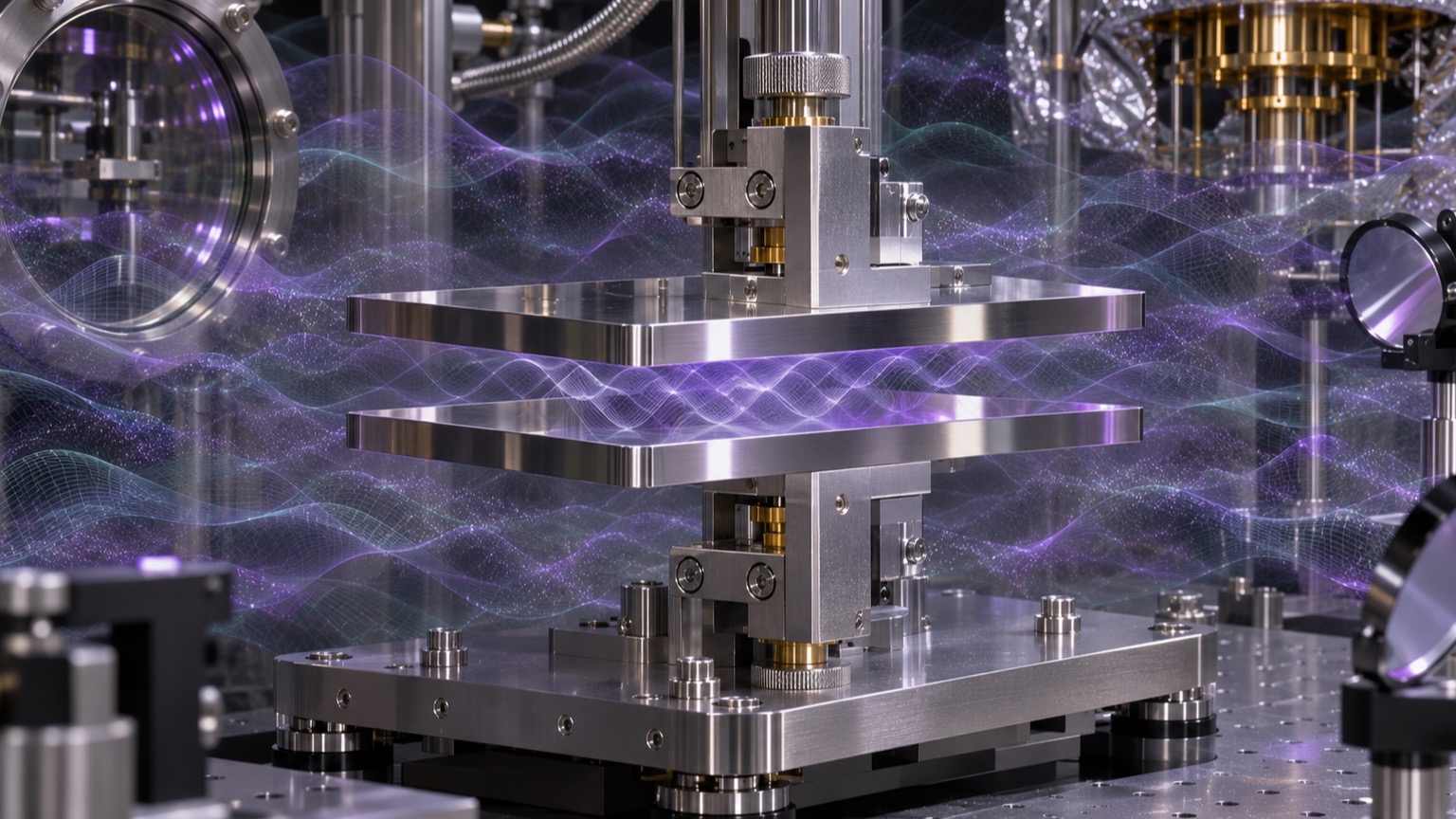
Vacuum effects can be observed. Boundaries change which electromagnetic modes are allowed, producing a Casimir force between closely spaced conducting surfaces. The Lamb shift modifies atomic energy levels through quantum electrodynamic effects. Spontaneous emission depends on the coupling between an excited atom and electromagnetic vacuum modes.
Particles Depend on How the Field Is Observed
In ordinary flat spacetime, a stable vacuum and particle definition can be chosen consistently for inertial observers. In accelerated frames or curved spacetime, the separation into particles and vacuum can become observer-dependent. The Unruh effect predicts that a uniformly accelerating detector perceives a thermal response where an inertial observer describes vacuum.
Black-hole Hawking radiation arises from quantum fields in curved spacetime, though the popular picture of pairs splitting at a horizon is only a heuristic. The deeper calculation compares field modes in a changing gravitational background. These effects show that fields are more fundamental and portable than a fixed particle inventory.
Cosmology provides an even larger arena. Expanding spacetime can amplify field fluctuations and influence which excitations later appear as particles. Quantum fluctuations generated during an inflationary era are a leading explanation for the primordial variations that eventually seeded galaxies, although the identity and detailed physics of the inflation-driving field remain unknown.
The observer dependence does not mean particles are arbitrary opinions. A detector’s motion and spacetime path determine how it couples to field modes, producing a calculable response. Different observers can disagree about particle content while agreeing on invariant physical predictions when each measurement setup is specified.
How Fields Produce Forces and Matter
Electromagnetic interactions arise from the photon field coupled to charged matter fields. The strong interaction comes from gluon fields coupled to color-charged quark fields. Weak interactions involve W and Z fields that can change particle flavor. These gauge fields carry integer spin and have bosonic excitations.
Matter fields for quarks and leptons are fermionic. Their excitations obey exclusion and build structured matter. Composite protons, atoms, and solids are bound or collective states of the underlying fields. A table or hand is not made from isolated little field lumps alone; it is a stable many-body state maintained by interactions and quantum statistics.
Classical fields emerge when quantum states contain many coherent quanta or when quantum fluctuations are negligible for the measurement. A radio wave can be treated as a smooth electromagnetic field even though its energy exchange is quantized. Quantum theory contains the successful classical description as an approximation.
Why Calculations Need Renormalization
Interactions allow fluctuations across a wide range of distances and energies. Straightforward perturbative calculations can produce divergent expressions. Renormalization reorganizes the theory so measured masses and couplings define finite predictions, while the effects of unresolved short-distance physics are absorbed into scale-dependent parameters.
This procedure is not arbitrary subtraction that hides failure. A renormalizable theory requires only a controlled set of measured inputs to predict infinitely many outcomes. The spectacular agreement between quantum electrodynamics and precision experiments demonstrates its power.
Effective field theory broadens the idea. A theory can remain predictive below a particular energy scale even if new physics is required above it. Higher-order interactions are suppressed by powers of the larger scale. The Standard Model itself may be an effective field theory awaiting a deeper completion.
Renormalization-group equations track this scale dependence systematically. They connect measurements made at one energy with predictions at another and can reveal whether couplings approach unification, weaken, or become strongly interacting. The flow of parameters is physical information, not a defect to be removed.
What Quantum Field Theory Does Not Yet Include Completely
The Standard Model is a quantum field theory of electromagnetic, weak, and strong interactions. Gravity is described classically by general relativity, and straightforward quantization does not yield the same kind of complete high-energy theory. Approaches to quantum gravity seek a broader framework.
Dark matter also signals missing field content unless gravity is modified instead. Neutrino masses require extensions to the minimal Standard Model. The cosmological constant problem exposes an enormous mismatch between naive quantum vacuum-energy estimates and the observed cosmic acceleration.
A Practical Mental Model
Imagine space not as a container holding a few roaming beads but as a place where many fields are always defined. A particle detection is a localized transfer of energy and quantum numbers from those fields to an apparatus. Between detections, the field state evolves and can spread, interfere, and become entangled.
This model explains why a particle can show wave behavior without being a classical object riding on a separate wave. The particle and wave descriptions refer to different aspects of one quantum field. It also explains why collisions can change the species and number of particles while conservation laws remain intact.
Quantum fields are called invisible because we do not see a field value directly with our eyes. Their consequences are not hidden: spectra, forces, scattering rates, particle decays, semiconductor behavior, lasers, and nuclear structure all display them. The invisible foundations of reality are known through an unusually precise web of observable effects.
How Experiments Reconstruct a Field Theory
Experiments never place a sensor against “the electron field” as if measuring air pressure. They prepare states, allow interactions, and record outcomes. Scattering experiments vary energy and angle to reveal which couplings and quantum numbers reproduce the observed distributions. Spectroscopy measures bound-state energies with extraordinary precision. Correlation experiments expose statistics and vacuum structure. A proposed field earns acceptance when one mathematical framework predicts all of these independent results.
The reconstruction remains provisional at higher energies. New resonances could require new fields, while tiny deviations could reveal interactions with fields too heavy to produce. Conversely, repeated agreement limits which extensions remain possible. Quantum field theory is therefore both a description of known particles and a disciplined search language: it tells researchers how an unseen addition would alter measurable amplitudes, decays, or vacuum behavior.