From Atoms to the Smallest Known Building Blocks
A subatomic particle is anything smaller than an atom, but that simple definition opens onto several very different layers of nature. Electrons appear elementary, while protons and neutrons are composite objects made from quarks and gluons. Photons carry light, neutrinos pass through ordinary matter with astonishing ease, and short-lived particles emerge in cosmic rays and accelerator collisions. This guide builds a clear map of that crowded world: what the main particle families are, which particles make familiar matter, how forces act between them, and how physicists can study objects too small to see directly.
A: No. Subatomic means smaller than an atom or contained within its structure.
A: No. Quarks and gluons make protons composite systems.
A: Quarks and leptons are treated as pointlike; no size ranking is established.
A: They detect its interactions and reconstruct its properties from signals.
A: The strong interaction confines them into color-neutral hadrons.
A: No. Strong-interaction energy produces most nucleon mass.
A: No. Oscillation measurements prove that neutrino mass differences exist.
A: Tiny amounts occur naturally and are routinely handled in controlled applications.
A: No. It remains a hypothetical quantum carrier of gravity.
A: Yes. Current searches test energies and rare processes for new evidence.
Why “Subatomic” Does Not Mean “Fundamental”
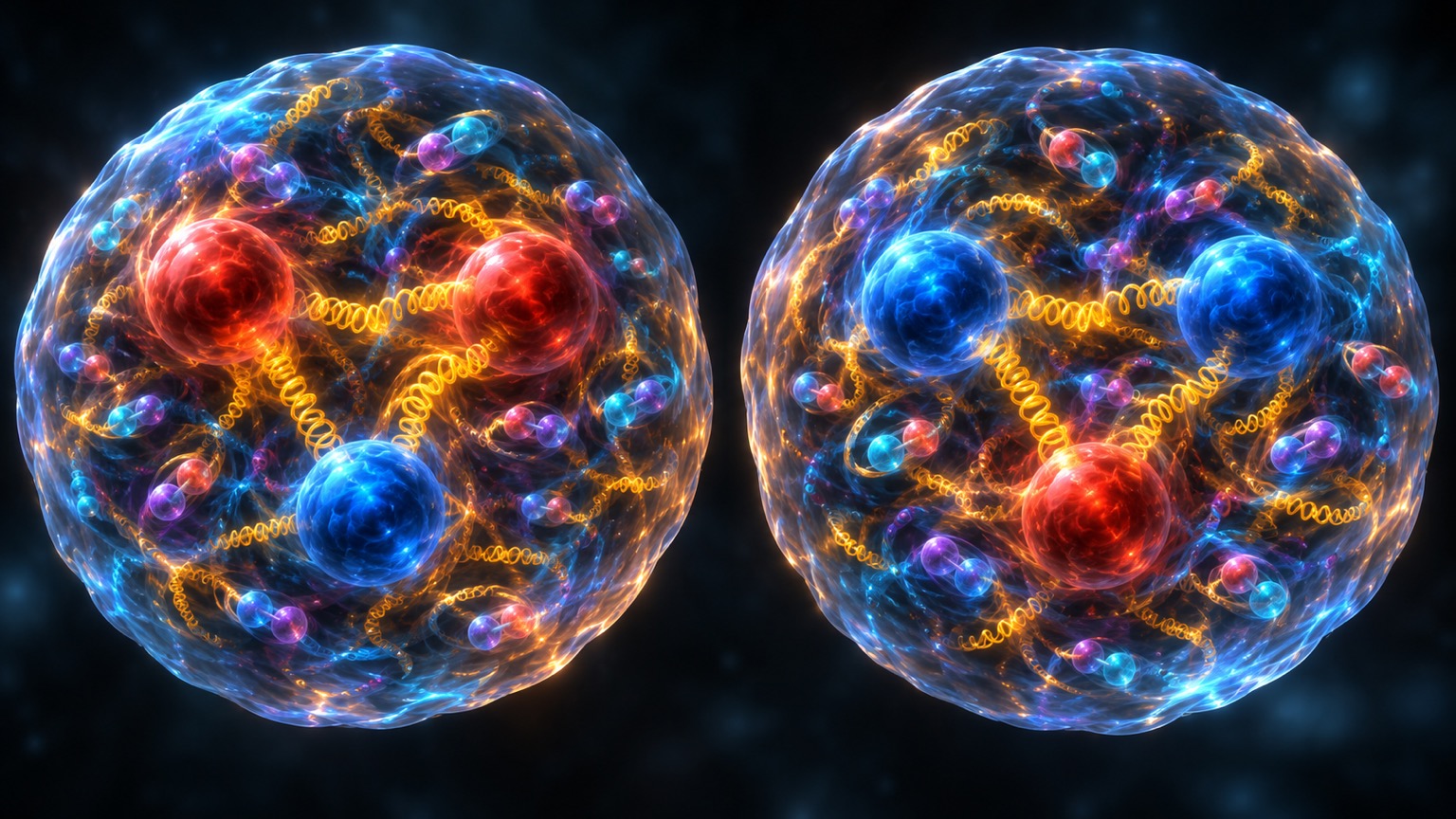
The word subatomic describes size in relation to an atom, not a particle’s internal simplicity. A proton is subatomic because it sits inside an atomic nucleus, yet experiments show that a proton contains quarks, gluons, and a shifting sea of short-lived quark-antiquark pairs. An electron is also subatomic, but no smaller constituents have been detected within it. Physicists therefore distinguish composite particles, which have internal structure, from elementary particles, which are treated as pointlike in the best-tested theory available.
This distinction matters because older “building blocks” often became systems in their own right. The atom was once imagined as indivisible. Scattering experiments revealed a compact nucleus, later resolved into protons and neutrons, and still higher-energy probes exposed quarks inside those nucleons. Calling a particle elementary is therefore a statement about present evidence. It means that experiments have found no internal parts down to the distances they can test, not that science has proved an absolute final layer.
The Familiar Atom Has Two Very Different Regions
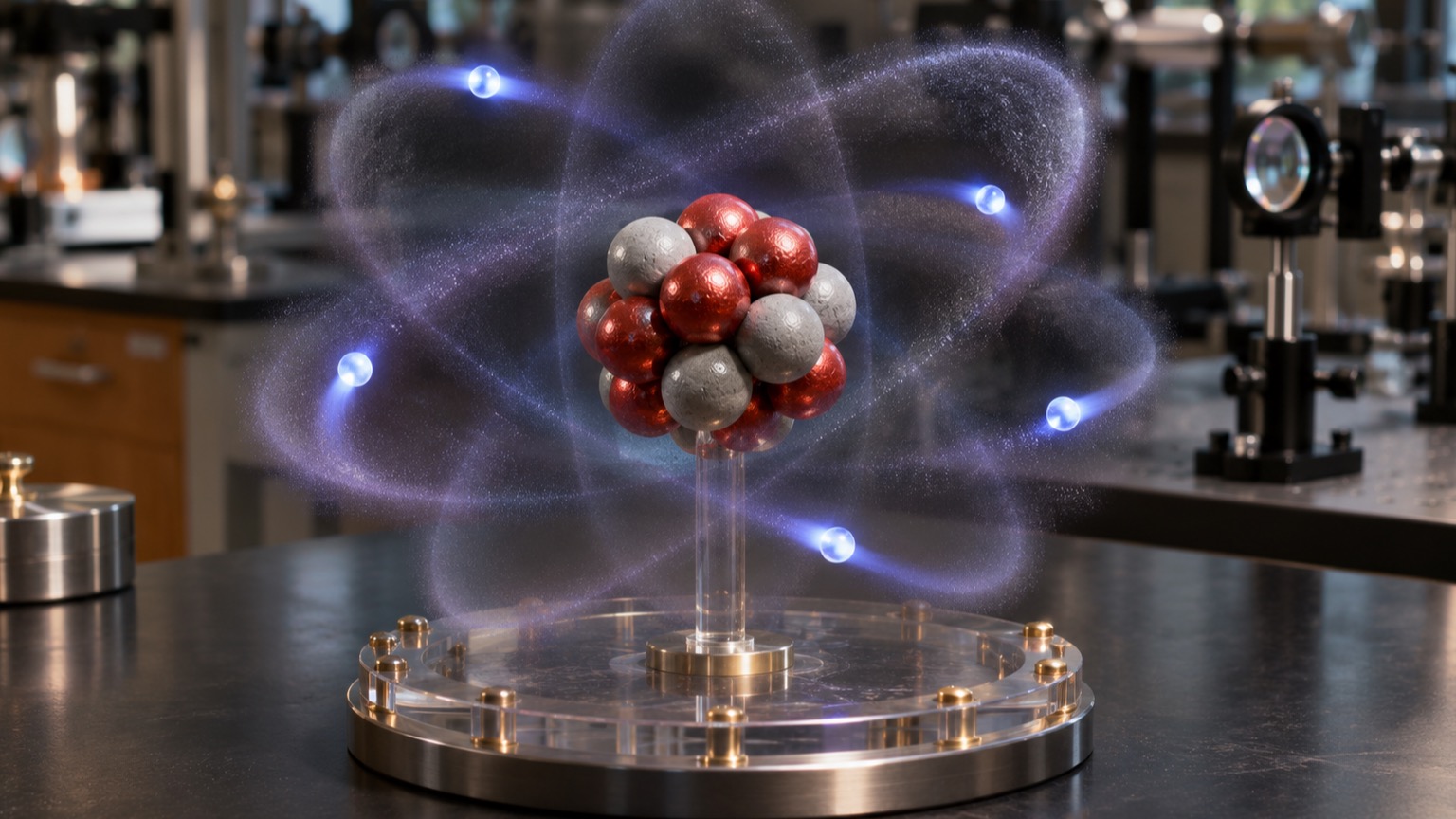
Nearly all of an atom’s mass is concentrated in its tiny nucleus. Protons give the nucleus positive electric charge, while neutrons add mass and help stabilize many nuclei through the nuclear interactions in which both kinds of nucleon participate. The number of protons defines the chemical element: every carbon atom has six protons, and every oxygen atom has eight. Changing the neutron count creates an isotope; changing the proton count creates a different element.
Electrons occupy quantum states around the nucleus rather than traveling on miniature planetary tracks. Their allowed energy levels and spatial probability patterns determine how atoms absorb light, form bonds, conduct electricity, and build molecules. An electron’s mass is small compared with a proton’s or neutron’s, but its electric charge and quantum behavior dominate chemistry. Ordinary objects feel solid largely because electron clouds repel and because identical electrons cannot all crowd into the same quantum state.
The scale difference is extreme. If an atom were enlarged to the size of a stadium, its nucleus would be closer to a small object near the center than to a large ball filling the field. The rest would not be empty in the classical sense; it would be the region described by the atom’s electron wavefunctions and electromagnetic fields. This picture replaces the misleading image of hard beads separated by literal nothingness.
Quarks and Leptons Form the Matter Families
The Standard Model organizes elementary matter particles into quarks and leptons. There are six quark flavors: up, down, charm, strange, top, and bottom. There are also six leptons: the electron, muon, and tau, each paired with its own neutrino. These particles come in three generations. Stable ordinary matter uses almost entirely the first generation—up and down quarks, electrons, and electron neutrinos—while heavier generations appear in energetic events and decay quickly.
Quarks have fractional electric charges, but they are not observed alone under ordinary conditions. The strong interaction confines them into color-neutral composite particles called hadrons. Three-quark hadrons are baryons, a group that includes protons and neutrons. Quark-antiquark pairs form mesons, many of which appear briefly in particle collisions or cosmic-ray showers. The top quark decays so rapidly that it does not form ordinary bound hadrons.
Leptons do not feel the strong interaction. The electron is stable and electrically charged. Muons and taus carry the same charge but are heavier and unstable. Neutrinos carry no electric charge and interact through the weak force and gravity, so enormous numbers can cross planets with little chance of a collision. Their ability to change type, called neutrino oscillation, shows that neutrinos have nonzero mass even though the simplest original form of the Standard Model treated them as massless.
Each quark and charged lepton also has an antiparticle, so the family structure extends beyond the matter usually drawn in a basic chart. The repeating generations are experimentally clear, but their origin is unknown. Physics can state the pattern and calculate its consequences without yet explaining why nature chose exactly this arrangement.
Bosons Describe How Interactions Happen
Matter particles do not simply sit in isolation. In quantum field theory, interactions are described through fields, and force-carrying particles are excitations of those fields. The photon belongs to the electromagnetic field. Gluons carry the strong interaction between quarks. The electrically charged W bosons and neutral Z boson mediate the weak interaction, which can change one particle type into another and enables processes such as beta decay.
The Higgs boson has a different role. It is the observable excitation of the Higgs field, whose nonzero value throughout space allows elementary particles to acquire mass through their individual couplings to it. The Higgs mechanism does not account for all the mass around us. Most of a proton’s or neutron’s mass comes from the energy of the strong interaction inside it, including gluon fields and the motion of confined quarks, rather than simply from adding the small masses of its quarks.
Gravity is the conspicuous outsider. The Standard Model successfully describes electromagnetic, weak, and strong interactions, but it does not provide a complete quantum description of gravity. A hypothetical quantum carrier called the graviton is often discussed, yet none has been detected and no experimentally confirmed theory places gravity inside the Standard Model.
Antimatter Mirrors the Particle Inventory
Every charged matter particle has an antiparticle with the same mass and opposite charges. The positron is the electron’s antiparticle; antiquarks carry charges opposite to their corresponding quarks. When a particle and antiparticle meet, they can annihilate into other particles if conservation laws permit. The reverse is also possible: sufficient concentrated energy can produce particle-antiparticle pairs.
Antimatter is not fictional or automatically exotic. Positrons are used in PET medical imaging, and antiparticles are routinely produced in high-energy experiments. The deeper mystery is cosmological. The observable universe contains far more matter than antimatter, while known differences in their behavior appear too small to explain the imbalance. Understanding that asymmetry is one reason physicists study rare decays with extraordinary precision.
Particles Are Quantum Excitations, Not Tiny Marbles
Pictures of colored spheres are useful for keeping categories straight, but they can smuggle in the wrong physics. A particle can arrive at a detector in a localized event while its state evolves with wave-like probabilities. Identical particles of the same type are fundamentally indistinguishable; nature does not attach serial numbers to electrons. Quantum properties such as spin are intrinsic and quantized, but spin is not a little surface rotating like a toy globe.
Modern particle physics goes further by treating each particle species as an excitation of an underlying quantum field. An electron is a quantum of the electron field, and a photon is a quantum of the electromagnetic field. Fields extend through space even where no particles are detected. Creating or destroying a particle means changing the excitation of the relevant fields while conserving energy, momentum, charge, and other required quantities.
This field picture also explains why particle number need not remain fixed. A high-energy collision can transform kinetic energy into new particles, and unstable particles can decay into lighter products. What persists are the conservation rules and the quantum state’s evolution, not a permanent collection of miniature objects.
Even the idea of a particle can depend on context. Inside an interacting system, the useful entities may be short-lived resonances or collective excitations rather than free, durable objects. Particle language remains powerful because detectors register discrete transfers of energy and momentum, but the underlying theory is a theory of fields and their quantum states.
How Experiments Detect Things That Cannot Be Seen
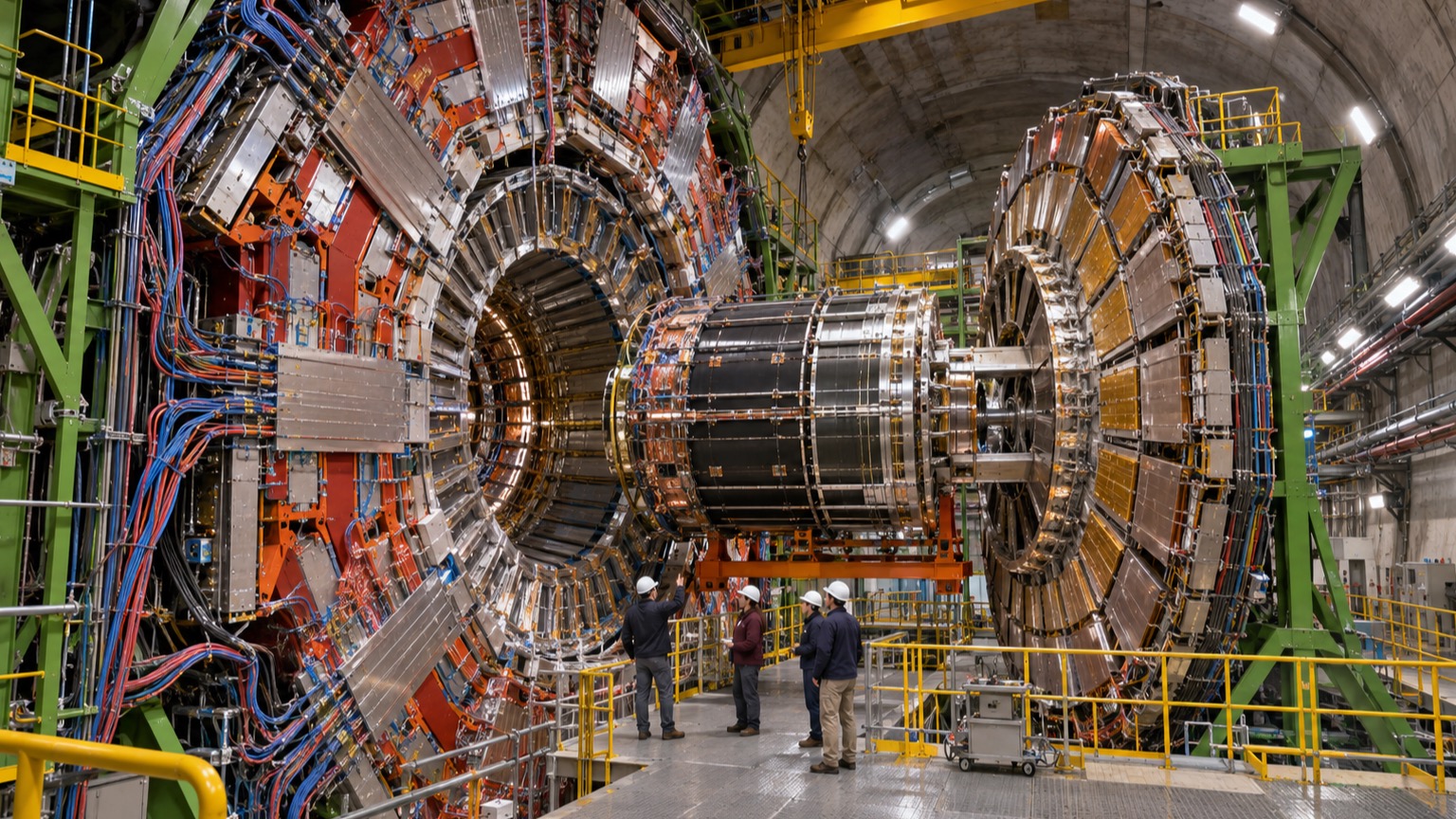
Physicists infer subatomic particles from interactions. A charged particle passing through detector material may ionize atoms and leave a trail of signals. Magnetic fields curve charged tracks, allowing researchers to infer momentum and the sign of electric charge. Calorimeters absorb particles and measure deposited energy. Other detector layers identify muons, photons, electrons, or hadronic sprays by the characteristic patterns they produce.
Neutral and weakly interacting particles often reveal themselves through what is missing. If the measured collision products do not balance the initial energy and momentum, an unseen particle may have carried some away. Neutrino experiments instead use enormous targets and wait for the rare occasion when a neutrino interacts. Confidence comes from repeated events, calibrated instruments, statistical analysis, and agreement among independent measurements—not from a camera snapshot of a tiny ball.
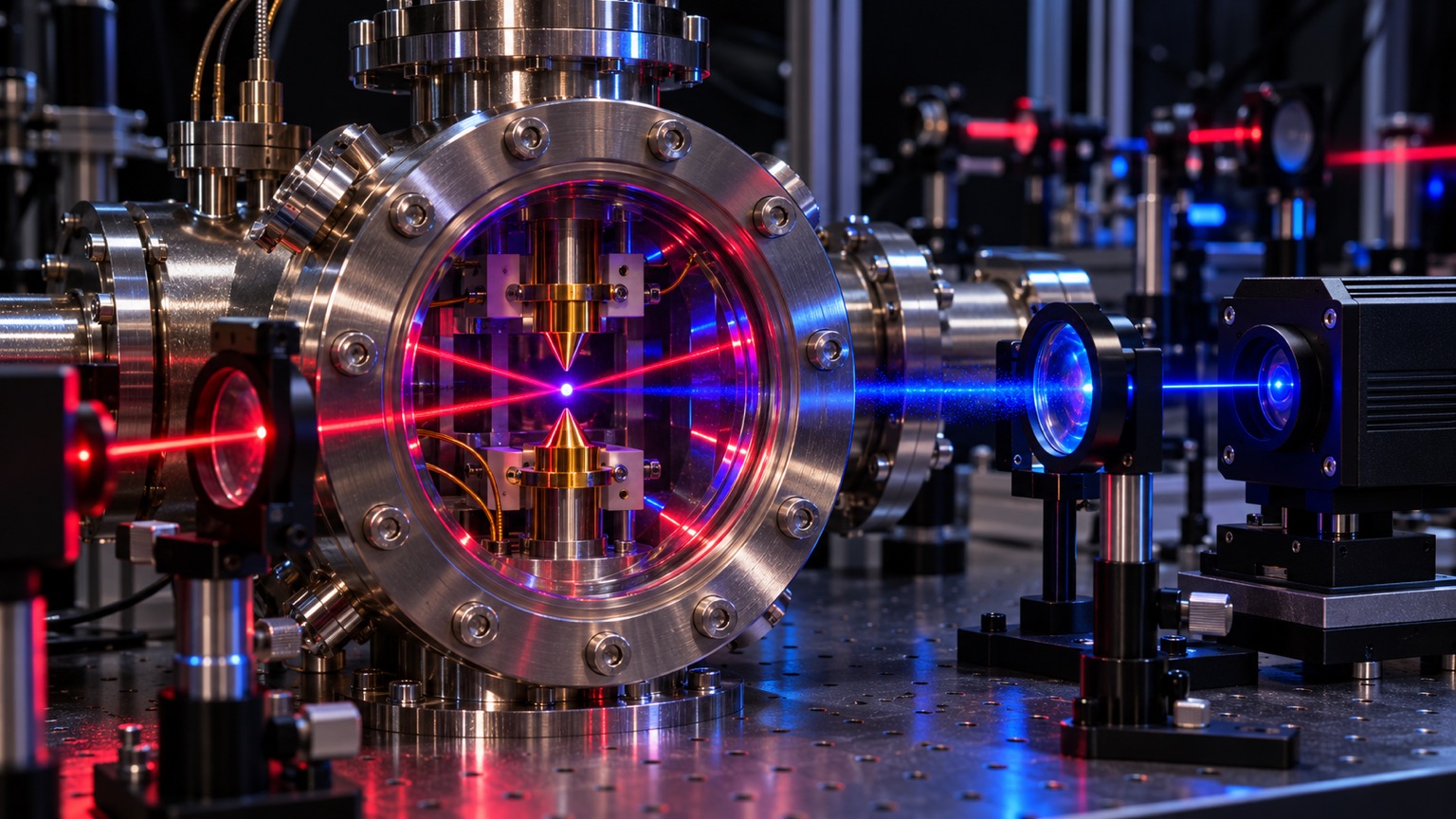
Accelerators are only one source. Cosmic rays continually strike Earth’s atmosphere and generate cascades of secondary particles. Radioactive nuclei expose weak-interaction processes. Precision tabletop experiments measure atomic spectra, magnetic moments, or tiny forces. Together these methods test the same framework across very different energies and distances.
Energy, Distance, and the Meaning of Particle Size
Exploring smaller distances requires probes with shorter wavelengths, which generally means higher momentum and higher energy. That is why modern particle accelerators are so large: their size is not meant to make a particle visibly bigger, but to control energetic beams and create collisions capable of resolving finer structure. The relationship resembles using shorter-wavelength light to reveal smaller details, although collider experiments reconstruct the result through quantum interactions rather than ordinary photography. Higher collision energy also opens the possibility of producing heavy particles that are absent from everyday matter, because concentrated energy can become mass.
A measured “radius” can mean different things for different objects. The proton has an extended distribution of electric charge and strong-interaction energy, so scattering experiments can characterize its scale. An electron has shown no comparable internal distribution and is modeled as pointlike, but that does not mean an experiment has established a literal mathematical point at every possible distance. It means no size or internal structure has appeared within present limits. Clear language here prevents two common errors: imagining that every particle is a tiny hard sphere, or claiming that physics has already reached an unquestionably final smallest length.
What the Standard Model Explains—and What It Leaves Open
The Standard Model predicts a remarkable range of results, from particle collision rates to the magnetic behavior of the electron. Its particle list and interaction rules have survived decades of demanding tests. Yet it is not a complete account of nature. It does not explain dark matter, the cosmic dominance of matter over antimatter, the pattern of particle masses, or why there are three generations. It accommodates neutrino mass only through extensions, and it leaves gravity outside its quantum framework.
Those gaps do not make the model a failure. They mark the boundary between a powerful tested description and unanswered questions. New experiments search for rare decays, subtle deviations, unknown particles, and clues from the cosmos. A beginner’s map of subatomic particles therefore ends with an invitation: the known inventory is precise enough to build modern technology, yet incomplete enough that the next layer of matter may still surprise us.
Learning the inventory is most useful when it is paired with this boundary. Electrons, quarks, neutrinos, and bosons are not speculative placeholders; they are parts of an exceptionally successful framework. The unanswered questions begin where that framework stops explaining observed nature, giving future discoveries a precise standard to exceed.