Three Particles, Three Different Jobs
Electrons, protons, and neutrons are often introduced as three tiny components of the atom, but they do not contribute in equal ways. Protons establish an element’s identity, neutrons reshape nuclear stability, and electrons control nearly every chemical interaction. Two of the three are themselves composite: quarks and gluons make protons and neutrons, while the electron is elementary according to current evidence. Their masses, charges, locations, and quantum rules work together to produce the periodic table, isotopes, electricity, materials, and the stable matter of everyday life.
A: The number of protons sets the atomic number and element.
A: They have the same proton count but different neutron counts.
A: No. Orbitals are quantum states without definite classical paths.
A: Electromagnetic repulsion and fermion exclusion resist overlap and compression.
A: Yes, but a free neutron decays with a lifetime of minutes.
A: No. Both are quark-and-gluon composite particles.
A: Neutrons strengthen binding without adding electric repulsion.
A: Ordinary chemistry rearranges electrons and leaves proton counts unchanged.
A: Spatially extended electron quantum states surround the tiny nucleus.
A: Their internal charges give them magnetic structure despite zero net charge.
A Modern Picture of the Atom
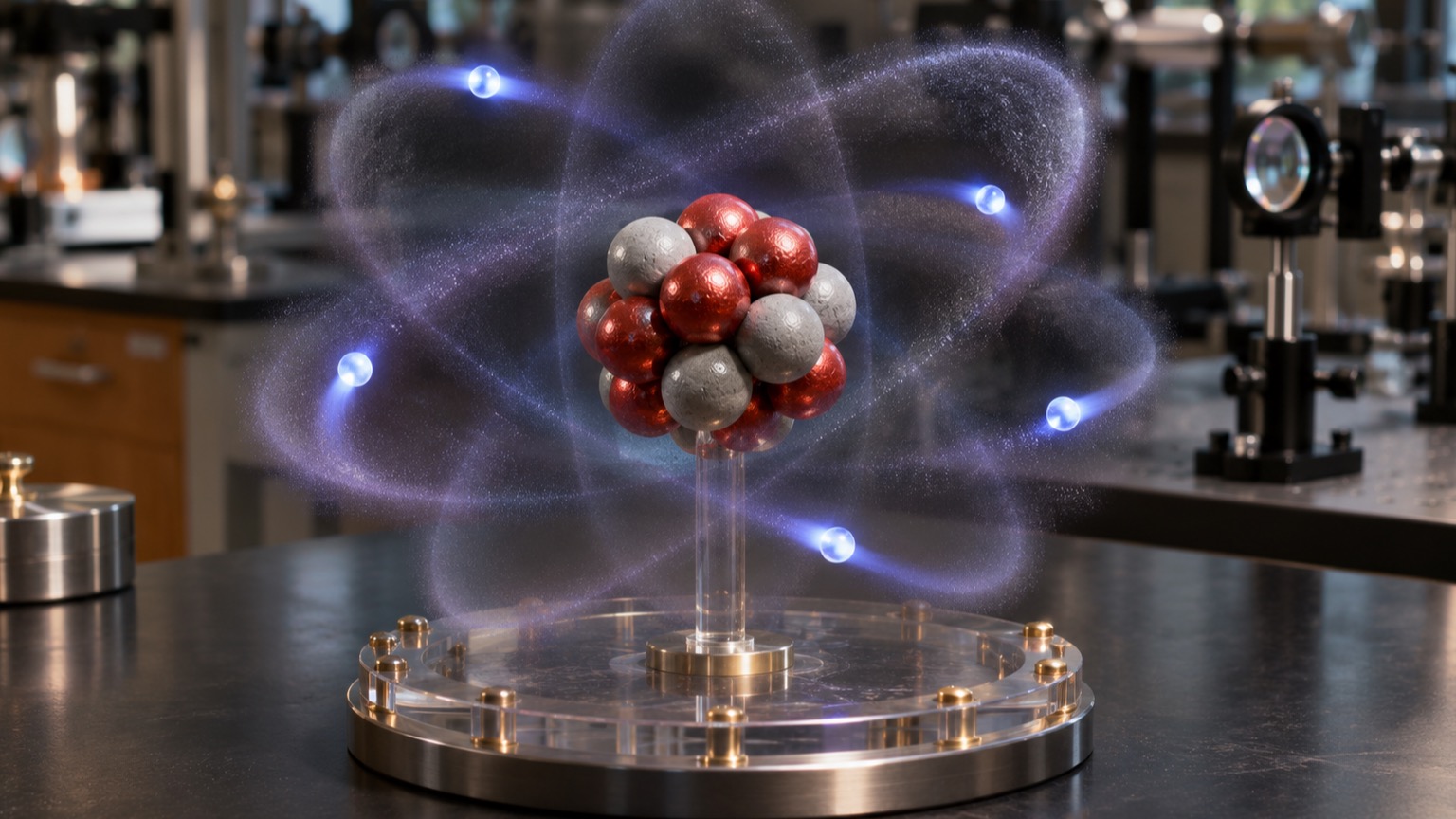
An atom consists of a compact nucleus surrounded by electrons in quantum states. The nucleus contains protons and, except in ordinary hydrogen, neutrons. Nearly all atomic mass is concentrated there, even though the nucleus occupies only a minute fraction of the atom’s volume. Electrons spread through a much larger region described by wavefunctions, which give probabilities for where an interaction may occur.
This is not a miniature solar system. An electron in an atomic orbital does not have a hidden classical path winding around the nucleus. Its state has a particular energy, angular momentum, and spatial pattern. When an atom absorbs or emits the right amount of energy, an electron can transition between allowed states. Those discrete transitions produce characteristic spectral lines and give each element a recognizable optical fingerprint.
Protons Set the Element’s Identity
Every proton carries one positive elementary charge. The atomic number—the organizing number of the periodic table—is simply the number of protons in the nucleus. Hydrogen has one, helium has two, carbon has six, and gold has seventy-nine. If a nuclear reaction changes that count, the atom has undergone transmutation and become another element.
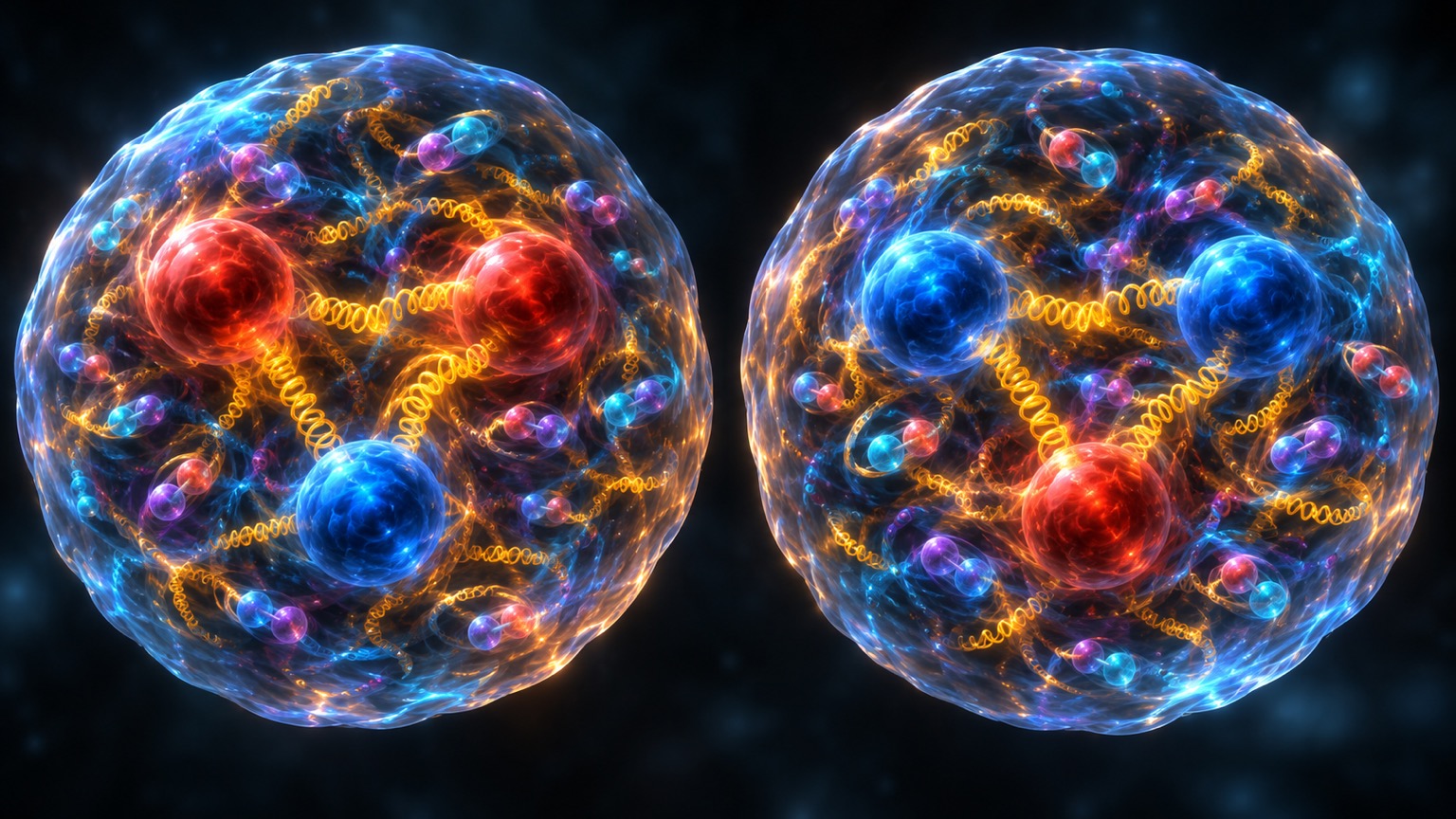
A proton is not elementary. Its enduring valence structure contains two up quarks and one down quark, held in a dynamic strong-interaction system by gluons. The quark charges sum to positive one. Most of the proton’s mass arises from the energy of that confined system rather than from the intrinsic masses of its quarks. The proton is stable as far as experiments have established; searches for proton decay have set extremely long lower limits on its lifetime.
In a neutral atom, the number of electrons equals the number of protons, so positive and negative charges cancel. An imbalance creates an ion. Losing electrons makes a positive ion; gaining them makes a negative ion. Chemical processes usually move or share electrons and leave the nucleus unchanged, which is why ordinary reactions do not turn one element into another.
Proton number also controls the strength of the nuclear electric attraction experienced by electrons. Across a row of the periodic table, increasing nuclear charge pulls electron states inward while electron shielding and shell structure modify the trend. Atomic size and ionization energy therefore emerge from the proton count filtered through a many-electron quantum system.
Neutrons Stabilize—and Sometimes Destabilize—Nuclei
A neutron has no net electric charge, but neutral does not mean structureless. Its valence content is one up quark and two down quarks, again surrounded by gluons and sea quarks. The neutron is slightly more massive than the proton. A free neutron decays through the weak interaction into a proton, an electron, and an electron antineutrino, with a mean lifetime of roughly fifteen minutes.
Inside a nucleus, the energy balance changes. Some neutrons become stable because a decay would not leave the nucleus in an allowed lower-energy state. Nuclear stability depends on the competition among the residual strong interaction, proton-proton electric repulsion, quantum shell structure, and the neutron-to-proton ratio. Light stable nuclei often contain similar numbers of protons and neutrons. Heavier nuclei generally need extra neutrons to help bind the system without adding more electric repulsion.
Atoms with the same proton count but different neutron counts are isotopes. Carbon-12 and carbon-14 are both carbon because each has six protons, but carbon-14 has two additional neutrons and is radioactive. Isotopes can behave almost identically in chemistry while differing greatly in nuclear stability. That combination makes them useful as tracers, medical sources, industrial gauges, and chronological tools.
Too many or too few neutrons can move a nucleus outside the valley of stability. It may then approach a more stable balance through beta decay, particle emission, or a sequence of transformations. Nuclear charts reveal this landscape more clearly than a simple list of elements because each square records a distinct proton-neutron combination.
Neutrons can also moderate the pace of a chain reaction because they enter nuclei without first overcoming electric repulsion. Their energies and capture probabilities determine how reactor materials and shielding behave. The same neutrality that complicates neutron detection makes neutrons unusually effective nuclear probes.
Electrons Build Chemistry
The electron carries one negative elementary charge and has no detected internal components. Its mass is about one eighteen-hundredth of a proton’s, so exchanging electrons barely changes an atom’s mass. Yet electrons determine how atoms bond because the outermost occupied states are the part of one atom that encounters another.
Quantum mechanics limits how electrons fill available states. The Pauli exclusion principle prevents two identical electrons in an atom from sharing the same complete set of quantum numbers. Electrons therefore build layered configurations rather than collapsing together into the lowest state. Recurring outer-electron arrangements create the periodic table’s repeating chemical patterns.
Covalent bonds arise when atoms share electron density. Ionic bonding involves attraction between oppositely charged ions after electron transfer. Metallic bonding allows some electrons to spread through a solid, supporting electrical and thermal conduction. These classroom categories are useful limits of a continuous quantum description; real bonds often combine features rather than fitting into a perfectly isolated box.
Charge Explains Attraction but Not the Whole Atom
Electromagnetism attracts negatively charged electrons to the positive nucleus. Classical reasoning alone would predict an accelerating orbiting charge should radiate energy and spiral inward. Atomic stability instead comes from quantum mechanics. The electron occupies stationary energy states, and the lowest allowed state cannot continuously shed arbitrary amounts of energy.
The nucleus faces a different challenge. Positively charged protons repel one another electromagnetically, but the nuclear interaction between nearby nucleons can bind them. That effective attraction arises from the underlying strong interaction among quarks and gluons. It is short-ranged, so adding more protons eventually increases electrical repulsion faster than nuclear binding can compensate. This helps explain why very heavy nuclei tend to be unstable.
Binding changes the mass of the completed atom. A bound nucleus weighs less than its separated protons and neutrons by an amount corresponding to the released binding energy. The missing mass has not vanished; it left the system as radiation or kinetic energy when the nucleus formed. Precise atomic masses therefore record nuclear energy differences.
Electron binding changes total mass too, though by a much smaller amount. Modern mass measurements can resolve both nuclear and electronic contributions, letting researchers test decay energies before a rare process is ever observed directly.
Spin and Statistics Shape Matter’s Structure
Electrons, protons, and neutrons all have half-integer spin and are fermions. Spin is intrinsic quantum angular momentum, not the classical rotation of a tiny sphere. Fermionic statistics require the total quantum state to change sign when identical fermions are exchanged. The practical consequence is exclusion: identical fermions cannot occupy precisely the same quantum state.
For electrons, exclusion creates atomic shells, supports chemical variety, and contributes to matter’s resistance to compression. For protons and neutrons, it helps organize nuclear shells and influences which nuclei are especially stable. In dense stars, degeneracy pressure associated with fermions can resist gravitational collapse. The same abstract exchange rule therefore connects atomic size, nuclear structure, and astrophysical objects.
How the Three Particles Respond to Forces
All three respond to gravity, although gravity is negligible compared with other forces at atomic scales. Electrons and protons respond to electromagnetism because they carry opposite electric charges; neutrons can still interact electromagnetically through their internal charged quarks and magnetic moment despite having zero net charge. Protons and neutrons participate in the residual strong interaction that binds nuclei. Electrons do not.
Each can participate in weak processes. Beta decay can convert a neutron into a proton or, in suitable nuclear conditions, a proton into a neutron through related reactions. Electrons can be emitted or captured, and neutrinos carry energy, momentum, and lepton information away. Weak interactions are essential to radioactive decay, stellar fusion chains, and the production of elements.
The particles also possess magnetic moments. Electron spin makes atoms responsive to magnetic fields, while proton and neutron moments reveal internal and nuclear structure. Magnetic resonance methods manipulate these moments and read their collective response, connecting fundamental particle properties with chemical analysis and medical imaging.
How We Know Their Properties
Different experiments isolate different evidence. Cathode-ray studies and oil-drop measurements established the electron’s charge-to-mass behavior and elementary charge. Scattering revealed the small atomic nucleus and later the proton’s internal structure. Mass spectrometry separates ions by mass-to-charge ratio, exposing isotopes. Spectroscopy maps electron energy levels from absorbed and emitted light.
Neutrons reveal themselves through nuclear recoil, capture reactions, and the secondary radiation those processes produce because neutral particles do not directly ionize matter along a track as charged particles do. Modern facilities use beams, traps, precision clocks, magnetic measurements, and layered detectors to test the particles’ properties. The resulting numbers agree across methods that operate on very different physical principles.
Precision also exposes tiny differences that a simple atom model hides. Isotope shifts reveal how nuclear mass and charge distribution affect electron transitions. Scattering at different energies distinguishes an extended proton or neutron from a pointlike electron. Measurement does not merely confirm that the three particles exist; it maps how their layers of structure influence one another.
Antiparticle comparisons sharpen the tests further. Positrons match electron mass with opposite charge, while antiprotons mirror proton properties within demanding limits. Any unexplained mismatch could signal a failure of fundamental symmetries, so laboratories compare matter and antimatter with increasingly refined traps and spectroscopy.
What Changes in Chemistry and What Changes in Nuclear Physics
A chemical reaction rearranges electrons while preserving each nucleus. Burning, dissolving, rusting, and biological metabolism all change electron sharing and molecular structure, but the proton counts remain fixed. The energy per event is typically far smaller than in a nuclear transformation because chemical energies reflect electron configurations.
Nuclear reactions rearrange protons and neutrons or convert one into the other. Fission splits heavy nuclei, fusion combines light nuclei, and radioactive decay changes an unstable nuclear state. Because nuclear binding energies are much larger per particle, these processes release vastly more energy than ordinary chemical reactions. Mass differences between initial and final systems account for the released energy.
The division is useful but connected. Nuclear charge determines how many electrons a neutral atom holds, nuclear mass shifts spectral lines slightly, and electron density can affect certain rare nuclear decay rates. Matter is layered rather than compartmentalized: nuclear structure sets the stage on which electron physics creates the visible world.
Why This Three-Particle Model Still Matters
Particle physics contains many more species, yet electrons, protons, and neutrons remain the practical foundation for describing ordinary matter. Their different responsibilities prevent a common beginner mistake: treating them as interchangeable balls distinguished only by charge. Protons label the element, neutrons tune the isotope and nuclear stability, and electrons create the atom’s chemical personality.
The model is also a gateway rather than an endpoint. Looking inside nucleons leads to quarks, gluons, and emergent mass. Looking more carefully at electrons leads to quantum fields and precision tests. Studying unstable nuclei leads to neutrinos and the weak interaction. Three familiar particles thus connect the periodic table to the deeper architecture of the Standard Model.