A Physical Quantity Defined at Every Point
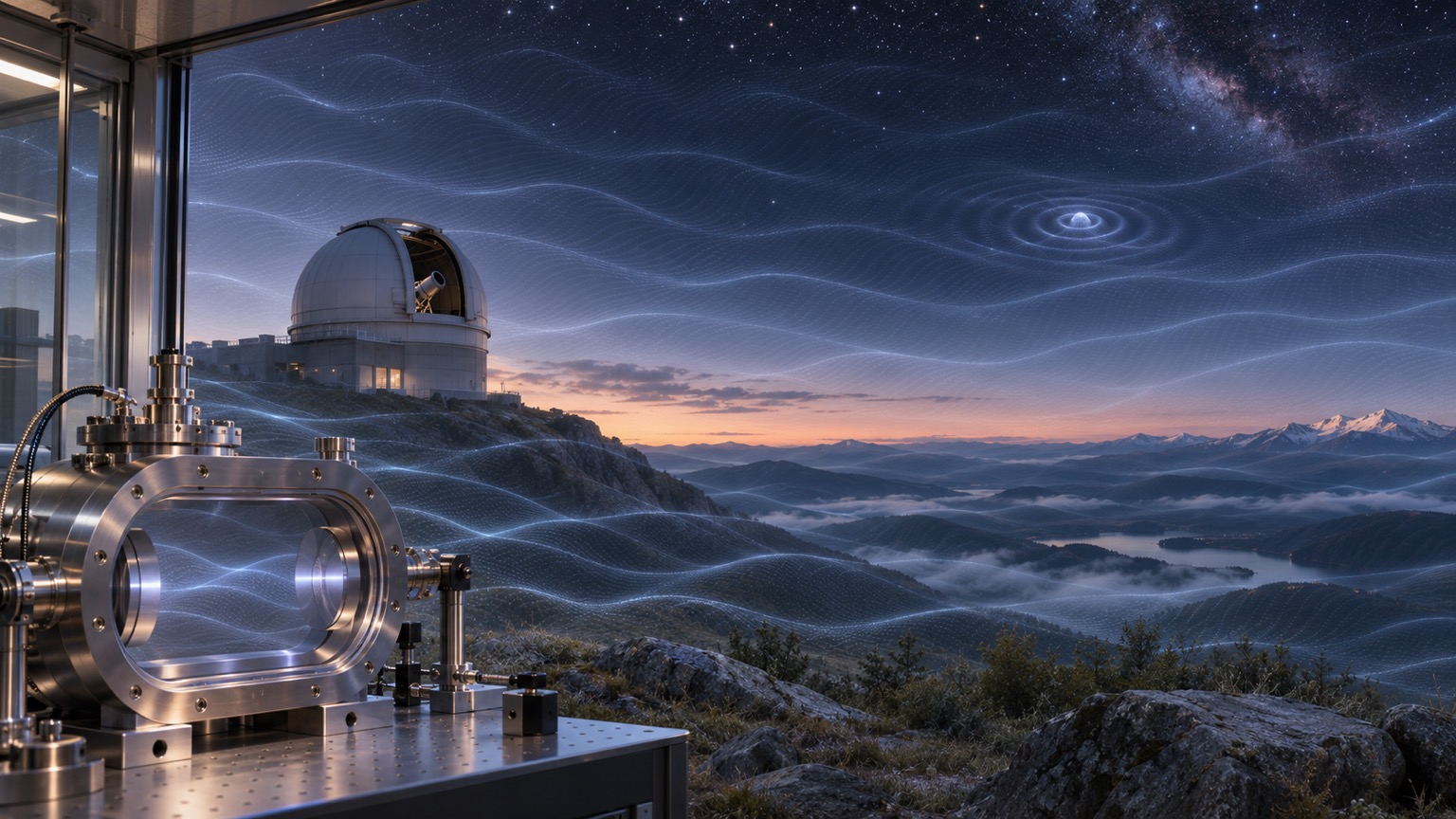
A quantum field is a physical entity whose state extends across space and time, even where no particle is detected. Different fields have different values, symmetries, and interactions: the electron field, electromagnetic field, quark fields, and Higgs field are examples. A particle is a discrete excitation of one of these fields, much as a localized wave packet is an excitation without being separate from the medium—but fundamental fields require no material medium underneath them. Saying a field “fills space” means it is defined everywhere and its vacuum state persists everywhere, not that the universe is packed with an invisible fluid.
A: It is defined through volume rather than displacing other fields.
A: Yes. Many distinct fields coexist and may interact there.
A: A localized excitation is a useful picture, though quantum states can be spread out.
A: The fields remain in their joint vacuum state.
A: Eyes detect electromagnetic excitations, while experiments infer broader field effects.
A: No. Its scalar vacuum respects Lorentz symmetry.
A: Fundamental fields have no known spatial edge.
A: No. The ground state cannot be cyclically mined for unlimited energy.
A: Heavy W and Z excitations produce rapidly decreasing amplitudes.
A: A consistent set of predicted excitations, interactions, and correlations must be observed.
“Everywhere” Means Defined, Not Densely Stuffed
A weather map assigns temperature to every location even if the temperature is the same across a quiet region. A quantum field similarly has a state throughout space. The analogy helps with spatial definition, but a fundamental field is not made from molecules and is not merely a summary of hidden objects.
In an ideal vacuum, the field does not disappear. It occupies its lowest-energy state. Some fields, such as the Higgs field, have a nonzero average vacuum value. Others have zero average while retaining quantum correlations and uncertainty. Zero average does not mean the mathematical and physical field is absent.
Multiple fields coexist at the same location without excluding one another. The electromagnetic field, electron field, neutrino fields, quark fields, and Higgs field can all be defined in the same room. They are distinguished by their transformation properties and couplings rather than by occupying separate layers of volume.
Field Values Can Have Different Kinds of Structure
A scalar field assigns one number to a point. A vector field includes a direction and magnitude. Fermion fields use spinor quantities that transform differently under rotations and relativity. Gauge fields contain additional internal structure tied to interaction symmetries.
These mathematical types determine physical behavior. A scalar background can be uniform without pointing in a preferred direction. A vector field can exert direction-dependent effects. Spinor fields generate half-integer-spin excitations and fermionic statistics. The field’s structure is not decorative notation; it determines what particles and interactions can exist.
How a Spread-Out Field Produces a Local Particle
A particle state can be built as a wave packet from many field modes. The packet may spread or interfere as the field evolves. When it interacts with a detector, energy and charge are transferred in a localized event. Repeating the experiment builds a distribution of detection positions predicted by the state.
This reconciles wave and particle language. The extended quantum state has wave-like amplitudes, while the exchange of energy occurs in discrete quanta. No tiny classical bead must secretly choose a path while riding a separate wave.
Localization has limits. A state squeezed into a very small region requires a wide range of momenta. At sufficiently high energy, the attempt to localize one particle can create additional particle-antiparticle excitations. Relativistic field theory replaces the idea of a permanently fixed particle count.
A field excitation also need not be stable. Couplings allow it to transform into excitations of other fields. A muon decays; an excited atom emits a photon; a Higgs boson produces lighter particles. The field network carries the process continuously even though detectors identify distinct incoming and outgoing quanta.
Modes Show How the Field Occupies Space
Boundary conditions and geometry determine the field’s possible modes. A cavity admits standing electromagnetic patterns at particular frequencies. A guitar string is a limited classical analogy: its vibration can be decomposed into harmonics, but a quantum field’s modes extend through three-dimensional space and do not require a string substance.
Quantization assigns discrete excitation numbers to each mode. A cavity mode may contain no photons, one photon, or many. Changing the cavity walls changes the allowed spatial patterns and frequencies. This is why resonators can control spontaneous emission and why boundary conditions affect vacuum energy differences.
Free space has a continuous range of plane-wave modes, but localized packets are built by combining them. The choice of mode basis can vary; the underlying field state does not depend on one preferred decomposition. Different mathematical views must yield the same detector predictions.
The Vacuum Still Has Physical Consequences
The vacuum is not an unlimited energy source. A ground-state detector does not harvest free particles from emptiness under ordinary inertial conditions. Yet vacuum correlations influence what interacting systems can do.
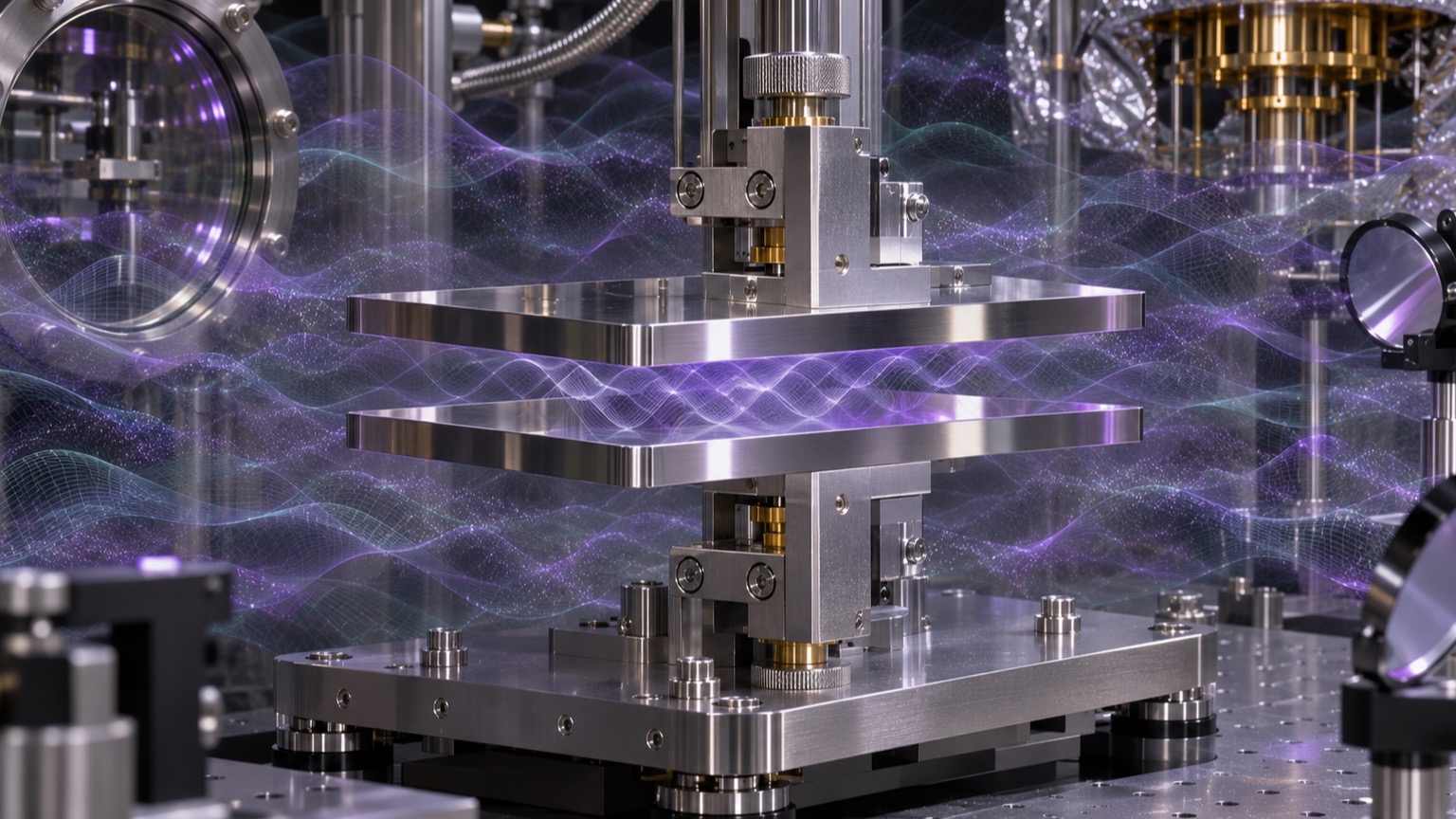
The Lamb shift changes atomic energy levels from the values predicted by a simpler equation. The Casimir effect produces a force between carefully arranged surfaces because boundaries alter field modes. Spontaneous emission occurs when an excited atom couples to available electromagnetic field states.
Descriptions of virtual particles constantly appearing and disappearing can obscure this. Virtual particles are elements of certain calculation expansions, not necessarily brief detectable occupants. Vacuum fluctuations are more accurately described through field uncertainties and correlations.
Vacuum state also depends on context. Boundaries, acceleration, curved spacetime, and time-dependent backgrounds can change which modes a detector treats as particles. What remains reliable is the field description plus a specified measurement procedure, not one universal picture of little objects inhabiting emptiness.
Fields Carry Energy, Momentum, and Charges
A changing electromagnetic field transports energy in light and radio waves. Gluon fields store energy inside protons. A field configuration can carry momentum and angular momentum. These quantities are calculated from the field, not attached only to particle points.
Charges determine couplings. The electron field carries electric charge and responds to the electromagnetic field. Quark fields carry color charge and couple to gluons. Neutrino fields lack electric and color charge but participate in weak interactions. Field properties decide which influences are possible.
Why Fields Do Not Create an Absolute Rest Frame
An old ether was imagined as a material medium through which light moved, defining absolute rest. Relativity rejected that structure. Fundamental quantum fields transform according to Lorentz symmetry, so inertial observers agree on physical laws even if they divide energy and momentum differently.
A uniform scalar vacuum value, such as the Higgs background, does not point in space or identify a preferred velocity. Particles do not experience drag through it. Vector or tensor backgrounds could break Lorentz symmetry, and experiments place stringent limits on such effects.
Accelerated observers complicate the particle concept without breaking the field. The Unruh effect predicts a thermal detector response for uniform acceleration through the inertial vacuum. This reveals that “how many particles?” can depend on motion, while the quantum field and measurement predictions remain consistent.
How Far Does a Field Extend?
A fundamental field is defined without a sharp outer edge. The influence of a localized source, however, can decrease with distance. A charged particle creates an electromagnetic field whose static strength falls away; the existence of the electromagnetic field itself does not end where the influence becomes tiny.
Mass affects propagation. Massless fields can support long-range influences, while massive field disturbances decay more rapidly in static situations. The W and Z fields mediate short-range weak interactions because their quanta are heavy. QCD is different again: massless gluons are confined by their self-interacting color field, so free long-range color fields do not appear.
How Scientists Measure Something Invisible
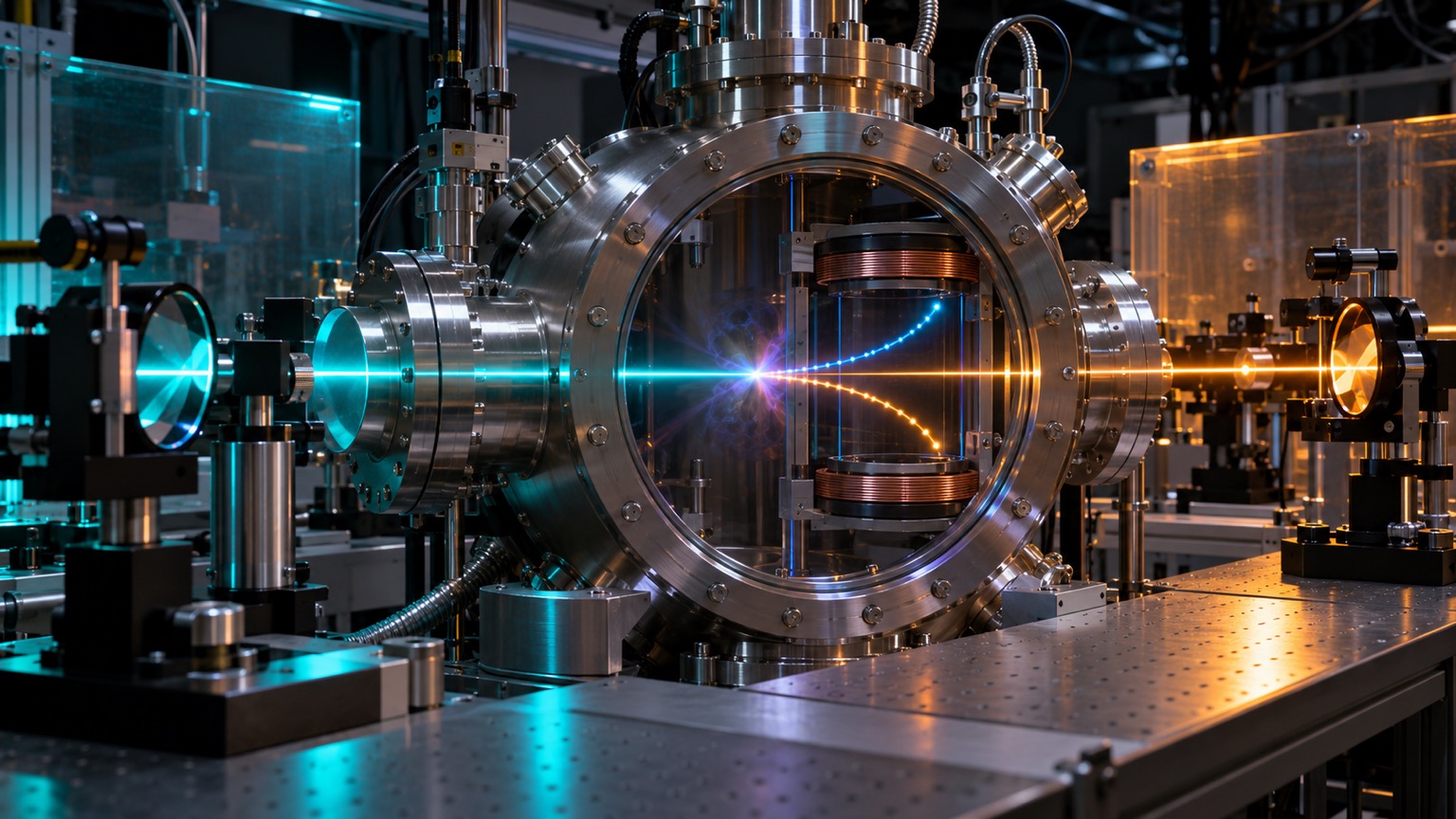
Scientists measure field effects, excitations, and correlations. Antennas respond to electromagnetic waves. Spectrometers read atomic transitions. Colliders measure scattering rates that depend on couplings. Precision plates can detect vacuum-related forces. None of these devices needs to display a field as a visible substance.
A proposed field must explain a connected set of observations and predict new ones. The Higgs field gained compelling support when a scalar excitation with appropriate couplings was discovered. Gravitational fields are mapped through motion, clock rates, light deflection, and waves in spacetime.
Invisible does not mean unconstrained. Field theories often predict numerical results far more precise than direct pictures could provide. Visibility is a feature of human eyes; measurability is the scientific standard.
A Field-Filled Space Is Not Crowded
Many fields can share the same empty region in their vacuum states without filling it with ordinary matter. “Filled” refers to definition and state, not a volume fraction. Excitations add energy and detectable particles, but the underlying fields require no open gaps between them.
This mental shift is the heart of the subject. Space is not a stage on which particles alone perform. Quantum fields define the possible performers, their properties, and their interactions. Particles are what those fields look like when energy is organized into countable excitations and exchanged with detectors.
Field Changes Must Propagate Causally
If a source changes, the influence does not update the entire universe instantly. Disturbances propagate according to the field equations and the causal structure of spacetime. Electromagnetic changes travel at light speed in vacuum. Massive disturbances travel more slowly, though the underlying relativistic theory still prevents controllable signals from outrunning light.
Quantum entanglement does not overturn this. Measurements on entangled field excitations can have correlations that no local classical model reproduces, but one observer cannot choose an outcome to transmit a readable message instantaneously. Relativistic QFT enforces compatible measurements at spacelike separation through locality conditions.
This causal behavior is another reason a field is more than a static map. It has dynamics: local changes influence neighboring regions, waves transport energy, and interactions create correlated states. “Filling space” includes rules for how the state evolves through space and time.
When Classical Fields Become Good Approximations
A radio transmitter produces an electromagnetic state containing an enormous number of photons arranged coherently. Tracking every photon is unnecessary; Maxwell’s classical field equations predict the signal accurately. A laser likewise has a well-defined phase and large occupation in selected modes, allowing wave optics to work.
Quantum behavior becomes essential when individual quanta, entanglement, squeezing, vacuum noise, or particle creation matters. The classical field is not a rival substance. It is the large-scale limit of certain quantum field states, just as smooth pressure is a useful limit of many molecular collisions.
Does a Field Exist Where It Cannot Interact?
Existence in physics is tied to a theory’s measurable consequences, not to visual texture. A field with exactly no coupling to anything could not be distinguished experimentally from no field at all. Known fields reveal themselves because they carry energy, respond to sources, alter propagation, or couple to detectors.
Some proposed dark-sector fields may interact so weakly that ordinary instruments rarely notice them. Scientists search for tiny energy deposits, missing momentum, altered cosmic structure, or new long-range effects. A null result limits the possible coupling and mass rather than proving that every conceivable field is absent.
Thus “fills space” is always part of a larger claim specifying dynamics and interaction. The electron field fills space and couples electromagnetically; the Higgs field fills space with a nonzero vacuum value; a hypothetical dark field would need its own testable signature. The phrase gains physical meaning from the rules attached to the field. Those rules must also remain consistent when observers move, when spacetime curves, and when the field interacts at different energies. A name without such predictive structure is not yet a physical theory, regardless of how intuitive its visual metaphor may sound to a curious beginner initially.