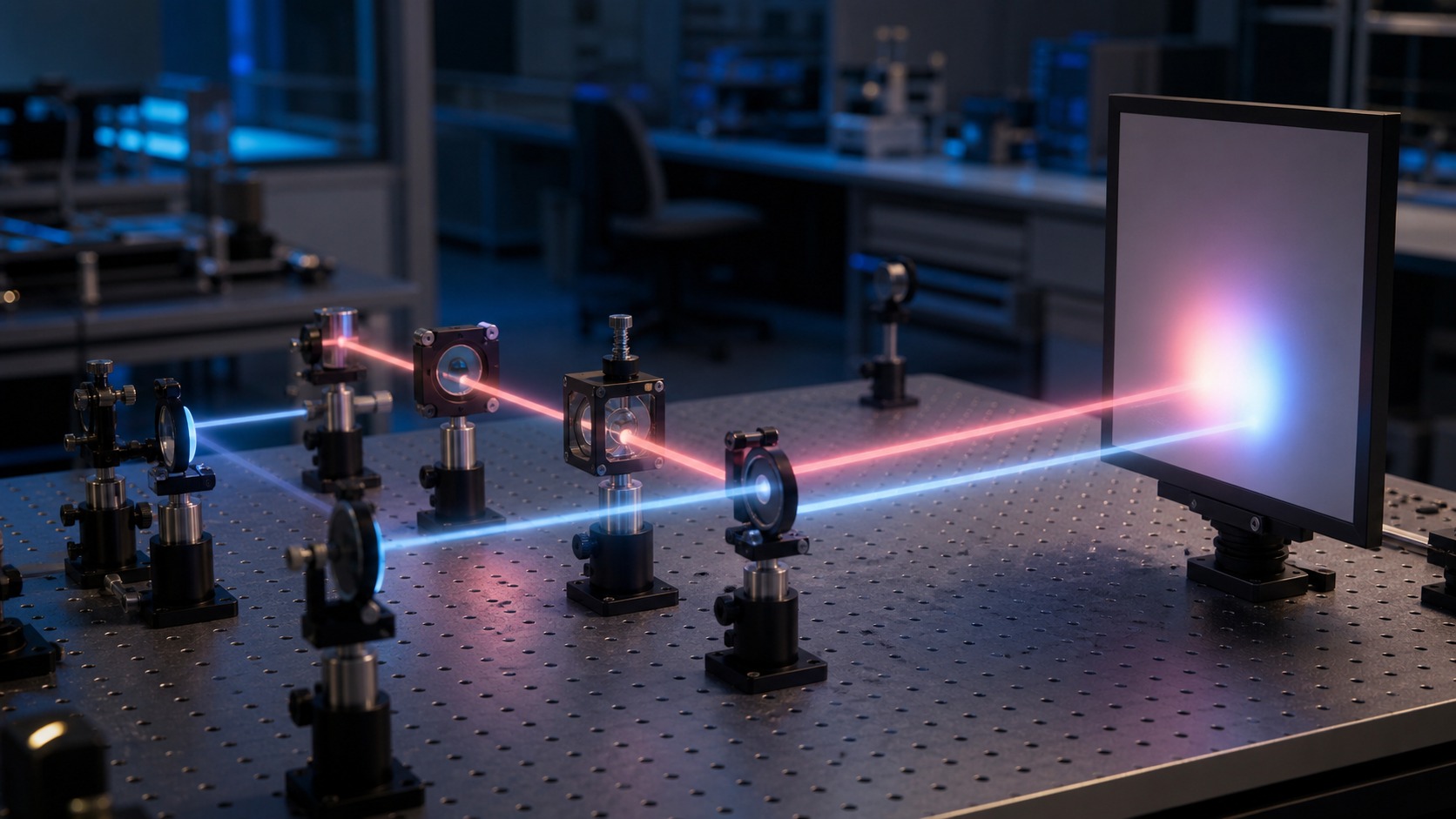
At first glance, the world feels solid, predictable, and familiar. A coffee mug sits on a desk. A light switch turns a lamp on or off. A baseball arcs through the air following a path that can be calculated with impressive accuracy. These everyday experiences are governed by what physicists call classical states—descriptions of reality that assume objects have definite properties at all times. Position, speed, and energy are assumed to be well-defined, even if we do not measure them directly. Yet beneath this comfortable surface lies a far stranger layer of reality. At the scale of atoms, electrons, and photons, the rules change dramatically. Objects no longer behave like tiny billiard balls. Instead, they exist in quantum states, where uncertainty, probability, and possibility dominate. Understanding the difference between quantum states and classical states is one of the most profound challenges in modern science, because it reshapes how we think about reality itself. This article explores that difference in depth—conceptually, intuitively, and practically—without assuming advanced mathematical training. By the end, you will see why quantum states are not just “smaller versions” of classical states, but a fundamentally different way the universe organizes information.
A: No—quantum states describe real probabilities, not hidden values.
A: Interactions with the environment suppress quantum effects.
A: No, but they challenge classical intuitions about cause and effect.
A: Classical behavior emerges from underlying quantum states.
A: In quantum physics, probability is fundamental.
A: Measurement helps select outcomes from quantum possibilities.
A: They are mathematical descriptions that match real experiments.
A: They persist unless disturbed by interaction or measurement.
A: They expand it beyond everyday experience.
A: They explain how the universe works at its most basic level.
What Do Physicists Mean by a “State”?
Before comparing quantum and classical states, it helps to clarify what the word state means in physics. A state is a complete description of a system at a given moment. In principle, if you know the state, you know everything that can be known about that system and can predict its future behavior.
In classical physics, the state of an object might be defined by its position and velocity. If you know where a planet is and how fast it is moving, Newton’s laws can tell you where it will be tomorrow or next year. The state is concrete, definite, and deterministic.
In quantum physics, the idea of a state still exists, but its meaning changes. A quantum state does not describe a single outcome. Instead, it describes a set of possible outcomes along with their probabilities. This shift—from certainty to probability—is the first major dividing line between classical and quantum thinking.
Classical States: Certainty and Determinism
Classical states reflect the intuition humans have developed from everyday experience. Objects are assumed to have specific properties whether or not anyone is watching. A car has a precise speed. A ball occupies a precise location. Even if measurements are imperfect, the underlying reality is assumed to be sharp and well-defined.
One defining feature of classical states is determinism. If you know the present state with sufficient accuracy, the future follows inevitably from physical laws. Small uncertainties in measurement might lead to practical prediction errors, but in principle the universe behaves like a gigantic clockwork mechanism.
Another key aspect is independence from observation. Measuring a classical system does not fundamentally alter its state. Reading a thermometer does not change the temperature of the room in any meaningful way. Observation reveals reality rather than shaping it.
Classical states also obey additive logic. If a system can be in state A or state B, it is always in one or the other, never both at once. This “either/or” structure aligns perfectly with everyday reasoning and classical probability theory.
Quantum States: Probability Replaces Certainty
Quantum states operate under a very different set of rules. Instead of assigning exact values to properties like position or momentum, a quantum state encodes a range of possibilities. Each possible outcome is associated with a probability that becomes apparent only when a measurement is made.
Before measurement, a quantum system does not behave as though it secretly holds a single hidden value. Rather, it exists in a structured blend of possibilities known as a superposition. This is not merely a statement about human ignorance; it is a statement about how nature itself behaves at small scales.
In a quantum state, observation plays a central role. Measuring a system does not simply reveal pre-existing information. It actively participates in selecting one outcome from many possibilities. This interaction between observer and system has no true classical counterpart and lies at the heart of quantum weirdness.
Superposition vs Single-Valued Reality
One of the clearest contrasts between classical and quantum states lies in how systems handle alternatives. In classical physics, a system must always choose. A coin is either heads or tails, even if it is spinning in the air. The uncertainty is only in our knowledge, not in the coin itself.
In quantum physics, alternatives coexist. An electron can occupy multiple energy states at once. A photon can take multiple paths simultaneously. The quantum state does not commit to a single answer until a measurement forces the issue.
This difference is subtle but profound. Superposition does not mean that a quantum object is “half in one state and half in another” in a vague sense. It means the object is fully described by a mathematical combination of states, each contributing to the final probabilities in precise ways. Interference effects—where possibilities reinforce or cancel each other—are direct consequences of this structure.
Measurement: Passive in Classical Physics, Active in Quantum Physics
Measurement highlights another sharp divide between classical and quantum states. In classical physics, measurement is passive. You can observe a system repeatedly without changing its essential behavior. Any disturbance introduced by measurement can, in principle, be made arbitrarily small.
In quantum physics, measurement is inherently active. The act of measuring changes the system’s state in an unavoidable way. A quantum state evolves smoothly over time according to physical laws, but measurement interrupts this evolution and replaces it with a definite outcome.
This phenomenon is often described as the “collapse” of the quantum state. While the terminology can be misleading, the idea is simple: before measurement, many outcomes are possible; after measurement, only one remains. Classical states do not undergo such collapses because they were never spread across possibilities to begin with.
Determinism vs Probability
Classical states support a deterministic universe. Given enough information, the future is fixed. Quantum states replace this picture with fundamental probability. Even with complete knowledge of a quantum state, physics can only predict probabilities, not certainties, for individual outcomes.
This probabilistic nature is not due to incomplete theory or hidden variables in standard quantum mechanics. It is built into the structure of the theory itself. Experiments repeatedly confirm that quantum randomness cannot be eliminated by better measurement techniques or deeper classical descriptions.
Over large scales, quantum probabilities average out, giving rise to the reliable patterns we associate with classical physics. But at the level of individual particles, probability is unavoidable.
Continuity vs Discreteness
Classical states often assume continuity. Positions can vary smoothly. Energies can take on any value within a range. While classical physics allows for quantization in some contexts, it does not require it.
Quantum states, by contrast, naturally introduce discreteness. Energy levels in atoms are quantized. Transitions between states occur in jumps rather than smooth slides. This discrete structure is not imposed artificially; it emerges directly from the mathematics of quantum states.
The stability of matter itself depends on this discreteness. Without quantized states, atoms would not hold together in any recognizable way. Classical states alone cannot explain why electrons do not simply spiral into atomic nuclei.
Information and Reality
Another difference between classical and quantum states lies in how information is stored and manipulated. In classical physics, information corresponds directly to physical properties. Knowing the state means knowing the values of all relevant variables.
In quantum physics, information is encoded in probabilities and correlations. Some information cannot be accessed directly without destroying other aspects of the state. This leads to trade-offs, such as the impossibility of knowing both position and momentum precisely at the same time.
Quantum states also allow for correlations that have no classical analogue. These correlations, often discussed under the heading of entanglement, reveal that quantum states cannot always be decomposed into independent parts. Classical states, by contrast, are usually built by combining the states of individual components.
When Quantum Becomes Classical
If quantum states are so different, why does the world appear classical to us? The answer lies in scale, interaction, and environment. Quantum effects are most visible when systems are small, isolated, and carefully controlled. In everyday objects, countless interactions with the environment rapidly suppress quantum superpositions.
As a result, quantum states effectively behave like classical states under ordinary conditions. This process does not eliminate quantum mechanics; it hides it. The classical world is not separate from the quantum world—it is an approximation that emerges naturally when quantum states interact with their surroundings.
Understanding this transition remains one of the most active areas of research in physics. It connects foundational questions about measurement with practical issues in emerging technologies.
Practical Implications of the Difference
The distinction between quantum and classical states is not merely philosophical. It has tangible consequences. Technologies based on classical states, such as traditional computers, store information in definite bits that are either zero or one.
Quantum technologies exploit quantum states to store and process information in new ways. Superposition and probability allow quantum systems to represent multiple possibilities simultaneously. While this does not mean quantum devices “try all answers at once” in a naive sense, it does give them access to computational strategies that classical systems cannot replicate efficiently. In sensing, communication, and computation, the difference between classical and quantum states becomes a practical resource rather than an abstract curiosity.
A Shift in How We Think About Reality
Perhaps the most important difference between quantum and classical states is conceptual. Classical states support a worldview in which reality is definite, local, and observer-independent. Quantum states challenge each of these assumptions in subtle but measurable ways.
Reality at the quantum level is not fully defined until interactions occur. Observation is not merely a window onto nature but a participant in it. Probability is not just a reflection of ignorance but a fundamental feature of the universe. This does not make the world arbitrary or chaotic. Quantum physics is one of the most precise and successful scientific frameworks ever developed. It simply asks us to accept that the universe operates on principles very different from those suggested by everyday experience.
Conclusion: Two Frameworks, One Universe
Quantum states and classical states represent two ways of describing the same underlying universe at different scales and levels of detail. Classical states emphasize certainty, determinism, and independence from observation. Quantum states emphasize probability, superposition, and the active role of measurement. Neither framework is “more real” than the other in practice. Classical physics works because quantum effects average out in large systems. Quantum physics works because it captures the deeper rules that govern matter and energy at their most fundamental level. Understanding the difference between quantum and classical states is not just about learning new terminology. It is about expanding our intuition to include a universe where possibilities can be as real as outcomes, and where the act of knowing is inseparable from the nature of what is known.