Quantum mechanics has a reputation for being weird, but a lot of that weirdness comes from one idea: superposition. It’s the rule that says a quantum object can be described as a blend of multiple possibilities at once—until an interaction forces one outcome to show up. That sounds like science fiction, yet it’s the everyday math behind how atoms hold together, how lasers stay coherent, and how modern electronics work at microscopic scales. The trick is to stop imagining superposition as a tiny marble literally being in two places like a magic trick. Instead, think of it as a menu of potential outcomes written into the system’s wave-like description. The system carries a set of “if you check for X, here are the odds” statements all at once. Quantum mechanics doesn’t say reality is nonsense; it says that at very small scales, the universe stores information as probability amplitudes—values that can reinforce or cancel each other like waves. Once you see superposition as “multiple possible results encoded together,” the strange world starts to feel less like a prank and more like a different kind of logic.
A: It means the state includes multiple possible outcomes with wave-like amplitudes until measured.
A: No—measurement is any interaction that leaves a stable physical record in the environment or detector.
A: The system becomes entangled with the detector, scrambling phases needed for interference.
A: Decoherence happens extremely fast for large, warm objects due to constant environmental interactions.
A: Not exactly—superposition allows interference; ordinary uncertainty doesn’t produce wave cancellation effects.
A: The double-slit: outcomes build an interference pattern unless which-path info is available.
A: No—correlations appear, but you can’t control outcomes to send a message.
A: The theory predicts probabilities precisely, but individual outcomes are not determined in the same way as classical systems.
A: Quantum circuits manipulate amplitudes so wrong answers can cancel and right answers can reinforce.
A: It’s wave math for reality: possibilities combine, interfere, and only later show a single result when recorded.
The Everyday Intuition That Breaks in the Quantum World
In normal life, objects have properties whether you look or not. A coin is either heads or tails; a light is either on or off; a cat is either inside the closet or not. Classical physics is built on that intuition: the world is a collection of definite states that we can measure more accurately if we build better instruments. Uncertainty, in this worldview, is mostly about us—our limited knowledge, our noisy tools, our imperfect predictions. Quantum mechanics flips that. At the scale of electrons, photons, and atoms, uncertainty isn’t just a lack of information. It’s part of the description itself. A particle is not always best described as “here, going this fast.” Often it’s better described as a wavefunction, a mathematical object that encodes the range of outcomes you could get if you measured position, momentum, energy, spin, or other properties. The wavefunction doesn’t merely hide a secret answer; it creates a structured landscape of possibilities. That’s why superposition matters. Superposition is not a weird add-on—it’s the core feature that makes the wavefunction behave like a wave. And once something behaves like a wave, you get interference: crests add to crests, troughs cancel crests, patterns appear that can’t be explained by simple “either/or” thinking.
What Superposition Really Means (Without the Mystical Fog)
A superposition is a combination of states. If that sounds abstract, it’s because we’re used to states being mutually exclusive. In quantum mechanics, “state” means a complete description of what the system will do when asked certain questions. When the system is in a superposition, it’s like saying: “If you measure this property, you might get option A or option B, and the math includes both at once.”
The word “at once” is where people get stuck. It makes it sound like the universe can’t make up its mind. A better framing is: the wavefunction contains amplitudes for different outcomes, and amplitudes are not probabilities. They’re more like arrows or wave heights that can add and subtract. When you square the amplitude (in a specific way), you get probabilities. But before you square, amplitudes can interfere—so quantum mechanics can produce outcomes that are more or less likely because possibilities combine like waves. That interference is the whole drama. Superposition isn’t just “many options.” It’s “many options that can collaborate or sabotage each other.” That’s why quantum mechanics can create patterns that look impossible if you assume the particle always had one definite path.
The Double-Slit Experiment: The Poster Child for Superposition
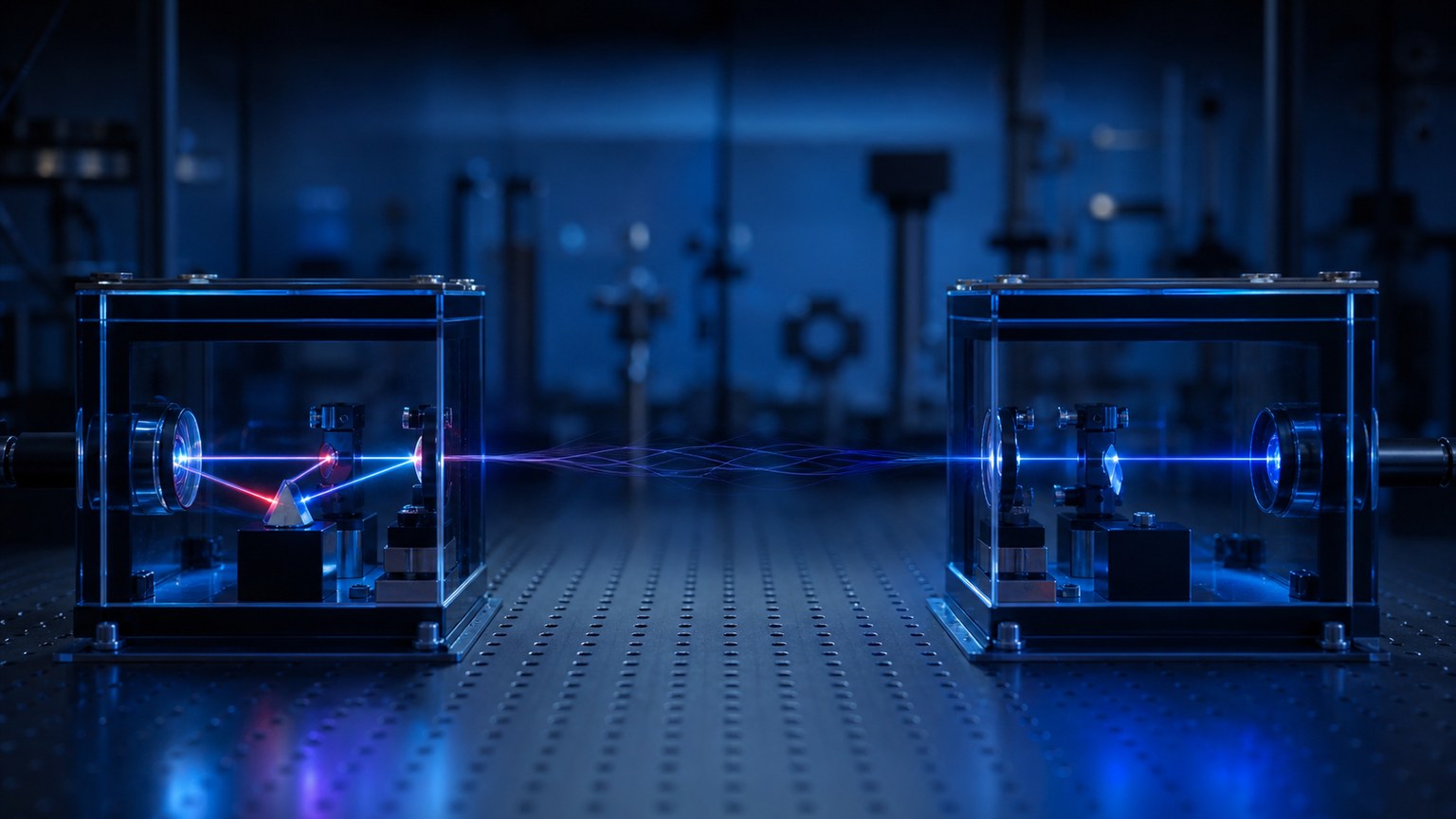
If superposition had a single stage performance, it would be the double-slit experiment. Shine light through two slits onto a screen and you see an interference pattern: bright and dark bands. That makes sense if light is a wave. But here’s the twist: if you dim the source so much that photons go one at a time, the pattern still builds up over time. Each photon lands as a single dot—yet collectively they form an interference pattern as if each photon somehow behaved like a wave that went through both slits. That “both slits” language is tempting, but the key idea is this: the photon’s wavefunction includes contributions from paths through slit A and slit B. Those contributions combine. In some places they reinforce, making dots more likely. In other places they cancel, making dots less likely. The photon isn’t choosing a secret classical route and hiding it from you; the wave-like structure of its state is doing what waves do: interfering.
Now comes the part that really highlights superposition’s role in “quantum strangeness.” If you set up detectors to learn which slit the photon went through, the interference pattern disappears. You get a more ordinary distribution, as if the photon “picked” a slit. What changed? The system became entangled with the detector environment in a way that destroys the phase relationships needed for interference. In plain terms: once the world has a stable record of “which path,” the delicate wave-combination that produces interference can’t do its magic.
Measurement Isn’t Just Looking—It’s Interacting
People often say “the act of observation collapses the wavefunction,” and that phrase can sound like human consciousness is running the universe. You don’t need that. In quantum physics, “measurement” means a physical interaction that leaves durable information somewhere—on a detector, in scattered photons, in vibrations of atoms, in electronic signals. When the system interacts strongly with its environment, superposition becomes extremely hard to maintain because the environment effectively “tracks” the alternatives.
This is where decoherence enters the story. Decoherence is the process by which a quantum system loses its ability to show interference because it becomes entangled with many uncontrolled degrees of freedom around it. The information about the system’s state leaks into the environment, scrambling the phase relationships. Once those phases are scrambled, superpositions don’t vanish from the math, but they become unusable for producing visible quantum effects. The world starts to look classical because interference becomes practically impossible to observe at large scales. So the “collapse” you hear about is often a shorthand for: “After interaction with a measuring apparatus and environment, the system behaves as if it has a definite outcome, and you can treat it that way because interference is gone.”
Why We Don’t See Superpositions of Chairs and Coffee Mugs
If superposition is real, why isn’t your coffee mug in a superposition of being on the table and on the floor? The short answer: it probably is in a microscopic sense, but decoherence destroys the interference so fast that the superposition can’t be used to produce macroscopic weirdness. Large objects are made of astronomically many particles. They collide with air molecules, exchange heat, emit infrared radiation, pick up vibrations from the floor, and scatter light. Every one of those interactions “tags” the object’s state to the environment. The phases become effectively random. Without stable phase relationships, you can’t get interference, and without interference, superposition looks like ordinary uncertainty rather than a controllable quantum effect. This is why quantum experiments are often done in extreme conditions: vacuum chambers, cryogenic temperatures, electromagnetic shielding, isolation from vibration. The goal isn’t to make quantum mechanics start working—it’s to stop the environment from smearing out the superposition before you can observe it.
Superposition Explains Quantization and “Allowed” States
Superposition doesn’t just create weird experiments; it also explains why atoms have discrete energy levels. Inside an atom, an electron is described by a wavefunction. The electron’s wave-like nature means only certain standing-wave patterns fit around the nucleus in stable ways. Those stable patterns correspond to specific energy levels—like notes on a guitar string that can only vibrate at certain frequencies.
In this picture, the electron isn’t a tiny planet orbiting like a miniature solar system. It’s more like a cloud of possibility whose shape is determined by wave equations. Superposition allows that cloud to be formed from combinations of simpler wave patterns. The orbitals you see in chemistry diagrams are not literal electron paths; they’re probability distributions—maps of where the electron is more likely to be found if measured. This is where quantum mechanics stops being “just weird” and becomes beautifully practical. The periodic table, chemical bonding, semiconductor behavior, and the stability of matter are all tied to the fact that quantum states superpose and interfere in constrained, quantized ways.
Spin: A Superposition You Can’t Visualize, But Can Measure
Superposition becomes even stranger when the “states” aren’t about position but about spin, a quantum property that behaves like angular momentum but doesn’t have a perfect classical analogue. A particle like an electron can be in a state that, when measured along an axis, yields “up” or “down.” Before measurement, it can be in a superposition of up and down. What makes spin a great teaching tool is that it’s clean. You can prepare an electron in a known spin state along one direction, then measure along another direction and get probabilistic outcomes. The rules are consistent and repeatable: superposition isn’t random chaos, it’s structured mathematics that predicts outcomes with stunning accuracy.
And there’s a deeper lesson: in quantum mechanics, what you can say about a system depends on the questions you ask. A state that is “definitely up” along one axis can be a superposition of up and down along another axis. That’s not the universe changing its mind; it’s the state being represented in different measurement bases—like describing a vector in different coordinate systems.
Superposition and Interference: The Real “Strange” Ingredient
If you want one sentence that captures why superposition feels so alien, it’s this: quantum possibilities can interfere. In everyday probability, possibilities just add. If you have a 50% chance of rain and a 50% chance of sun, you don’t get “negative weather” by combining them. But quantum amplitudes can cancel. One route to an outcome can subtract from another route, making an event less likely or even impossible. That cancellation is not a philosophical quirk; it’s a physical effect that shows up in experiments and technologies. Interference is why certain transitions in atoms are “forbidden,” why some scattering angles have dips, and why quantum systems can be engineered to suppress unwanted behaviors. Superposition gives you interference, and interference gives you the strange, precise patterns that classical intuition can’t imitate.
Quantum Tunneling: When Superposition Sneaks Through Walls
Tunneling is another place superposition helps you stop thinking “the universe is cheating” and start thinking “the wavefunction spreads.” In classical physics, if a ball doesn’t have enough energy to roll over a hill, it doesn’t cross. In quantum mechanics, a particle’s wavefunction can extend into and beyond a barrier. There can be a nonzero probability of finding the particle on the other side, even if it “shouldn’t” have enough energy.
This doesn’t mean particles magically gain energy. It means the particle’s state includes components that overlap with the region beyond the barrier. If conditions are right, those components can lead to a measurable chance of transmission. Tunneling powers real things: scanning tunneling microscopes that “feel” surfaces at atomic resolution, nuclear fusion processes in stars, and the operation limits of tiny transistors. Superposition is the quiet engine here. The particle isn’t choosing between “bounce” and “pass” like a coin flip; its wavefunction evolves into a superposition of reflected and transmitted components. The barrier sets the odds. Measurement reveals one outcome.
Entanglement: When Superposition Becomes Shared Reality
Superposition becomes mind-bending when it spreads across multiple particles. If two particles interact and become entangled, you can no longer describe each particle independently. Instead, the pair has a shared wavefunction. The system can be in a superposition of joint states—like “A is up and B is down” combined with “A is down and B is up”—where neither particle has its own definite value before measurement, yet the outcomes are strongly correlated.
Entanglement is not “telepathy.” It doesn’t let you send messages faster than light. But it does show that quantum states can link possibilities across distance in a way that classical physics doesn’t allow. When you measure one particle, you learn something about the other because the pair’s state was a single combined object in the mathematics. This is another reason superposition matters: it’s not just about one particle being “in many states.” It’s about entire systems carrying joint possibilities that only resolve into specific pairs of results when interactions force them to.
Superposition in the Real World: Tech That Runs on Quantum Weirdness
Quantum mechanics isn’t a distant theory; it’s the operating system under modern technology. Superposition and interference are central to devices that rely on precise control of electron states. Semiconductors work because electrons occupy quantum bands and can be nudged across energy gaps. Lasers work because atoms are driven into particular quantum states, producing coherent light where waves align. MRI relies on quantum spin behavior in nuclei and how those spins respond to magnetic fields and radio pulses. Even when we don’t explicitly “use superposition” as a feature, we live inside its consequences. The reason materials have color, the reason metals conduct, the reason chemical bonds hold: at the foundation, these are wavefunctions superposing and interfering in stable patterns.
And in quantum computing, superposition becomes a resource you try to preserve. A quantum bit can be in a superposition of 0 and 1, and computations manipulate amplitudes so that wrong answers interfere away while right answers interfere strongly. The difficulty is that the environment wants to steal the phase relationships through decoherence, turning a delicate quantum advantage into ordinary noise.
A Friendly Way to Think About Superposition Without Getting Lost
If you’re trying to hold superposition in your mind without turning it into fantasy, use three anchors: First, superposition is a math rule for waves, and wave interference is real. Second, the wavefunction encodes probability amplitudes, not hidden classical facts. Third, measurement is an interaction that creates a record and usually destroys the interference that made the superposition observable.
When you combine those anchors, the strange world of quantum mechanics becomes less like a paradox generator and more like a consistent framework with a different intuition than everyday life. Classical physics is the limit where superpositions exist but decoherence and large numbers bury the interference. Quantum physics is what you get when you can keep interference alive long enough to see it.
Why Superposition Is the Gateway to Quantum Understanding
Superposition is the doorway because it explains why quantum mechanics doesn’t behave like common-sense probability. It gives you interference, and interference gives you the patterns that make quantum experiments famous. It also explains how atoms can be stable, why energy levels are discrete, why particles can tunnel, and how entanglement creates correlations that aren’t built from independent pieces. If the quantum world feels strange, that’s partly because our brains evolved to navigate a world where decoherence is overwhelming and objects are large. Superposition asks us to accept that at the smallest scales, nature stores its possibilities in a wave-like form where alternatives can cancel or reinforce. Once you accept that, quantum mechanics stops being a collection of spooky stories and becomes a coherent explanation for why reality—at its deepest level—has both limits and incredible power.