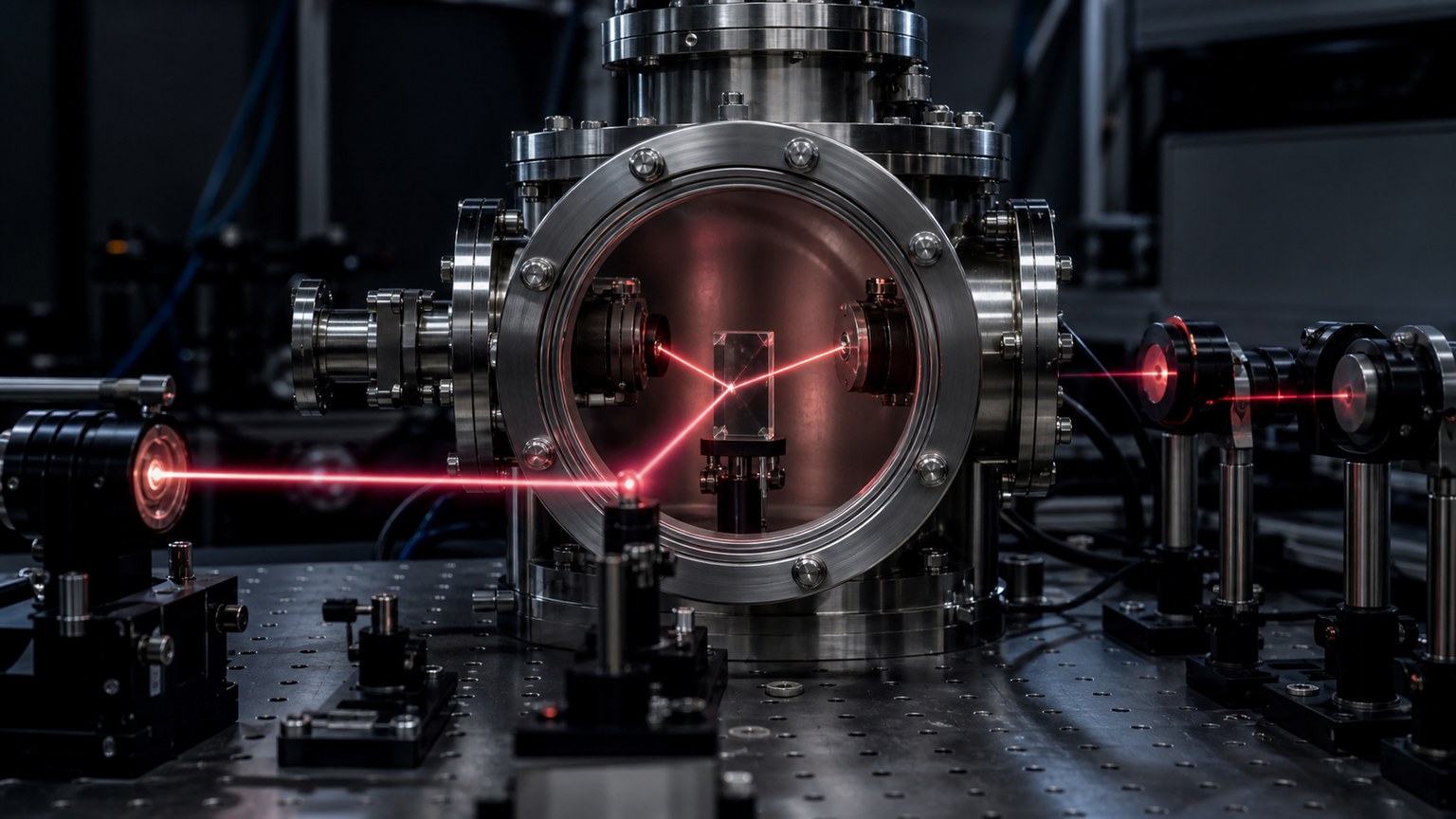
Schrödinger’s cat is famous because it feels like a prank played by physics: put a cat in a sealed box with a quantum trigger, and the cat is somehow both alive and dead until you look. People repeat it as if quantum mechanics literally says cats hover between life and death, waiting for human eyeballs to decide reality. But that isn’t the real point. The cat thought experiment is a spotlight, aimed right at the weird seam where everyday life and quantum rules meet—and the beam reveals a puzzle that scientists still debate in different ways. In plain terms, Schrödinger’s cat is not a claim about cruelty, cats, or magical observation powers. It’s a carefully designed “What if?” that exposes a mismatch between how quantum theory describes tiny things (atoms, photons, electrons) and how we experience big things (tables, clocks, cats). The real lesson is about measurement, information, and why the quantum world seems to have many possibilities at once—while our world insists on one outcome, one story, one “this happened.”
A: The thought experiment says the *description* can include both outcomes; it’s not meant as a literal claim about real cats.
A: No—measurement can be any interaction that produces a stored result, like a detector click.
A: It’s the idea that the wavefunction updates from many possibilities to one outcome when measured.
A: Decoherence: constant interactions with the environment rapidly destroy the interference that reveals superposition.
A: No—it’s a thought experiment designed to expose a conceptual problem.
A: It’s when two things share one linked state, so their outcomes are connected.
A: It predicts probabilities very precisely; randomness shows up in individual outcomes.
A: No—different interpretations fit the same math and experiments, but tell different stories about reality.
A: Quantum theory works incredibly well, but the meaning of measurement and “one outcome” is still deeply fascinating.
A: The same ideas behind the cat also power quantum computing, precision sensing, and modern physics tech.
A Quick Setup: What’s Actually Inside the Box?
Imagine a sturdy, sealed box. Inside: a cat, a tiny amount of radioactive material, a detector (like a Geiger counter), and a device that breaks a vial of poison if it detects radiation. The radioactive material has a 50/50 chance of decaying within an hour. If it decays, the detector triggers the device, the poison is released, and the cat dies. If it doesn’t decay, nothing happens, and the cat lives. That part feels normal—probabilities happen all the time. But quantum mechanics says something more slippery: before you measure whether the atom decayed, the system is described by a “superposition,” a blend of multiple possible states. In the math, the atom isn’t simply “decayed” or “not decayed” in the way a coin is either heads or tails after it lands. Instead, the atom’s state is represented as a combination of both possibilities, with weights that predict the odds of each result if you measure it. Schrödinger’s move was to connect that microscopic uncertainty to a macroscopic consequence. If the atom is in a superposition, and the detector is linked to it, and the poison vial is linked to the detector, then the entire chain becomes linked. In the simplest reading of the math, the cat becomes entangled with the atom’s fate. That’s how we arrive at the shocking sentence: before you open the box, the cat is in a superposition of alive and dead.
Superposition: “Both” Doesn’t Mean What You Think
When people hear “superposition,” they imagine a cat that is half alive and half dead in a spooky fog. But superposition isn’t a mushy physical mixture the way milk and coffee blend. It’s a description of how a system behaves when it hasn’t been measured in the relevant way. It’s a compact way to encode multiple possible outcomes—and the way those possibilities can interfere with each other.
A good everyday analogy is tricky because our daily life doesn’t include interference between “maybe” and “maybe” the way quantum systems do. But you can think of superposition as the system holding more than one potential story at the same time, and the math keeps track of how strongly each story is “in play.” The weird part is that these stories aren’t just ignorance about a hidden truth. In quantum mechanics, the system genuinely behaves as if multiple possibilities are real in the description, until measurement pins down an outcome. So Schrödinger’s cat isn’t saying “the cat is secretly either alive or dead but we don’t know which.” It’s saying: If you apply the quantum rules to everything inside the box, the formal description doesn’t pick one outcome until the measurement happens. Schrödinger wanted you to feel how unacceptable that sounds when the “system” includes a cat.
Measurement: The Moment Quantum Turns Into a Single Result
The heart of the cat paradox is measurement. In quantum theory, measuring is not just “finding out.” Measurement is an interaction that produces a definite outcome. You don’t get a gentle peek behind the curtain; you get a firm answer: decayed or not decayed. The theory is excellent at predicting the probabilities of outcomes, but it gets philosophically thorny when you ask: What exactly counts as a measurement? If the detector inside the box registers radiation, did a measurement already happen? If the poison vial breaks, did that count? If the cat feels symptoms, does the cat’s nervous system “measure” the situation? And if measurement happened inside the box, why should an outside observer matter at all?
This is why Schrödinger’s cat remains iconic: it forces the question into everyday language. It pokes at the boundary we casually assume exists between “quantum stuff” and “normal stuff.” If quantum rules are universal, then the cat-plus-device should follow them too. If normal reality is universal, then the atom should have been either decayed or not decayed all along. The cat makes it hard to shrug and say, “Quantum is only for tiny things.”
Entanglement: When One Fate Becomes Two Fates
Entanglement is the glue that makes Schrödinger’s story bite. In entanglement, two systems become linked so that you can’t fully describe one without referencing the other. It’s not a secret signal or a spooky message; it’s a shared state. If the atom’s decay triggers the mechanism, then the atom and the mechanism become correlated. If the mechanism determines the cat’s outcome, then the cat becomes correlated too.
Once entangled, the combined system behaves like a single object in the quantum description. The “state” isn’t “atom + cat” as separate lists of properties; it’s one combined state that includes the relationship between them. This is why, in the thought experiment, the cat’s state is tied to the atom’s state in the math. Entanglement is also why quantum mechanics can feel like it disrespects common sense. In everyday life, you expect objects to have their own properties. In quantum mechanics, the relationship can be the main thing the theory tracks.
The Real Puzzle: Why Don’t We See Superpositions Every Day?
If superpositions are real in the math, why don’t we see them in normal life? Why don’t we open a door and find a room both clean and messy until we look? Why don’t we see a basketball simultaneously swishing and missing until the scoreboard “measures” it? One big reason is something called decoherence. Decoherence is what happens when a delicate quantum system interacts with its environment—air molecules, photons, heat vibrations, everything. Those interactions effectively “leak” information about the system into the environment. When that happens, the clean quantum interference between different possibilities gets scrambled. The system stops behaving like a coherent superposition, and starts behaving like a classical mixture where one outcome effectively dominates for all practical purposes.
In the cat box, you might imagine the system as isolated. But in real life, perfectly isolating a cat, poison, detector, and atom from all environmental interaction is basically impossible. The cat itself is a warm, complex organism constantly interacting internally and with the surroundings. Decoherence would happen extremely fast. That means: even if quantum mechanics is universal, macroscopic superpositions become practically unobservable because the environment continuously “monitors” and destroys the interference patterns that would reveal the superposition. Here’s the subtle but crucial point: decoherence explains why superpositions look like they collapse into ordinary outcomes. But many physicists argue it doesn’t fully answer why we experience one specific outcome rather than a spread of them. Decoherence shows why the weirdness becomes hidden; it doesn’t necessarily tell you what reality “is” underneath.
What Schrödinger Was Really Criticizing
Schrödinger introduced the cat not to celebrate quantum weirdness, but to criticize a naive reading of it. He wanted to show that if you take the standard measurement rule too literally, you end up with absurd situations. In his era, the dominant “Copenhagen-like” attitude often treated the wavefunction as a tool for predicting measurement outcomes, and “collapse” as a special rule that occurs during observation. Schrödinger’s cat was a way of saying: “Okay, but if collapse is real and observation is special, where is the line? Does it happen at the detector? At the human eye? At consciousness?” So the cat is less a statement—more a challenge. It’s a question disguised as a story: What counts as a measurement, and why should it create a single reality?
The Main Interpretations, in Human Language
Schrödinger’s cat sits in the middle of interpretations—different ways of understanding what the math is telling us. None of these interpretations change the predictions of standard quantum mechanics in everyday experiments. They change the story we tell ourselves about what’s “really happening.”
One family of views says: the wavefunction is not a literal physical thing; it’s information, a tool, or a catalog of expectations. In this view, the cat isn’t both alive and dead in reality; rather, we are in a state of incomplete information until the box is opened, and the wavefunction updates to reflect the new information. The tension here is explaining why the tool works so perfectly and why “information” seems to behave like a real physical structure. Another view says: the wavefunction is real and never collapses. Instead, all outcomes happen, but in different branches of reality. On this “many worlds” style picture, the box opening doesn’t choose an outcome; it splits the observer into correlated versions—one who sees a live cat and one who sees a dead cat. People find this either elegant or outrageous. It removes collapse as a special rule, but it makes “reality” far larger than everyday intuition.
Another approach adds hidden variables: properties exist definitively, but we can’t see all of them, and quantum probabilities reflect deeper underlying facts. Some versions maintain that measurement reveals what was already true; others say measurement helps create the truth in a structured way. These approaches aim to restore a single objective outcome without giving special powers to observers, but they come with their own tradeoffs, like nonlocal connections. Then there are interpretations that treat collapse as a real physical process—something that happens spontaneously or due to gravity or complexity. In these ideas, superpositions of large objects become unstable and “collapse” on their own, meaning you won’t get long-lived cat-scale superpositions. These theories are interesting because they can, in principle, be tested by pushing experiments to larger and larger scales. For a non-scientist, the key takeaway is simple: Schrödinger’s cat is a map marker that says, “Here be dragons.” The math works. The experiments agree. The debate is about what the math means.
What the Cat Teaches You About Probability
Quantum probability is not quite like everyday probability. If you roll a die under a cup, the outcome is already fixed; you just don’t know it until you lift the cup. That’s ignorance. Quantum probability often behaves as if the outcome isn’t fixed in the same way until measurement. This is why quantum systems can show interference patterns: the probabilities can combine in ways that depend on phase relationships, not just simple percentages.
The cat experiment exaggerates this difference. In daily life, we’re comfortable saying “I don’t know what happened in the box.” Quantum theory nudges us toward “Before measurement, the system isn’t in a single definite state in the way you expect.” Schrödinger’s genius was to attach that statement to a cat, because our instincts revolt.
Why “Observation” Doesn’t Mean Human Eyeballs
Pop culture often turns Schrödinger’s cat into: “Reality depends on consciousness.” That’s not what the mainstream science says. In physics, “observation” usually means “an interaction that produces a record.” A detector clicking is an observation. A photographic plate developing is an observation. A computer storing a bit is an observation. A human seeing the readout is just one more step in the chain.
The confusion comes from sloppy language. Early presentations sometimes made it sound like the mind plays a special role. Most working physicists don’t need consciousness to do quantum mechanics. What they need is a measurement interaction that yields a definite outcome in the apparatus. The cat thought experiment is partly about that confusion. If measurement is just interaction plus record, then the cat should have a definite fate as soon as the detector triggers or doesn’t trigger—no mysticism required. The remaining puzzle becomes: how to precisely describe the transition from quantum possibilities to classical definiteness without hand-waving.
How Modern Experiments Echo the Cat—Without the Cat
Nobody runs the cat experiment literally, for obvious ethical reasons. But scientists do create “cat states” in laboratories—superpositions of two distinct states—in systems like photons, ions, superconducting circuits, and even mechanical resonators. These are not furry cats; they’re quantum states that mirror the logical structure of the thought experiment: two very different outcomes coexisting in a single quantum description.
Researchers also routinely demonstrate entanglement and decoherence, showing how fragile superpositions can be and how quickly environmental interactions wipe out the telltale interference. These experiments don’t settle the interpretation debate by themselves, but they confirm that the ingredients of the cat story—superposition, entanglement, and measurement—are not philosophy. They are real physical effects that engineers now use in quantum computing, sensing, and communications.
What It Really Means, in One Clean Sentence
Schrödinger’s cat means this: quantum mechanics describes reality as a set of potential outcomes that can be linked together, and the act of measurement forces a single outcome to be recorded—yet the theory leaves open deep questions about how and why that single outcome becomes the one we experience.
If you remember nothing else, remember that the cat is a flashlight, not a rule. It illuminates the tension between two worlds: the quantum rules that govern the small and the classical certainty we live inside. The thought experiment doesn’t claim cats are magic. It claims our intuitions about “how things must be” are not the same as nature’s operating system.
Why the Thought Experiment Still Matters
Schrödinger’s cat survives because it’s honest about the strange part. It refuses to let quantum mechanics be reduced to a trivia fact about particles doing weird tricks. Instead, it asks a human question: When does “maybe” become “is”? That question matters not just for philosophy, but for building technology that depends on quantum states staying coherent long enough to do useful work. It also matters culturally, because it’s a reminder that science sometimes advances by confronting what sounds ridiculous. Schrödinger wasn’t trying to be cute—he was trying to make the problem impossible to ignore. And he succeeded. Every time someone mentions the cat, they’re touching the edge of one of the most successful and most puzzling theories humans have ever written. If you want the most practical, non-mystical way to carry the lesson into your life, it’s this: quantum mechanics is a probability machine that becomes a reality machine when interactions create records. Schrödinger’s cat is what happens when you ask, “Okay, but where exactly does that switch flip?” The fact that the question still sparks debate isn’t a weakness. It’s evidence that we’re looking at something genuinely deep.