Why a Microscopic Idea Reaches So Far
Understanding superposition helps explain the universe because the universe is not built from tiny classical parts that simply follow miniature everyday rules. At the quantum level, particles, atoms, light, and fields are described by states that can combine alternatives with amplitudes and phase. That fact shapes matter from the inside out. It helps explain atomic stability, chemical bonds, spectra, lasers, semiconductors, stars, sensors, clocks, and the transition from quantum possibility to classical-looking reality. Superposition also forces deeper questions about measurement, probability, and what counts as a physical property before a record exists. It does not mean the whole universe is easy to visualize as everything happening at once, and it does not settle every interpretation of quantum mechanics. Its importance is more disciplined than that. Superposition is one of the rules that lets small-scale possibility produce large-scale structure. It helps explain why atoms have allowed states, why light can interfere, why matter has wave-like features, and why ordinary objects usually look definite after environmental interactions erase accessible coherence. To understand superposition is to understand why the universe is stranger, more structured, and more mathematical than everyday intuition suggests.
A: It helps explain the quantum state structure behind matter and light.
A: No. Decoherence makes ordinary objects look definite.
A: Atomic states connect quantum rules to matter.
A: Spectra carry quantum information across distance.
A: No. Interpretations remain debated.
A: Electron states combine across atoms.
A: In standard quantum mechanics, probabilities come from amplitudes.
A: Not by itself.
A: Devices show quantum state control in practical form.
A: Superposition is a key ingredient, not the whole recipe.
Atoms Are the First Bridge
Atoms connect superposition to the visible universe. Electrons in atoms are not tiny planets on definite orbits. They occupy quantum states that can be described by wavefunctions, probability patterns, energy levels, and allowed transitions.
Superposition helps explain how state components combine and evolve. Those rules shape spectra, chemical behavior, and atomic stability. Without quantum states, matter would not have the structure we observe.
The universe becomes understandable because atoms have disciplined quantum patterns, not arbitrary miniature mechanics.
Light Carries the Lesson Everywhere
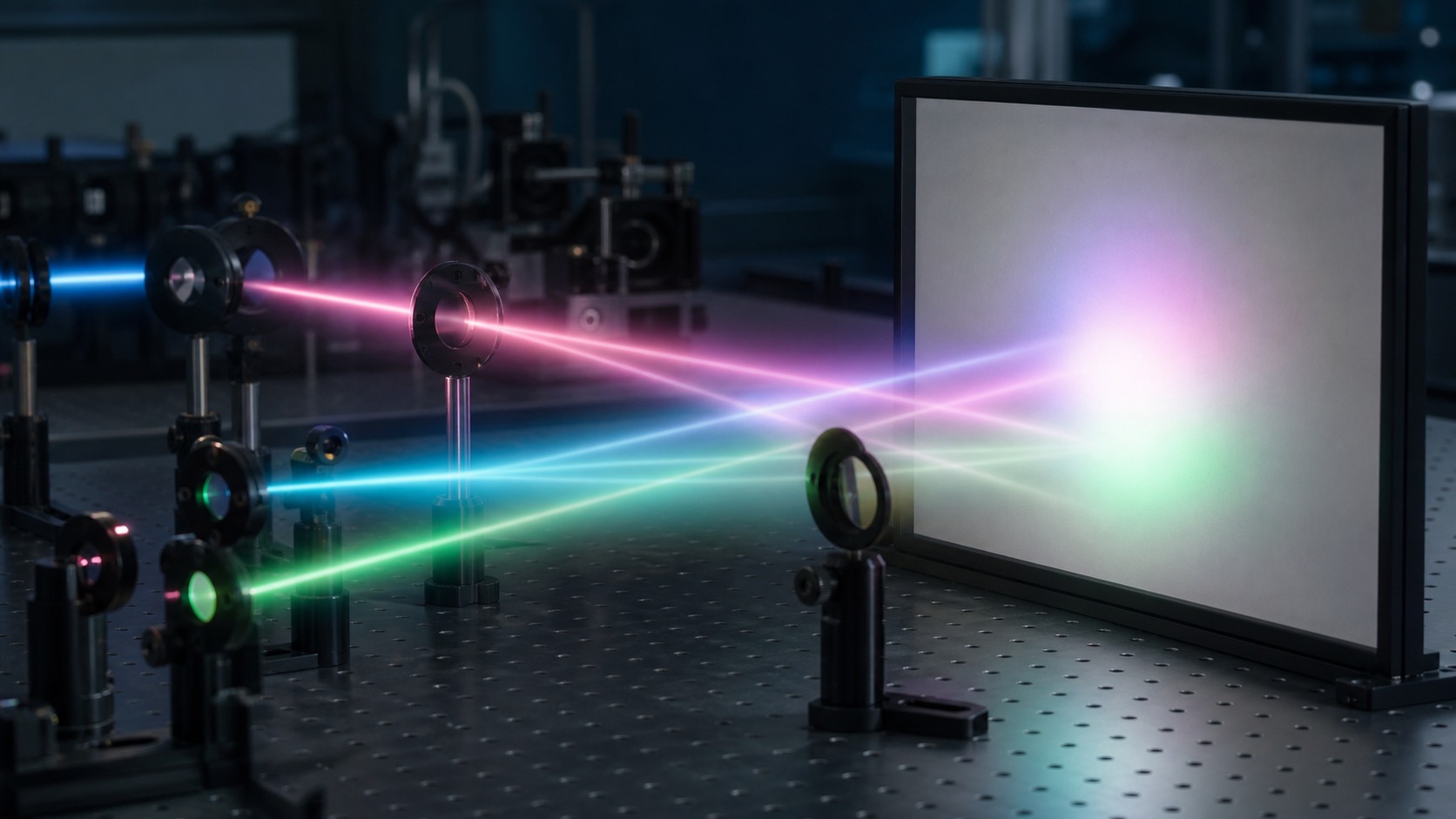
Light shows superposition through interference, polarization, and photon behavior. The same principles help explain optics in laboratories and light from distant astronomical objects.
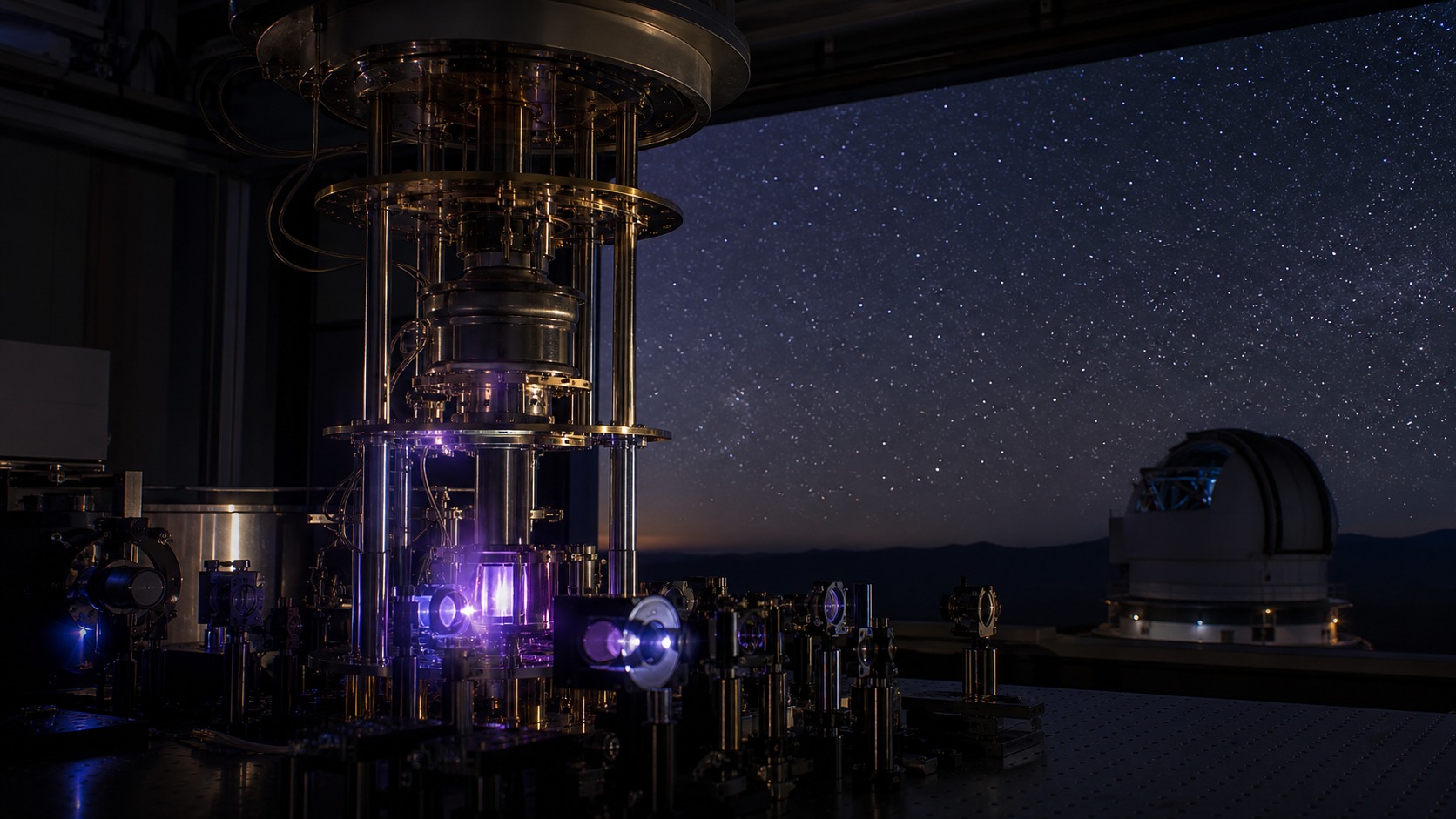
Spectra from stars and galaxies carry information about atoms, molecules, temperature, motion, and fields. Quantum state transitions turn light into a messenger across the universe.
This is one reason quantum mechanics is not confined to tiny tabletop puzzles. It helps decode the sky.
Every spectral line is a reminder that quantum states govern matter far beyond Earth.
Chemistry Needs Superposed States
Chemical bonds depend on electron states combining across atoms. Bonding and antibonding orbitals, resonance, molecular shape, and reaction pathways all rely on quantum state structure.
The everyday materials around us are therefore consequences of quantum rules. Wood, water, metals, proteins, pigments, and semiconductors all depend on electron behavior that classical pictures cannot fully explain.
Measurement Explains Why the World Looks Definite
Superposition also helps explain why the world does not look like a haze of possibilities. Large objects interact constantly with their environments. Light, heat, air, and internal vibrations create records that make alternatives stop interfering for practical purposes.
This process, decoherence, helps explain the emergence of classical appearance. It does not solve every interpretive question, but it shows why coherent superpositions are difficult to see in ordinary life.
The universe can be quantum underneath while still presenting stable tables, planets, and instruments at human scale.
Probability Becomes a Basic Feature
Superposition changes the meaning of probability. Quantum probabilities are not always ignorance about prewritten classical facts. They are derived from amplitudes and measurement context.
This matters for how we understand nature. The universe may be predictable in its statistical rules while individual outcomes remain fundamentally probabilistic under standard quantum mechanics.
That combination of lawfulness and uncertainty is one of quantum theory’s deepest lessons.
It makes reality less mechanical without making it lawless.
Fields and Particles Share the Structure
Modern physics often describes the world through quantum fields. Particles are excitations of fields, and states of fields can also exhibit superposition. This extends the idea beyond a single electron or photon.
The details become more advanced, but the conceptual thread remains: quantum states organize possible outcomes and their relationships. Superposition is part of that state language.
Cosmic Questions Need Care
It is tempting to leap from superposition to dramatic claims about the whole universe. Some advanced research does discuss quantum cosmology, vacuum states, early-universe fluctuations, and the quantum origin of cosmic structure. Those topics are real but subtle.
A beginner should be careful. Understanding superposition does not license every slogan about parallel universes or cosmic consciousness. It gives a foundation for seeing why quantum ideas can matter at large scales when the physical conditions require them.
Careful curiosity is better than instant certainty.
Technology Makes the Connection Practical
Quantum technologies connect superposition to civilization. Lasers, semiconductors, atomic clocks, MRI-related physics, quantum sensors, and emerging quantum computers all depend on state behavior that goes beyond classical intuition.
These technologies show that superposition is not merely an interpretive headache. It is part of the operating manual for matter and light.
What It Does Not Explain Alone
Superposition does not explain everything by itself. Gravity, spacetime, thermodynamics, complexity, and cosmology involve additional principles. Quantum mechanics is enormously successful, but it is not a one-word answer to every mystery.
The value of superposition is that it changes the starting point. It shows that reality’s building blocks are described by state relationships, not only by definite little objects carrying full property lists.
That shift is enough to reshape the entire picture.
Why Classical Reality Still Matters
Understanding superposition should not make classical reality seem fake. Classical physics remains one of the greatest approximations ever discovered. It works because, at human scales, quantum alternatives are usually decohered and averaged into stable behavior.
The universe is not less real because its deeper rules are quantum. Instead, classical reality is a large-scale pattern that emerges under conditions where definite records are constantly being produced.
This view makes the relationship between quantum and classical less like a fight and more like a layered explanation.
Both layers matter in the domains where they work.
How Superposition Shapes Explanation Style
Superposition changes how explanations are built. Instead of asking only what a thing is, physicists ask how a state is prepared, how it evolves, what can be measured, and what correlations appear.
That style of explanation is less object-centered than everyday thinking. It is more relational and experimental. It connects reality to the questions nature is being asked under controlled conditions.
Why the Universe Is Not One Simple Picture
No single picture captures the full universe. Particles, fields, spacetime, thermodynamics, information, and measurement each require their own tools. Superposition is one crucial tool, but it does not replace all the others.
This is especially important for big claims. A phrase like quantum universe can be true in a broad sense while still hiding many unresolved details. The challenge is to respect both the reach of quantum theory and the limits of what is currently understood.
Good explanations make room for both confidence and uncertainty.
What Beginners Gain From the Big Picture
The big-picture value of superposition is that it unifies examples that otherwise look unrelated. Atomic spectra, chemical bonds, interference patterns, qubits, clocks, and sensors all become expressions of state relationships.
That unity helps beginners move beyond isolated facts. Superposition is not just one strange chapter. It is a thread running through many parts of physics.
Seeing the thread makes the universe feel less random, even when it remains deeply surprising.
The bigger picture is strongest when it stays grounded in experiments. Superposition explains patterns that have been tested in atoms, photons, molecules, circuits, and materials. Its cosmic significance comes from that repeated success, not from vague mystery.
Why Superposition Changes What Explanation Means
Superposition changes the meaning of explanation because it shifts attention away from hidden classical pictures. A good account is not always a story about which definite path was secretly taken. Often it is a state-based description that predicts the pattern of possible records.
That shift reaches from tiny experiments to broad questions about matter. Atomic stability, chemical bonding, light emission, and particle behavior all depend on quantum states that cannot be translated cleanly into everyday alternatives. The universe is organized by possibilities that can interfere.
This does not mean anything imaginable is physically real. Superposition is constrained by preparation, dynamics, conservation laws, and measurement. It is strange, but it is not vague permission for every outcome.
The concept also shows why classical reality feels so stable. Large systems shed phase information into their surroundings extremely quickly. That environmental bookkeeping helps explain why tables, planets, and instruments appear definite.
At a deeper level, superposition reveals that reality may not be built from ready-made properties alone. It may be built from states whose definite facts emerge through interaction. Different interpretations describe that emergence differently.
For a beginner, the value is not to settle cosmology in one leap. It is to understand why quantum theory asks a different kind of question than classical mechanics.
Once that difference is clear, many famous puzzles become less theatrical. They become signs that our older explanatory habits were too narrow.
Superposition helps widen those habits without giving up discipline.
The change in explanation is especially visible when definite facts appear gradually through interaction. A record in a detector, a stable atomic state, or a classical-looking object can all be discussed as outcomes of quantum structure meeting an environment.
That foundation is strongest when it stays connected to examples readers can test in thought, calculation, or experiment.
Why The Concept Rewards Careful Language
Superposition reaches into large questions, but it punishes careless language. Saying that everything is in every possible state at once can sound impressive while losing the discipline that makes the idea useful. A real superposition is defined by a state, a basis, and an experimental context.
Careful language also protects the boundary between science and speculation. Quantum theory has deep implications for reality, but not every cosmic claim follows from a double-slit experiment. The evidence must be carried upward step by step.
That stepwise approach makes the concept more powerful, not less. It connects atoms, chemistry, light, matter, measurement, and technology without pretending that one slogan explains the universe. The explanation grows through linked examples.
Beginners benefit from that restraint. They can appreciate the size of the idea while still asking what the theory actually predicts.
The universe becomes stranger, but also more intelligible.
Careful language keeps wonder and accuracy together. It lets readers feel the size of the idea without turning superposition into a slogan that explains too much and predicts too little.
That balance is useful far beyond one topic. It lets quantum mechanics remain connected to ordinary evidence while still challenging ordinary assumptions. The universe is not made simpler by superposition, but it becomes explainable in a deeper grammar.
The deeper grammar is not a replacement for every other science. It is a foundation that helps chemistry, materials, light, and measurement fit together under one quantum description.
Careful wording keeps that foundation usable instead of theatrical.
The Universe Takeaway
Superposition helps explain the universe because quantum state relationships shape atoms, light, chemistry, measurement, probability, and technology.
It does not answer every cosmic question, but it changes what a good answer must include.