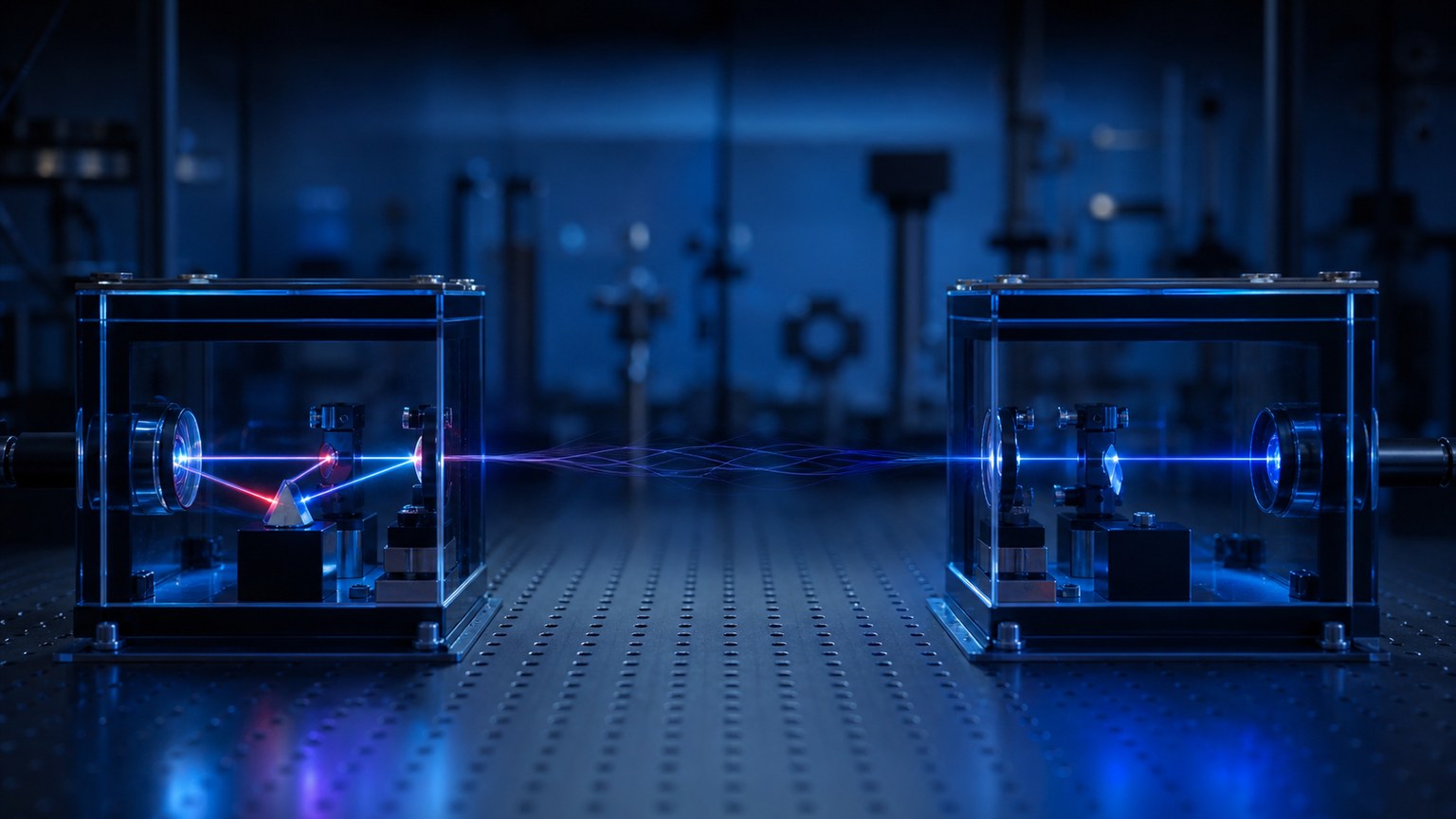
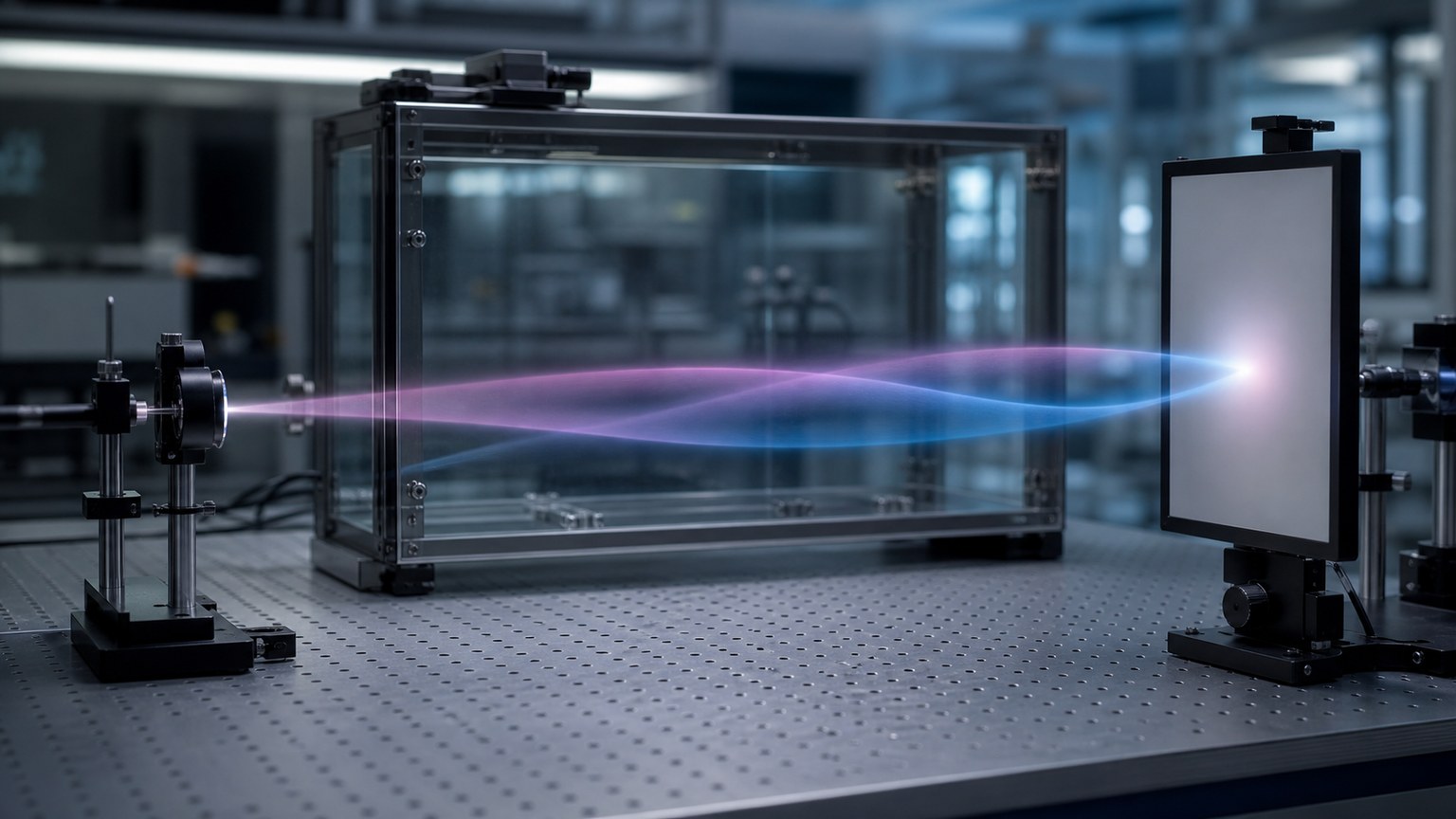
Quantum physics has a reputation for being strange, abstract, and almost impossible to picture. Words like “uncertainty,” “entanglement,” and “superposition” often sound more like science fiction than science. Yet these ideas are not just theoretical curiosities. They describe how the universe truly behaves at its smallest scales and they already power much of the technology we rely on every day. Among all quantum concepts, superposition stands out as one of the most fascinating and confusing. It challenges the way we naturally think about reality, forcing us to reconsider ideas like “either/or,” “here or there,” and “on or off.” Superposition suggests that, at the quantum level, nature does not always choose a single state. Instead, it allows multiple possibilities to exist at the same time. This article is a beginner-friendly guide to superposition. You do not need a background in physics or mathematics. We will explore what superposition means, why it exists, how scientists discovered it, and how it shows up in real technologies. Along the way, we will use everyday analogies to make this mind-bending idea feel more intuitive and less intimidating.
A: No, they are confirmed by repeated experiments.
A: At quantum scales, particles exist as probabilities.
A: No, any interaction that gathers information counts.
A: Large objects interact too much with their environment.
A: Outcomes are random, but probabilities are precise.
A: Yes, they power electronics, lasers, and computing.
A: Yes, under carefully engineered conditions.
A: They are real descriptions encoded in math.
A: Yes, research continues to expand its limits.
A: No—concepts can be understood intuitively.
The Classical World We’re Used To
To understand why superposition feels so strange, it helps to start with how the everyday world works. In normal, everyday life, objects tend to be in one clear state at a time. A light switch is either on or off. A coin lying on a table is either heads or tails. A car is either parked in your driveway or it is not.
This way of thinking is called classical logic. It works extremely well for objects we can see and touch. If you throw a ball, it follows a single path through the air. If you open a door, it is either open or closed. Our brains evolved in this environment, so we naturally expect reality to behave this way. For centuries, scientists assumed that everything in the universe followed these same rules. Atoms, electrons, and light were assumed to behave like tiny versions of familiar objects. But as scientists began to study matter and energy at very small scales, they found something deeply unexpected.
Enter the Quantum World
The quantum world is the realm of atoms, electrons, photons, and other fundamental particles. At this scale, nature behaves very differently. Objects no longer have sharply defined positions and states the way larger objects do. Instead, they are described by probabilities.
One of the most surprising discoveries of quantum physics is that particles can exist in multiple states simultaneously. This is not a metaphor or a philosophical trick. It is a mathematically precise and experimentally verified feature of reality. This phenomenon is called superposition. In simple terms, superposition means that a quantum system can be in more than one state at the same time until it is measured or observed. Only when we look does the system appear to “choose” a single outcome.
What Is Superposition, in Plain Language?
Imagine flipping a coin into the air. While it is spinning, it is not heads or tails yet. It has the potential to become either outcome. In the classical world, this uncertainty is just practical. We do not know the result yet, but the coin itself is always in a definite physical state.
In the quantum world, superposition goes further. A quantum coin, so to speak, is not just unknown. It truly exists as both heads and tails at the same time. The system contains multiple possibilities simultaneously, each with a certain probability.
An electron, for example, can be in multiple positions at once. A photon can travel along multiple paths at the same time. An atom can exist in multiple energy states simultaneously. This continues until something interacts with the system strongly enough to count as a measurement. At that moment, the superposition appears to collapse into a single outcome.
Why Superposition Is Not Just Ignorance
A common misunderstanding is to think that superposition simply reflects our lack of knowledge. It might seem like scientists are saying, “We just don’t know which state the particle is in yet.” But quantum experiments show that superposition is not about ignorance. It is about how nature actually behaves.
This becomes clear in experiments where quantum states interfere with each other, much like overlapping waves on water. When particles in superposition are allowed to recombine, they produce interference patterns that could not exist if the particles had secretly been in one definite state all along. These experiments reveal that all the possible states in a superposition are real in a measurable, physical sense. They can reinforce each other, cancel each other out, and shape the final outcome in ways that classical physics cannot explain.
Waves, Particles, and the Roots of Superposition
One reason superposition exists is that quantum objects behave like waves as well as particles. Waves naturally spread out and overlap. When two waves meet, they do not choose a single path. They combine, forming complex patterns.
In quantum physics, particles such as electrons and photons are described by wavefunctions. A wavefunction encodes all the possible states a particle can occupy and the probabilities associated with each one. When a particle is in superposition, its wavefunction contains multiple overlapping possibilities.
This wave-like nature explains why superposition is not an exception but a fundamental rule of quantum physics. Wherever waves can exist, superposition follows naturally.
Schrödinger’s Cat and Popular Misunderstandings
No discussion of superposition would be complete without mentioning Schrödinger’s cat. This famous thought experiment imagines a cat placed in a sealed box with a quantum device that has a 50 percent chance of killing the cat. According to the logic of quantum superposition, until the box is opened, the cat would be both alive and dead at the same time. This scenario was not meant to be taken literally. Schrödinger proposed it to highlight how strange quantum rules become when applied to everyday objects. In practice, large objects like cats interact with their environment so strongly that superposition breaks down almost instantly. Still, the thought experiment is useful because it captures the essence of superposition and its unsettling implications. It shows how quantum physics challenges our assumptions about reality, observation, and measurement.
Measurement and the Collapse of Superposition
One of the deepest questions in quantum physics is what happens during measurement. When a quantum system is observed, its superposition appears to collapse into a single state. An electron suddenly has a definite position. A photon chooses a single path. A quantum bit becomes either a zero or a one.
What exactly counts as a measurement is still debated. Does it require a human observer? A measuring device? Interaction with the environment? Different interpretations of quantum mechanics answer these questions in different ways. What is clear is that before measurement, the system behaves as if all possible states coexist. After measurement, we observe only one outcome. Superposition governs the evolution of the system up until that moment.
Superposition in Everyday Technology
Although superposition sounds abstract, it is already embedded in modern technology. Many devices rely on quantum effects that would be impossible without superposition. Lasers work because atoms exist in superpositions of energy states, allowing them to emit coherent light. Semiconductors and transistors depend on quantum behavior inside materials. Magnetic resonance imaging, or MRI, uses quantum superposition in atomic nuclei to produce detailed images of the human body. Even the screens you are reading this on depend indirectly on quantum rules that include superposition. While you do not see superposition directly, it quietly shapes the behavior of the microscopic components inside your devices.
Superposition and Quantum Computing
One of the most exciting applications of superposition is quantum computing. Traditional computers use bits that are either zero or one. Quantum computers use quantum bits, or qubits, which can exist in superpositions of zero and one at the same time.
This does not mean quantum computers try every answer simultaneously in a magical way. Instead, superposition allows quantum algorithms to explore many possibilities at once and then use interference to amplify correct answers and suppress incorrect ones.
This ability could make quantum computers extraordinarily powerful for certain tasks, such as factoring large numbers, simulating molecules, and optimizing complex systems. Superposition is the core resource that gives quantum computing its potential advantage.
Why We Don’t See Superposition in Daily Life
If superposition is a fundamental rule of nature, why do we not experience it directly? Why don’t chairs exist in multiple places at once or traffic lights show all colors simultaneously?
The answer lies in a process called decoherence. Large objects constantly interact with their environment through light, heat, air molecules, and other influences. These interactions destroy delicate quantum superpositions almost instantly, forcing systems into classical behavior. At the scale of everyday objects, superposition disappears so quickly that classical physics becomes an excellent approximation. The quantum world is still there underneath, but its strange effects are hidden from view.
Superposition and Reality: Philosophical Implications
Superposition raises profound questions about the nature of reality. If particles exist in multiple states at once, what does that say about the idea of a single, objective world? Does reality depend on observation? Do all possible outcomes exist in some sense?
Different interpretations of quantum mechanics offer different answers. Some suggest that all outcomes occur in branching universes. Others propose that reality remains fuzzy until measured. Still others treat the wavefunction as a tool for calculating probabilities rather than a physical object.
While physicists continue to debate these ideas, experiments consistently confirm the predictions of superposition. Regardless of interpretation, the mathematical framework works remarkably well.
Learning to Think Quantum
For beginners, the hardest part of understanding superposition is letting go of classical intuition. Quantum physics does not replace common sense; it supplements it. Classical rules still apply where they work, but they are not the whole story. Thinking quantum means becoming comfortable with probabilities, overlapping possibilities, and outcomes that are not determined until measurement. It means accepting that reality at small scales is not built from tiny billiard balls but from waves of possibility. With time and exposure, superposition becomes less mysterious and more fascinating. It reveals a universe that is richer, more flexible, and more creative than classical physics ever imagined.
Why Superposition Matters
Superposition is not just a technical detail in physics textbooks. It is a central principle that shapes our understanding of nature. It explains why atoms are stable, why chemistry works, why light behaves the way it does, and why future technologies like quantum computers are possible.
By learning about superposition, you gain insight into the hidden structure of reality. You begin to see the universe not as a rigid machine but as a dynamic system of possibilities constantly interacting and evolving. For beginners, superposition is often the first step into the strange and beautiful world of quantum physics. It challenges intuition, sparks curiosity, and opens the door to deeper questions about existence itself.
Final Thoughts: Embracing the Strange
Superposition reminds us that the universe does not have to make sense in the ways we expect. Nature is not obligated to follow human intuition. Instead, it follows deeper rules that reveal themselves through careful observation and experiment. What once seemed impossible, such as being in two states at the same time, turns out to be a fundamental feature of reality. Far from undermining science, superposition has strengthened it, leading to new technologies, new insights, and new ways of thinking. For anyone curious about the quantum world, superposition is a perfect place to begin. It captures the wonder, the challenge, and the excitement of modern physics, all while showing that reality is far more interesting than we ever imagined.