When Quantum Alternatives Meet Again
Quantum state interference happens when coherent alternatives in a quantum state overlap and combine before a measurement is finished. The word interference can make people imagine two physical waves crashing into each other like water. That picture helps a little, but the deeper idea is about amplitudes. A quantum system can have several possible ways to reach the same measured outcome. If those ways remain coherent, their amplitudes must be combined before probabilities are calculated. Sometimes the combination makes an outcome more likely. Sometimes it makes an outcome less likely. That is why interference patterns contain bright regions, dark regions, shifted fringes, or changed readout statistics. The system is not choosing a secret path and then adding decorative wave effects later. The possible alternatives are part of the state description until the experiment creates a record that distinguishes them. When the alternatives overlap without being marked, they can act together. When the apparatus or environment records which alternative occurred, the interference can fade. For beginners, the main lesson is not that quantum objects are simply ordinary waves. It is that quantum states combine possibilities in a way ordinary either-or thinking cannot reproduce.
A: Coherent amplitude contributions that can reach the same measured result.
A: Quantum alternatives can carry phase and cancel.
A: No. The pattern appears across many trials.
A: Distinguishing records about the alternatives.
A: Yes. Their abstract state components can recombine.
A: Amplitudes can oppose each other there.
A: No. Matter systems can show it too.
A: They vary phase, mark alternatives, and compare statistics.
A: No. Physical records are enough.
A: Coherent alternatives combine before outcomes become records.
What Overlap Means in a Quantum State
Overlap does not always mean two visible things occupy the same place. In quantum mechanics, overlap often means that different amplitude contributions can lead to the same final measurement possibility. The mathematics then requires those contributions to be added before probabilities appear.
This is different from ordinary alternatives. If two classical routes lead to a detector and a particle definitely took one route, we can add ordinary probabilities. If the route alternatives remain coherent, quantum mechanics adds amplitudes. The difference changes the final pattern.
Overlap is therefore a condition for comparison. The alternatives have to be arranged so the experiment can no longer say which one happened while still asking about their combined effect.
Why Amplitudes Combine Before Probabilities
Probabilities are the numbers we see in repeated results. Amplitudes are the ingredients used before those probabilities are formed. Because amplitudes can carry phase, they can reinforce or cancel one another.
This is the heart of interference. Two alternatives with the same individual strength can produce different final results depending on their relative phase. Ordinary probability has no matching operation for cancellation between possibilities.
The Double-Slit Lesson Without the Myth
The double-slit experiment is famous because it gives a simple version of this logic. If the setup does not reveal which slit the particle went through, the alternatives contribute together to the final pattern. Detections arrive one at a time, but the long-run distribution shows interference.
If the apparatus records which slit was used, the pattern changes. The alternatives no longer combine in the same way because the experiment has made them distinguishable. Nothing in this lesson requires a conscious observer staring at the apparatus.
The myth is that a particle knowingly chooses how to behave. The stronger lesson is that the physical setup decides whether alternatives remain coherent enough to interfere.
Constructive and Destructive Combination
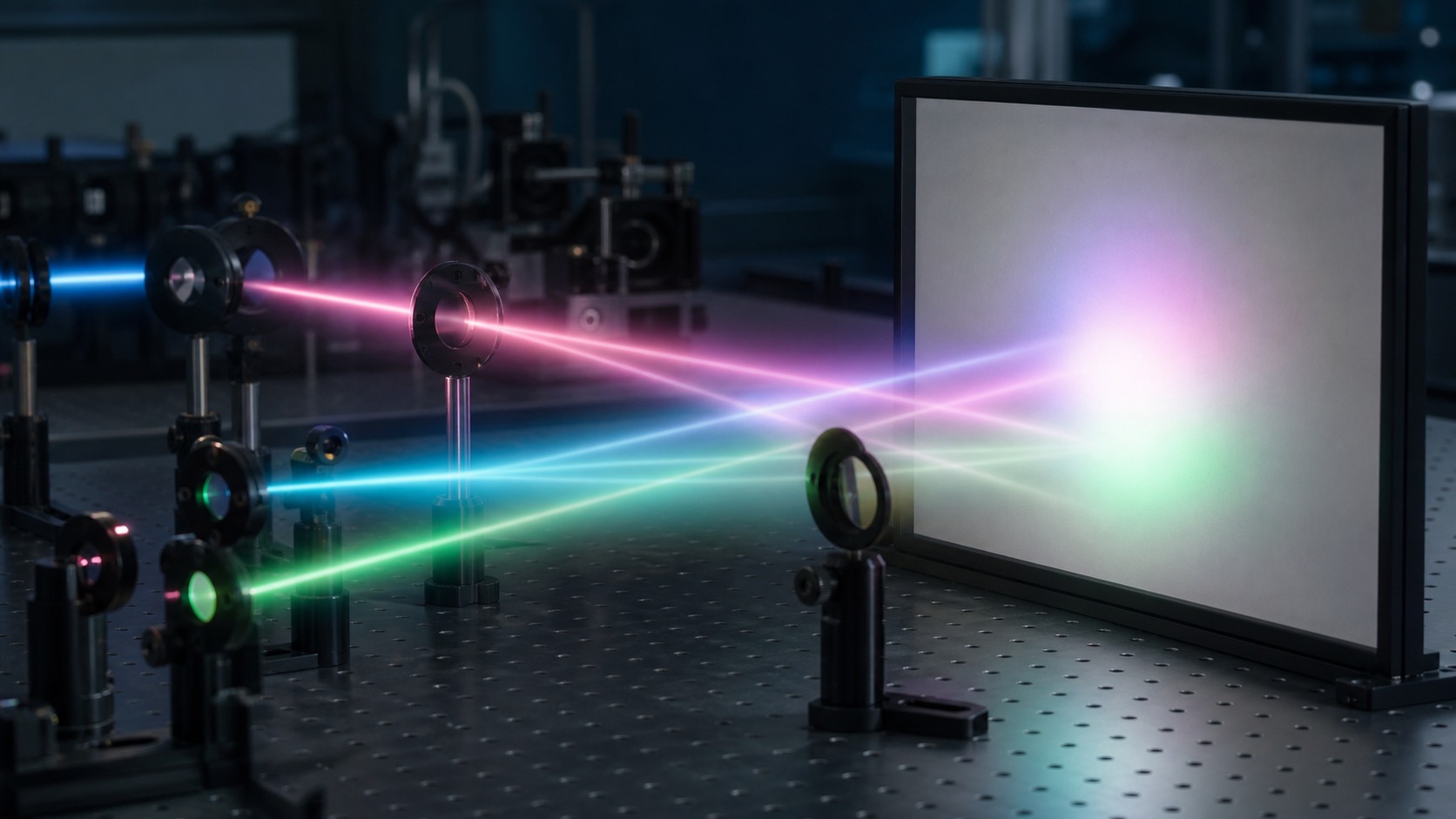
Constructive interference means amplitude contributions line up so that a result becomes more likely. Destructive interference means they oppose each other so that a result becomes less likely. These names describe probability changes, not emotional behavior by particles.
The effect can appear as bright and dark bands, changing spin results, altered qubit readout probabilities, or shifted atom-interferometer signals. The form depends on the system, but the logic is shared.
What matters is not that quantum objects look like little waves on a screen. What matters is that their state contributions combine according to phase-sensitive rules.
The water-wave picture is helpful only up to a point. Quantum amplitudes carry both size and phase, so overlap is a rule for combining possibilities rather than a visible ripple in space. That is why interference can appear even when the alternatives were never classical little waves.
Why One Detection Is Not the Pattern
A single detection event is localized. An electron lands in one place. A photon triggers one detector. A qubit readout returns one value. That single outcome does not display the whole interference structure.
The pattern appears only after many similarly prepared trials. Each trial contributes one record, and the distribution of records reveals how amplitudes combined. This is why quantum evidence often lives in statistics rather than in a single dramatic picture.
What Which-Path Information Removes
Which-path information is any physical record that distinguishes alternatives. It may be stored in a detector, scattered light, a vibrating surface, a surrounding gas molecule, or another part of the system. If that information exists in principle, interference can weaken.
The important phrase is physical record. A human does not need to read the record for it to matter. Once the alternatives become correlated with distinguishable marks, the amplitudes for the smaller system no longer recombine cleanly.
This is why interference experiments are often so carefully isolated. Researchers are not hiding the result from people. They are preventing the environment from carrying away the comparison before the intended measurement.
Interference in Qubits
Qubits do not always interfere through literal paths in space. Their alternatives may be abstract readout states, energy levels, spin orientations, or collective states in a circuit. Gates create, rotate, and recombine those alternatives.
In a useful quantum algorithm, wrong-answer amplitudes can be arranged to cancel while useful-answer amplitudes are strengthened. That is a form of interference, even when no screen shows stripes. The pattern is in the final distribution of readouts.
This makes qubit interference less pictorial but deeply practical. It is the controlled overlap of state components that gives quantum computation its distinctive behavior.
Good interference data also includes the quiet places. The missing detections between bright regions are part of the evidence, not empty decoration. They show that some alternatives canceled instead of merely failing to arrive.
Interference in Matter Waves
Matter-wave interference shows that the same state logic applies to objects with mass. Electrons, atoms, neutrons, and molecules can produce interference when their alternatives remain coherent. The object is detected in one place, yet the distribution reflects wave-like state combination.
These experiments are powerful because they pressure the simple idea that matter always travels as a tiny classical pellet. During the coherent part of the setup, more than one possible contribution must be included.
How to Read an Interference Claim
When an article says an experiment showed interference, ask what alternatives were allowed to overlap. Were they paths, spin states, energy states, polarizations, or qubit readout states? The answer tells you what kind of coherence was being tested.
Next ask how the researchers ruled out ordinary explanations. A strong interference claim usually includes control settings, phase scans, visibility measurements, or deliberate marking of alternatives to show the pattern disappears when distinguishability is introduced.
That habit keeps the result grounded. Interference is not just any repeating pattern. It is a pattern whose behavior follows from coherent amplitude combination.
Why Coherence Is the Gatekeeper
Interference needs coherence because alternatives must remain connected long enough to be compared. If the environment marks one alternative, the comparison no longer belongs only to the small system. The final pattern changes because information has leaked outward.
This makes coherence the gatekeeper for quantum overlap. A system can have several possible outcomes and still fail to interfere if the phase relationship has become inaccessible. Uncertainty alone is not enough.
That distinction is useful when reading experiments. Ask not only whether alternatives existed, but whether they stayed coherent until the intended recombination or readout.
Good interference results usually show both sides: the pattern appears when coherence is protected, and it fades when distinguishability is introduced.
How Phase Scans Strengthen the Case
A phase scan changes a controlled setting and watches the pattern move or the readout statistics oscillate. This is stronger than seeing one static pattern because it shows that the result responds to the expected quantum relationship.
For example, shifting one path in an interferometer should shift where constructive and destructive combinations occur. In a qubit, changing a pulse phase should change the final readout distribution. The details differ, but the logic is the same.
A moving pattern is harder to dismiss as a fixed detector artifact. It ties the evidence to the controlled overlap of amplitudes.
Why Interference Is Useful, Not Just Strange
Interference is a practical tool. It lets scientists measure tiny changes in distance, acceleration, gravity, magnetic fields, and time. It also lets quantum algorithms suppress some outcomes and favor others through amplitude manipulation.
The same feature that makes interference philosophically surprising makes it technologically valuable. A small phase change can become a large change in probability or fringe position when the setup is sensitive enough.
This is why laboratories protect interferometers so carefully. A fragile pattern can become a precise instrument if the unwanted noise is controlled.
Interference turns the delicacy of quantum states into a measurable advantage.
What Classical Waves Teach and Hide
Classical waves teach the basic idea of reinforcement and cancellation. Water waves and sound waves can combine in ways that make peaks larger or quieter regions appear. That analogy helps at the beginning.
The analogy hides the quantum twist. Quantum interference appears in the probabilities of localized measurement outcomes, even when events arrive one by one. The wave-like structure belongs to the state description, not necessarily to a visible material ripple.
Use the wave analogy for combination, then let it go before it turns particles into miniature ocean waves.
Why Interference Needs a Complete Setup
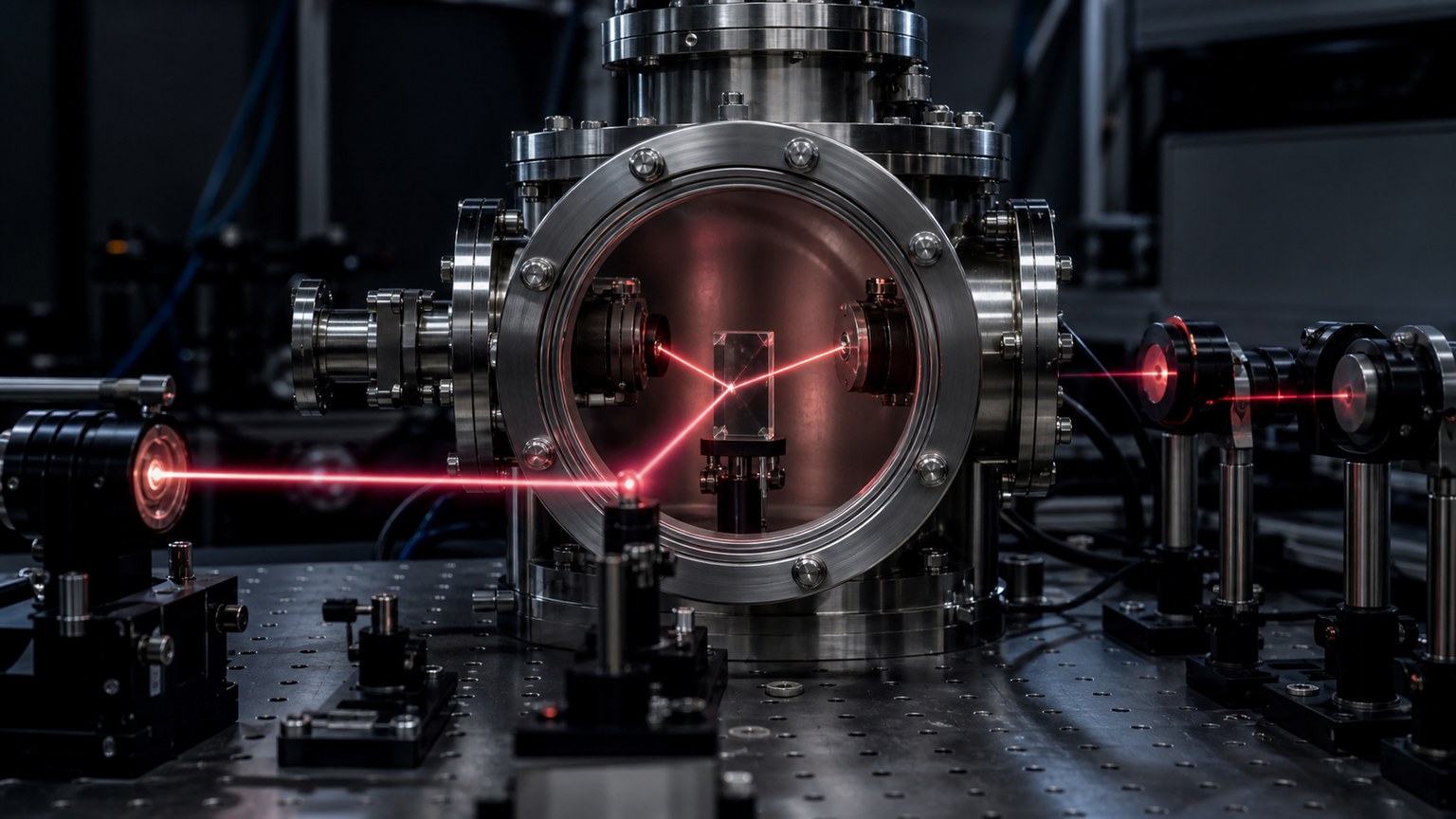
Interference is never only about the particle. It is about the whole arrangement: source, paths, phase stability, environment, recombination, and detector. Change the setup, and the possible amplitude combinations change with it.
This is why two experiments involving the same particle can tell different stories. One arrangement can preserve alternatives and reveal interference. Another can mark alternatives and produce ordinary-looking statistics. The particle has not changed personality; the physical question has changed.
Thinking in terms of the complete setup also prevents the observer myth. The important issue is not whether someone watches from across the room. It is whether the apparatus or environment creates a record that distinguishes the alternatives.
When the setup is understood, interference becomes less like a magic trick and more like a strict test of coherence.
That is the mindset researchers use when they build phase scans, path markers, and control experiments.
Why Losing Interference Is Also Information
A failed interference pattern can teach nearly as much as a successful one. If the expected bright and dark regions disappear, the experiment is saying that the alternatives no longer combine with stable phase. That loss points to hidden records, noise, or poor control.
This is why researchers test several versions of the same setup. They may block one path, add a phase shift, change the environment, or alter the timing. The goal is to show that the pattern responds like quantum interference rather than like an accidental blur.
Reading interference well means respecting both presence and absence. The pattern matters, and so does the disciplined way it fades.
The Overlap Takeaway
Quantum interference appears when alternatives remain coherent enough to be compared before the final record is made.
When those alternatives overlap, amplitudes combine first, and the probabilities we later measure can rise, fall, or shift in ways classical alternatives cannot imitate.