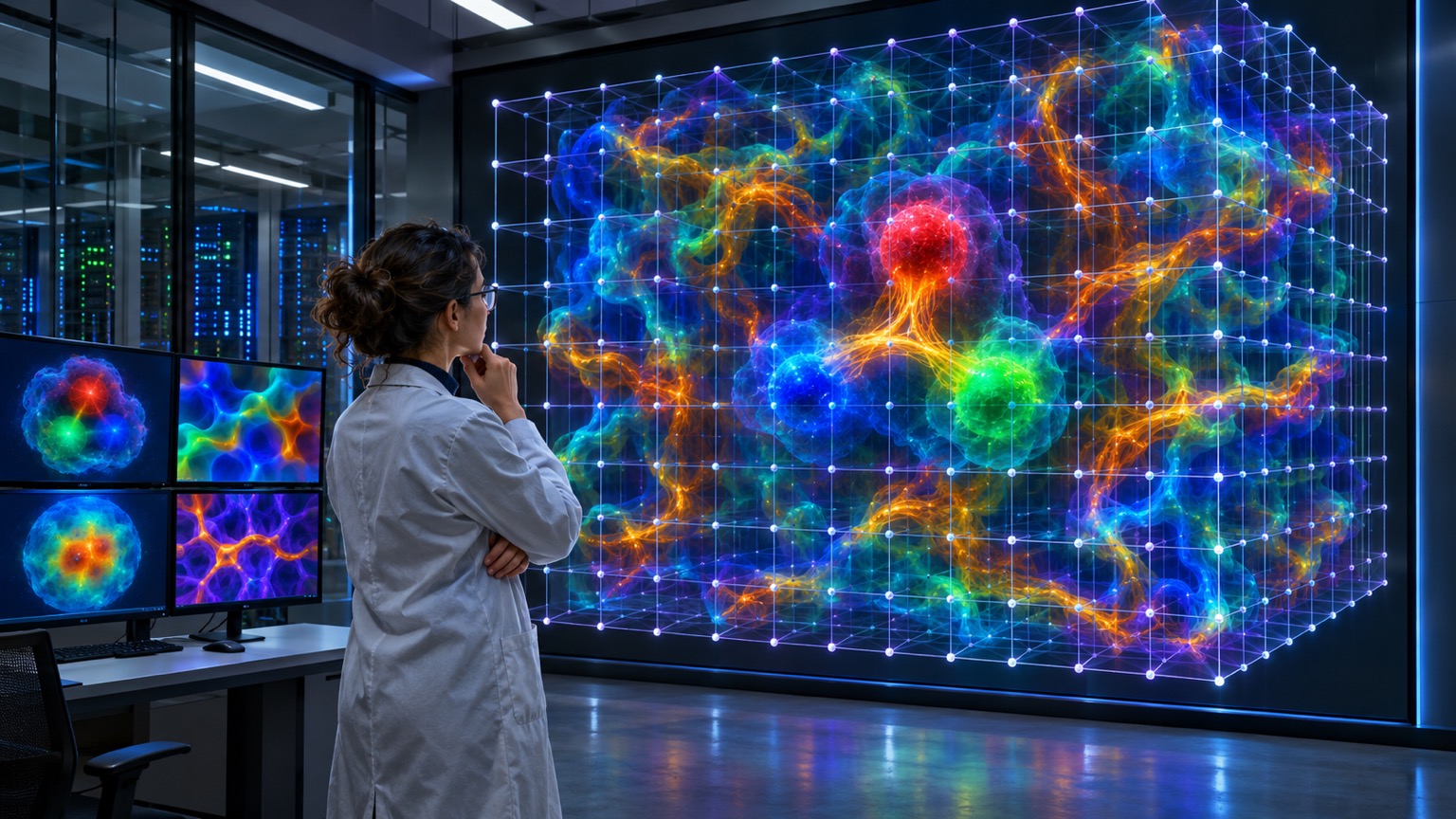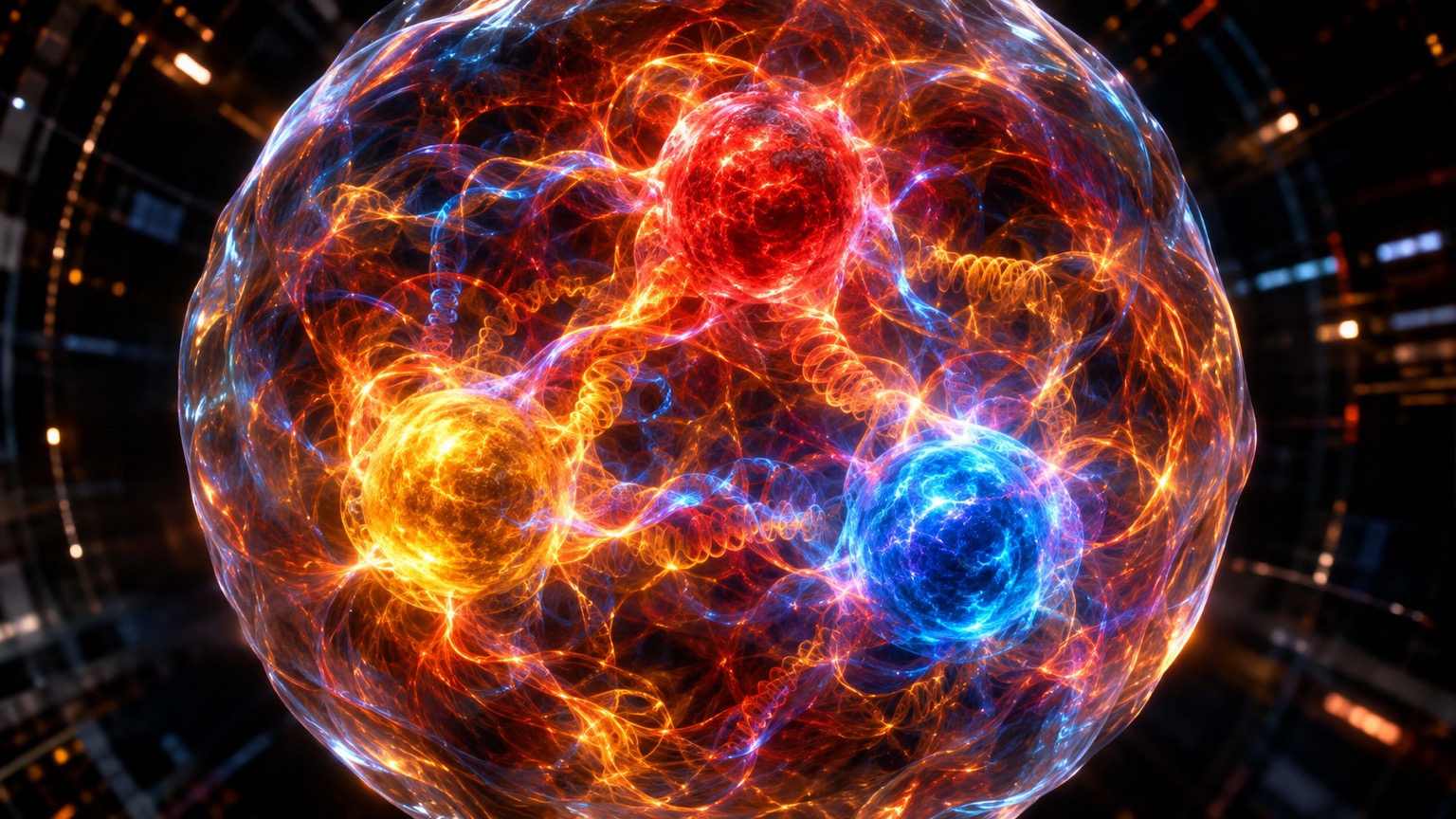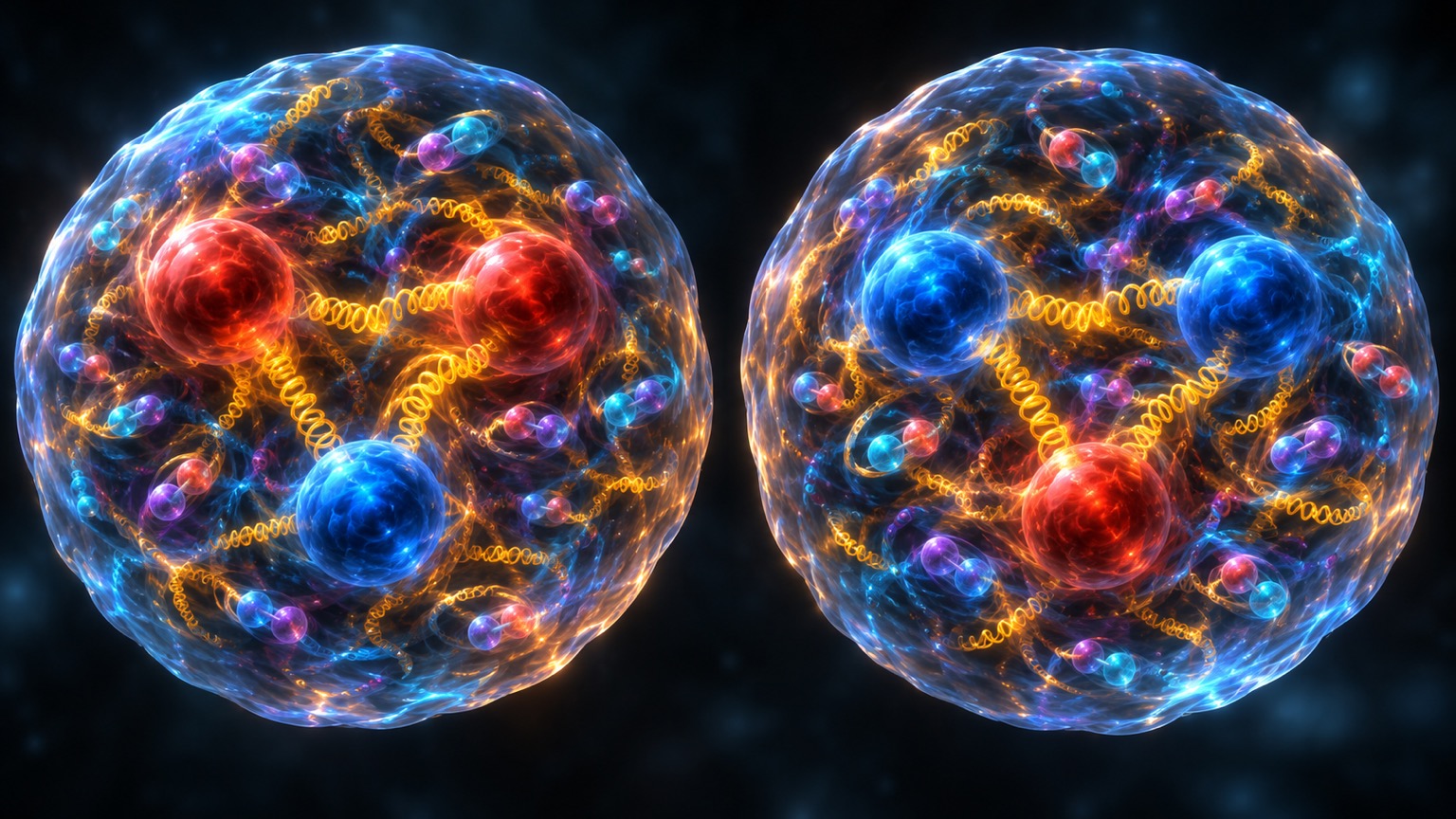
Inside a Nucleon, Quarks and Gluons Form a Moving Quantum System
The familiar statement that a proton contains two up quarks and one down quark is correct, but incomplete. Those valence quarks identify the proton’s lasting quantum numbers while gluons carry much of its momentum and continually generate short-lived quark-antiquark pairs. A neutron has one up and two down valence quarks, yet its interior is equally dynamic. Neither particle has a miniature mechanical skeleton. Each is a fluctuating QCD state whose measured structure changes with the resolution and viewpoint of the experiment.
A: Three valence quarks set its identity, while gluons and sea pairs also populate its state.
A: They form a distributed quantum field rather than occupying fixed classical positions.
A: Finer probes distinguish radiation that coarser measurements treat as unresolved.
A: QCD motion and field energy dominate over bare light-quark masses.
A: Their particle-antiparticle contributions preserve the net charge and flavor totals.
A: They alter scaling, jets, heavy-flavor production, and many correlated event rates.
A: No. It is distributed among quark, gluon, and orbital contributions.
A: Its internal positive and negative charge distributions cancel only overall.
A: It radiates and hadronizes, producing an observable jet or hadron system.
A: Higher energy resolves shorter distances but final colored partons still hadronize.
Valence Quarks Define Identity, Not a Complete Inventory
Adding the electric charges of two up quarks and one down quark gives the proton’s positive unit charge. Replacing one up with a down produces the neutron’s zero charge. The same valence pattern helps determine baryon number, isospin, and other persistent properties.
At any instant described by quantum field theory, additional components contribute. A gluon may split into a quark-antiquark pair, and quarks may emit further gluons. These sea constituents do not change the net flavor numbers because particles and antiparticles appear together, but they affect momentum, spin, and scattering.
The word inside can also mislead. A proton does not have a rigid boundary containing classical objects at definite positions. Experiments describe probability distributions, correlations, and field configurations. Different measurements project different aspects of the same quantum state.
Gluon Exchange Constantly Rearranges Color
A quark emitting a gluon changes its color state. The gluon carries the compensating color and can interact with another quark or gluon. Through countless allowed configurations, the total proton or neutron remains a color singlet even though its components exchange color continually.
Because gluons interact with one another, the field forms a dense network rather than a few simple messenger lines. This self-coupling helps concentrate color flux and drives confinement. The nucleon’s stability is therefore a collective property of the full field, not a balance of three pairwise springs.
Momentum Is Shared Among Many Constituents
In a fast-moving proton, physicists describe constituents through parton distribution functions. A distribution gives the probability density for finding a quark, antiquark, or gluon carrying a particular fraction of longitudinal momentum at a chosen resolution scale.
Valence quarks dominate some moderate momentum fractions, while gluons and sea quarks become especially important at small fractions. The distributions evolve as resolution changes because a finer probe can distinguish additional radiation that a coarser probe treats as part of one constituent.
Momentum conservation constrains the total share across all partons. Global analyses fit distributions using deep-inelastic scattering, vector-boson production, jets, and other reactions. No single experiment maps every flavor and momentum region equally well.
Calling the distributions pictures is useful only with care. They depend on factorization conventions and scale. Their predictive value comes from universality: distributions extracted from selected processes successfully enter calculations for different high-energy collisions.
Nucleon Spin Emerges from Several Sources
The proton has spin one-half, but simply aligning three quark spins does not explain the measured decomposition. Quark and antiquark helicities supply one contribution. Gluon helicity supplies another, while orbital angular momentum of quarks and gluons completes the accounting.
Experiments using polarized beams compare scattering rates for different spin orientations. The differences constrain helicity distributions and reveal how spin-dependent momentum is organized. Considerable uncertainty remains, particularly for gluons at small momentum fractions and for orbital components.
Different decompositions can assign contributions in mathematically distinct but consistent ways. A valid statement must specify the definition, scale, and experimental observable. The so-called proton spin puzzle is not evidence that angular momentum disappears; it is a program to identify how the total is distributed.
Mass Comes Mostly from Motion and Field Energy
The current masses of up and down quarks are only a small portion of a nucleon’s mass. Quarks move relativistically inside a confining gluon field, and that field stores energy. QCD dynamics set a natural scale that turns these light ingredients into a roughly one-gigaelectronvolt composite particle.
Virtual quark-antiquark activity also changes the vacuum around the constituents. Chiral symmetry is spontaneously broken, producing effective constituent behavior and light pion modes. These concepts organize low-energy physics, though a constituent quark in a model is not identical to the fundamental quark field parameter.
Protons and Neutrons Have Spatial Structure
Elastic electron scattering measures form factors related to charge and magnetization distributions. The proton’s positive charge is spread across a finite region rather than concentrated at a point. The neutron, despite zero net charge, has nontrivial internal charge structure because positive and negative contributions cancel only in total.
Generalized parton distributions connect longitudinal momentum information with transverse spatial information. They support a three-dimensional description often called nucleon tomography. Such maps also provide routes toward understanding parton orbital angular momentum.
Transverse-momentum-dependent distributions retain information about motion perpendicular to the nucleon’s overall direction. Spin and transverse motion can be correlated, creating measurable asymmetries. These effects turn a one-dimensional momentum inventory into a richer picture of internal dynamics.
No single density is the unique photograph of a nucleon. Relativistic quantum systems look different under different projections, frames, and operators. Combining complementary observables is the scientifically honest route to structure.
Deep-Inelastic Scattering Resolves Partons
An energetic electron exchanges a highly virtual photon with the nucleon. The electron’s changed energy and angle determine the momentum transfer, while produced hadrons reveal aspects of the struck system. At sufficiently large transfer, the event resolves short-distance quark and gluon behavior.
Scaling patterns first suggested pointlike constituents. Their controlled violations later matched QCD evolution, showing that partons radiate and that the resolved content changes with scale. This provided crucial evidence for both quarks and gluons.
Neutrino scattering adds different flavor sensitivity through weak interactions. Semi-inclusive measurements identify selected outgoing hadrons, and exclusive reactions keep the nucleon intact or produce a defined final state. Each channel sacrifices some inclusiveness to gain a particular structural insight.
Collisions Expose Gluon Dynamics Through Jets
At proton colliders, a quark or gluon from each beam undergoes a hard interaction. The remaining beam fragments continue forward, while the scattered partons generate showers and jets. Rates depend on both the hard QCD matrix element and the probability of finding the initiating partons.
Gluon-initiated jets tend to radiate more and appear broader than quark-initiated jets, although individual classification is probabilistic. Heavy quarks leave additional signatures through displaced decays and identified hadrons. Modern analyses combine many observables while controlling detector and modeling biases.
Confinement Turns Partons into Hadrons
As a scattered parton moves away, its color field cannot remain as an isolated long-range strand. Additional pairs form, and the system reorganizes into color-neutral mesons and baryons. Energy, momentum, charge, and quantum numbers are conserved across the transition.
Hadronization occurs at a scale where perturbative calculations lose reliability. Event generators use models calibrated against data, while analytic work identifies observables that minimize sensitivity to modeling. The resulting uncertainty is part of the prediction and must not be confused with detector error.
The same physics explains why searching for a free quark by simply increasing collision energy fails. More energy produces richer sprays and heavier hadrons, not an isolated color charge. High energy reveals shorter-distance parton behavior during the collision while confinement governs the final state.
Neutrons Change the Balance Without Changing the Rules
Protons and neutrons follow the same QCD equations. Their different valence flavors change electric charge, magnetic moment, weak response, and a small portion of their mass. The neutron is slightly heavier, allowing a free neutron to beta decay, whereas a proton is the lightest baryon and is stable within the Standard Model.
Inside nuclei, binding changes available decay energies and modifies parton distributions subtly. Nuclear environments can alter measured quark and gluon behavior without implying that nucleons lose all identity. Separating conventional nuclear effects from more exotic collective phenomena is a continuing experimental challenge.
Future electron-ion facilities aim to map gluons with unprecedented precision, especially at small momentum fractions. Polarized measurements will refine spin decomposition, and exclusive reactions will sharpen spatial imaging. The emerging picture is not three static quarks but a stable quantum pattern maintained by incessant quark and gluon interaction.
Comparing proton and neutron targets helps disentangle flavor contributions while preserving the shared QCD framework.
Correlations Reveal More Than One-Parton Distributions
An ordinary parton distribution asks about one constituent while summing over everything else. More detailed functions retain correlations between momentum, transverse position, spin, or multiple partons. These quantities help explain how the nucleon’s collective structure influences exclusive reactions and events containing several hard scatterings.
Generalized distributions connect different nucleon momentum states. Their moments relate to form factors and to components of angular momentum under specified definitions. Experiments access them indirectly through processes such as deeply virtual Compton scattering, where a highly virtual photon probes the nucleon and a real photon emerges while the nucleon remains intact.
Transverse-momentum-dependent distributions describe intrinsic sideways motion together with spin. They can produce azimuthal asymmetries when a polarized nucleon is struck. Careful factorization and evolution are essential because soft radiation also creates transverse momentum, and the separation between intrinsic and radiative effects depends on scale.
At small momentum fractions, gluon densities can grow so large that recombination competes with further splitting. Saturation frameworks explore this nonlinear regime. Establishing it experimentally requires multiple observables, nuclear-size comparisons, and control of conventional QCD evolution rather than relying on a single suggestive suppression.
Multiparton correlations also matter when two separate hard interactions occur in one proton-proton collision. Their rates depend on joint spatial and momentum structure, not merely products of independent probabilities. Studying such events turns collider backgrounds into probes of how partons are arranged together inside a nucleon.
Time-dependent language needs caution as well. A static image of three objects exchanging glowing threads can aid intuition, but a relativistic bound state does not possess one frame-independent sequence of internal snapshots. Calculations use quantum states and correlation functions, while experiments access response to a probe. The dynamic picture is real, yet its precise content is encoded in measurable operators rather than an unseen movie.
Nucleon structure also connects to nuclear physics. When protons and neutrons overlap in a nucleus, short-range correlations can produce high relative momenta. Quark distributions measured in nuclei differ from a simple sum of free-nucleon distributions, an observation known broadly through the EMC effect. Explaining the detailed pattern tests how QCD composites behave in a many-body environment.
Astrophysical matter extends the question further. Neutron-star cores compress baryons beyond ordinary nuclear density, where new phases involving hyperons, paired quarks, or deconfined matter may become favorable. Laboratory data and QCD calculations constrain possible equations of state, while stellar masses, radii, cooling, and merger signals test the resulting macroscopic predictions.
Across all these settings, the proton and neutron remain useful names for stable quantum states, not sealed containers with fixed contents. Their valence flavors anchor identity, while gluon fields, sea pairs, and correlations respond to scale and environment. Measurements of momentum, spin, spatial structure, nuclei, and stars illuminate different projections. The challenge is to combine them without forcing a classical interior onto a relativistic field system. That program turns a deceptively simple three-quark label into a quantitative account of dynamic matter composing nearly every atomic nucleus under conditions ranging from laboratories to neutron stars.
The same field rules govern every environment studied.