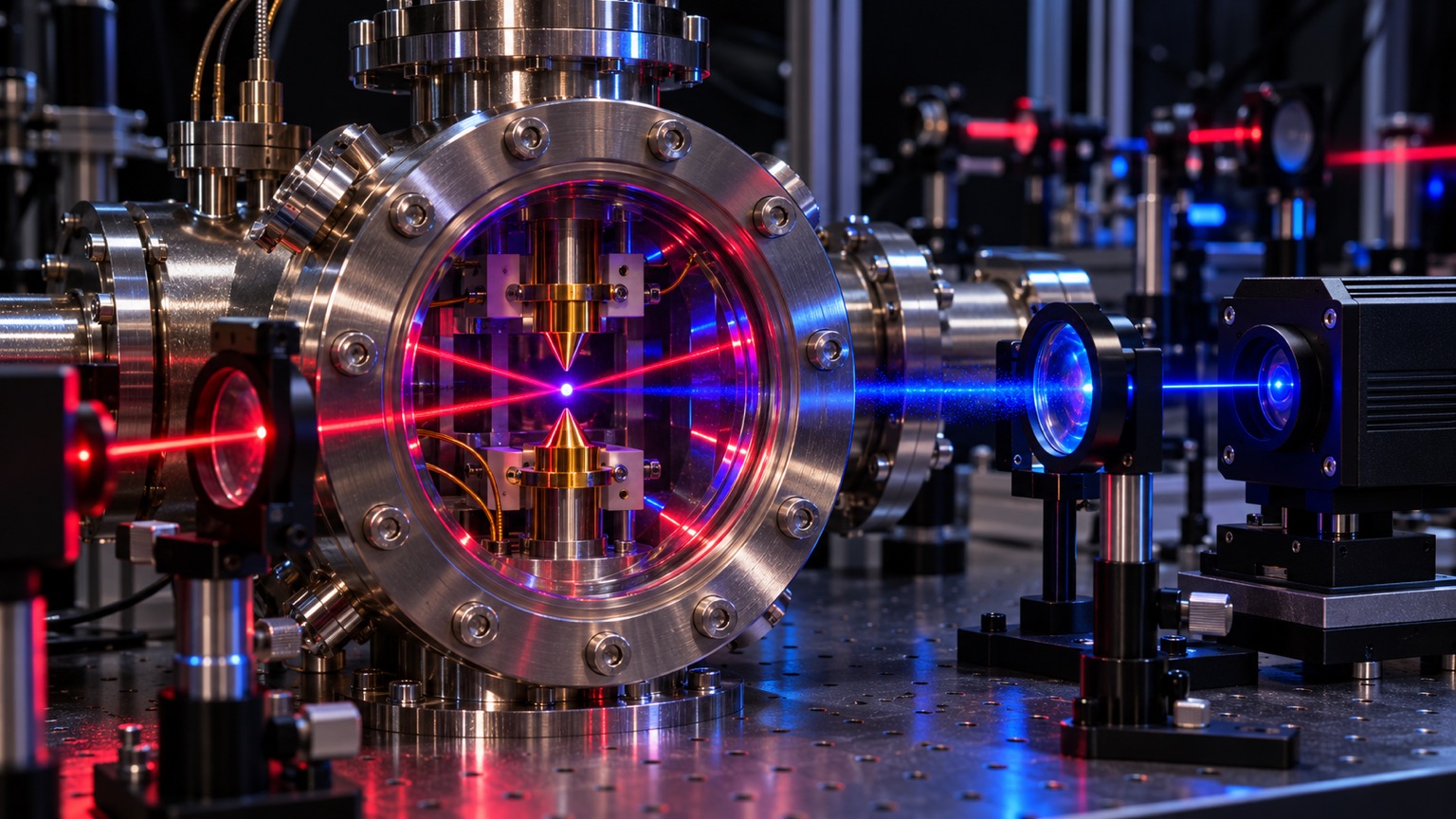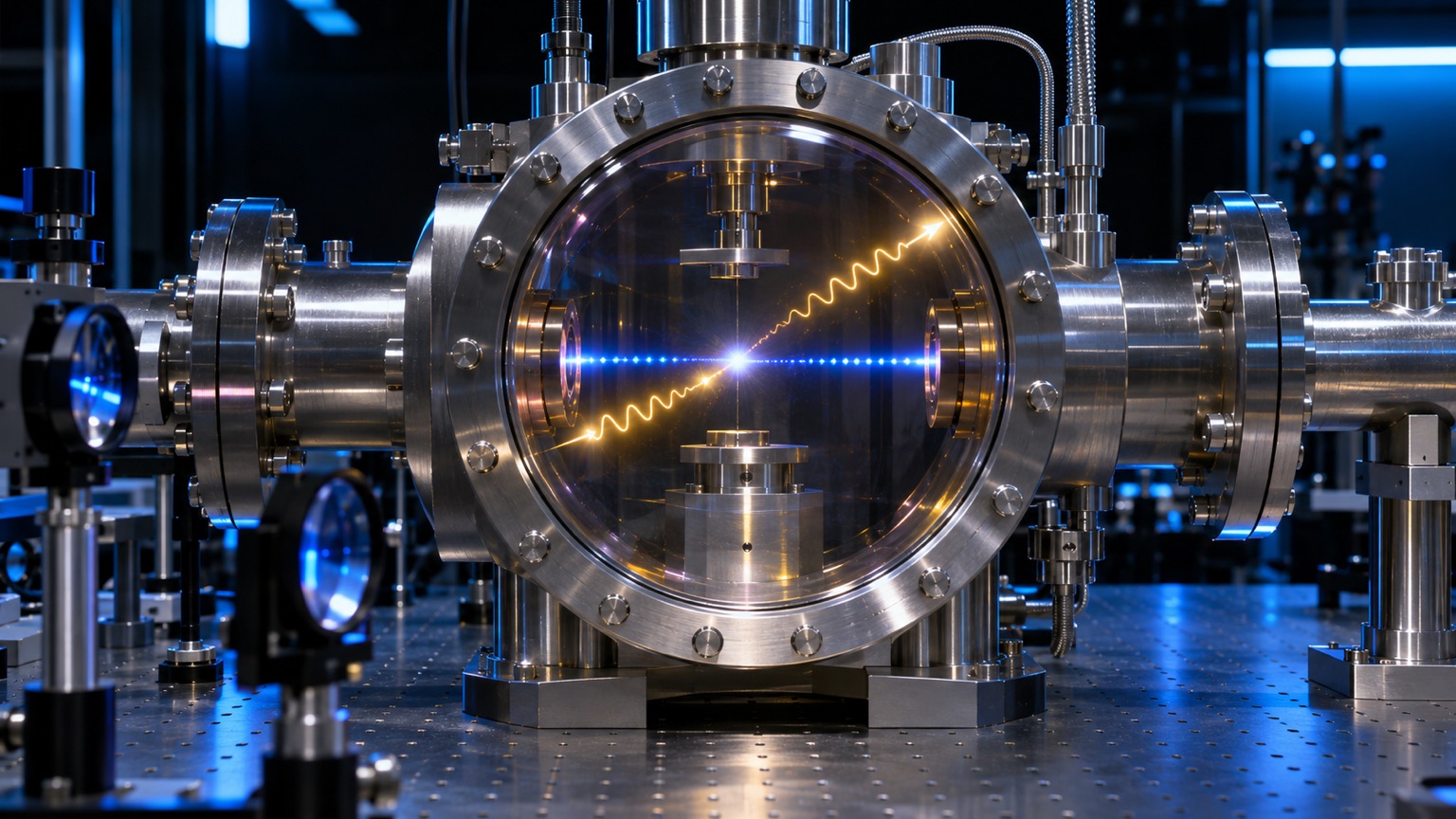
QED Is the Quantum Rulebook for Charged Matter and Light
Quantum electrodynamics, or QED, joins quantum mechanics, special relativity, and electromagnetism in one field theory. Its ingredients are charged fermion fields, especially the electron field, and the electromagnetic field whose quanta are photons. From their coupling, QED predicts scattering, atomic energy shifts, antimatter creation, radiation, magnetic moments, and the everyday interactions behind light and chemistry. The theory is celebrated not because every calculation is easy, but because a small set of symmetry rules produces extraordinarily precise numerical agreement with experiments.
A: It is the relativistic quantum field theory of charged particles and electromagnetic radiation.
A: No. It is an internal contribution within a complete measurable amplitude.
A: The Abelian U(1) gauge field is neutral under its own charge.
A: Yes indirectly, through loops of charged particles.
A: Charged quantum fluctuations modify how electromagnetic interaction appears at different scales.
A: It relates divergent intermediate expressions to finite measured parameters and predictions.
A: Its low-energy exchange amplitude produces the familiar inverse-distance potential.
A: Radiative QED corrections move atomic levels beyond the simpler Dirac prediction.
A: No, though both are embedded within the Standard Model's electroweak framework.
A: Many independently measured quantities agree with calculations including extremely small corrections.
Classical Electromagnetism Becomes a Quantum Field Theory
Maxwell’s equations describe electric and magnetic fields as continuous classical quantities. Quantum theory promotes the electromagnetic field to an operator capable of creating and annihilating photons. Light still shows interference and wave propagation, while individual interactions transfer discrete energy and momentum.
Charged matter is also represented by fields. The relativistic electron field includes electron and positron excitations. QED therefore treats matter and radiation within the same framework and naturally allows particle number to change when conservation laws and available energy permit.
Gauge Symmetry Determines the Interaction
An electron quantum state can be multiplied by a phase without changing observable probabilities. If that phase is allowed to vary across spacetime, ordinary derivatives stop transforming consistently. Introducing the electromagnetic gauge field restores the local symmetry and produces the coupling between electric current and photons.
The symmetry is called U(1), an Abelian group whose transformations commute. Photons carry no electric charge, so the basic QED Lagrangian contains no direct photon-photon vertex. Photons can still scatter indirectly through a loop of charged virtual particles.
Gauge symmetry also supports charge conservation and constrains the mathematical form of corrections. Identities connecting different quantities help ensure that physical predictions do not depend on arbitrary gauge choices.
Photons Mediate Electromagnetic Processes
Two electrons repel through the electromagnetic interaction. In a perturbative calculation, exchange diagrams contribute to the scattering amplitude. Calling the exchanged object a virtual photon is convenient, but it should not be imagined as a detectable little projectile traveling between fixed classical positions.
Real photons can propagate to detectors and satisfy the energy-momentum relation for massless particles. Virtual contributions are internal parts of an amplitude and need not satisfy that relation individually. Only the complete observable process must conserve energy and momentum.
At low speeds and suitable distances, QED reproduces the Coulomb potential. Classical electric and magnetic fields emerge as large-scale, many-quantum limits. The quantum theory extends the classical one rather than declaring ordinary circuits or radio waves mistaken.
Because photons are massless, electromagnetism has long range. Neutral matter usually hides that reach through cancellation and screening, but residual electromagnetic forces still shape molecules, solids, friction, elasticity, and light-matter interactions.
Feynman Diagrams Organize Probability Amplitudes
QED calculations expand an amplitude in powers of the electromagnetic coupling. The simplest diagrams give a leading approximation. Additional diagrams contain extra photon emissions, absorption events, or loops and provide smaller corrections in many ordinary regimes.
Diagrams encode integrals and algebraic factors. Alternative diagrams connecting the same initial and final states must be added coherently, allowing interference. Squaring the summed amplitude and integrating over allowed outcomes yields probabilities or cross sections.
Quantum Loops Reveal Vacuum Activity
A photon propagator can be modified by a virtual charged-particle loop, an effect called vacuum polarization. An electron can emit and reabsorb a virtual photon, changing its self-energy and magnetic response. These fluctuations are not directly photographed; their consequences are measured through shifted energies and scattering rates.
Vacuum polarization screens electric charge. At shorter distances, a probe penetrates more of the surrounding polarization cloud and sees a slightly larger effective charge. The QED coupling therefore runs with energy, although much more slowly than the strong coupling.
Loops can also enable light-by-light scattering. The absence of a basic photon self-coupling does not forbid a process mediated by virtual charged particles. This illustrates why statements about allowed vertices must be distinguished from statements about complete physical reactions.
Renormalization Produces Finite Measurable Predictions
Loop integrals often contain ultraviolet divergences. QED renormalization expresses bare parameters in terms of measured mass and charge at specified conditions. Divergent pieces are absorbed consistently, leaving finite relations among observables.
The procedure succeeds because QED is renormalizable: a finite set of parameter definitions handles divergences at every perturbative order. Renormalization scale dependence then tracks how effective quantities change with resolution. A calculation truncated after finite orders retains small scale and higher-order uncertainties.
Historically, a consistent relativistic treatment emerged through work by Tomonaga, Schwinger, Feynman, Dyson, and others. Their formulations looked different but produced equivalent physical predictions. The achievement turned troublesome infinities into a systematic precision framework.
Renormalization does not mean arbitrary answers can be chosen. Once measured inputs fix the parameters, the theory predicts other quantities. Agreement across independent observables is what makes the framework testable.
Atomic Spectra Provide Sensitive Tests
The Dirac equation captures major relativistic features of hydrogen, but radiative QED corrections shift energy levels further. The Lamb shift separates levels that a simpler treatment would make degenerate. Vacuum polarization, electron self-energy, recoil, and nuclear structure all contribute at different sizes.
Spectroscopy measures transition frequencies with exquisite precision. Extracting a QED test requires equally careful theory and independent knowledge of nuclear size and constants. Disagreement might reflect experimental calibration, missing conventional physics, or genuinely new interactions.
The Electron Magnetic Moment Reaches Extreme Precision
A pointlike Dirac electron has a baseline magnetic g-factor, while QED loops produce a small anomalous part. Successive corrections involve increasingly intricate diagrams. The fine-structure constant controls their typical suppression.
Penning traps measure an electron’s cyclotron and spin-precession frequencies. Combining the result with QED calculations provides one of physics’ sharpest comparisons between theory and experiment. The precision is so high that independent determinations of constants become crucial.
The muon anomaly follows similar principles but is more sensitive to heavier virtual particles and hadronic effects because the muon is much heavier. Its interpretation requires QED, electroweak, and strong-interaction contributions, so it is not a test of pure QED alone.
QED Explains Scattering, Radiation, and Pair Creation
Electron-positron annihilation can produce photons, while an energetic photon near another charged object can produce an electron-positron pair. Compton scattering changes photon energy through interaction with an electron. Bremsstrahlung occurs when a charged particle accelerates in a field and emits radiation.
Each reaction follows the same vertex structure and conservation laws. Crossing symmetry relates processes that appear different when particles are moved between initial and final states. Precision measurements across energies test whether one coupling and one field theory describe them all.
Soft photons create a subtle issue because arbitrarily low-energy emissions may be experimentally unresolvable. Meaningful predictions combine virtual corrections with real radiation below detector thresholds. Inclusive observables allow the corresponding infrared divergences to cancel.
At very strong fields, many-photon effects can become important and a simple low-order expansion may be insufficient. Specialized calculations and intense-laser experiments explore this nonlinear regime while remaining grounded in QED.
QED Sits Inside the Standard Model
At ordinary energies, QED accurately describes electromagnetic interactions. In the Standard Model, electromagnetism emerges from electroweak symmetry breaking and is related to the weak interaction. Quarks also couple to photons according to their fractional electric charges, though strong-interaction effects complicate processes involving hadrons.
QED is not a theory of gravity, nuclear confinement, or weak decay. Its precision makes it a foundation for isolating those other effects. Atomic calculations, collider predictions, and detector simulations often require electromagnetic corrections before a residual discrepancy can be interpreted.
The theory’s central lesson is economical: local phase symmetry and relativistic quantum fields determine how charge and light interact. From that rule, careful amplitude calculations and renormalization connect single photons to the measurable behavior of atoms, beams, materials, and radiation with remarkable accuracy.
Light in Materials Requires QED Plus Many-Body Physics
QED supplies the fundamental electromagnetic interaction, but predicting a real material atom by atom is often impractical. Condensed-matter physics introduces collective descriptions such as bands, quasiparticles, dielectric response, and normal modes. These effective concepts compress the consequences of vast numbers of electrons and nuclei without changing the underlying electromagnetic foundation.
A photon entering transparent matter repeatedly couples to charged constituents. The combined response produces a refractive index and a reduced phase velocity, even though light still travels at its invariant vacuum speed between local interactions. Absorption occurs when available material excitations accept the photon’s energy and momentum under the relevant selection rules.
In a conductor, mobile electrons rearrange to screen slowly varying electric fields. At optical frequencies their response becomes frequency dependent, leading to reflection, transmission, or absorption. The familiar shine of metal is therefore a collective charge response, not photons simply bouncing from a geometrically hard surface.
Semiconductors add a controllable energy gap between occupied and available electronic states. Photon absorption can promote an electron and leave a mobile hole, while recombination can emit light. Devices such as LEDs and photodiodes exploit these transitions, with material structure determining useful wavelengths and efficiencies.
Lasers require population inversion and stimulated emission. An incoming photon encourages an excited system to emit into the same optical mode, enabling coherent amplification. Mirrors select resonant modes and provide feedback. QED defines the transition coupling, while pumping, losses, thermal effects, and cavity engineering determine whether a practical laser operates.
These examples show how a fundamental theory scales upward. QED fixes the permitted interaction between light and charge, but chemistry and materials science organize enormous correlated systems into solvable levels. Effective models are successful when their parameters and limits remain compatible with the deeper field theory.
Quantum optics explores regimes where the granularity of the electromagnetic field cannot be ignored. Single-photon sources, number-resolving detectors, squeezed states, and entangled light reveal statistics that no classical field distribution reproduces fully. QED supplies the field operators, while cavity and circuit models identify the modes that an experiment controls.
In cavity QED, an atom can exchange excitation coherently with a confined electromagnetic mode. When coupling exceeds loss and decoherence rates, the combined atom-photon states split into measurable dressed levels. The experiment studies neither an isolated atom nor an independent photon, but a hybrid quantum system whose behavior follows the same fundamental charge-field interaction.
Superconducting circuits create artificial atoms with engineered energy levels and strong microwave coupling. Their components are macroscopic, yet collective electrical variables behave quantum mechanically at low temperature. QED-inspired circuit models predict coherent control and readout, providing practical hardware for quantum information while illustrating how electromagnetic field quantization extends far beyond visible light.
Across atoms, materials, and circuits, the level of description changes while the electromagnetic foundation remains consistent. Researchers do not calculate a laptop by summing every QED diagram. They derive or measure reliable effective parameters and solve the collective problem appropriate to the scale. The ability to move between these levels is a sign of theoretical strength. QED supplies exact symmetry constraints and precision corrections where needed, while specialized many-body theories make complex matter tractable without contradicting the underlying interaction. This hierarchy connects the smallest radiative shift to technologies built from enormous assemblies of interacting charges and photons, while keeping every effective prediction accountable to measurable electromagnetic behavior.
That accountability persists across changing scales and experimental settings.