When Superposition Leaves the Thought Experiment
The weirdest examples of superposition in real experiments are not weird because scientists are careless with language. They are weird because carefully controlled systems keep showing behavior that everyday categories cannot capture. Photons can travel through interferometers as coherent path alternatives. Electrons can build interference patterns one detection at a time. Atoms can be placed in superpositions of paths, spins, or internal energy states. Larger molecules can show matter-wave interference under extremely controlled conditions. Superconducting circuits can behave as engineered quantum systems with superposed current, charge, or energy-like states. Mechanical resonators, clocks, and sensors push the idea toward larger, longer-lived, or more precise regimes. Each example needs careful wording. The experiment does not usually show a tiny object visibly splitting like a movie effect. It shows phase-sensitive evidence that more than one alternative contributed before measurement. The strangeness is disciplined by preparation, isolation, control settings, repeated trials, and verification. That is what makes the examples powerful. They are not campfire stories about impossible objects. They are laboratory demonstrations of coherent quantum alternatives surviving long enough to affect real records.
A: Coherent alternatives affect records before one outcome appears.
A: They can show matter-wave interference under controlled conditions.
A: No. They are inferred from controlled device readout.
A: They are clean, controllable, and good for interference tests.
A: Yes. Spin states can combine relative to a measurement basis.
A: They use coherent quantum state evolution for precision.
A: Preparation, control tests, and repeatable statistics.
A: No. The rules can be precise even when intuition struggles.
A: Environmental records can destroy the effect.
A: Real experiments make superposition measurable without turning it into spectacle.
Single Photons in Interferometers
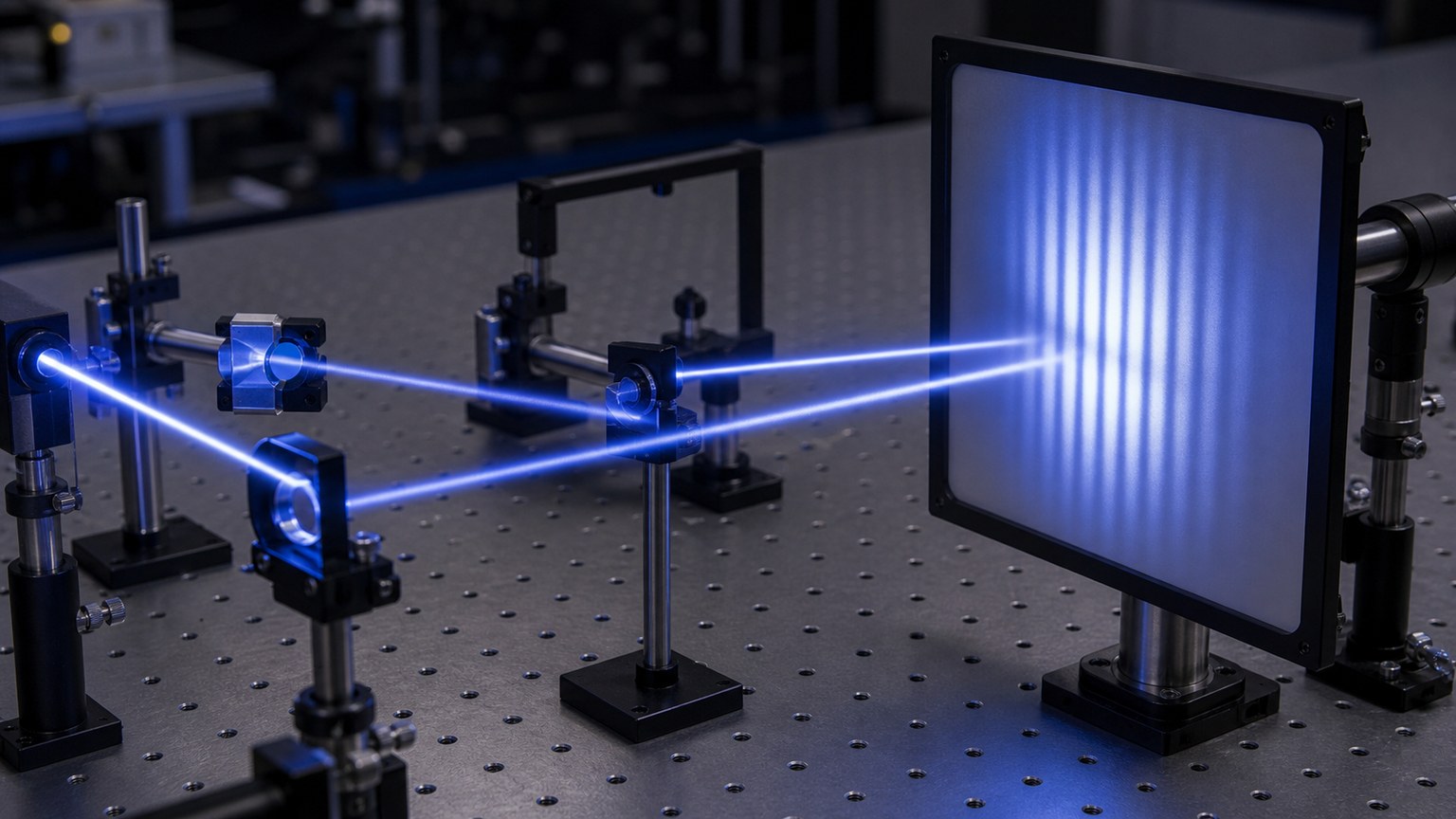
A single photon sent through an interferometer can be described as having coherent path alternatives. If the paths are recombined without which-path information, the final detector statistics depend on interference. If one path is marked, the pattern changes.
This example feels strange because a single detection occurs at one detector. The photon does not arrive as a smeared visible object. Yet the distribution of many trials shows that both path alternatives contributed to the prediction.
Photon experiments remain favorites because they can be controlled cleanly and adapted to many questions about measurement, entanglement, and information.
The weirdness is visible in the statistics, not in a slow-motion picture of the photon.
Electrons Building Patterns One by One
Electron interference experiments show individual localized detections accumulating into a wave-like pattern. Each electron leaves one mark, but the pattern formed by many electrons cannot be explained as simple classical pellets passing through fixed routes.
This example is powerful because electrons are matter, not just light. It pushes wave-like behavior into something people often picture as a particle.
Atoms Split and Recombined
Atom interferometers prepare atomic states so alternatives can accumulate different phases and later recombine. The alternatives may involve paths, momenta, or internal states depending on the design.
These experiments are weird because atoms are heavy enough to feel more object-like than photons or electrons. Yet their quantum states can still interfere when cooled, isolated, and controlled.
Atom superposition is also practical. It can support precision sensing, tests of gravity, and atomic clocks.
Molecules Showing Matter Waves
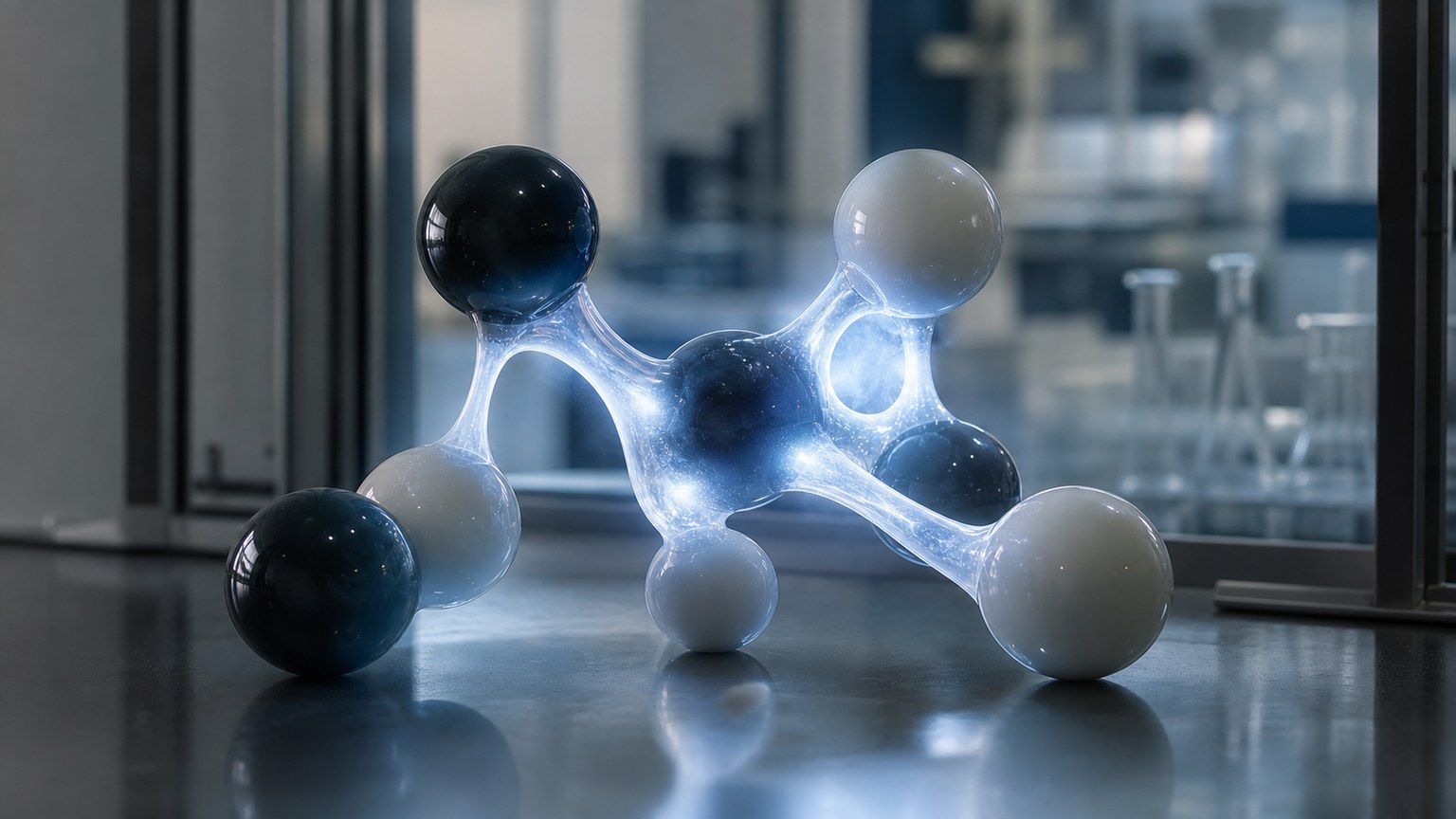
Large molecule interference experiments are especially striking because molecules contain many atoms and internal degrees of freedom. Keeping their center-of-mass motion coherent is much harder than doing the same with a single electron.
The experiment must control temperature, collisions, vibrations, and path distinguishability. If too much information leaks into the environment, the interference disappears. That fragility is part of the achievement.
These demonstrations do not mean a molecule looks like a giant visible wave. They show that a larger material object can still require a quantum state description under the right conditions.
The boundary between quantum and classical behavior becomes a measured question.
Superconducting Circuit States
Superconducting circuits are engineered devices that can behave quantum mechanically at macroscopic circuit scales. They can be placed in superpositions of selected circuit states and manipulated as qubits.
This feels weird because the hardware is visible in a laboratory. The superposed variable, however, is not a naked-eye image. It is inferred from controlled microwave operations, readout statistics, coherence measurements, and device behavior.
Spin Superpositions
Spin superposition is strange because spin is not a tiny spinning ball. A particle can be prepared so that one spin direction has a definite result while another direction gives probabilistic outcomes.
Spin experiments are foundational because they show that quantum weirdness is not only about where a particle is. It can concern abstract properties and measurement directions.
Spin also matters in practical technology, from magnetic resonance to qubits and sensing platforms.
Clock States
Atomic clocks depend on coherent superpositions or controlled transitions between extremely stable energy states. The phase evolution between those states lets scientists compare time with remarkable precision.
The weirdness is quiet. Nothing theatrical seems to happen, but the quantum state keeps an exquisitely regular reference. Tiny shifts can reveal gravity, motion, or changes in the clock environment.
Mechanical Motion Near the Quantum Limit
Researchers also study tiny mechanical systems whose motion approaches quantum behavior. These systems can involve resonators, membranes, or oscillators cooled and controlled so that quantum state effects become important.
The goal is not to make an everyday object visibly hover between two places. The goal is to test how mechanical motion can be prepared, measured, squeezed, entangled, or protected from environmental noise.
Such experiments matter because they push quantum control toward systems that look less like textbook particles and more like engineered devices.
They also probe the transition between microscopic quantum behavior and classical motion.
Why Weird Does Not Mean Unclear
The best superposition experiments are weird and careful at the same time. They specify what was superposed, how coherence was protected, what measurement was made, and what control tests were used.
That care is what separates real physics from a dramatic headline. A narrow verified claim can be more impressive than a broad vague one.
When reading about a weird example, ask what alternatives remained coherent and how the evidence would change if those alternatives were marked.
Why Scale Makes Examples Memorable
Examples become memorable when the system feels less microscopic than expected. A large molecule, a tiny mechanical resonator, or a visible chip in a refrigerator feels closer to ordinary objects than a lone photon. That closeness makes the superposition claim feel more dramatic.
Scale alone, however, is not the whole achievement. The experiment must also preserve coherence, control the variable being tested, and show evidence that alternatives affected the outcome. A larger system with weak verification teaches less than a smaller system with clean controls.
The best scale-pushing experiments make the boundary measurable. They ask how mass, complexity, temperature, and environmental contact change the survival of quantum behavior.
That is why the headline should never be only big. It should also be controlled.
Why Weird Examples Often Look Ordinary
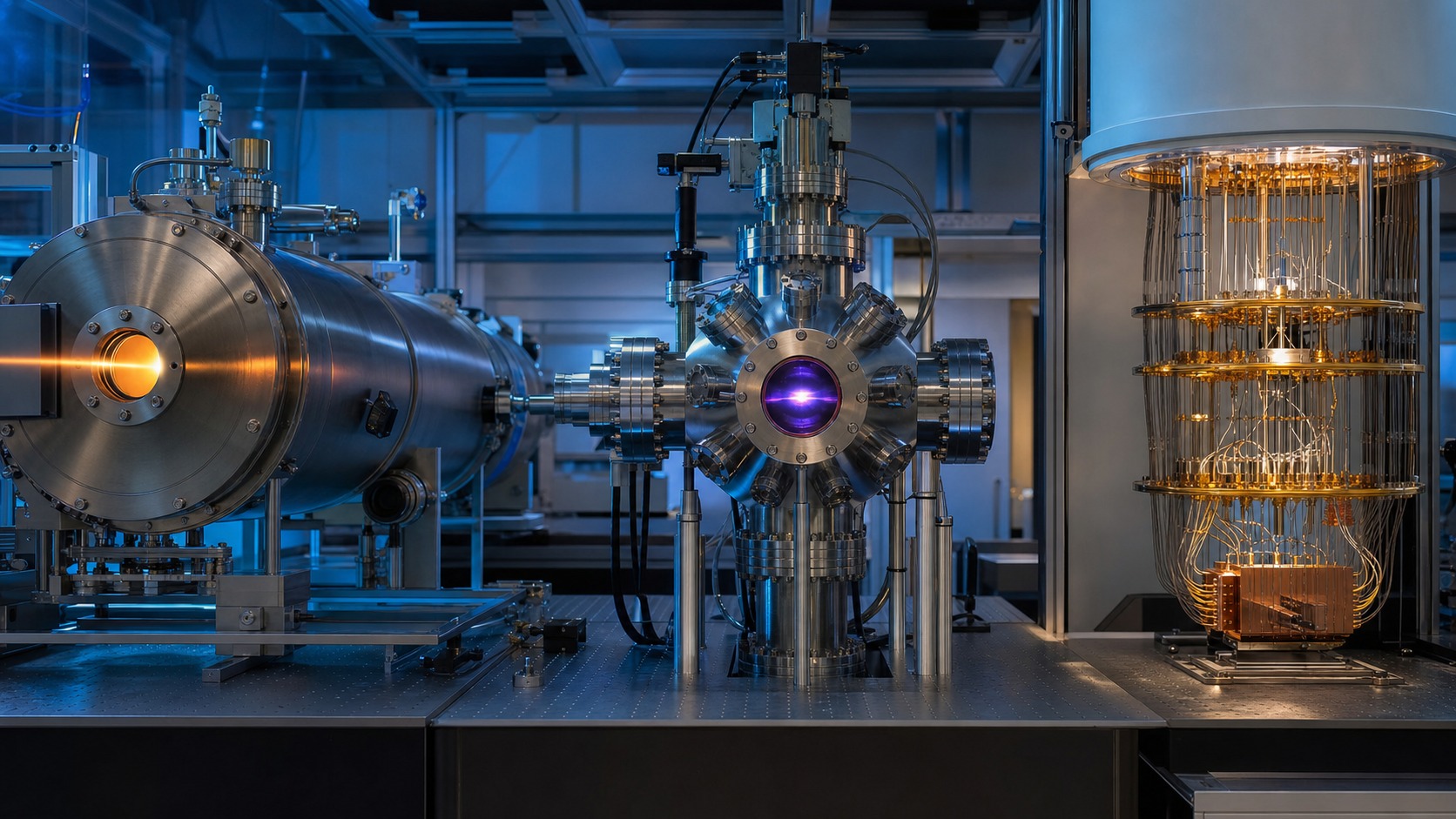
Many real superposition experiments look like careful engineering rather than science fiction. They involve vacuum chambers, lasers, electronics, cryogenic equipment, detectors, and data analysis. The weird part is hidden in the state relationships.
This can surprise beginners. The apparatus may look like ordinary lab hardware, while the result depends on a quantum state that cannot be photographed directly. The gap between the plain equipment and the strange conclusion is part of the charm.
Real weirdness is often quiet.
How Control Experiments Remove Easy Stories
Control experiments are what make a weird example trustworthy. Researchers may mark a path to show interference disappears, vary a phase to show fringes move, change temperature to test decoherence, or compare against a classical model.
These controls remove easy stories such as detector bias, source instability, vibration, or ordinary averaging. They show that the result follows from coherent quantum behavior rather than from an unnoticed classical effect.
A weird claim without controls is only a story. A weird claim with controls becomes evidence.
That difference is the heart of experimental physics.
How to Enjoy the Weirdness Responsibly
It is fine to enjoy the weirdness. Superposition is surprising, and the experiments are often beautiful. The responsible move is to let the details make the result more impressive, not less.
Ask what variable was superposed, what measurement was made, and how the researchers knew coherence survived. Those questions do not drain the wonder. They show why the result deserved attention in the first place.
The strongest awe is the kind that can survive a methods section.
Why Real Examples Keep Improving
The strangest superposition experiments are not frozen museum pieces. Researchers keep improving isolation, control, and readout, so the boundary between easy and difficult examples keeps moving. What once looked nearly impossible can become a careful laboratory routine.
That progress changes the tone of the subject. Older explanations often leaned on shock value because the effect seemed so remote from ordinary experience. Modern experiments show that the weirdness can be measured, tuned, and compared.
The improvements also sharpen the questions. Larger systems make decoherence easier to study. Better detectors reveal whether the expected interference is truly present or has already been washed out.
Not every headline captures that discipline. A superposition of a molecule, resonator, or current is impressive, but the details decide what claim is actually being made. The scale, lifetime, and measurement method all matter.
This is why the examples should be read as evidence, not spectacle. They show how far quantum control has reached and where it still faces hard limits.
The next generation of examples will probably feel less like isolated curiosities. They will connect foundations, sensors, computing hardware, and precision tests of nature.
The weirdness remains, but it becomes better mapped every year.
Progress also changes what counts as a fair example. As control improves, researchers can ask sharper questions about size, mass, separation, duration, and reversibility. The weirdness becomes more quantitative, which makes the result easier to compare across experiments.
Better examples also make better teaching possible. They replace vague amazement with specific, testable claims.
Why The Ordinary Equipment Matters
Real superposition experiments often look surprisingly ordinary from the outside. They use vacuum chambers, mirrors, lasers, electronics, cryostats, traps, and detectors. The strange claim rests on equipment built to remove easy classical explanations.
That ordinary machinery is part of the wonder. It shows that superposition is not protected by mystery; it is exposed through patient control. Every alignment, timing pulse, and calibration choice helps separate quantum behavior from noise.
When examples involve larger objects, the equipment becomes even more important. Researchers have to prove that the system was isolated enough, measured carefully enough, and compared against the right alternatives. Scale alone does not make the result meaningful.
This is why responsible accounts spend time on method. The experiment is weird because the evidence is disciplined, not because the description is dramatic.
The best examples leave readers with both surprise and respect for the craft.
That craft is especially visible when an experiment rules out boring explanations one by one. Thermal noise, vibration, detector artifacts, and accidental classical mixing can all imitate parts of a result. A strong superposition claim shows why those alternatives fail.
The ordinary parts also make the result reproducible. Other groups need enough detail to rebuild the conditions, test the controls, and see whether the claimed superposition behaves the same way. Weird physics becomes stronger when it can be repeated with ordinary discipline.
The Real-Examples Takeaway
Real superposition experiments are strange because coherent alternatives can survive in systems that intuition wants to treat classically.
The evidence is strongest when weirdness is tied to preparation, interference, control tests, and repeatable records.