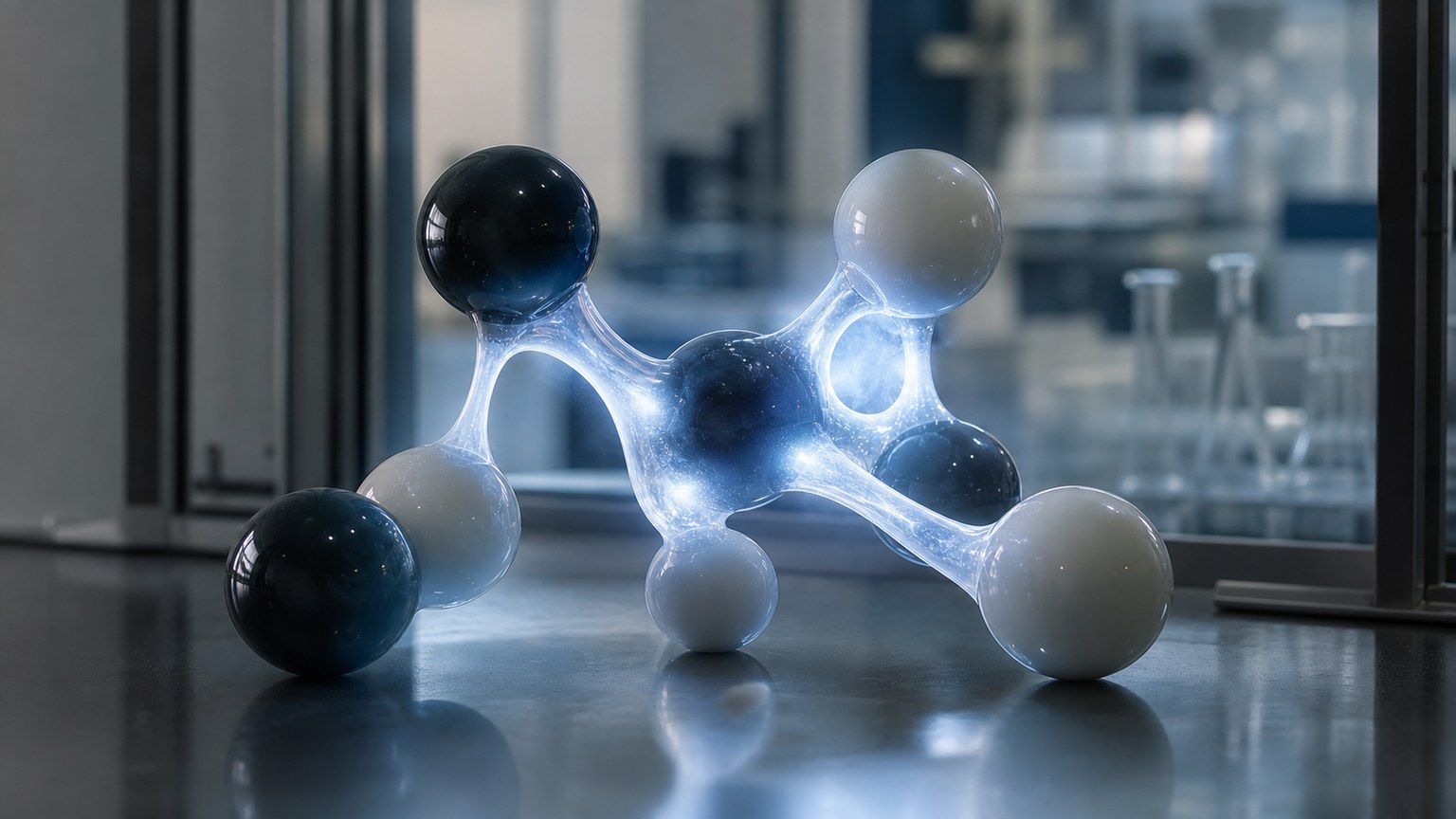
Quantum Possibility Inside Chemical Structure
Superposition shapes chemical bonds and molecules because electrons in matter are not tiny beads locked to one classical path around one atom. Their quantum states can combine across regions, atoms, and possible arrangements. That combination helps create molecular orbitals, shared electron density, resonance structures, bonding and antibonding states, and the stability of many molecules. In chemistry class, bonds are often drawn as lines between atoms. Those lines are useful shorthand, but the deeper story is quantum. A bond forms when the allowed electron states of atoms combine into molecular states that can lower the energy and distribute electron density in a stable way. Superposition is part of that combination. Atomic orbitals can add constructively to create bonding orbitals or combine with opposite phase to create antibonding orbitals. Electrons can occupy states that extend over more than one nucleus, which is why molecules are not just collections of isolated atoms touching at the edges. This does not mean every chemical explanation needs advanced quantum math. It means the simple bond picture rests on quantum state structure. The shapes, strengths, colors, spectra, and reactions of molecules all depend on how electron states are allowed to combine.
A: Atomic state contributions combine into molecular states.
A: No. Lines summarize quantum electron structure.
A: A lower-energy molecular state that helps stabilize atoms together.
A: A higher-energy combination that can weaken bonding.
A: No. It represents a delocalized quantum description.
A: It decides whether orbital contributions combine constructively or destructively.
A: Yes. Light absorption and emission reveal energy differences.
A: Spin and exclusion rules control state filling.
A: They may represent some molecular states more naturally.
A: Molecular structure is quantum state structure made visible.
Why Bonds Need Quantum States
A chemical bond is often drawn as a line, but the line is a shorthand for a deeper quantum arrangement. Electrons and nuclei settle into states that can lower energy and create stable structure.
Classical pictures cannot fully explain why atoms form specific bonds, angles, spectra, and reaction pathways. Electron states are wave-like and constrained by quantum rules.
When atoms approach, their electron states can interact. Some combinations become lower in energy and help hold the molecule together. Other combinations become higher in energy and resist bonding.
This is why bonding is not just tiny hooks between atoms.
It is a state-structure problem.
Superposition is part of that structure.
Atomic Orbitals Combine
Atomic orbitals describe possible electron states around individual atoms. When atoms form molecules, those orbitals can combine into molecular orbitals that extend over more than one nucleus.
This combination is a form of superposition. The molecular state is built from contributions associated with the atoms, but the final state belongs to the molecule.
If the contributions line up constructively between the nuclei, electron density can increase in the bonding region. That can lower energy and stabilize the molecule.
If they combine with opposite phase, a node can appear between the nuclei. That creates an antibonding orbital, which tends to weaken or prevent bonding when occupied.
Phase therefore matters in chemistry.
Bonding Orbitals Lower Energy
A bonding orbital is not a little tube of glue. It is a molecular state whose electron distribution and energy favor holding atoms together.
When electrons occupy bonding orbitals, the molecule can be more stable than the separated atoms. The details depend on nuclear charges, electron repulsion, spin, and the Pauli principle.
The idea is still simple at the first level: constructive combination can place useful electron density between nuclei and lower the energy of the arrangement.
This is why orbital diagrams show bonding and antibonding levels. They help track which state combinations strengthen or weaken the molecule.
The diagram is not decorative.
It records how quantum states combine.
Antibonding States Matter Too
Antibonding states are higher-energy combinations that often have a node between nuclei. Occupying them can reduce bond strength or make a molecule less stable.
These states matter because electrons fill available orbitals according to quantum rules. A molecule’s stability depends not only on the bonding states that exist but on how many electrons occupy each kind of state.
Antibonding orbitals also help explain excited states, photochemistry, and molecular reactions. Light can promote electrons into states that change bonding behavior.
A molecule can therefore change shape, break bonds, or react differently after electronic excitation.
The higher state is not a side note.
Resonance Uses Delocalized States
Resonance in chemistry is often taught with several drawn structures. The real molecule is not rapidly switching between drawings like a flipbook. The drawings are approximations to a delocalized quantum state.
Superposition gives a better way to understand the idea. The electron structure can be spread across several bonding arrangements, producing a molecule with properties that no single drawing captures perfectly.
Benzene is the classic example, but the principle appears in many molecules and ions. Delocalization can affect bond lengths, stability, color, and reactivity.
This is another place where quantum thinking improves a familiar chemistry shortcut.
The molecule is not indecisive.
Its electron state is delocalized.
Spin and the Pauli Principle Shape Bonds
Electron spin and the Pauli exclusion principle are essential for chemistry. Electrons cannot all occupy the same quantum state. Their spin and orbital structure determine how states fill.
This filling pattern helps explain the periodic table, valence, magnetism, and bond formation. It is not enough to know where electrons might be; the state labels and allowed combinations matter.
Paired electrons in a bonding orbital can stabilize a bond, while unpaired electrons can lead to magnetism or reactive behavior. The quantum state controls the chemical role.
Spin also affects which molecular states are accessible in reactions and spectroscopy.
Chemistry is quantum information organized into matter.
Molecular Shape Comes From State Structure
Molecular shape depends on the distribution of electrons and nuclei in allowed quantum arrangements. Geometry is not chosen by miniature sticks. It emerges from energy minimization under quantum rules.
Electron density, repulsion, hybridization, orbital symmetry, and nuclear positions all contribute. The familiar shapes in chemistry class are simplified outcomes of this deeper calculation.
Superposition appears when atomic states combine into orbitals oriented in particular ways. Hybrid orbitals are one teaching tool for describing these combinations.
The final shape affects polarity, reactivity, biological function, and material properties.
Quantum state structure becomes visible as molecular form.
That is a quiet but profound connection.
Spectra Reveal Molecular States
Molecules absorb and emit light according to differences between energy states. Electronic, vibrational, and rotational transitions each reveal part of the molecule’s quantum structure.
Spectroscopy can identify molecules, measure bond strengths, detect environments, and track reactions. It works because molecular states are quantized and structured.
Superposition can appear in coherent spectroscopy, where pulses prepare combinations of states and read their evolving phase relationships.
Even ordinary spectra carry the imprint of quantum states. Lines, bands, widths, and intensities all point back to the allowed molecular structure.
Light becomes a record of hidden chemistry.
Reactions Follow Quantum Pathways
Chemical reactions involve changes in electron states and nuclear positions. Reactants move through possible pathways toward products, and quantum effects can shape which pathways are likely.
Tunneling, zero-point energy, avoided crossings, and excited-state dynamics can all matter. These effects are not always visible in simple reaction diagrams, but they can decide rates and outcomes.
Modern quantum chemistry uses approximate methods to calculate molecular states because exact solutions are usually impossible for large systems. The approximations still rest on the same state-combination principles.
This is why quantum computers are interesting for chemistry. They may eventually represent certain molecular states more naturally than classical computers can.
The bond is only the beginning.
The full molecule is a dynamic quantum system.
Why Approximation Is Necessary
Molecules quickly become too complex for exact quantum solutions. Each electron interacts with nuclei and with other electrons, and the full state space grows rapidly.
Quantum chemistry therefore uses approximations that preserve the important structure while making calculation possible. Methods such as molecular orbital theory, density functional theory, and configuration interaction each choose a different compromise.
Approximation does not mean the quantum picture is optional. It means the real quantum problem is rich enough that scientists need controlled shortcuts.
The quality of a shortcut is judged by evidence. Calculated bond lengths, spectra, energies, and reaction barriers are compared with measurements.
The best models make the invisible electron structure predictive.
How Delocalization Changes Materials
Electron delocalization can extend beyond one molecule into a material. In metals, semiconductors, and conjugated systems, electron states may spread across many atoms rather than belonging to one bond.
This affects conductivity, color, magnetism, and mechanical behavior. The material’s properties depend on how quantum states combine across the structure.
Energy bands in solids are a large-scale version of the same idea. Atomic states combine into extended allowed bands and forbidden gaps, shaping how electrons move.
That is why superposition is not only a topic for tiny isolated particles. It is woven into the behavior of materials we use every day.
Solar cells, LEDs, transistors, and batteries all depend on quantum state structure in matter.
Chemical bonding is the local beginning of a much broader materials story.
Why Bonds Are Stable but Not Static
A stable molecule is not frozen. Its nuclei vibrate, its electrons respond to fields, and its states can be excited, distorted, or reorganized during reactions.
Superposition helps explain this flexibility. Molecular states can combine vibrational, electronic, and rotational features, and external light or collisions can move the molecule into new combinations.
Stability means the molecule has a low-energy arrangement that persists under ordinary conditions. It does not mean nothing quantum is happening inside.
This distinction helps connect static drawings with real chemistry. A bond line on paper is a useful snapshot of a dynamic quantum structure.
The molecule is stable because the state structure supports it, not because the parts stop moving.
Why the Same Idea Reaches Biology
Biological molecules are also governed by quantum state structure, even when biology is described at larger scales. Proteins, pigments, DNA bases, and enzyme active sites all depend on electron arrangements and molecular shapes.
Most biological explanations do not need to solve the full quantum state explicitly, but the stability and reactivity of the molecules still rest on quantum chemistry.
Light absorption in vision, charge transfer in photosynthesis, and enzyme reaction pathways all involve molecular states. The details can be complex, but the foundation is the same: electrons occupy allowed quantum structures.
This shows why superposition in chemistry is not an exotic side topic. It supports the behavior of ordinary matter, including matter inside living systems.
The quantum state becomes biology through chemistry.
That bridge does not make biology reducible to one equation. It means the molecules that biology uses get their shapes, colors, and reactions from quantum state structure.
How Models Stay Useful
Chemists use models at different levels because no single picture is best for every question. A Lewis structure can explain valence quickly. Molecular orbitals can explain delocalization. Quantum calculations can compare energies and spectra.
The models are connected by evidence. If a simple drawing predicts the wrong shape or reactivity, a deeper quantum model may be needed. If a complex calculation cannot match spectra, the approximation must be improved.
Superposition sits underneath these models because electron states can combine and redistribute. The visible chemistry is the practical face of that hidden structure.
Good chemical thinking therefore moves between shorthand and quantum detail without confusing the two.
The line drawing helps the student; the state structure explains why the line works.
The Chemistry Takeaway
Superposition shapes chemistry by letting electron states combine into bonding, antibonding, delocalized, and molecular orbitals.
The familiar lines between atoms are shorthand for quantum state structure that determines stability, spectra, shape, and reactions.