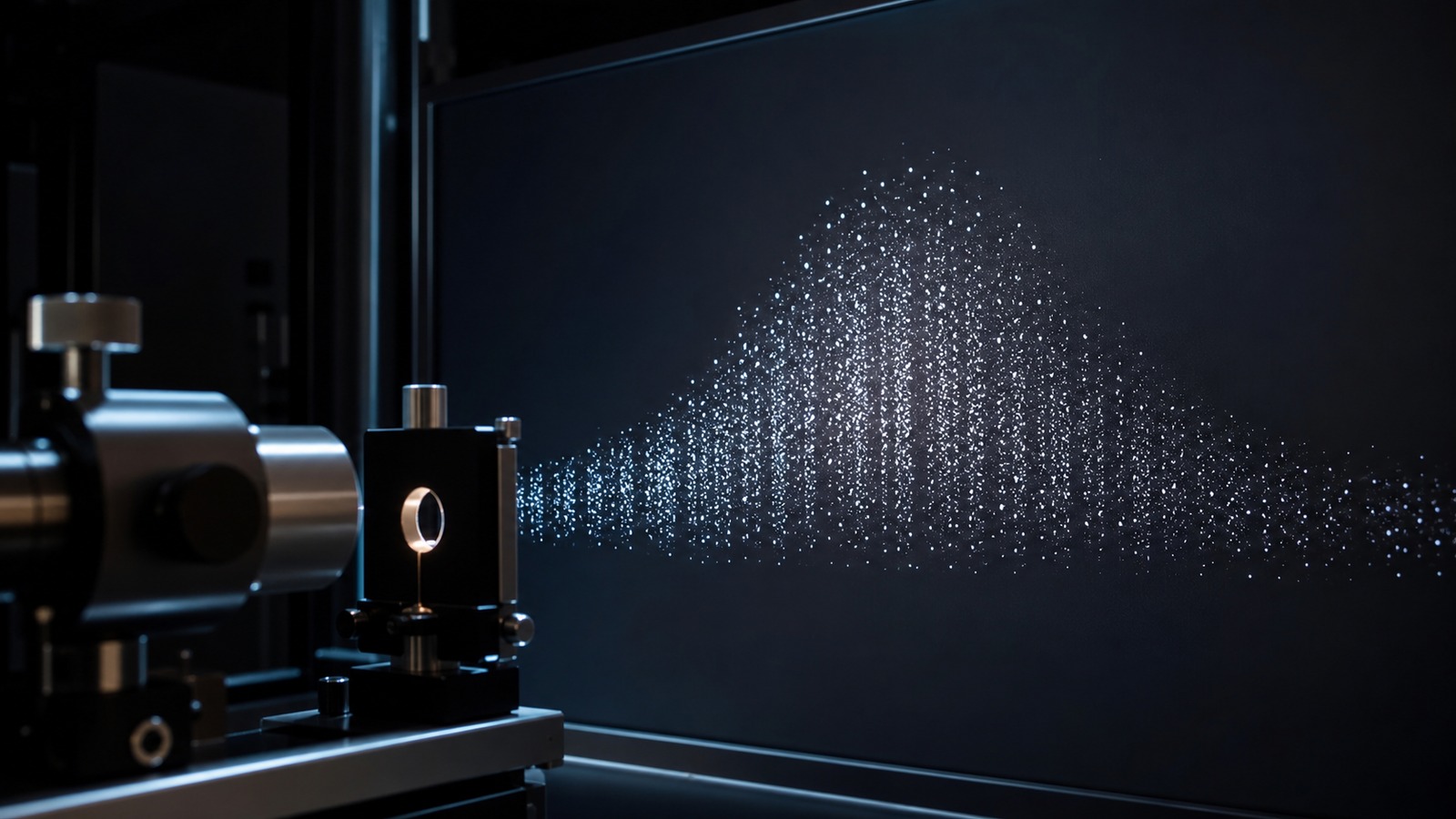
Reality feels stable and predictable. Objects appear solid, time flows forward, and causes reliably lead to effects. This everyday experience shapes how we instinctively understand the world. Yet when scientists began exploring nature at its smallest scales—inside atoms and subatomic particles—they discovered something deeply unsettling. At this level, reality does not behave like a collection of solid things with clear properties. Instead, it behaves like a shifting landscape of possibilities. At the heart of this strange behavior lies the concept of quantum states, a framework that reveals why reality is far more mysterious than it appears. Quantum states force us to rethink what it means for something to “exist.” They suggest that nature does not always choose a single outcome until it is forced to do so. They blur the line between what is real and what is possible, between observation and participation. Understanding quantum states doesn’t require advanced mathematics—it requires a willingness to let go of some deeply held assumptions about certainty and objectivity.
A: No—uncertainty is built into reality itself.
A: They exist as possibilities, not fixed outcomes.
A: No—any interaction counts as measurement.
A: Environmental interactions collapse them instantly.
A: It’s probabilistic, not chaotic.
A: Yes—lasers, chips, and quantum computers rely on them.
A: Scientists still debate this.
A: It reshapes how objectivity works.
A: Only probabilities can be predicted.
A: It works extremely well, but questions remain.
The Classical World We Expect
For most of human history, reality was assumed to work like a machine. Objects had definite positions, definite speeds, and definite properties whether anyone was watching or not. This view reached its peak with classical physics, which described the motion of planets, falling apples, and spinning gears with extraordinary accuracy.
In the classical worldview, uncertainty is simply a lack of information. If we don’t know exactly where something is, it’s because we haven’t measured it carefully enough. In principle, perfect knowledge is possible. The universe is deterministic, meaning the future is fully determined by the present.
This perspective matches everyday experience. A chair remains where it is whether you look at it or not. A light switch is either on or off. Reality feels settled and independent of observation. Quantum physics disrupts this comforting picture completely.
When Physics Reached the Quantum Frontier
At the beginning of the twentieth century, experiments revealed behaviors that classical physics could not explain. Light sometimes behaved like a wave and sometimes like a particle. Electrons appeared to jump between energy levels without traveling through the space in between. Attempts to force these observations into classical explanations failed.
To account for these results, scientists developed quantum mechanics, a theory that replaced certainty with probability. Instead of tracking precise paths, quantum mechanics described systems using mathematical objects called quantum states. These states did not say where something was or what it was doing. They said what could happen if a measurement were made. This shift was not just technical. It was philosophical. Physics moved from describing reality as it is to describing reality as a set of potential outcomes.
What a Quantum State Really Represents
A quantum state is often misunderstood as a kind of hidden reality waiting to be uncovered. In fact, it is something more subtle. A quantum state is a complete description of a system’s possibilities. It encodes every outcome that could occur when the system is measured, along with the probability of each outcome.
Before measurement, the system does not secretly possess one of those outcomes. The quantum state is not incomplete. It is reality at that level. The probabilities are not reflections of ignorance; they are reflections of how nature works.
This idea is difficult to accept because it contradicts everyday thinking. We are used to believing that things have properties even when we are not looking. Quantum states suggest that, at the smallest scales, some properties do not exist until they are observed.
Superposition and the Nature of Possibility
One of the most striking features of quantum states is superposition. Superposition means that a system can exist in multiple possible states at the same time. An electron can be in several locations simultaneously. A particle can have multiple energies at once.
This does not mean the particle is rapidly switching between states or hiding its true condition. It means the quantum state genuinely includes all those possibilities at once. Only when a measurement is made does the system settle into a single outcome.
Superposition is not rare or fragile. It is the natural condition of quantum systems. It is only because interactions with the environment constantly force measurements that we do not see superposition in everyday objects. At large scales, superpositions collapse almost instantly, creating the illusion of a stable, classical world.
Schrödinger’s Cat and the Limits of Intuition
To illustrate how strange superposition can be, physicists often refer to a thought experiment involving a cat sealed in a box with a quantum-triggered mechanism. According to quantum rules, until the box is opened, the system exists in a superposition of mutually exclusive outcomes. This example was designed to expose the tension between quantum theory and common sense. It highlights a central mystery: if quantum states govern reality, at what point does the world become definite?
The power of the thought experiment lies in its discomfort. It forces us to confront the possibility that definiteness is not a fundamental property of the universe, but an emergent one—something that arises from interactions and observations rather than existing independently.
Measurement as a Creative Act
In classical physics, measurement reveals information without altering the system in any fundamental way. In quantum physics, measurement is transformative. When a quantum system is measured, its state changes. Possibilities collapse into a single outcome. This process is often called “collapse,” but that word can be misleading. Nothing physically crashes or breaks. What changes is the structure of possibilities described by the quantum state. After measurement, the system no longer contains multiple outcomes—it contains only the one that was observed. The unsettling implication is that measurement plays an active role in shaping reality. Observation is not merely passive witnessing; it is participation. At the quantum level, there is no clear separation between observer and observed.
Why Uncertainty Is Fundamental
Quantum mechanics famously introduces uncertainty into the heart of physics. Certain pairs of properties cannot both be precisely defined at the same time. This is not due to faulty instruments or limited skill. It is a reflection of how quantum states are structured.
In everyday thinking, uncertainty means ignorance. In quantum physics, uncertainty means indeterminacy. The quantum state does not contain precise values for all properties simultaneously. Reality itself is not fully defined in those terms. This realization challenges the classical belief that the universe is ultimately predictable. Even with perfect knowledge of a quantum state, only probabilities can be predicted, not exact outcomes. The future is not fixed—it is constrained but open.
Entanglement and the End of Separation
One of the most profound discoveries of quantum physics is entanglement. When two particles interact in certain ways, their quantum states can become linked. Once entangled, they form a single system, even if they are separated by great distances.
Measuring one particle immediately determines the outcome of a measurement on the other, regardless of the distance between them. This does not involve signals traveling through space; it reflects the fact that the quantum state describes the system as a whole. Entanglement reveals that nature is not fundamentally composed of independent pieces. At the quantum level, reality is relational. Parts of the universe can be deeply connected in ways that defy classical ideas of locality and separation.
Why the Macroscopic World Looks Normal
If quantum states are so strange, why doesn’t the world around us look bizarre? Why don’t tables exist in superposition or cats appear both asleep and awake?
The answer lies in interaction. Large objects constantly interact with their environments—air molecules, light, vibrations, and thermal energy. These interactions effectively perform countless measurements every second, rapidly collapsing quantum states into definite outcomes.
This process creates the appearance of a stable, classical world. Classical reality is not separate from quantum reality; it emerges from it. The everyday world is what quantum behavior looks like when possibilities are forced to settle almost instantly.
Competing Interpretations of Quantum States
Quantum mechanics works extraordinarily well, but it does not explain itself. Scientists agree on how to calculate outcomes but disagree on what the quantum state means. Some interpretations treat the quantum state as a real physical object. Others see it as a tool for organizing knowledge.
Some interpretations suggest that all possible outcomes occur in different branches of reality. Others propose that quantum states reflect underlying processes we do not yet understand. None of these interpretations change experimental results, but they offer different philosophical lenses through which to view reality. What unites them is a shared acknowledgment: reality at the quantum level does not resemble common sense.
Quantum States and the Limits of Knowledge
Quantum states impose limits not only on prediction but on explanation. They suggest that asking “what is really happening when no one looks?” may be the wrong question. At the deepest level, reality may not be a collection of facts waiting to be uncovered, but a structure of possibilities waiting to be realized.
This does not mean reality depends on human consciousness. Measurement can be performed by any physical interaction. But it does mean that reality is not fully defined independently of interaction. This perspective reshapes how we think about objectivity. The universe is not a finished story unfolding mechanically. It is a dynamic process in which outcomes crystallize through interaction.
Why Quantum States Matter Beyond Physics
Quantum states are not just abstract curiosities. They underpin technologies that shape modern life, from semiconductors to lasers to medical imaging. Emerging technologies like quantum computing rely directly on superposition and entanglement to perform tasks impossible for classical machines.
Beyond technology, quantum states influence philosophy, psychology, and even art by challenging assumptions about certainty, identity, and causation. They remind us that intuition evolved for survival, not for understanding the deepest layers of reality.
A Universe of Possibility
The mystery of quantum states teaches us something humbling. Reality is not obligated to make sense to human intuition. Beneath the solid world we experience lies a realm where possibility comes first and certainty follows only through interaction. Quantum states reveal a universe that is not fully written until events occur. They show that the act of observation is woven into the fabric of reality itself. The world is not a static collection of facts but an unfolding web of potential. In this light, reality is not less real because it is probabilistic. It is richer. Quantum states show us that the universe is not merely a machine—it is a canvas of possibilities, continuously shaped by interaction, measurement, and chance. And that may be the deepest mystery of all.