Four Interactions Behind Every Physical Process
All known physical changes can be traced to four fundamental interactions: gravity, electromagnetism, the strong interaction, and the weak interaction. They differ in strength, range, source, mathematical description, and the particles or systems they affect. Gravity organizes planets, stars, and galaxies. Electromagnetism builds atoms, chemistry, light, and technology. The strong interaction confines quarks and helps bind nuclei. The weak interaction changes particle flavor and enables radioactive decay and stellar fusion chains. Comparing them by a single “strength ranking” is useful only after specifying distance and energy, because each interaction dominates a different physical regime.
A: At typical particle scales the strong interaction, but strength depends on energy.
A: Mass accumulates while large objects are nearly electrically neutral.
A: A residual strong interaction overcomes proton repulsion at short range.
A: The weak interaction changes quark flavor through W exchange.
A: No. It is one aspect of electromagnetism.
A: No. Gravity is described separately by general relativity.
A: Its W and Z carrier particles are very massive.
A: Confinement prevents isolated long-range color fields.
A: Electromagnetism and the weak interaction share electroweak theory.
A: Yes, but it would require reproducible evidence beyond known interactions.
What Makes an Interaction Fundamental?
A fundamental interaction is not currently explained as a residual effect of another known interaction. Friction, tension, pressure, and contact forces are not additional fundamental forces; they emerge mainly from electromagnetism, quantum statistics, and the collective behavior of matter.
In the Standard Model, electromagnetism, the strong interaction, and the weak interaction are described by quantum gauge fields. Their observable carrier particles are photons, gluons, and W and Z bosons. Gravity is described successfully by general relativity as spacetime geometry, but no complete tested quantum theory places it alongside the other three.
Gravity Governs Accumulated Mass and Energy
Gravity acts on energy and momentum and is always attractive for ordinary matter in familiar conditions. Newton’s inverse-square law accurately describes many weak-field systems. Einstein’s general relativity gives the deeper account: mass-energy curves spacetime, and freely falling objects follow the geometry.
Gravity is extraordinarily weak between individual particles. A small magnet can lift an object against the pull of the entire Earth. Yet gravity dominates astronomical structure because it has infinite range, cannot be screened by opposite gravitational charge in ordinary matter, and adds coherently as mass accumulates.
Gravity forms planets and stars, drives orbital motion, compresses stellar cores, shapes galaxies, bends light, slows clocks, and creates black holes. Gravitational waves carry changing distortions of spacetime across the universe at light speed.
A hypothetical graviton would be a quantum carrier in many candidate theories, commonly with spin two and zero mass. No graviton has been detected. Using the graviton as if it were a confirmed Standard Model particle erases the important gap between quantum theory and gravity.
Electromagnetism Builds the Visible World
Electromagnetism acts on electric charge. Opposite charges attract and like charges repel. Electric and magnetic fields are aspects of one relativistic electromagnetic field: moving charges produce magnetic effects, and changing magnetic fields produce electric fields.
The photon is the massless spin-one quantum of the electromagnetic field. Its zero mass supports infinite range, with static influence weakening according to inverse-square behavior for point sources. Positive and negative charges can cancel, so large objects are often nearly neutral even though electromagnetic forces inside them remain powerful.
Atomic electrons are bound to positive nuclei electromagnetically. Chemical bonds, material stiffness, surface contact, electricity, magnetism, light, radio, and most biological molecular behavior follow from this interaction combined with quantum mechanics. The upward support force from a floor is mainly electromagnetic resistance and exclusion at atomic surfaces.
The Strong Interaction Confines Color
The strong interaction acts on color charge carried by quarks and gluons. Quantum chromodynamics describes eight gluon states. Gluons carry color themselves and interact with one another, unlike photons, which carry no electric charge.
At short distances and high momentum, the strong coupling becomes weaker through asymptotic freedom. At larger distances, it grows and confines quarks and gluons into color-neutral hadrons. Pulling quarks apart produces new hadrons rather than isolated color charges.
Protons and neutrons are hadrons whose mass arises mostly from QCD energy. The force binding nucleons inside a nucleus is a residual effect of the underlying strong interaction, often modeled through meson exchange at low energy. It is powerful but short-ranged and changes character with distance.
The strong interaction makes stable nuclei possible despite electromagnetic repulsion among protons. Its balance with electromagnetism, neutron number, and quantum shell structure determines which isotopes exist.
The Weak Interaction Changes Particle Identity
The weak interaction acts on quarks and leptons and can change flavor. W-plus and W-minus bosons carry electric charge and mediate charged-current processes. The neutral Z boson mediates neutral currents. Their large masses make weak interactions effective only across extremely short distances at ordinary energies.
Beta decay is a familiar consequence. At the quark level, a down quark can become an up quark through a W-mediated process, turning a neutron into a proton while producing an electron and antineutrino. Related reactions convert protons and neutrons in nuclei and stars.
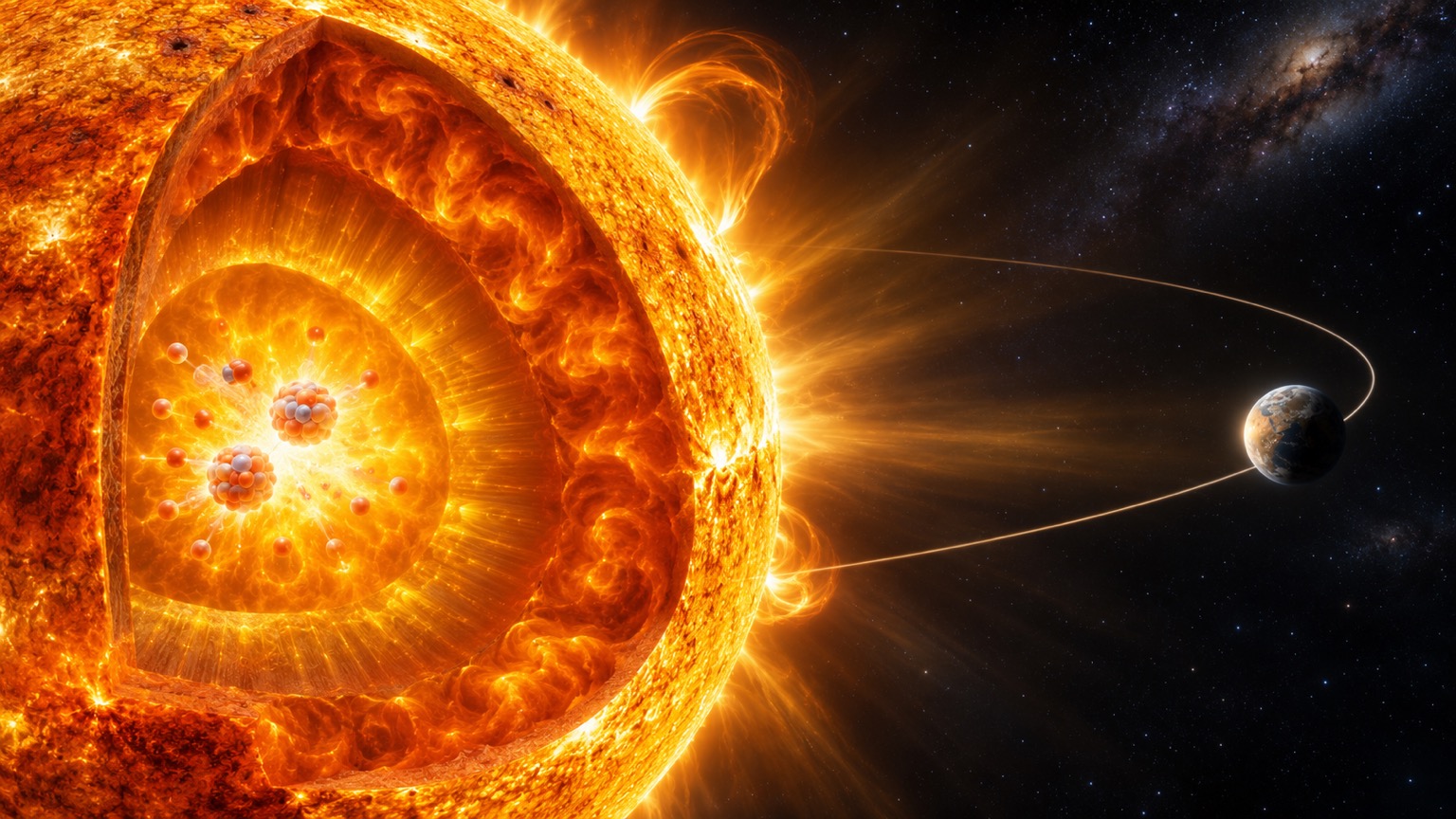
The first step of the Sun’s proton-proton chain requires the weak interaction to convert a proton into a neutron. Its rarity regulates how slowly the Sun burns. Without that bottleneck, a star like the Sun would not shine steadily for billions of years.
Weak interactions treat left- and right-handed states differently and violate several symmetries. They also enable neutrino scattering and flavor-sensitive processes central to particle physics.
Neutrinos can change flavor as they propagate because their mass states and weak-interaction states are not identical. Oscillation does not require a fifth force, but it extends the weak sector beyond the massless-neutrino assumption of the earliest Standard Model. Long-baseline experiments use this phenomenon to measure mixing and search for matter-antimatter differences.
Range Is Not the Same as Importance
Gravity and electromagnetism have infinite range. The weak interaction is short-ranged because W and Z bosons are heavy. The strong interaction’s fundamental gluons are massless, yet confinement prevents a simple long-range color force. Residual nuclear forces fade over distances comparable to a nucleus.
Short range does not make an interaction unimportant. Strong and weak processes determine nuclear stability, element formation, and stellar energy. Long range does not guarantee local dominance: gravity is negligible in atomic structure, while electromagnetic forces often cancel across neutral astronomical matter.
Strength Depends on the Question
Textbooks often rank strong, electromagnetic, weak, and gravitational interactions from strongest to weakest. That ordering captures a rough comparison at a chosen particle scale, not a universal constant valid at every energy. Quantum couplings run with energy, and the relevant charges and distances differ.
At electroweak energies, electromagnetic and weak interactions reveal their unified origin. At extremely high speculative scales, other unifications may occur. At low energy, the heavy W and Z suppress weak processes, making them appear dramatically weaker than electromagnetism.
Macroscopic outcome also depends on addition and cancellation. Electric charges can neutralize; mass-energy generally adds. Gravity wins across galaxies despite tiny microscopic coupling. Inside a proton, the strong field overwhelms gravity by an immense margin.
How the Interactions Work Together in a Star
Gravity compresses a gas cloud and heats its center. Electromagnetism controls collisions among charged nuclei and transports energy outward as radiation. Quantum tunneling helps nuclei approach despite electric repulsion. The weak interaction changes a proton into a neutron in the fusion chain. The strong interaction binds the resulting nucleus.
No single force “powers” the star in isolation. Gravity creates the pressure and temperature, weak reactions regulate key conversion steps, strong binding provides the final lower-energy nuclei, and electromagnetism carries much of the released energy through plasma and into space.
Unification: What Has Succeeded
Maxwell unified electricity and magnetism into electromagnetism. The electroweak theory later united electromagnetic and weak interactions at a deeper symmetry level, with the Higgs mechanism explaining their different low-energy appearances. Experiments have strongly confirmed this framework.
Grand unified theories attempt to combine strong and electroweak interactions. They can predict phenomena such as proton decay, but no decisive evidence has selected one. Incorporating gravity is harder still because spacetime geometry and quantum field theory do not merge straightforwardly at high energy.
Unification does not mean the forces must look identical at everyday energy. A symmetric high-energy theory can produce distinct low-energy fields after symmetry breaking, just as electroweak theory yields a massless photon and heavy weak bosons. The challenge is finding a larger structure that makes new correct predictions rather than merely placing existing equations beside one another.
How Each Interaction Is Tested
Planetary motion, gravitational lensing, clock comparisons, black-hole observations, and gravitational waves test gravity. Spectroscopy, electrical measurements, light scattering, and precision magnetic moments test electromagnetism. Collider jets, hadron spectra, and lattice calculations test QCD. Radioactive decays, neutrino experiments, and W and Z production test weak physics.
The four-force picture survives because it predicts across these independent domains. A new fundamental interaction would need distinct evidence: a reproducible force, decay, scattering pattern, or conservation-law violation that cannot be explained by the existing fields.
A Complete Guide Ends With an Incomplete Theory
Three interactions fit inside the Standard Model, and gravity fits general relativity. Together they explain an extraordinary span of nature, but their union is unfinished. Dark matter may involve new particles or forces. Dark energy and the cosmological constant remain mysterious. Neutrino masses require extensions.
The four forces are therefore both a compact inventory and a research map. They identify which interaction dominates a problem, reveal where successful theories meet, and show exactly where modern physics still lacks one coherent foundation.
They also prevent category errors. Buoyancy, elasticity, friction, and pressure are emergent outcomes, not missing fundamental entries. Dark energy is not automatically a fifth force, and hypothetical new interactions require evidence beyond an unexplained observation. The four-force framework is a tested baseline against which genuine additions must be judged.
Conservation Laws and Interaction Charges
Each gauge interaction is organized around a charge. Electric charge sources electromagnetism; color charge sources QCD; weak isospin and hypercharge underlie electroweak interactions. Symmetries lead to conserved quantities, although the conserved combinations can be less intuitive after symmetry breaking or quantum effects.
Gravity couples more universally to the energy-momentum content of every field. This universality underlies the equivalence principle: objects in the same gravitational environment fall alike when nongravitational influences are removed. Comparing these source rules explains why forces select different particles, cancel differently, and dominate different scales.
Effective Forces Versus Fundamental Interactions
Many named forces summarize collective behavior. Friction converts organized motion into microscopic vibration, deformation, and heat through electromagnetic contact. Buoyancy results from pressure differences in a gravitationally stratified fluid. Elasticity reflects changes in atomic bonds and quantum states when a material is deformed.
The nuclear force between protons and neutrons is also effective in a specific sense. It is a residual consequence of fundamental QCD among quarks and gluons, much as forces between neutral molecules arise from underlying electromagnetism. Nuclear physicists use nucleons and mesons because that description is efficient at the relevant scale.
Calling only four interactions fundamental does not diminish the reality of emergent forces. It identifies the deepest presently tested source rules. Effective descriptions often make better practical predictions for complex systems while remaining compatible with the underlying interactions. A bridge engineer uses stress and elasticity rather than calculating photon exchange between every atom. A nuclear physicist may use nucleon potentials rather than following every gluon. The correct level of description depends on the question, yet all successful levels must agree where their domains overlap. This hierarchy of theories is a strength, not an admission that the fundamental forces are unreal or experimentally remote from practical science and modern engineering applications in the observable world.