How Four Interactions Built a Structured Universe
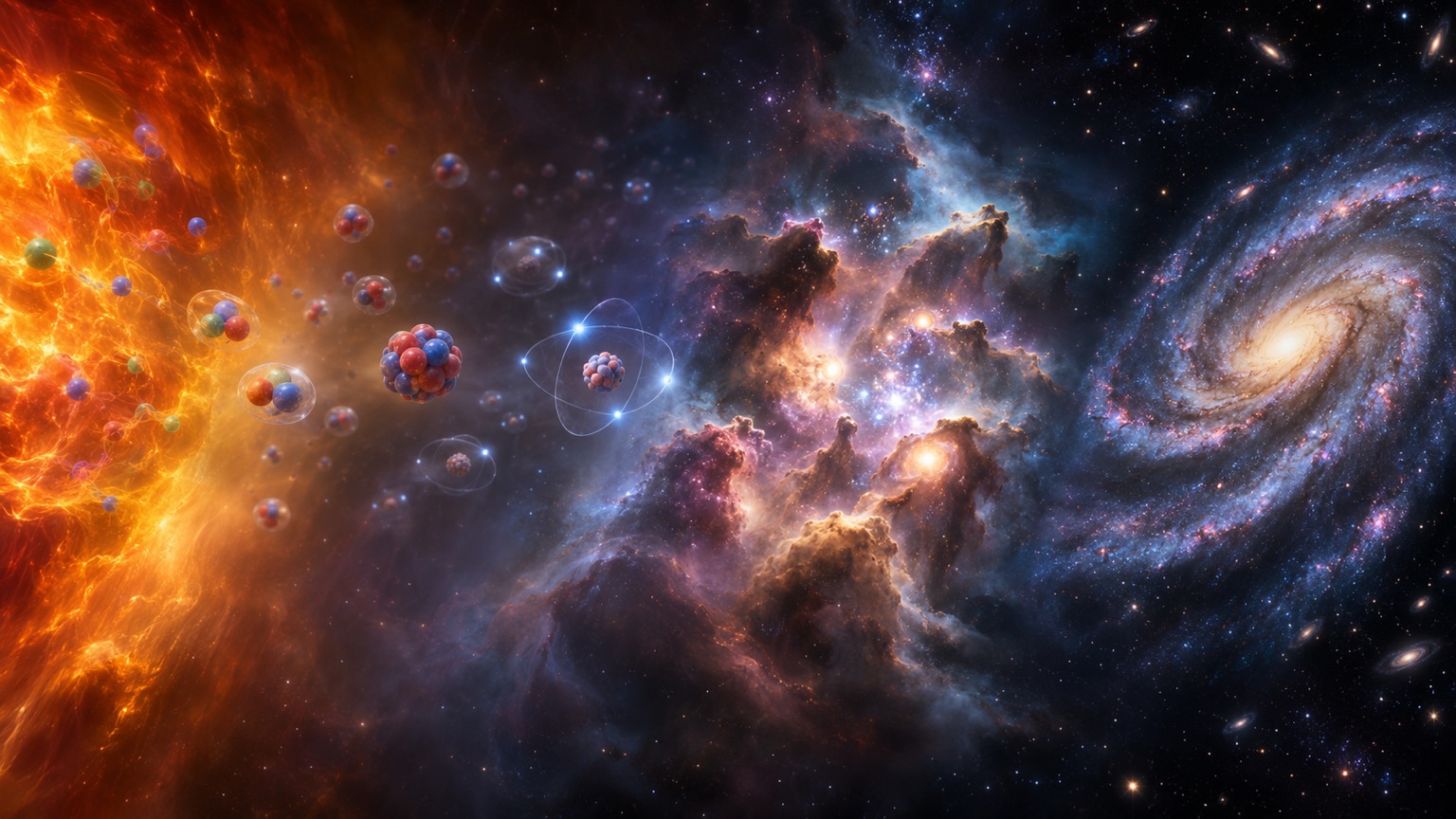
The universe’s shape is not the product of gravity alone. The strong interaction made protons, neutrons, and stable nuclei possible. The weak interaction changed particle identities, regulated stellar fusion, and shaped element production. Electromagnetism formed atoms, molecules, radiation, magnetic fields, and nearly every material process. Gravity gathered matter across enormous distances into stars, galaxies, clusters, and black holes. Their different ranges and behaviors created a division of labor across cosmic history: short-range forces established the building blocks, electromagnetism created complex visible matter, and long-range gravity assembled those materials into astronomical structure.
A: No. Strong-interaction confinement assembled quarks into nucleons.
A: Electrons bound to nuclei, making matter transparent to photons.
A: Electromagnetic radiation let collapsing gas lose thermal energy.
A: A weak conversion creates deuterium in the proton-proton chain.
A: Evolved stars, supernovae, and neutron-star mergers provide suitable reactions.
A: Large bodies are nearly charge-neutral, so electric effects cancel.
A: They transport energy and record weak reactions in dense environments.
A: They measure changing spacetime from compact-object motion.
A: Their surroundings and quantum properties require other fields too.
A: Each interaction escapes and records different parts of an event.
The Earliest Universe Did Not Display Today’s Separation
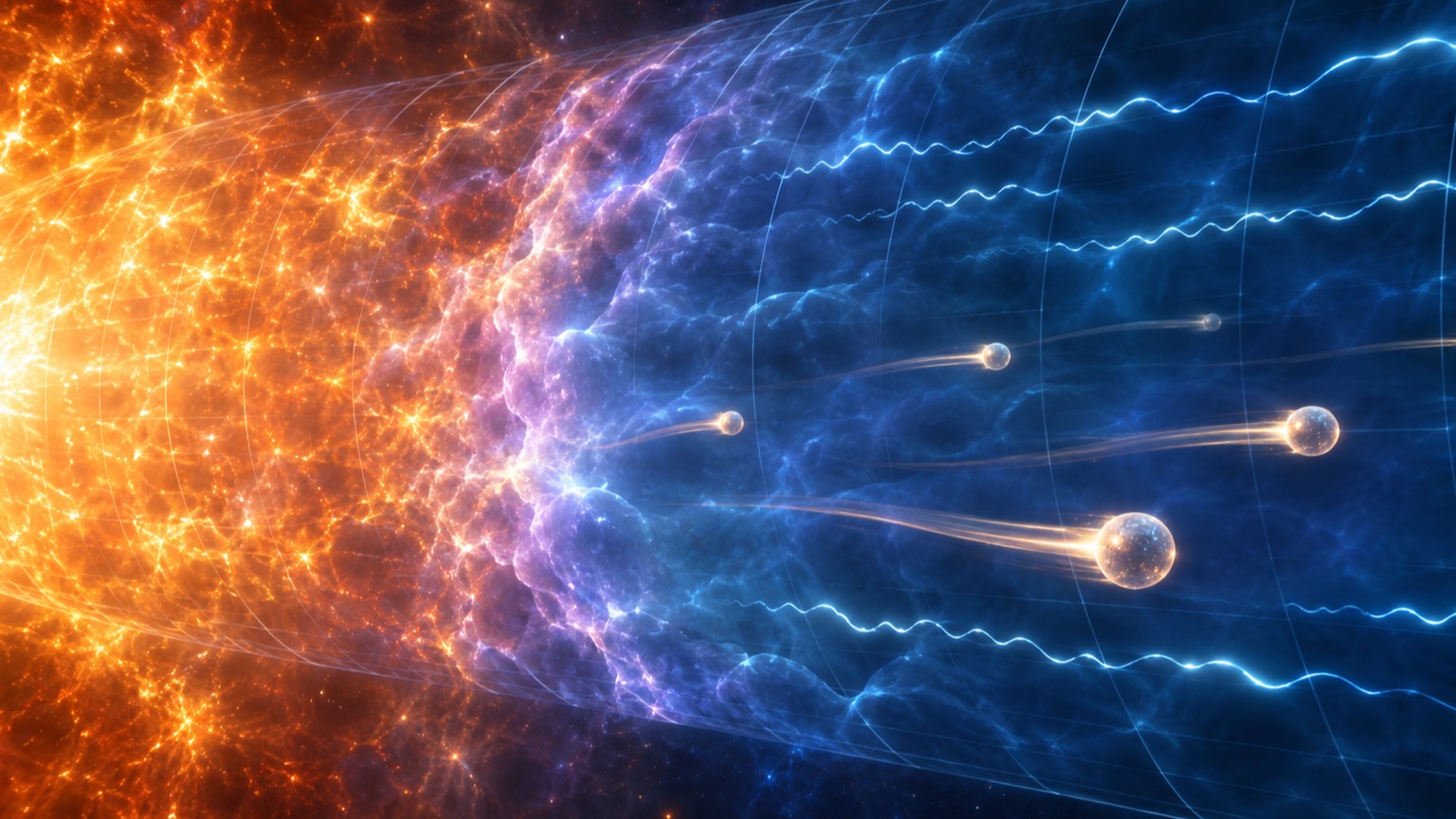
At extremely high temperature, familiar particles could not form stable bound systems. Energetic interactions continually created and destroyed excitations. Electromagnetic and weak interactions belonged to an electroweak phase whose low-energy distinction had not yet emerged in the present way.
As expansion cooled the universe, the Higgs field settled into a nonzero vacuum state. W and Z bosons became massive while the photon remained massless. This electroweak symmetry breaking helped establish the distinct long-range electromagnetic and short-range weak behaviors observed today.
Physics at even earlier and higher energies is less certain. Grand unification may connect the strong interaction with electroweak fields, and quantum gravity may alter spacetime itself, but current experiments have not confirmed those extensions.
The Strong Interaction Assembled Hadrons
When the universe cooled below the quark-gluon plasma regime, quarks and gluons became confined into color-neutral hadrons. Protons and neutrons emerged as durable composite systems. Matter and antimatter annihilated extensively, leaving a small unexplained excess of matter.
Strong-field dynamics supplied most nucleon mass. Without confinement and QCD energy, the material inventory available to gravity would be entirely different. Short-range physics therefore established the mass-bearing objects that later built stars and galaxies.
Weak Reactions Set Neutron and Proton Balance
Weak interactions converted neutrons and protons into one another while the early plasma remained hot. As expansion lowered the reaction rate relative to the cosmic expansion rate, these conversions froze out with a particular neutron-to-proton balance.
Free neutrons also decayed. The remaining population influenced primordial nucleosynthesis, which produced mostly hydrogen and helium with trace amounts of other light nuclei. The weak interaction’s rate therefore helped set the universe’s initial chemical recipe.
Neutrinos decoupled and continued through space as a cosmic background. Their tiny masses later affected how structure grew, because fast-moving neutrinos do not cluster on small scales as readily as cold matter.
Weak symmetry violation is also part of the search for why matter survived annihilation. Known effects are not sufficient to explain the observed excess, suggesting additional early-universe physics.
Electromagnetism Let Atoms Form
For hundreds of thousands of years, the universe remained a hot ionized plasma. Photons scattered frequently from free charged particles. As temperature fell, electrons bound electromagnetically to nuclei, creating neutral atoms in the epoch called recombination.
Photons then traveled far more freely. We observe that ancient radiation today as the cosmic microwave background. Its tiny temperature variations preserve a snapshot of density patterns that gravity later amplified.
Electromagnetism also enabled atoms to cool gas by emitting radiation. Cooling allowed gas clouds to lose energy, contract, fragment, and form stars. Without radiative processes, gravity alone would struggle to turn diffuse gas into compact luminous objects on the observed schedule.
Gravity Amplified Small Density Differences
Gravity attracts every form of ordinary mass-energy and acts across unlimited distance. Slightly denser regions pulled in more matter, becoming denser still. Dark matter, whatever its microscopic identity, provided additional gravitational wells without being slowed by electromagnetic radiation.
Over time, halos formed, gas fell into them, and the first stars and galaxies appeared. Gravity organized filaments, clusters, and voids into a cosmic web. Expansion competed with attraction, while dark energy later accelerated the large-scale expansion.
General relativity becomes essential around compact objects and across cosmology. Spacetime curvature guides light, produces gravitational lensing, supports black-hole horizons, and allows gravitational waves from accelerating asymmetric masses.
Dark matter reveals gravity without corresponding light. Galaxy rotation, gravitational lensing, cluster dynamics, and cosmic structure require more gravitating material than ordinary atoms provide under the standard framework. Whatever the microscopic substance is, its gravitational behavior helped build halos before much ordinary gas could cool.
Gravity also creates time. Clocks run at different rates in different gravitational potentials, an effect measured on Earth and required for satellite navigation. Across cosmology, the geometry determines how distances, wavelengths, and horizons evolve as the universe expands.
Stars Use All Four Interactions
A star begins when gravity compresses gas and raises the central temperature. Electromagnetic repulsion makes positively charged nuclei resist close approach, while quantum tunneling permits rare encounters. In the Sun, weak conversion lets two protons begin the proton-proton chain by creating a neutron-containing deuterium nucleus.
The strong interaction binds later fusion products. The mass-energy difference becomes kinetic energy and radiation. Electromagnetism transports energy through the plasma and eventually releases photons from the surface. Gravity contains the hot material and balances pressure.
The weak step is slow, giving the Sun a long stable lifetime. In massive stars, later fusion stages build heavier nuclei until iron-group binding no longer releases energy through ordinary fusion. The interaction balance then changes dramatically.
Core collapse, neutrino transport, strong-interaction nuclear matter, electromagnetic plasma, and gravity all participate in supernovae. The explosions distribute heavy elements and seed future stars, planets, and chemistry.
Elements Beyond Iron Need Extreme Environments
Slow neutron capture in evolved stars and rapid neutron capture in violent events build many heavy elements. Neutrons avoid electric repulsion, enter nuclei, and can later undergo weak beta decay that changes a neutron into a proton. Repeated capture and decay move matter across the nuclear chart.
Neutron-star mergers combine intense gravity, dense strong-interaction matter, neutrino-rich weak processes, and electromagnetic outflows. Their gravitational waves and kilonova light provide different views of one event. Multimessenger astronomy succeeds because separate interactions carry complementary information.
Electromagnetism Created Chemistry and Planets
After stars manufactured and dispersed heavy elements, electromagnetic bonding built molecules, dust grains, minerals, liquids, and biological structures. Gravity collected dust and gas into disks, planetesimals, and planets. Contact, friction, pressure, and material strength in those bodies emerge mostly from electromagnetic forces and quantum exclusion.
Planetary magnetic fields arise from moving conductive fluids. They shape charged-particle environments and can deflect part of a stellar wind. Radiation, atmospheric chemistry, and surface temperature are electromagnetic processes operating inside a gravitationally retained atmosphere.
Complexity grows because electromagnetic bonds are directional and varied. Carbon can form stable networks, water has unusual collective properties, and minerals assemble into durable structures. Gravity decides where material collects, but electromagnetism determines most of what that collected material can become.
Why Gravity Wins at Large Scale
Electromagnetism is far stronger between elementary charged particles, but positive and negative charge cancel efficiently. Bulk matter is nearly neutral. Gravity has no observed negative mass that screens ordinary positive mass-energy, so its small contributions add.
The strong and weak interactions do not extend far beyond subatomic systems. Their cosmic effects are indirect but essential: they determine what nuclei exist and how stars release energy. Gravity then moves the accumulated products across astronomical distances.
Black Holes Expose the Unfinished Unification
Black holes are predicted by general relativity, while their surrounding plasma and radiation require quantum field theory. Hawking radiation arises when quantum fields are studied on curved spacetime, suggesting that black holes possess temperature and entropy.
A complete account of the singularity, information, and the earliest universe likely requires quantum gravity. The four-force story therefore reaches a boundary where one interaction changes the arena in which the other fields operate.
Black-hole evaporation makes the conflict concrete. Quantum fields predict thermal radiation and declining mass, while general relativity supplies the horizon geometry. Following the process to its endpoint raises the information problem, where the two successful frameworks appear to demand a deeper reconciliation.
How We Read the Forces Across the Cosmos
Electromagnetic telescopes collect radio waves, infrared, visible light, X-rays, and gamma rays. Neutrino observatories detect weakly interacting messengers from the Sun, supernovae, and energetic cosmic sources. Gravitational-wave observatories measure spacetime distortions. Cosmic rays reveal high-energy charged particles and strong-interaction showers.
Combining messengers breaks ambiguities. Light reveals hot matter, neutrinos escape dense cores, gravitational waves track bulk compact motion, and laboratory nuclear data interpret element production. The universe becomes understandable when the four interactions are studied together.
Timing is especially revealing. The near-simultaneous arrival of gravitational waves and light from a neutron-star merger constrained their propagation speeds and the source’s geometry. Delays among photons of different energies, neutrinos, and gravitational waves can test both astrophysical models and possible departures from known physics.
Non-detections contribute too. Missing neutrinos, absent gamma rays, or a lack of gravitational waves can exclude source orientations and physical mechanisms. Each messenger has selection effects, so a coordinated network is more informative than one instrument alone.
A Division of Labor, Not Four Isolated Stories
The strong and weak interactions shaped the particle and nuclear inventory. Electromagnetism allowed atoms, radiation, cooling, and chemistry. Gravity amplified density variations and assembled systems across distance. Their roles overlap in every star and many violent cosmic events.
The universe has structure because the forces differ. If gravity were much stronger, stars and planets would evolve differently. If electromagnetism did not permit neutral atoms, long-range plasma behavior would dominate. If nuclear forces changed, stable elements and stellar lifetimes could vanish. Cosmic history is the unfolding consequence of one particular set of interaction rules.
Selection Effects Shape What We Can Observe
Most astronomy begins with electromagnetism because photons are abundant and comparatively easy to detect, but luminous matter is not the whole universe. Gravity reveals dark structures, neutrinos reveal hidden nuclear reactions, and cosmic rays sample high-energy charged particles. An apparent absence may reflect a messenger that cannot escape or one our instruments rarely detect.
Building a complete cosmic history therefore requires translating among interaction channels. Nuclear experiments calibrate reaction rates; particle detectors measure neutrino behavior; telescopes map radiation; gravitational surveys trace mass. The four forces shape not only the universe but also the evidence through which observers reconstruct it.
That evidence is archived at different timescales. Light from distant galaxies records the past, primordial radiation preserves early plasma conditions, and radioactive abundances integrate nuclear history. Forces leave both immediate signals and long-lived fossils.
The Future Universe Still Depends on the Same Balance
Stars will continue converting nuclear fuel until usable gradients diminish. Gravity will merge some systems and isolate others as cosmic expansion accelerates. Electromagnetic radiation will cool structures, while weak decays transform unstable remnants. The rates differ enormously, but the governing interactions remain the same.
Future discoveries may add dark-sector interactions or reveal quantum gravity. Any addition must reproduce the established cosmic history where the four-force framework already succeeds. The universe’s future, like its past, is a test of how microscopic rules accumulate across time. Precise cosmological surveys, stellar observations, and multimessenger events will keep testing that accumulation across scales no laboratory can reproduce directly, while improved particle and nuclear experiments refine the microscopic inputs used by every cosmic model in increasingly demanding detail and expose subtle mismatches that could signal genuinely new fundamental physics.