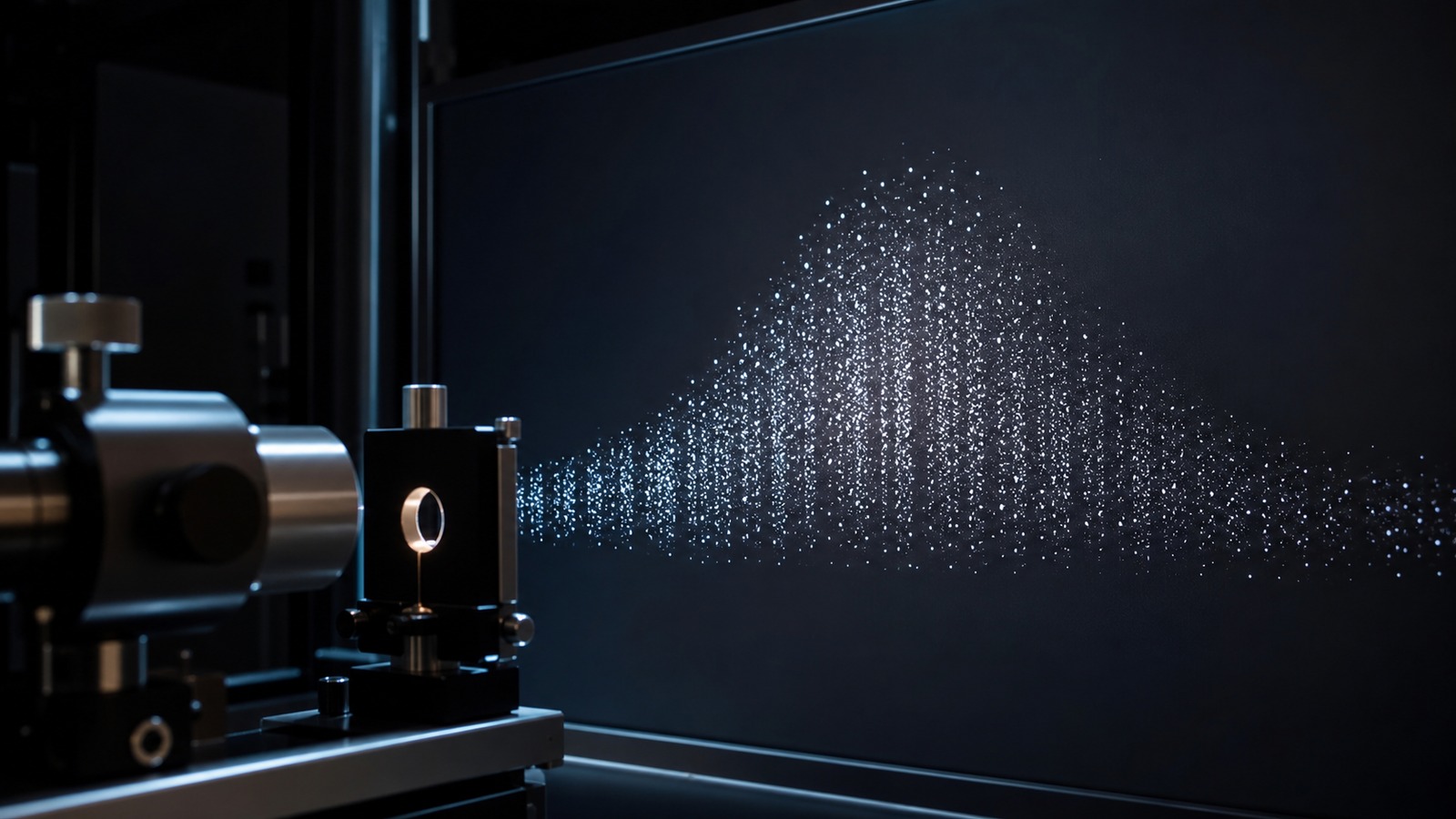
Quantum physics is often described as strange, counterintuitive, and even unsettling. Particles behave like waves, outcomes refuse to be certain, and observation itself seems to change reality. At the heart of all this strangeness lies one idea that ties everything together: superposition. If there is a single concept that unlocks the logic of the quantum world, it is this one. Superposition is not a minor technical detail or an abstract curiosity. It is the foundation upon which quantum theory is built and the reason the microscopic universe behaves so differently from the world we experience every day. To understand quantum physics without understanding superposition is like trying to understand music without rhythm. You might recognize some sounds, but the structure that gives everything meaning is missing. Superposition explains why particles can act like waves, why probabilities replace certainties, why measurement matters, and why modern technologies like quantum computers are even possible. It is the key that turns confusion into coherence.
A: No, it has been confirmed by experiments.
A: Not necessarily—interpretations differ.
A: Environmental interactions destroy it quickly.
A: Outcomes are random, but probabilities are precise.
A: In principle yes, but extremely difficult.
A: Measurement forces a definite outcome.
A: No, it has physical consequences.
A: Yes, it is essential.
A: No, it follows consistent rules.
A: Yes, everything else builds on it.
From Classical Certainty to Quantum Possibility
Classical physics, the physics of everyday life, is built on certainty. A ball is either here or there. A light switch is either on or off. An object has a definite position, speed, and direction at any given moment. Even when classical systems are complicated, they are still governed by the idea that properties exist independently of observation. The universe, in this view, is like a machine with parts whose states are always well defined.
Quantum physics dismantles this assumption. At very small scales, particles do not always possess definite properties in the way classical objects do. Instead, they are described by a range of possible states at once. Superposition is the formal way of expressing this idea. It says that a quantum system can exist in multiple possible configurations simultaneously until it interacts with something that forces a definite outcome.
This shift from certainty to possibility is not philosophical hand-waving. It is a precise mathematical statement that has been confirmed by countless experiments. Without superposition, quantum theory would collapse back into classical physics, and many of its most accurate predictions would fail.
What Superposition Really Means
Superposition does not mean that a particle is “confused” or undecided. It means that the particle is described by a combination of states, each with a certain weight or amplitude. These states coexist mathematically and physically, and their combined effects determine what can be observed.
Consider an electron that can occupy one of two energy levels in an atom. In classical terms, it must be in one level or the other. In quantum terms, it can exist in a superposition of both levels at the same time. This does not mean that half the electron is in one level and half in the other. Instead, the entire electron is described by a single quantum state that includes both possibilities.
When a measurement is made, the superposition does not gradually fade into a result. It produces a single outcome, and the probabilities of those outcomes are determined by the structure of the superposition itself. This is why probability is not an add-on in quantum physics. It emerges directly from superposition.
Waves, Particles, and the Power of Combination
One of the earliest clues that superposition was essential came from the wave-like behavior of particles. Light, once thought to be purely a wave, was shown to behave like particles called photons. Later, electrons and other particles were shown to produce interference patterns, a hallmark of waves.
Interference only makes sense if waves overlap and combine. Superposition is exactly the rule that governs this combination. When two waves meet, their peaks and troughs add together, producing patterns of reinforcement and cancellation. Quantum particles follow the same mathematical principle, even though we usually think of them as tiny objects rather than spreading waves.
The famous double-slit experiment illustrates this vividly. When particles pass through two slits without being observed, they behave as if each particle goes through both slits at once. The resulting interference pattern is a direct consequence of superposition. If superposition were not real, the experiment would produce a simple pattern corresponding to particles choosing one slit or the other. Instead, nature insists on something far stranger and far more interesting.
Superposition and the Role of Probability
Probability in classical physics reflects ignorance. If you flip a coin, the outcome is uncertain because you do not know all the forces and initial conditions. In principle, perfect knowledge would allow perfect prediction. Quantum probability is different. Even with complete knowledge of a quantum system’s state, the outcome of a measurement is fundamentally probabilistic. This is not due to missing information. It is a direct consequence of superposition.
Each possible outcome corresponds to a component of the superposition. The structure of the quantum state determines how likely each outcome is. When a measurement occurs, one outcome is realized, but the probabilities are fixed by the superposition itself. This makes superposition the engine that drives quantum randomness. Without superposition, probability would have no natural place in the theory. With it, probability becomes unavoidable and precise, woven into the fabric of reality at the smallest scales.
Measurement and the Collapse Question
One of the most debated aspects of quantum physics is what happens during measurement. Before measurement, a system exists in a superposition of possibilities. After measurement, it appears to be in a single definite state. This transition is often called the collapse of the wavefunction.
Superposition is central to this mystery. If quantum systems did not exist in superpositions, there would be nothing to collapse. The very fact that measurement plays such a dramatic role is evidence that superposition is not just a mathematical trick but a real feature of nature.
Different interpretations of quantum mechanics explain this transition in different ways. Some suggest that collapse is a real physical process. Others argue that the superposition never truly collapses, and that all outcomes exist in separate branches of reality. Despite these differences, all interpretations agree on one thing: superposition is the starting point. Remove it, and the measurement problem disappears, but so does quantum physics itself.
Entanglement: Superposition Across Space
Superposition becomes even more powerful when applied to multiple particles. When particles interact, their combined state can form a superposition that cannot be separated into individual parts. This phenomenon is known as entanglement.
In an entangled system, the superposition describes correlations between particles rather than independent states. Measuring one particle instantly affects the description of the other, no matter how far apart they are. This does not allow faster-than-light communication, but it does challenge classical ideas about locality and independence.
Entanglement is not an extra feature added onto superposition. It is a natural consequence of it. The combined system exists in a superposition of joint states, and those joint states define relationships that have no classical counterpart. Understanding entanglement requires first understanding superposition, because entanglement is superposition taken seriously across multiple particles.
Why Superposition Defies Intuition
Human intuition evolved in a world where quantum effects average out and disappear. Large objects interact with their environments constantly, causing quantum superpositions to break down almost instantly. As a result, we never experience macroscopic superpositions in daily life.
This is why superposition feels unnatural. Our brains are trained to think in terms of definite states, not overlapping possibilities. Yet the universe at small scales does not care about our intuitions. It follows rules that are consistent, testable, and astonishingly successful, even if they feel strange. The discomfort we feel when thinking about superposition is not a sign that the concept is flawed. It is a sign that our everyday experience is not a reliable guide to the fundamental structure of reality.
Superposition as the Foundation of Quantum Technology
The practical importance of superposition extends far beyond theory. Modern technologies rely on it in ways that are often invisible but essential.
Quantum computing is the most famous example. A classical bit is either a zero or a one. A quantum bit, or qubit, can exist in a superposition of zero and one at the same time. This allows quantum computers to process information in fundamentally new ways. The power of a quantum algorithm comes from manipulating superpositions, allowing many possibilities to be explored simultaneously.
Quantum sensors use superposition to achieve extreme sensitivity, detecting tiny changes in time, gravity, and electromagnetic fields. Quantum communication protocols rely on superposition and entanglement to ensure security in ways that classical systems cannot match. In all these cases, superposition is not a metaphor or a mathematical convenience. It is a physical resource that can be engineered, controlled, and exploited.
Superposition and the Limits of Knowledge
Superposition also reshapes our understanding of what it means to know something. In classical physics, knowledge is about discovering which state a system is in. In quantum physics, knowledge is about understanding the structure of a superposition.
You cannot ask a quantum system to reveal all its properties at once, because some properties correspond to different superpositions. Measuring one property reshapes the system’s state and destroys information about other possibilities. This is not a limitation of our tools. It is a consequence of how superposition works.
This insight changes the role of the observer from passive recorder to active participant. Observation is not just learning about reality. It is part of the process that defines which aspect of reality becomes actual.
The Mathematical Simplicity Behind the Mystery
Despite its philosophical weight, superposition is mathematically simple. Quantum states can be added together, scaled, and combined according to clear rules. These rules form a linear structure that makes quantum mechanics both elegant and powerful.
This mathematical simplicity is one reason quantum theory is so successful. Complex behaviors emerge from simple principles applied consistently. Superposition allows small sets of basic rules to generate an astonishing variety of phenomena, from atomic spectra to superconductivity.
The mystery of superposition does not come from mathematical complexity. It comes from the gap between the math and our everyday expectations. The equations are straightforward. Accepting what they imply about reality is the harder part.
Superposition and the Nature of Reality
At its deepest level, superposition forces us to rethink what we mean by reality itself. In a classical worldview, reality is a collection of definite facts waiting to be discovered. In a quantum worldview, reality includes possibilities that are just as fundamental as actual outcomes.
This does not mean that reality is subjective or arbitrary. The structure of superpositions is governed by precise laws. But it does mean that the universe is not built from fixed properties alone. It is built from relationships, probabilities, and potentialities that only become definite in specific contexts.
Superposition suggests that the universe is more flexible and more subtle than classical physics ever imagined. It invites us to see reality not as a static snapshot, but as a dynamic interplay of possibilities.
Why Superposition Comes First
Many concepts in quantum physics are fascinating in their own right: uncertainty, entanglement, wave-particle duality, and quantum tunneling. Yet all of them trace back to superposition. Uncertainty arises because superpositions involve incompatible properties. Entanglement arises because superpositions can link particles together. Wave-particle duality arises because superpositions behave like waves while producing particle-like outcomes. If you grasp superposition, these ideas begin to align into a coherent picture. If you do not, they remain disconnected puzzles. This is why superposition is not just one concept among many. It is the core from which the rest of quantum physics unfolds.
Conclusion: The Master Key to the Quantum World
Superposition is the master key to understanding quantum physics because it explains why the microscopic world behaves the way it does. It accounts for probability, measurement, interference, and entanglement in a single unifying framework. It bridges abstract mathematics and physical reality, showing how simple rules can give rise to profound consequences. While superposition challenges intuition, it rewards careful thought with a deeper appreciation of nature’s elegance. It reveals a universe that is not limited to either-or choices, but one that allows both-and possibilities until reality demands a decision. To understand quantum physics is not to eliminate mystery, but to recognize where that mystery comes from. At the center of it all stands superposition, quietly shaping the behavior of the smallest things and, through them, the structure of the universe itself.