A Universe Made of Ripples
For centuries, humanity has tried to answer one of its biggest questions: what is reality made of? Ancient thinkers imagined tiny, solid building blocks called atoms. Modern science confirmed atoms exist—but then shattered our simple picture of them. As physicists probed deeper into matter, they found something astonishing. At the smallest scales, the universe does not behave like a collection of solid objects. Instead, it behaves like waves. This strange discovery sits at the heart of quantum physics, the science that studies how nature works at extremely small scales. According to quantum theory, everything we see—chairs, oceans, stars, and even our own bodies—is built from entities that act both like particles and like waves. These “particle waves” challenge our intuition. They blur the line between something being “here” or “there,” solid or fluid, object or vibration. The idea is radical but powerful: perhaps reality itself is not made of tiny marbles of matter. Perhaps it is woven from ripples in deeper fields of energy. Could particle waves explain reality itself? To explore that question, we need to understand what these waves are, how they were discovered, and what they reveal about the nature of existence.
A: They behave like both, depending on how we test them.
A: At small scales, outcomes follow probability patterns.
A: Measurement influences what becomes definite.
A: No, it contains active quantum fields.
A: Large systems average out quantum effects.
A: Yes, experiments confirm it with high precision.
A: Not fully—scientists are still searching.
A: Multiple possible states existing at once.
A: A deep connection between particles across distance.
A: No, but it may be more dynamic than it appears.
The Birth of Wave–Particle Duality
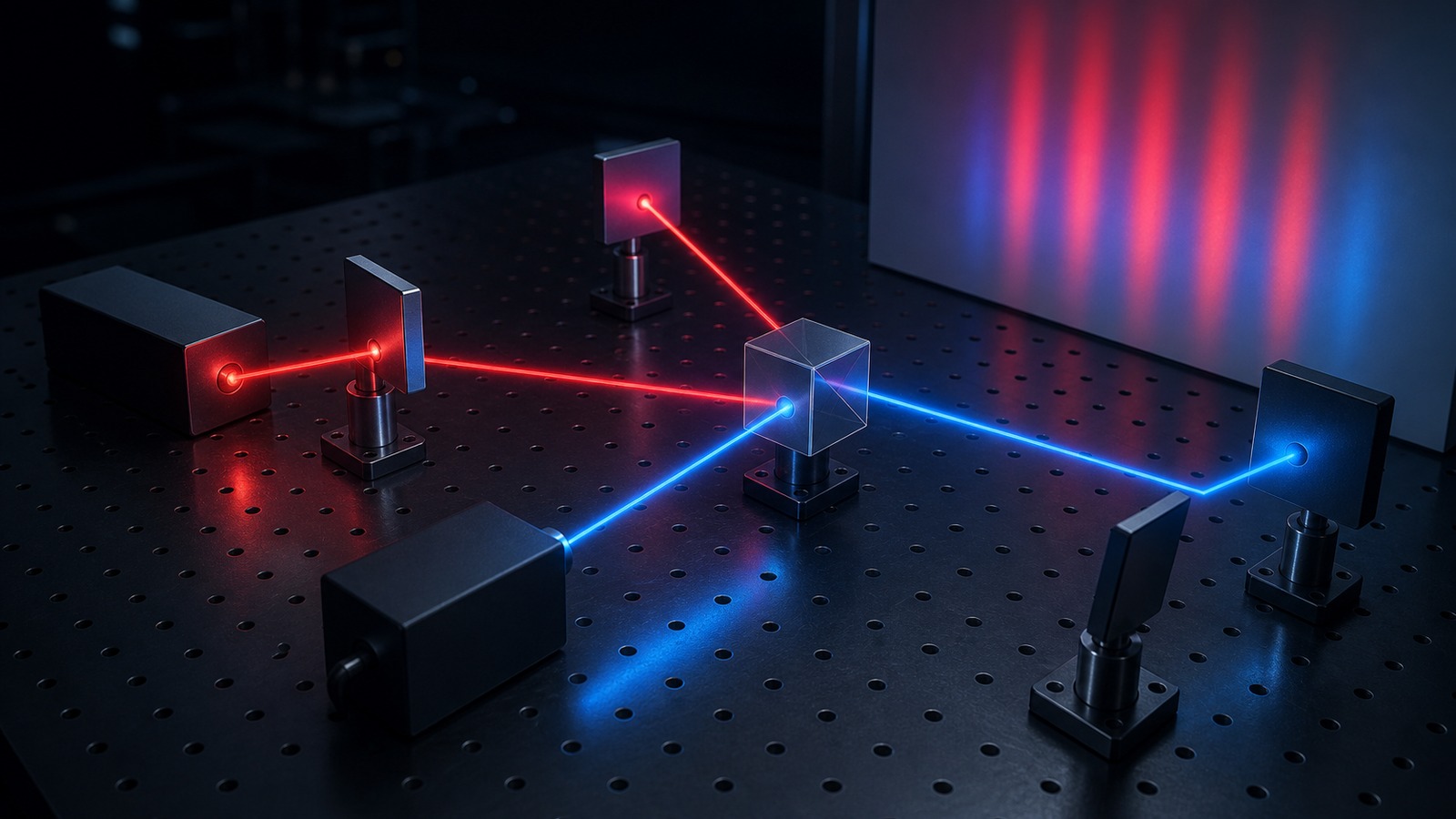
In the early 1900s, scientists faced a crisis. Experiments showed that light sometimes acted like a wave—spreading out and creating interference patterns—yet in other situations, it behaved like a stream of tiny packets of energy. This discovery helped launch the field of quantum physics. Albert Einstein proposed that light could be thought of as bundles of energy, later called photons. Around the same time, other researchers discovered that electrons—once believed to be solid particles orbiting atoms—could also create wave-like patterns. This dual behavior became known as wave–particle duality. The famous double-slit experiment demonstrated this strangeness vividly. When particles such as electrons are fired toward two narrow slits, they create an interference pattern on a screen behind the slits—a pattern normally associated with waves. Yet when scientists try to measure which slit the electron passes through, it behaves like a single particle. This experiment suggests that, at the quantum level, particles do not simply travel along one path. Instead, they exist as probability waves that describe many possible outcomes at once. Only when we measure them do they appear to “choose” a position.
What Is a Particle Wave?
To understand particle waves in simple terms, imagine dropping a pebble into a calm pond. Ripples spread outward from the impact point. Now imagine that instead of water ripples, reality itself consists of ripples in invisible energy fields. Modern physics suggests that what we call “particles” may actually be small excitations—tiny vibrations—in underlying quantum fields. Every type of particle corresponds to a field that fills the universe. An electron is not a tiny solid sphere; it may be a localized vibration in an electron field. A photon is a ripple in an electromagnetic field.
This perspective comes from quantum field theory, one of the most successful frameworks in modern science. It explains how particles interact and how forces operate at microscopic scales. According to this view, the universe is less like a box of marbles and more like a vast ocean of interacting fields. If this is true, reality at its deepest level might be fundamentally wave-like.
Probability, Not Certainty
One of the most unsettling aspects of particle waves is their relationship with probability. In everyday life, objects have definite positions. A book is either on the table or it is not. But in quantum mechanics, particles are described by wave functions that represent probabilities rather than fixed outcomes. Before measurement, a particle does not have a single, definite location. Instead, it has a spread-out wave describing where it might be found. The wave function evolves smoothly according to precise mathematical rules. But when a measurement occurs, the wave appears to “collapse,” producing one specific result.
This raises profound philosophical questions. Does measurement create reality? Or does it merely reveal something that was always there in hidden form? Scientists debate this issue intensely. Some interpretations suggest that the wave function represents our knowledge. Others argue that the wave itself is physically real. If particle waves are fundamental, then reality might not be made of solid things at all. It could be made of possibilities that solidify only when interactions occur.
Entanglement and the Connected Universe
One of the most dramatic features of particle waves is quantum entanglement. When two particles interact in certain ways, their wave functions become linked. Even if the particles are separated by large distances, measuring one instantly influences the other. Albert Einstein famously referred to this as “spooky action at a distance.” Today, experiments confirm that entanglement is real. It does not allow faster-than-light communication, but it does reveal that the universe is deeply interconnected at the quantum level.
Entanglement suggests that particle waves cannot always be treated as separate, independent entities. Instead, they can form shared wave functions that span vast distances. This challenges our classical view of objects as isolated units. Could this interconnectedness be a clue that reality is fundamentally relational rather than composed of independent building blocks?
Quantum Fields: The Fabric Beneath Particles
Modern particle physics rests on the framework known as the Standard Model. It describes fundamental particles such as quarks and electrons, along with force carriers like photons and gluons. These particles are understood as excitations of quantum fields. The discovery of the Higgs field—and the Higgs boson associated with it—provided further evidence that fields are fundamental. The Higgs field interacts with particles and gives them mass. Without it, atoms and molecules as we know them would not exist. This field-based view shifts our understanding dramatically. Instead of picturing reality as a collection of tiny objects floating in empty space, we picture space itself filled with active, dynamic fields. Particles are temporary patterns in those fields. In this sense, matter becomes something closer to music than marble. It is not solid substance but structured vibration.
The Role of Observation
The role of observation in quantum physics has inspired both scientific inquiry and philosophical speculation. Some interpretations emphasize the importance of measurement, while others avoid assigning any special role to observers. The Copenhagen interpretation, developed by early pioneers of quantum theory, treats the wave function as a tool for calculating probabilities. According to this view, quantum behavior becomes classical only when measured.
The Many-Worlds interpretation, on the other hand, suggests that the wave never collapses. Instead, all possible outcomes occur in branching universes. In this scenario, particle waves describe a vast, ever-dividing reality. There are also pilot-wave theories and objective collapse models. Each interpretation attempts to explain how wave-like possibilities lead to definite experiences. What all these views share is the recognition that particle waves lie at the heart of physical theory. Whether they represent information, reality, or branching universes, they shape how we understand existence.
From Quantum Ripples to Everyday Reality
A natural question arises: if everything is made of waves, why does the world appear solid? The answer involves a process called decoherence. When quantum systems interact with their environments, their delicate wave-like behavior becomes effectively hidden. In large systems—like rocks, trees, or people—countless particles interact constantly. These interactions cause quantum probabilities to spread and overlap in ways that make wave effects practically invisible at large scales. As a result, classical physics emerges from quantum foundations. The smooth, predictable world we experience is built upon underlying wave dynamics that average out at macroscopic scales. This means that while particle waves govern the microscopic realm, they also underpin the stability of everyday reality.
Can Particle Waves Explain Everything?
Quantum physics successfully explains the behavior of atoms, molecules, and subatomic particles. It underlies modern technologies such as semiconductors, lasers, and magnetic resonance imaging. Its predictions have been confirmed with astonishing precision. However, it does not yet fully explain gravity at the quantum level. The theory of general relativity describes gravity as the curvature of spacetime, but it does not easily merge with quantum field theory. Physicists continue to search for a unified theory of quantum gravity.
Some approaches, such as string theory, propose that fundamental entities are tiny vibrating strings rather than point particles. In this sense, the wave-like nature of reality becomes even more central. Other approaches explore the idea that spacetime itself might emerge from quantum entanglement. If true, this would mean that even space and time are not fundamental objects but products of deeper wave relationships.
The Philosophical Implications
If reality is built from particle waves, our everyday notions of solidity, individuality, and permanence need rethinking. Objects would not be self-contained chunks of matter but dynamic patterns in a larger field. This perspective resonates with certain philosophical traditions that describe the world as a process rather than a static structure. It suggests that stability arises from continuous interaction rather than rigid substance.
Yet we must be cautious. Quantum mechanics is a powerful scientific theory, but extending it too far into metaphysics can lead to speculation unsupported by evidence. The strength of particle wave theory lies in its experimental confirmation and mathematical rigor. Still, it undeniably changes how we imagine the universe.
The Ongoing Quest
The question “Can particle waves explain reality itself?” remains open. Quantum theory has reshaped science and technology. It has revealed that matter behaves like waves, that particles can be entangled across space, and that fields may be more fundamental than objects.
But the ultimate nature of reality may involve layers we have yet to discover. Future breakthroughs could deepen our understanding or even transform it again. For now, particle waves offer the most accurate description we have of the microscopic world. They reveal a universe that is dynamic, interconnected, and probabilistic at its core.
Conclusion: A Rippled Reality
The idea that reality is built from particle waves is no longer science fiction. It is supported by over a century of experiments and theoretical development. From the double-slit experiment to modern quantum field theory, evidence consistently points toward a wave-based foundation of matter. At the smallest scales, reality is not solid but fluid, not fixed but probabilistic. Fields vibrate. Possibilities interfere. Measurements reveal outcomes from waves of potential. Whether this fully explains reality or is part of an even deeper picture, one thing is clear: the universe is far stranger and more beautiful than a simple collection of tiny objects. It may be, at heart, a grand symphony of ripples. And we, too, are part of that music.