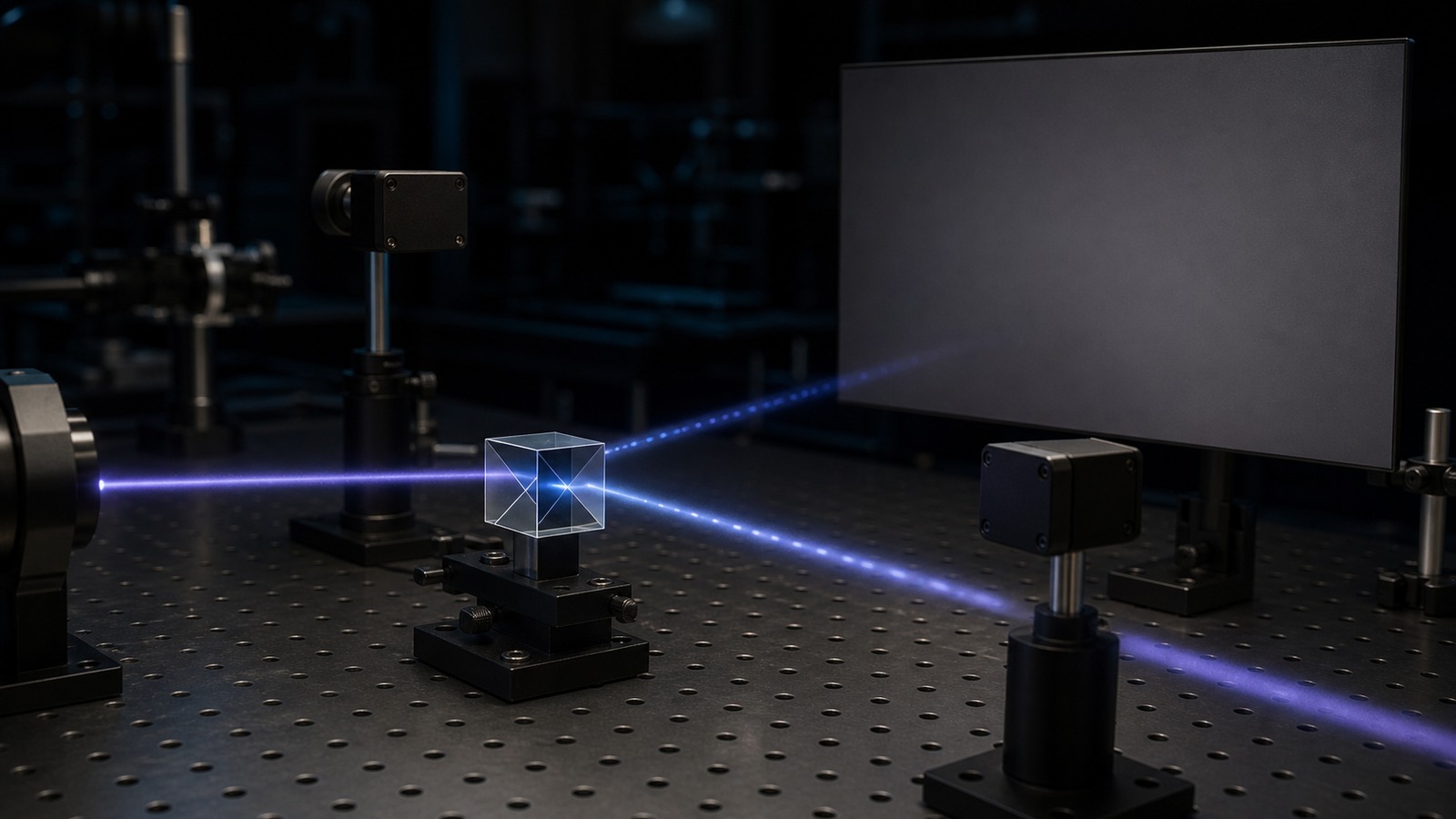
A Simple Setup That Shook the World
In the early nineteenth century, a quiet experiment with light began to unravel our deepest assumptions about reality. Known as the double-slit experiment, it appears almost too simple to matter: shine light at a barrier with two tiny openings and observe what appears on a screen behind it. Yet this modest setup has become one of the most important experiments in science. It reshaped physics, sparked the development of quantum mechanics, and continues to influence how we think about the nature of existence itself. At first glance, the experiment seems like a test of basic physics. But what it reveals is far more dramatic. The double-slit experiment suggests that particles can behave like waves, that observation may change outcomes, and that the physical world is far stranger than our everyday experiences suggest. Understanding what the double-slit experiment reveals about reality does not require advanced mathematics. It requires curiosity and a willingness to let go of familiar assumptions about how the world works.
A: It shows properties of both depending on how it is measured.
A: The experiment shows measurement matters, not necessarily human thought.
A: Large objects interact constantly with their environment.
A: Yes, it has been confirmed many times.
A: A state where multiple outcomes exist before measurement.
A: Overlapping wave-like probabilities.
A: Quantum outcomes are probabilistic but follow precise rules.
A: No, it led to quantum mechanics.
A: It reshaped science and technology.
A: The math works, but the interpretation is still debated.
The Classical Expectation: Particles or Waves
Before diving into the experiment itself, it helps to understand the scientific expectations that existed before it. For centuries, scientists debated whether light was made of particles or waves. Particles are small, solid bits of matter that move in straight lines. Waves, by contrast, spread out and interfere with one another, creating patterns of peaks and valleys. If you throw two handfuls of sand through two narrow openings, you would expect two piles to form behind the barrier. That is what particles do. But if you send waves through two openings, like water waves passing through gaps in a dock, the waves overlap. Where peaks meet peaks, the water rises higher. Where peaks meet valleys, they cancel out. This creates a striped pattern of highs and lows known as an interference pattern. Before the double-slit experiment was fully understood, scientists believed the universe was neatly divided: solid objects behaved like particles, and energy such as light behaved like waves. The experiment challenged that clean distinction.
Thomas Young and the First Surprise
In 1801, English scientist Thomas Young conducted a now-famous version of the double-slit experiment using light. When he shined light through two narrow slits, he expected to settle the particle-versus-wave debate. Instead of two bright patches on the screen, he observed a series of bright and dark bands. The pattern clearly resembled wave interference. Light, it seemed, behaved like a wave. This discovery was controversial at the time, but it eventually convinced the scientific community that light had wave-like properties. For a while, the mystery seemed resolved. Light was a wave. Case closed.
The Quantum Twist: Particles Join the Experiment
The true shock came more than a century later. With the rise of quantum physics in the early 1900s, scientists began exploring the behavior of extremely small particles such as electrons. Researchers repeated the double-slit experiment, but this time instead of shining light, they fired electrons at the barrier. Since electrons are particles of matter, the expectation was simple: two clumps would form behind the slits. Instead, the screen showed an interference pattern.
Even more astonishing was what happened when scientists fired electrons one at a time. You might expect each electron to pass through one slit or the other and land on the screen like a tiny pellet. And at first, that is exactly what appeared to happen. Each electron struck the screen at a single point. But as more and more electrons were sent through, a wave-like interference pattern gradually emerged. It was as if each electron had somehow interfered with itself. This result changed everything. It suggested that electrons, which we think of as solid particles, can also behave like waves.
Wave-Particle Duality: Both, Not Either
The double-slit experiment led to the idea of wave-particle duality. At the quantum level, objects do not fit neatly into categories. Electrons and even photons of light can display both particle-like and wave-like behavior. This does not mean they switch back and forth like actors changing costumes. Instead, they seem to exist in a state that cannot be fully described by classical categories. Their behavior depends on how we observe them.
This discovery became one of the foundations of quantum mechanics, the branch of physics that studies the smallest building blocks of the universe. Wave-particle duality suggests that reality at its deepest level is not made of solid, definite objects in the way we imagine.
The Observer Effect: Does Observation Change Reality?
The strangeness does not end there. Scientists wondered what would happen if they tried to observe which slit each electron passed through. They installed detectors at the slits to gather this information. When they did, the interference pattern disappeared. Instead of wave-like stripes, the electrons behaved like ordinary particles, forming two distinct clusters. Simply measuring which slit the electron used changed the outcome of the experiment. This phenomenon is known as the observer effect. It does not necessarily mean that human consciousness alters reality. Rather, it means that the act of measurement, which involves interacting with the system, influences the system’s behavior. Still, the implication is profound. At the quantum level, reality seems to depend on interactions. The properties of particles are not fixed until they are measured.
Superposition: Many Possibilities at Once
To explain these results, quantum theory introduced the idea of superposition. Before being measured, a particle like an electron does not have a single, definite position. Instead, it exists in a combination of possible states at once. In the double-slit experiment, this means the electron is not simply going through one slit or the other. In some sense, it is described as going through both slits simultaneously, in a wave-like spread of possibilities.
When a measurement is made, the superposition appears to collapse into a single outcome. The electron is detected at one location, not many. The interference pattern only appears when the system is allowed to remain in this delicate superposition state. Superposition challenges our everyday logic. We are used to thinking in terms of either-or choices. Quantum reality suggests that, at least at small scales, the universe operates with both-and possibilities.
From Experiment to Quantum Mechanics
The double-slit experiment became a cornerstone of modern physics. It helped inspire the development of quantum mechanics by scientists such as Albert Einstein, Niels Bohr, and Erwin Schrödinger. These thinkers wrestled with the meaning of quantum behavior and proposed different interpretations.
Einstein famously resisted the idea that reality could be fundamentally uncertain, declaring that he believed the universe did not operate by chance. Bohr, by contrast, argued that quantum theory does not describe an objective reality independent of observation but instead describes what we can say about nature. Schrödinger contributed the mathematical equation that describes how quantum systems evolve as waves of probability. His thought experiment involving a cat in a box became a popular illustration of superposition and measurement. The debates among these physicists continue to echo in modern discussions about the nature of reality.
What the Double-Slit Experiment Reveals About Reality
So what does the double-slit experiment truly reveal about reality? First, it shows that at the smallest scales, nature does not behave according to classical rules. The world is not made of tiny billiard balls following predictable paths. Instead, it is described by probabilities and wave functions. Second, it suggests that observation plays a fundamental role in how physical systems behave. Measurement is not a passive act. It is an interaction that shapes outcomes. Third, it reveals that our intuitive categories, such as particle and wave, are limited. The quantum world does not conform to simple labels. Finally, the experiment implies that reality may be deeply interconnected. The behavior of a particle depends not just on its own properties but on the experimental setup as a whole.
Modern Versions and Deeper Mysteries
Today, scientists have performed versions of the double-slit experiment with increasingly large objects, including molecules made of dozens of atoms. In each case, quantum interference appears as long as the system remains isolated from measurement. These experiments confirm that quantum behavior is not limited to tiny particles. It is a general feature of the universe. The reason we do not see such behavior in everyday life is that large objects constantly interact with their environment, causing quantum effects to fade through a process known as decoherence.
Even with advanced technology, the double-slit experiment continues to provoke new questions. Some interpretations of quantum mechanics suggest that all possible outcomes occur in parallel branches of reality. Others argue that hidden variables may still determine outcomes beneath the surface. While scientists agree on the mathematical accuracy of quantum theory, they continue to debate what it means for the nature of reality.
Why It Matters Beyond Physics
The double-slit experiment is not just a laboratory curiosity. It has influenced philosophy, technology, and culture. Quantum mechanics underlies modern technologies such as semiconductors, lasers, and quantum computing. Without understanding wave-particle duality, much of today’s digital world would not exist.
Philosophically, the experiment challenges materialism, determinism, and our assumptions about objectivity. It invites us to reconsider what we mean by reality. Is the universe fundamentally probabilistic? Does reality exist in a definite form independent of observation? Or is our role as observers more central than we once believed? While the experiment does not provide simple answers, it encourages humility. The deeper we look into the structure of the universe, the more mysterious it becomes.
A Window Into the Hidden Structure of the Universe
The double-slit experiment remains one of the most powerful demonstrations of quantum strangeness. With a simple arrangement of slits and a screen, it reveals that the universe operates according to principles that defy everyday intuition. It shows us that particles can act like waves, that possibilities can exist simultaneously, and that measurement influences outcomes. It reminds us that reality is not always what it appears to be. For non-scientists, the lesson is not that the world is incomprehensible. Rather, it is that the universe is richer and more surprising than we imagined. The double-slit experiment offers a glimpse behind the curtain of classical physics into a realm where probability, superposition, and interaction shape existence. In seeking to understand what the double-slit experiment reveals about reality, we discover something profound: the universe is not a simple machine made of solid parts. It is a dynamic, interconnected tapestry of possibilities, waiting to be explored.