The Clear Experiment With the Unsettling Meaning
The double-slit experiment still confuses scientists because the result is experimentally clean while the meaning is hard to force into everyday language. Send light, electrons, atoms, or other quantum objects toward two openings, and the long-run pattern can look like interference from waves. Detect individual arrivals, however, and each event appears at one localized place. The puzzle is not that physicists cannot calculate the pattern. Quantum mechanics predicts it very well. The discomfort comes from trying to say what happened between preparation and detection. Did the particle take one slit, both slits, neither ordinary path, or something that our path words distort? Add reliable which-path information, and the interference fades. Remove that path information, and the wave-like pattern returns. The experiment therefore presses on the same tender spot again and again: quantum objects are detected like particles, but their possible outcomes are organized like waves. Scientists can agree on the data and still debate the best interpretation. That is why the double-slit experiment remains famous. It is simple enough to describe in a classroom, strong enough to test in a laboratory, and deep enough to keep exposing the limits of classical imagination.
A: It is easy to calculate but hard to turn into one classical story.
A: Quantum mechanics assigns alternatives, but ordinary path language becomes limited.
A: Reliable path information prevents the alternatives from interfering the same way.
A: No. A physical detector or environmental record is enough.
A: Single-particle experiments build interference over many repeated events.
A: Individual events are probabilistic, but the distribution is structured.
A: They usually agree on predictions but differ on what the wavefunction means.
A: It shows localized detections and their long-run distribution.
A: Coherence allows alternatives to combine before measurement.
A: The whole setup determines which quantum evidence appears.
Why the Setup Looks So Simple
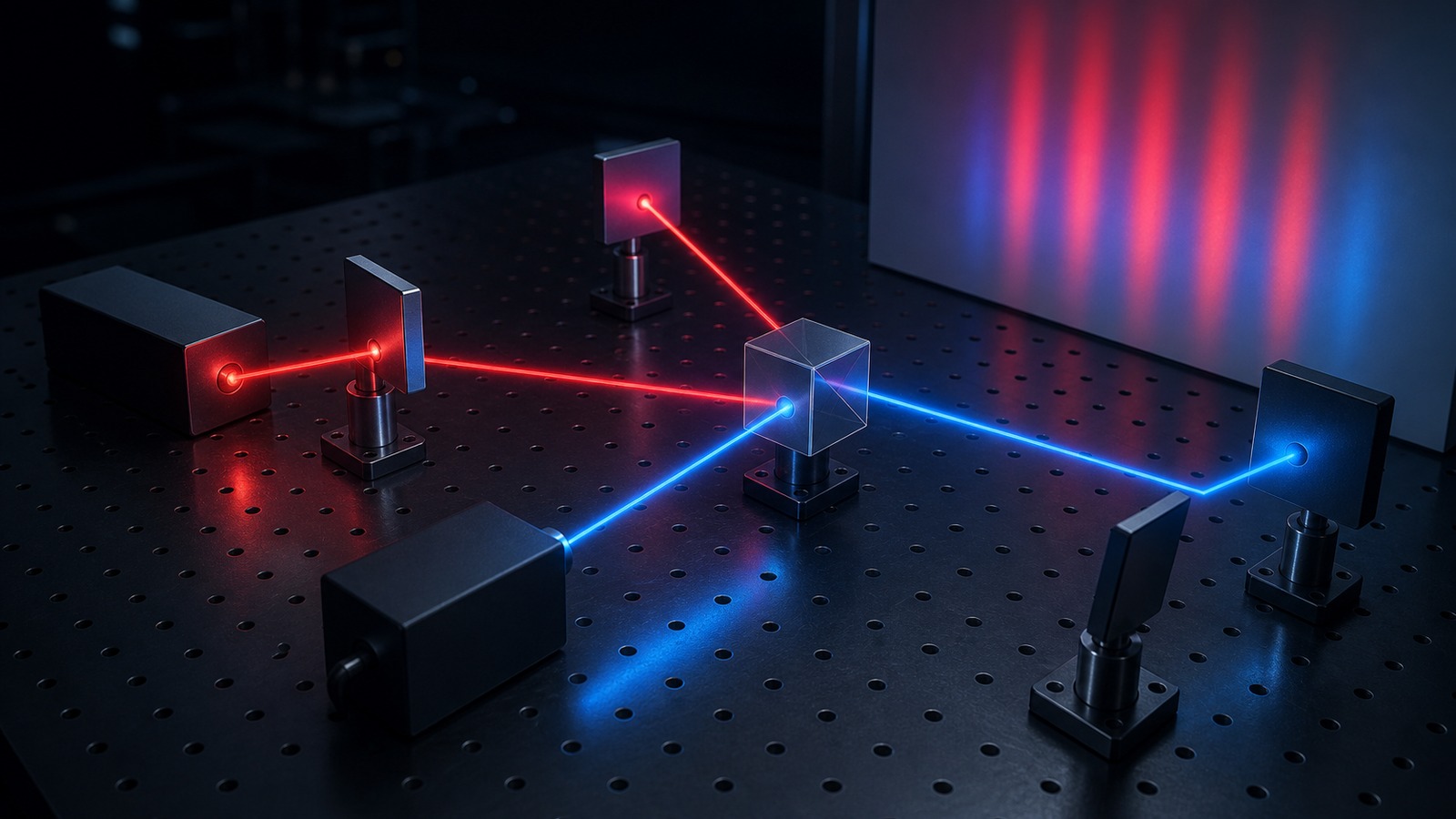
The basic double-slit arrangement sounds almost too plain to be profound. A source sends particles or light toward a barrier with two narrow openings. A screen or detector records where the arrivals end up. Change the slit spacing, wavelength, or distance to the screen, and the pattern changes in a predictable way.
That simple geometry is part of the experiment’s power. It removes many distractions and lets one question stand out: what kind of rule organizes the final distribution? If the objects behaved like ordinary pellets, the result would mainly be two broad piles behind the openings. Instead, under the right conditions, bands appear.
The bands are the first hint that ordinary path language is in trouble. They show bright and dark regions, as though alternatives are reinforcing and canceling. A classical particle does not cancel itself just because another possible route existed nearby. A wave can.
Yet the detection screen does not record a smooth sheet of stuff. It records localized events. This combination is what makes the setup so stubborn. Each arrival looks particle-like, while the total distribution carries wave-like structure.
The experiment’s simplicity therefore hides a sharp logical trap. The easier the apparatus is to explain, the harder it becomes to blame the puzzle on technical clutter. The strange part belongs to the quantum behavior, not to a confusing machine.
Why the Calculation Is Not the Confusion
Scientists are not confused because they lack equations for the double-slit experiment. The quantum state is assigned amplitudes for the alternatives, and those amplitudes combine. Squaring the combined amplitude gives probabilities for where detections appear. The mathematics is compact and successful.
The confusion begins when we ask what the mathematics means. An amplitude is not an ordinary wave of water, and it is not a hidden list of preselected particle paths. It is a quantum tool that carries phase information, allowing alternatives to interfere before a definite outcome is recorded.
This difference matters because a successful calculation can coexist with interpretive disagreement. Some physicists prefer language about a wavefunction evolving until measurement. Others emphasize information, histories, decoherence, pilot waves, or many worlds. The predictions match, but the story behind them can differ.
The double-slit experiment stays confusing because it refuses to reward one comfortable picture. It gives enough structure to calculate and enough mystery to argue about what the structure represents. That is a rare and productive kind of confusion.
What Which-Path Information Changes
Add a detector that reliably tells which slit the quantum object used, and the interference pattern disappears or weakens. This is often described as observation changing the result. A clearer description is that path information changes the experimental conditions. The alternatives are no longer indistinguishable.
The detector does not need to be dramatic. It does not have to shove the particle with a visible kick or wait for a human mind to notice. It only needs to create a physical record that separates the alternatives. Once the paths are marked, the amplitudes cannot combine in the same way.
This is why the experiment is so closely tied to measurement. The setup does not merely reveal a prewritten answer. It helps define what kind of answer can exist. A path-marking arrangement supports particle-like records, while a coherence-preserving arrangement supports interference.
That does not mean anything goes. The pattern is not chosen by opinion, expectation, or drama. It follows strict rules tied to the apparatus. Change the information available in a controlled way, and the pattern changes in a controlled way.
For scientists, that is both reassuring and unsettling. The experiment is disciplined enough to be precise, but it denies the simple claim that a particle always had one ordinary path waiting to be uncovered.
Why Single Particles Make It Stranger
The double-slit puzzle deepens when the experiment is run with one quantum object at a time. A single electron or photon arrives at one place. After many runs, the same interference pattern builds up. The wave-like distribution is not caused by particles bumping into one another.
This single-particle version is often where intuition starts to strain. If there is only one particle in the apparatus, what is it interfering with? Quantum mechanics answers with the interference of alternatives in the state, not with a tiny object colliding with a partner.
That answer is powerful, but it is not easy to picture. It asks us to treat the possible routes as physically meaningful in prediction even when only one detection occurs. The final dot is simple. The probability structure behind many dots is not.
Single-particle buildup also keeps the result honest. It shows that the mystery is not a crowd effect, a beam-smearing trick, or an ordinary wave hidden in a continuous stream. The same question returns with each carefully prepared event.
Why Interpretations Diverge
Different interpretations of quantum mechanics often use the double-slit experiment as a testing ground for language. A Copenhagen-style explanation may emphasize the limits of assigning paths before measurement. A pilot-wave account may give the particle a definite trajectory guided by a wave. A many-worlds account may describe branching alternatives.
These interpretations are not all saying the same thing in different accents. They make different claims about what exists, what the wavefunction means, and how outcomes should be understood. Yet in ordinary double-slit conditions, they generally reproduce the same observed pattern.
That is why the experiment can confuse scientists without undermining science. The empirical core is stable. The philosophical reading remains open. The experiment separates what is measured from what is inferred about the unseen process.
For beginners, this distinction is liberating. You do not need to solve every interpretive debate before understanding the result. You can first learn what changes the pattern, what does not, and why path information is so important.
The remaining debate is not a weakness. It is evidence that the experiment touches foundations directly. Few simple setups make the difference between prediction and explanation so visible.
What Scientists Agree On
Despite interpretive disagreements, there is broad agreement about the experimental facts. Coherent alternatives can produce interference. Reliable path information destroys or reduces that interference. Individual detections are localized. Repeated preparations reveal stable statistical patterns.
Scientists also agree that everyday pictures are incomplete. The quantum object is not just a pellet and not just a water wave. Classical words become useful only when tied to specific parts of the experiment. Particle language fits detection; wave language fits the distribution.
That agreement matters because it keeps the puzzle from becoming vague. The double-slit experiment is not a license for any mystical claim. It is a precise demonstration of how quantum predictions depend on preparation, coherence, and measurement.
The confusion that remains is sharper than popular mystery. It is the disciplined discomfort of a theory that works beautifully while refusing to become a familiar story.
Why It Still Belongs in Modern Physics
The double-slit experiment is not merely a museum piece from early quantum history. Its logic appears in interferometers, quantum information, precision measurement, and tests of decoherence. Modern instruments may be more complex, but they still exploit the same relationship between alternatives, phase, and detection.
New versions keep pushing the boundary. Researchers test interference with larger particles, better isolation, weaker measurements, and more elaborate delayed-choice arrangements. Each version asks how far quantum coherence can be preserved and what counts as a record.
This is why the experiment still confuses in a useful way. It is not that scientists are stuck. It is that the experiment keeps generating clean questions at the edge of what classical language can carry.
How the Puzzle Guides Better Questions
The double-slit experiment becomes less confusing when it is treated as a question about evidence rather than a demand for a hidden movie. Instead of asking which familiar path the particle really took, ask what the setup made distinguishable. That change of question moves the conversation toward physics.
It also helps to separate the single event from the full distribution. One dot cannot display interference by itself. The pattern appears only when many similarly prepared events are compared. This is why the experiment rewards patience and repeated preparation.
A better question is whether the alternatives stayed coherent. If they did, interference can appear. If a detector, environment, or path marker separated them, the pattern changes. Coherence becomes the hinge between the wave-like and particle-like descriptions.
Another useful question is what kind of record exists. A record can be a detector state, a scattered photon, or an environmental trace. It does not need to be a human-readable note. Once alternatives are recorded differently, the experiment has changed.
These questions do not solve every interpretation debate, but they keep the debate honest. They focus on preparation, information, and measurement rather than on dramatic metaphors. The experiment remains strange, but the strangeness becomes better organized.
That is why scientists keep teaching it. The double slit is not only a result to memorize. It is a training exercise in asking quantum questions carefully.
What the Confusion Is Good For
The remaining confusion has a useful job. It keeps students from mistaking a successful calculation for a complete mental picture. The experiment teaches that prediction can be solid even when classical imagination is unsettled.
It also trains skepticism toward simple claims. Any explanation that ignores measurement, coherence, or localized detection is leaving something out. The confusion points to the missing piece.
Used well, the puzzle becomes a guide. It tells readers where quantum mechanics is asking for better language rather than louder certainty.
What Readers Should Keep
The double-slit experiment is confusing because it is clear. It shows localized detections arranged by wave-like probabilities, then shows that path information changes the pattern.
The safest lesson is not that particles are magical. It is that quantum behavior must be read through the whole experimental arrangement, including what information is preserved or destroyed.