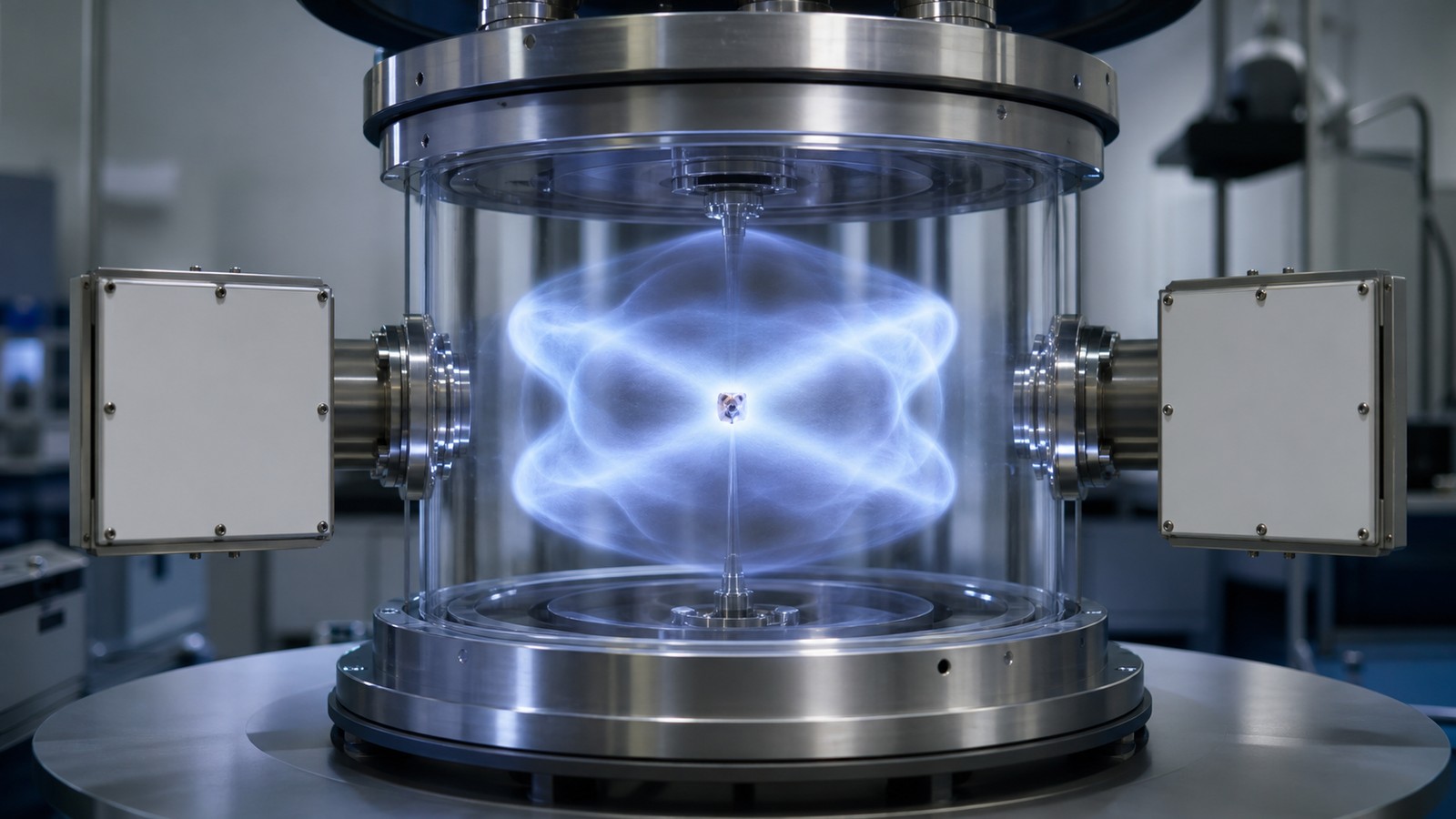
The Cloud Is A Map, Not A Mist
Particles behave like clouds of possibilities when their quantum state spreads the possible outcomes of a measurement instead of assigning one hidden classical path. The cloud image is useful because it reminds beginners that an electron, photon, or atom may not have one definite location waiting in the ordinary sense. It is also dangerous if taken too literally. The cloud is not a puff of material smeared through space. It is a map of likelihood created by the quantum state and the measurement being considered. A detector can still record one localized event. Repeated detections from the same preparation reveal the broader pattern. The particle is not vague in every way. Its state can be precise, while the outcome it offers to a particular measurement remains distributed.
A: The cloud is a probability map, not ordinary material fog.
A: It helps replace the hidden-track picture.
A: It is one record sampled from the distribution.
A: Repeated preparations build the pattern statistically.
A: No. The state assigns different likelihoods to different outcomes.
A: Yes, as probability maps for electron detection.
A: Yes. The quantum state evolves under physical rules.
A: Measurement creates a definite record from the prior spread.
A: Preparation sets the state that defines the cloud.
A: Cloud language means structured possibility before one recorded outcome.
Why The Cloud Picture Helps
The cloud picture helps because it breaks the tiny-billiard-ball habit. A particle in a quantum state is not always best imagined as a little object with a hidden track. The state may assign possible detections across a region.
That region can be broad, narrow, symmetric, lopsided, or shaped by barriers and fields. The shape is evidence that the state has structure. It is not a confession that physicists have stopped knowing anything.
A good probability cloud is therefore a disciplined map of possible records.
Why The Cloud Picture Misleads
The same image misleads when it suggests a particle is literally diluted into ordinary fog. Measurements do not usually find a thin mist. They find localized events, such as a dot, click, or energy transfer.
The cloud belongs to the prediction before the event. The record belongs to the measurement after the interaction. Keeping those apart prevents the metaphor from becoming a mistake.
How A State Creates Possibilities
A quantum state encodes what may happen in a chosen measurement. For position, it can tell where detections are more or less likely. For spin, it can tell how often different outcomes will appear along a chosen axis.
The possibilities are not free-floating guesses. They come from preparation, dynamics, and the measurement setup. Change the preparation or the measurement, and the cloud-like distribution can change too.
This is why the word possibility in quantum mechanics is more technical than ordinary speculation.
Why One Dot Is Not The Whole Cloud
A single detection gives one outcome from the distribution. It does not show the entire probability cloud, just as one raindrop does not show a weather map. The larger pattern requires repetition.
Scientists prepare the same kind of system many times and collect many records. The accumulated results reveal the cloud shape that guided individual outcomes.
How Orbitals Use The Image
Atomic orbitals are the most familiar probability-cloud pictures. They show where an electron is likely to be found around a nucleus. Their shapes explain spectra, chemical bonding, and the periodic table.
But orbitals are still state maps. An electron is not a little planet moving through every lobe as a classical route. The lobe shape summarizes the probability distribution for measurements on similarly prepared atoms.
That is why the cloud image can be both visually helpful and conceptually incomplete.
What Clouds Do Not Permit
A cloud of possibilities does not mean any outcome is equally allowed. Some regions can have high probability, some low probability, and some zero probability for a given state.
The distribution is constrained by the wavefunction, forces, boundary conditions, and conservation rules. Quantum possibility is structured possibility, not permission for anything whatsoever.
Why Measurement Looks Definite
The measured world looks definite because records are definite. A detector records a hit, a screen marks a point, or an atom changes state. Those records can be copied, compared, and used for later predictions.
That definiteness does not erase the role of the prior cloud. The cloud explains the pattern of many records, while each record gives one actual event within that pattern.
This relationship between spread and record is at the heart of quantum measurement.
How Clouds Change Over Time
A probability cloud can spread, shift, oscillate, or split depending on how the state evolves. Barriers, fields, lenses, and interactions can all reshape the distribution before measurement.
This dynamical behavior is why probability clouds are not static decorations. They are working predictions that respond to the physical situation.
How To Use The Metaphor Well
Use the cloud metaphor when it helps readers stop demanding a hidden classical path. Drop the metaphor when it starts sounding like literal vapor. The real idea is a quantum state assigning probabilities.
It also helps to specify the measurement. A cloud for position is not the same as a spread for momentum, energy, or spin. Possibility always belongs to a question the experiment can ask.
The best version of the metaphor points back to the state.
Why The Cloud Has Edges
The cloud metaphor sounds soft, but the actual probability structure can have sharp restrictions. Some regions may be highly likely, some may be unlikely, and some may be excluded by the state. A quantum cloud is shaped by rules, not by casual looseness.
That is why the picture helps most when it is treated as a map. A weather map has contours, gradients, and boundaries. A probability cloud has structure created by preparation, forces, and the measurement being considered.
How A Possibility Cloud Can Move
A probability cloud is not necessarily frozen. As a quantum state evolves, the distribution can spread, shift, rotate in abstract state space, or split around barriers. Fields and interactions can reshape the cloud before any final detection occurs.
This changing shape is part of the prediction. If the state is allowed to evolve for a longer time, the eventual distribution of records may differ from the distribution measured earlier. Time is part of the setup.
That movement keeps the metaphor from becoming a static picture. The cloud is a living calculation, not a decorative haze.
Why One Particle Still Gives One Event
The cloud image can make a particle seem spread into many little pieces. Measurements usually do not find many little pieces. They find one localized event, such as a dot on a screen or a transfer of energy in a detector.
This is the useful tension. The state before measurement can be spatially spread, while the record after measurement is definite. The cloud explains the distribution of many possible records, not a visible fog caught by the detector.
How The Image Helps Chemistry
Probability clouds become especially useful in atoms and molecules. Electron orbitals show where detections are likely, and those shapes help explain why bonds form in certain directions. The cloud is not literal mist, but it has real consequences for chemical structure.
A molecule’s shape depends on how electron probability is arranged between nuclei. Bond strength, reactivity, and light absorption all connect back to state patterns. The metaphor becomes useful because it points toward those patterns.
Used carefully, the cloud turns an invisible state into a workable mental image.
Why The Metaphor Should Stay Humble
The cloud should never be asked to explain everything. It is strongest for position probability and weaker for properties such as spin or phase. When the measurement changes, the relevant map changes too.
How Boundaries Shape The Cloud
Boundaries can shape a probability cloud dramatically. An electron in an atom, a particle in a trap, or light in an interferometer all face physical constraints. Those constraints help determine which probability shapes are allowed and which are not.
This is why clouds in quantum mechanics can have lobes, rings, gaps, and nodes. They are not soft guesses smeared over every direction. Their shapes carry information about the system.
Why The Cloud Can Be Tested
A probability cloud is not accepted because it looks plausible. It is tested by comparing predicted distributions with repeated measurements. If the recorded pattern does not match, the preparation, model, or apparatus has to be questioned.
That testability gives the metaphor discipline. The cloud is not a poetic substitute for data. It is a visual way to summarize a claim that experiments can challenge.
In atomic physics, spectroscopy and scattering give indirect checks on orbital structures. In interference experiments, screens and counters reveal the distribution more directly.
How Different Properties Need Different Images
A position cloud is only one kind of map. Momentum can have its own distribution. Spin may be represented by directions in an abstract space rather than by a physical haze. Energy states require another kind of description.
Remembering that variety prevents the metaphor from doing too much. Particles behave like clouds of possibilities only relative to the measurement being discussed.
What The Image Should Leave Behind
The cloud image should leave behind one habit: ask for the probability pattern before demanding a hidden classical route.
How The Cloud Meets A Detector
When the cloud-like state meets a detector, the apparatus records a definite event. The cloud does not land as a whole visible object. It guides the probabilities for where events appear.
This difference explains why quantum pictures can seem to switch styles. Before measurement, the useful image is distributed. After measurement, the useful record is localized. The experiment needs both descriptions.
Why The Metaphor Works Best With Repetition
Repeated trials let the cloud become visible as a pattern. One event may appear almost anywhere allowed by the state, but many events reveal where probability is concentrated.
That pattern is the reason scientists keep the cloud metaphor at all. It points toward something measurable, even if the image itself is not literal.
The metaphor earns its place by predicting the collection, not by photographing one particle.
How Scale Changes The Picture
For large objects, the cloud picture usually becomes useless in practice because environmental interactions make ordinary positions stable and records abundant. The quantum state is still part of the deeper story, but the visible behavior looks classical.
For small isolated systems, the cloud picture can remain essential. Electrons, photons, atoms, and carefully prepared molecules can preserve probability patterns long enough for experiments to reveal them.
The Cleanest Beginner Test
Ask what measurement the cloud describes. If the answer is not specified, the metaphor is probably being stretched beyond its useful range.
How To Read Cloud Pictures In Articles
When an article shows a cloud, ask whether it represents position likelihood, electron density, an abstract state, or a loose visual metaphor. Those are not interchangeable.
A strong article will connect the cloud to a measurement record. It will say what repeated detections would reveal and what the image is not meant to show literally.
That reading habit lets the picture stay useful. The cloud guides intuition without replacing the state or the experiment.
One Useful Final Guardrail
The cloud is best treated as a prediction about repeated measurement records. If an explanation makes it sound like ordinary fog, hidden indecision, or a picture of every property at once, the metaphor has been pushed too far.
The Possibility-Cloud Takeaway
Particles behave like clouds of possibilities when their states spread possible measurement outcomes.
The cloud is a probability map, while measurement records one actual event from the map.