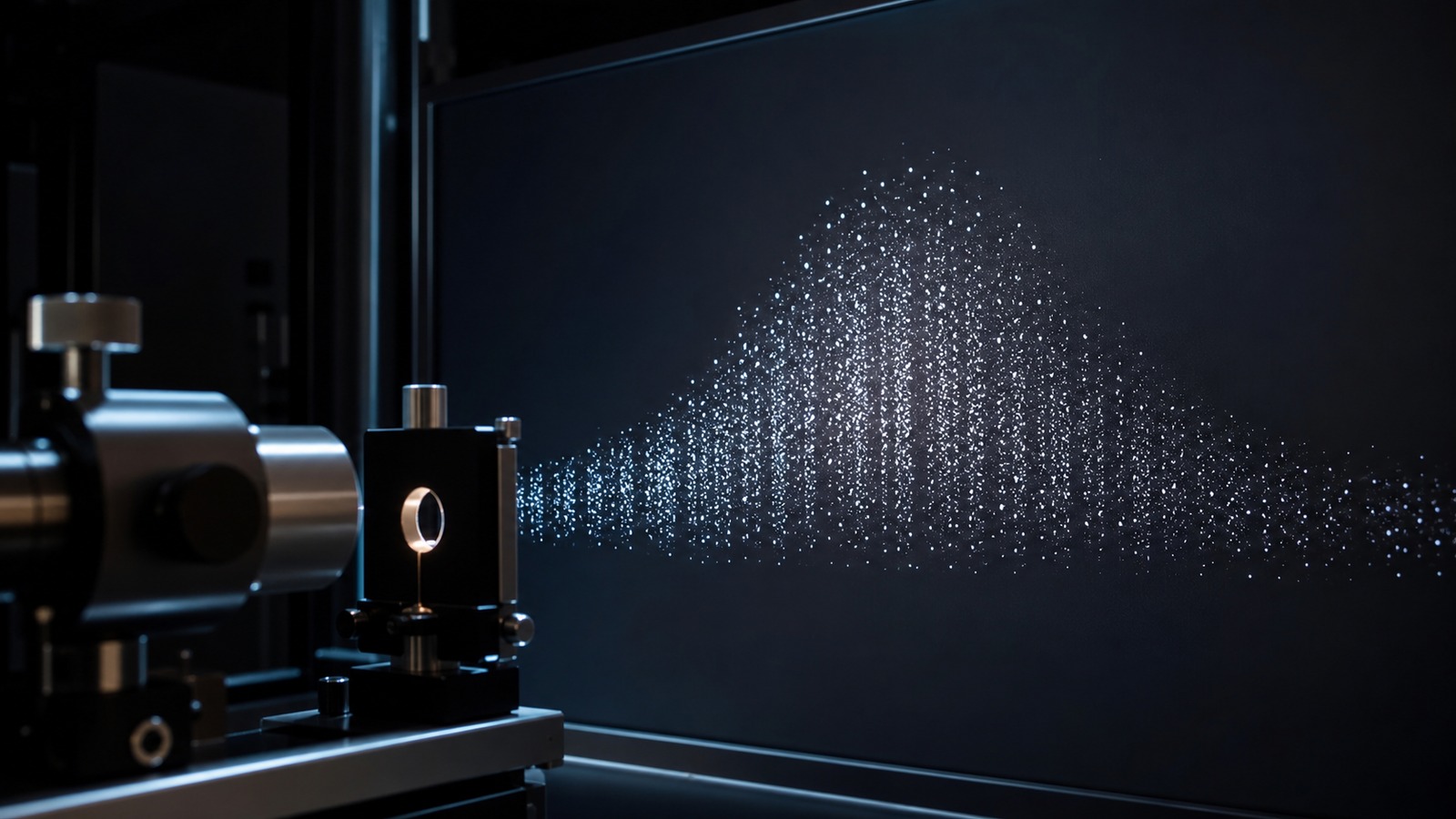
If you grew up picturing atoms like mini solar systems—electrons as little planets circling a nucleus “sun”—you’re not alone. It’s a useful starting image, but it breaks down fast. In real atoms, electrons don’t travel along neat tracks. Instead, they behave more like spread-out “possibility clouds” that tell you where an electron is likely to show up if you look. That cloud isn’t a fog of many electrons in one place—it’s a map of chances for a single electron. The reason atoms can exist at all, instead of collapsing into chaos, is that electrons follow quantum rules. One of the biggest rules is superposition: an electron can “be” in a blend of different states at once—different positions, energies, and patterns—until an interaction forces a definite outcome. Those blended states aren’t random. They combine in structured ways that create the stable shapes of atoms and ultimately the chemistry of everything around you.
A: Not everywhere—its probability is spread across a pattern, with some regions much more likely than others.
A: They’re real as stable probability patterns that predict measurements and chemistry reliably.
A: The lowest allowed quantum state is spread out and has a minimum energy that prevents collapse.
A: Measurements produce specific outcomes, but the wave pattern predicts where those outcomes tend to happen.
A: Overlapping electron patterns can lower energy by increasing electron probability between nuclei—this creates a bond.
A: A wave combination that cancels between atoms, reducing shared electron density and making bonding weaker.
A: Quantum rules still apply, but constant interactions make large objects behave in stable, classical-looking ways.
A: They have similar outer-electron orbital patterns, which drives similar bonding behavior.
A: Electrons occupy allowed states based on energy and rules; they’re not choosing so much as following constraints.
A: Like overlapping waves forming one combined pattern—reinforcing in some places, canceling in others.
Superposition, Explained Like You’re Not in Physics Class
Superposition sounds spooky because it clashes with everyday life. A coffee mug is either on the table or it isn’t. But electrons don’t act like mugs. A better analogy is music. A guitar string can vibrate in more than one way at the same time. You can pluck it and get a “mix” of tones—fundamental plus overtones—creating one rich sound. The string isn’t choosing one vibration; it’s doing several at once, and the result is a combined pattern you can hear. Electrons do something similar, except the “vibrations” are not in air or metal—they’re in the electron’s quantum wave. Superposition means an electron’s state can be a combination of multiple allowed states. When those states overlap, they can reinforce each other in some regions and cancel out in others. That “reinforce/cancel” behavior is what sculpts the electron cloud into the distinct orbital shapes that make atoms stable and predictable.
Electrons Act Like Waves of Possibility
Here’s the key mental shift: an electron isn’t just a tiny bead moving through space. In quantum physics, it’s described by a wave-like pattern that spreads out. This wave doesn’t mean the electron is literally smeared like paint. It means the electron has a spread-out set of probabilities for where it could be found. Where the wave is stronger, the electron is more likely to be detected if you measure it. Where the wave is weak, detection is unlikely. When you hear “wave,” don’t imagine ocean waves. Think of a pattern—like ripples on a pond or the standing wave on a jump rope. Patterns can overlap. Two patterns can combine into a new one. That is superposition in action: overlapping waves create a new probability pattern. Atoms form because the electron’s wave settles into stable patterns around the nucleus—patterns that are allowed by the quantum rules and that don’t self-destruct.
Orbitals Are Standing-Wave Shapes, Not Tracks
So what is an orbital, really? It’s not a path. It’s a standing-wave pattern—a stable shape the electron’s probability wave can take around the nucleus. Just like a guitar string has specific allowed standing waves (you can’t get any random vibration and keep it stable), electrons in atoms have specific allowed standing waves set by the nucleus’s electric pull and the electron’s quantum nature. Those allowed patterns are what we call energy levels and orbitals.
Superposition is how these orbitals become real “shapes.” The electron’s overall wave is often a combination of simpler wave components that blend together. The blend produces regions where the wave adds up strongly (high probability) and regions where it cancels (low or zero probability). Those zero regions are why orbital diagrams show lobes and gaps. The electron isn’t jumping between lobes like a rabbit; the lobes are the stable probability pattern created by superposition.
Why Electrons Don’t Spiral Into the Nucleus
A classic question: if the nucleus is positively charged and electrons are negative, why don’t electrons just crash into the nucleus like magnets snapping together? In everyday physics, a charged particle moving in a curve should radiate energy and spiral inward. That would make atoms unstable—and the universe would be a very short story. Quantum mechanics prevents that collapse by restricting what states electrons are allowed to occupy.
In an atom, the electron can only exist in certain standing-wave states. The lowest allowed state is not “sitting on the nucleus.” It’s a spread-out wave pattern with a specific minimum energy. Superposition helps create that minimum-energy pattern, which is stable like a resting note rather than a falling coin. The electron doesn’t lose energy continuously and spiral down, because “continuous in-between states” aren’t available. The atom’s stability is built into the rules of what wave patterns can exist.
Superposition Builds Shells, Which Build the Periodic Table
Atoms aren’t just one electron and one nucleus. Most atoms have many electrons, and electrons don’t all pile into the same pattern. Quantum rules limit how electrons can share states, and the result is the layered structure you’ve heard about: shells and subshells. These layers aren’t physical rings; they’re sets of allowed orbital patterns at different energies. Superposition shapes each orbital, and together these orbitals define the atom’s size, reactivity, and “personality.”
As electrons fill these orbitals, the patterns repeat in a way that creates the periodic table’s structure. Elements in the same column behave similarly because they have similar outer electron patterns. Chemistry is, in a sense, the art of outer-electron superposition: the outer electrons’ wave patterns determine which bonds form easily, which reactions happen quickly, and which combinations are stable. That’s why a tiny quantum rule about overlapping states can decide whether a metal conducts electricity or whether a gas stays stubbornly unreactive.
How Bonds Form: Sharing Superposed Electron Waves
When atoms approach each other, their electron waves begin to overlap. This is where superposition becomes chemistry. If the overlapping waves combine in a way that increases electron probability between the nuclei, that shared “electron density” can glue the atoms together into a chemical bond. Think of it like two musical notes blending into a chord that sounds stable. The shared pattern can lower the system’s energy, and nature tends to “prefer” lower-energy arrangements.
There’s also a flip side. If the waves overlap in a way that cancels between the atoms, you get a pattern with less electron probability where you’d want it for bonding. That creates an anti-bonding situation that pushes atoms apart or makes the bond weak. This is why molecules have specific shapes and strengths, not random ones. The bond is not a hook or a stick; it’s a stable shared superposition pattern. When you smell coffee, digest food, or charge a battery, you’re experiencing the large-scale consequences of tiny wave combinations.
Measurement, “Collapse,” and Why Matter Feels Solid
If electrons are spread-out probability clouds, why do tables feel solid and reliable? Because in the real world, electrons are constantly interacting—with light, with other electrons, with nearby atoms, with thermal motion. These interactions act like continuous “mini-measurements” that keep electron behavior constrained into stable, repeatable patterns. The atom’s orbitals are stable not because electrons are frozen in place, but because the overall wave patterns are robust and self-consistent under normal conditions.
When you do make a direct measurement—like hitting an atom with high-energy radiation—the electron can be forced into a definite outcome, such as being found in a particular spot or kicked into a new energy state. People sometimes describe this as the wave “collapsing,” but the practical takeaway is simpler: before interaction, the electron is best described as a superposition pattern; after interaction, you get a specific result. Atoms form because the “before interaction” patterns (orbitals) are stable solutions that keep matter from unraveling.
The Big Picture: Superposition as Nature’s Blueprint
Superposition isn’t a party trick; it’s the blueprint that lets atoms exist with structure and consistency. It turns raw electric attraction into stable architecture by allowing electrons to settle into standing-wave patterns. Those patterns create shells, shape the periodic table, and make chemical bonds possible. Without superposition, you wouldn’t have reliable materials, repeatable chemistry, or the stable building blocks needed for stars, oceans, and living cells. The most helpful way to remember it is this: atoms are patterns before they are particles. Electrons can show up as point-like detections when measured, but the reason they build stable atoms is that they live as wave-like superpositions in between measurements. The “weirdness” is actually what makes the world dependable. The chair you’re sitting on is solid because countless electrons are following the same quantum pattern rules—quietly, constantly, and with astonishing precision.