Why the Strong Force Needs Its Own Quantum Theory
A proton looks small and stable, yet its interior is one of nature’s most active places. Quarks continually exchange gluons, gluons interact with other gluons, and short-lived quark-antiquark pairs appear within a dense quantum field. Quantum chromodynamics, usually shortened to QCD, is the theory that organizes this activity. It explains why quarks remain confined inside composite particles, why the strong interaction weakens during extremely energetic collisions, and why most of the mass in ordinary matter comes from field energy rather than from the bare masses of quarks. Understanding the strong nuclear force therefore requires more than picturing an especially powerful attraction. It requires a quantum field theory whose charge changes as its carriers move.
A: No. The color words name internal quantum states unrelated to visible light.
A: Gluons carry the charge of their own interaction, whereas photons are electrically neutral.
A: Confinement and hadronization instead reorganize the available energy into color-neutral particles.
A: It is a residual low-energy manifestation acting between already neutral nucleons.
A: Quantum antiscreening makes the effective coupling smaller at shorter distances.
A: Mostly from quark motion and gluon-field energy governed by QCD.
A: It is a collimated particle spray produced when an energetic colored parton hadronizes.
A: No. The lattice is a numerical regulator removed through controlled extrapolation.
A: No. The hot collective state eventually cools and hadronizes.
A: Yes. Precision, structure, plasma, and exotic-hadron measurements continue challenging its predictions.
QCD Describes Quarks, Gluons, and Color Charge
QCD begins with six kinds of quarks and a property called color charge. The word color is only a label; it has no connection to visible red, green, or blue light. Physicists use three color names because the mathematical charge has three related states. Antiquarks carry corresponding anticolors, and observable particles arrange these charges so the complete object is color neutral.
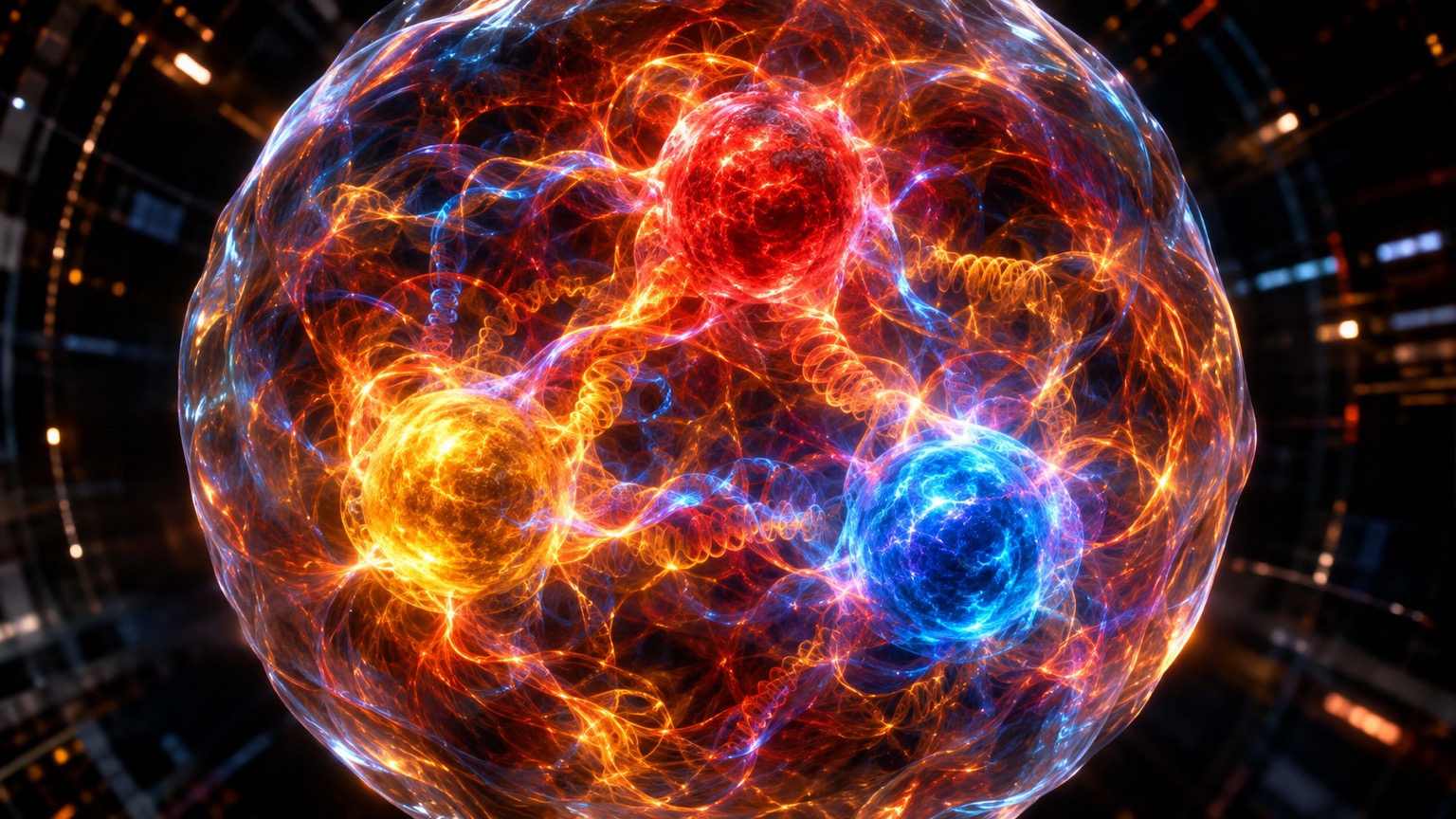
Gluons are the field quanta that transmit the interaction. Unlike photons, which carry no electric charge, gluons themselves carry combinations of color and anticolor. A gluon can therefore influence another gluon. This self-interaction produces much of QCD’s unusual behavior and prevents the strong force from acting like a simple stronger version of electromagnetism.
Color Neutrality Builds Hadrons
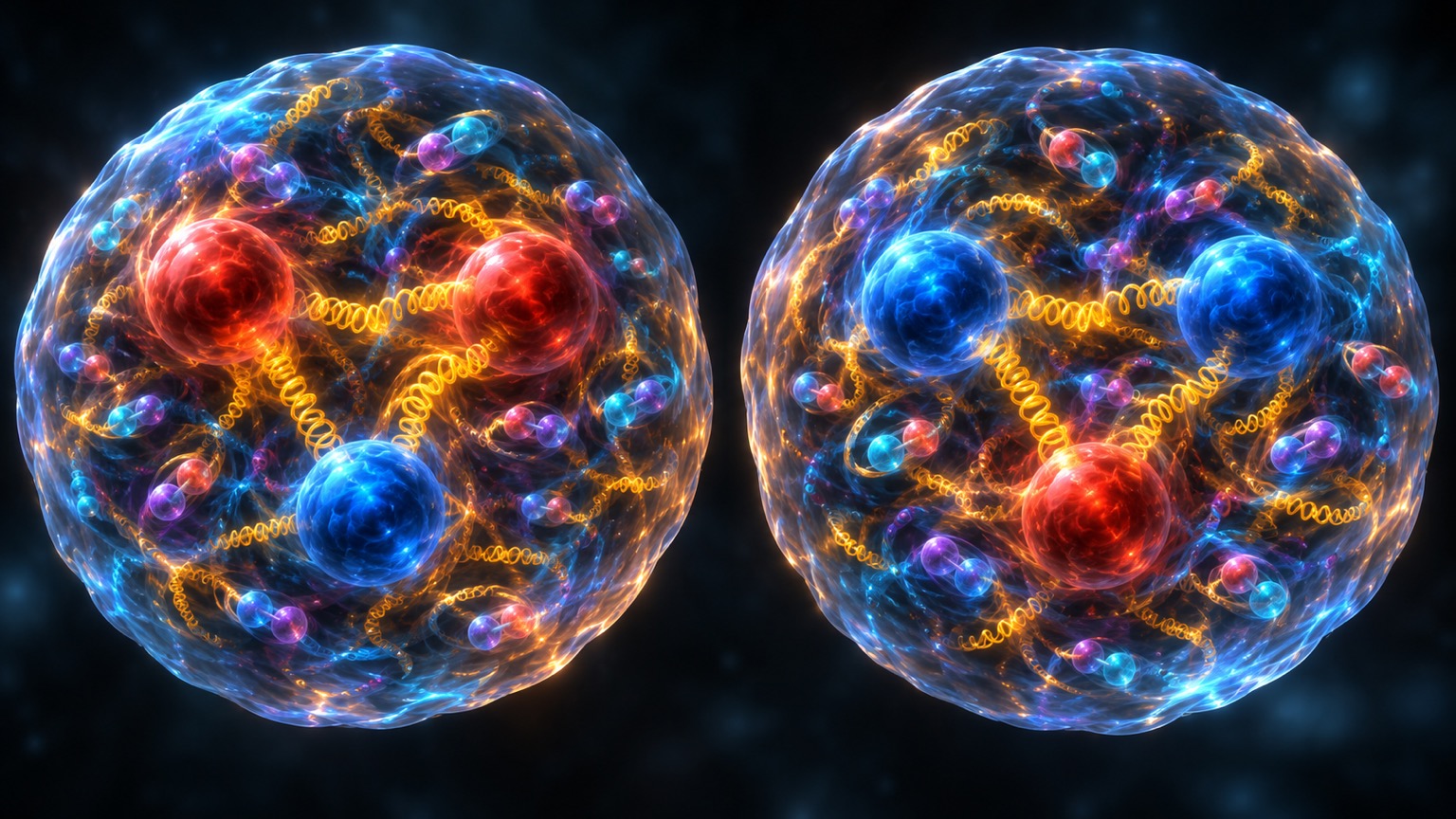
Quarks appear in composite particles called hadrons. A baryon such as a proton or neutron contains three valence quarks whose colors combine to a neutral state. A meson contains a quark and an antiquark with matching color and anticolor. The internal state is quantum mechanical, so these are not fixed colored beads sitting at permanent locations.
The proton’s two up valence quarks and one down valence quark determine its electric charge and several quantum numbers. They do not account for every constituent at every instant. Gluon fields carry a large share of the proton’s momentum, while the energy available in those fields continually produces a sea of temporary quark-antiquark pairs.
Color neutrality is why isolated hadrons can travel through detectors without leaving a long-range color field. It does not mean the interior interaction has switched off. The neutral object still contains intense color dynamics, much as an electrically neutral atom contains charged components, though QCD’s carrier self-interaction makes the analogy incomplete.
Confinement Keeps Quarks Inside Composite Particles
Attempts to pull quarks apart do not produce a lone quark at the end of a steadily weakening force. Energy accumulates in the color field between them. Once enough energy is stored, it becomes favorable to create a new quark-antiquark pair. The original system separates into new color-neutral hadrons rather than releasing a bare color charge.
This process, called hadronization, is visible indirectly in particle colliders. A high-energy quark or gluon initiates a collimated spray of hadrons known as a jet. Detectors record the stable particles in the spray, and physicists reconstruct the energy and direction of the original colored parton. Confinement changes what can be observed without erasing the information carried by the event.
Asymptotic Freedom Reverses Everyday Intuition
At very short distances or large momentum transfers, the effective QCD coupling becomes smaller. Quarks struck hard inside a proton can behave almost like weakly interacting particles during the brief collision. This property is asymptotic freedom, and it made precise calculations of deep-inelastic scattering and collider jets possible.
At lower energies and larger separations, the coupling grows. Perturbation theory, which organizes a prediction as a series of increasingly complicated corrections, becomes less reliable. The same theory therefore presents two calculation regimes: a high-energy domain where expansions work well and a low-energy domain where collective, nonperturbative behavior dominates.
The changing coupling follows from quantum fluctuations in the vacuum. Gluon self-interactions tend to antiscreen color charge, producing the opposite trend from the screening familiar in QED. Measurements of jet shapes, event rates, and particle production confirm that the strong coupling runs with energy.
Asymptotic freedom and confinement are not separate forces. They are limiting behaviors of QCD under different conditions. One lets experimenters resolve quark and gluon structure with energetic probes; the other determines why the final detector record contains hadrons instead of free colored particles.
Most Visible Mass Emerges from QCD Energy
The light up and down quarks inside protons and neutrons have small bare masses compared with the mass of the complete nucleon. The missing-looking mass is not supplied by hidden heavy ingredients. It arises largely from quark motion, gluon fields, and the energy associated with confining the system. Through mass-energy equivalence, that internal energy contributes to inertia.
The Higgs field still matters because it supplies the quarks’ intrinsic masses. QCD then amplifies the physical consequence by building bound states whose energy is much larger than the sum of those inputs. The mass of a chair, mountain, or human body is consequently dominated by the strong-field dynamics inside atomic nuclei.
This distinction also clarifies why saying “the Higgs gives everything mass” is too broad. Fundamental fermions receive mass through Higgs interactions, but composite-object mass can be governed mainly by binding and kinetic energy. For ordinary baryonic matter, QCD is the central mass-making engine.
The Nuclear Force Is a Residual Strong Interaction
QCD binds quarks into individual protons and neutrons. Nuclei require another descriptive level because those nucleons are already color neutral. Their attraction is a residual effect of the underlying strong interaction, often modeled through exchanges involving mesons and through effective nuclear forces fitted to data.
The relationship resembles the way neutral atoms can attract through residual electromagnetic effects, but nuclear forces are shorter-ranged and strongly dependent on spin, separation, and nucleon arrangement. At very short range the interaction becomes repulsive, helping prevent ordinary nuclei from collapsing into a single compact clump.
Experiments Probe QCD Through Scattering and Jets
Deep-inelastic scattering sends energetic electrons or other probes into nucleons. The scattering pattern reveals how momentum is distributed among quarks and gluons. Repeating the measurement at different energies tests the predicted evolution of that internal structure and supplies parton distribution functions used in collider calculations.
Hadron colliders provide complementary evidence. Quarks and gluons from incoming protons undergo hard collisions, then radiate and hadronize into jets. The number, energy, angle, and internal shape of those jets test QCD at short distances. Events containing heavy quarks add sensitivity to mass effects and to the transition from partons into recognizable hadrons.
No detector sees a gluon as an isolated track. Evidence comes from correlated patterns that match quantitative predictions across many processes. The agreement is powerful because the same coupling, symmetry, and particle content must describe electron scattering, proton collisions, heavy-flavor production, and numerous decay rates.
Lattice QCD Handles the Strong-Coupling Regime
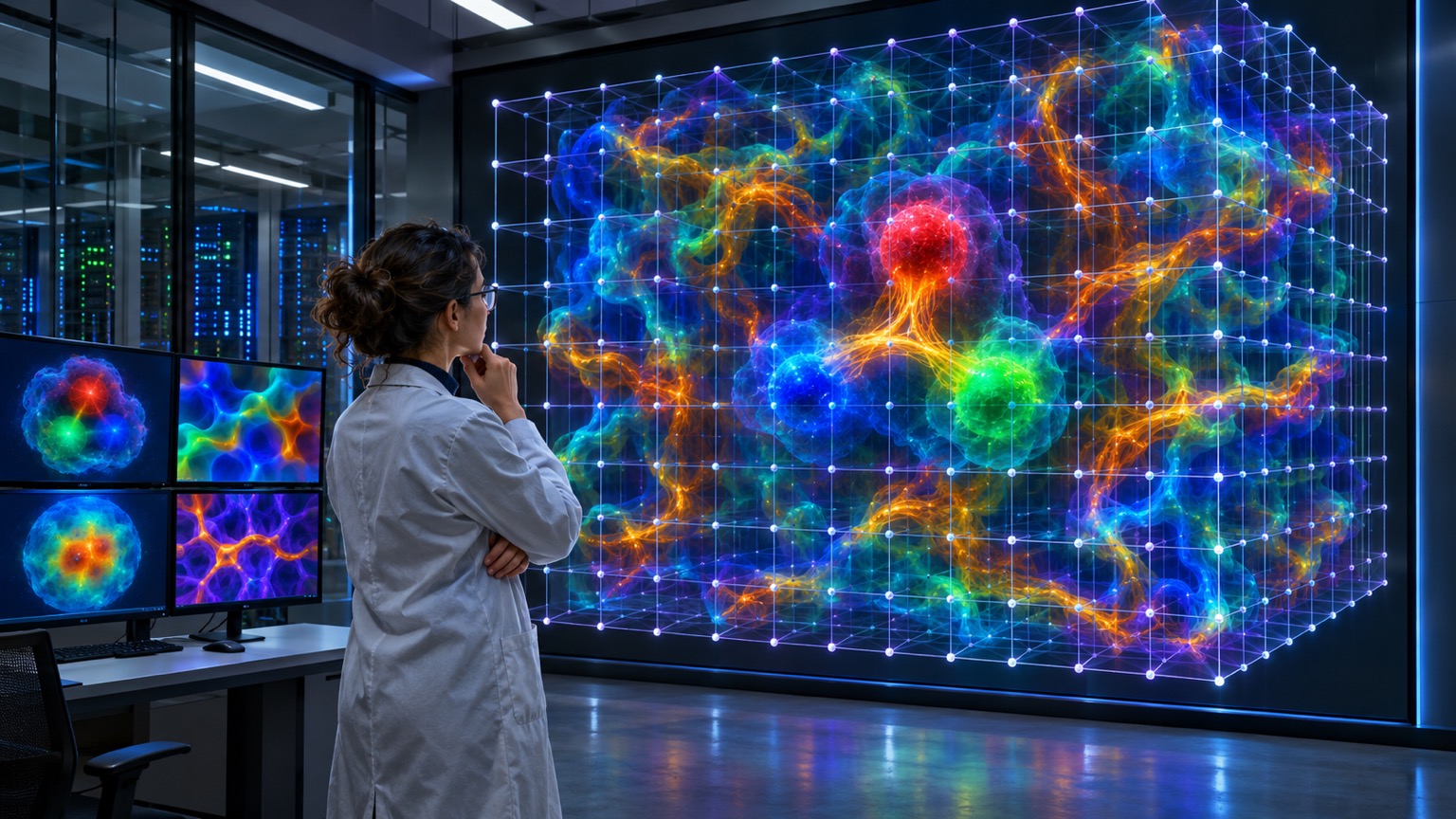
When perturbative expansions fail, physicists can formulate QCD on a discrete spacetime lattice and evaluate the field configurations numerically. The lattice spacing and box size are computational tools, not claims that physical space is literally a grid. Results must be extrapolated toward a continuous, sufficiently large spacetime.
Lattice calculations reproduce hadron masses from the underlying theory and estimate quantities needed to interpret experiments. They also investigate how matter changes with temperature. The calculations are demanding because the number of interacting degrees of freedom is enormous and some conditions, especially high baryon density, create difficult numerical sign problems.
Modern supercomputers allow finer lattices, more realistic quark masses, and tighter uncertainty estimates. A lattice prediction is meaningful only with careful control of discretization, volume, sampling, and scale-setting errors. These checks turn a colorful field visualization into a quantitative connection between QCD equations and measured particles.
Analytic methods, effective theories, and lattice computations complement one another. No single technique covers every scale efficiently. QCD’s success comes partly from matching the mathematical tool to the energy, distance, and observable being studied.
Extreme Heat Can Liberate Quark and Gluon Motion
In ordinary matter, color remains confined inside hadrons. Heavy-ion collisions can create temperatures high enough for matter to enter a quark-gluon plasma, where quarks and gluons move across a larger volume rather than remaining assigned to individual protons and neutrons. The state is not a dilute gas of permanently free particles; it behaves as a strongly interacting collective fluid.
Physicists infer the plasma’s properties from particle flow, jet energy loss, heavy-quark motion, and electromagnetic signals. These collisions recreate aspects of the universe’s first microseconds and test QCD under conditions far removed from a stable nucleus.
QCD Remains an Active Experimental Science
The theory’s basic equations are established, but their consequences are not exhausted. Researchers still map the proton’s three-dimensional structure, study how spin emerges from quarks and gluons, catalogue exotic hadrons, and calculate nuclear properties directly from QCD. Each question tests how simple field rules generate complicated matter.
Future electron-ion measurements will separate quark and gluon contributions with greater precision. Collider data will sharpen the strong coupling and explore rare multiquark states, while lattice calculations will reduce theoretical uncertainties. Progress does not require replacing QCD; it often requires learning how to extract more of what the theory already contains.
Quantum chromodynamics explains the strong nuclear force by uniting color charge, gluon exchange, confinement, and a scale-dependent coupling. Its most striking lesson is that familiar matter is not assembled from static miniature parts. It is sustained by restless fields whose energy creates the mass, stability, and internal structure of the protons and neutrons around us.
Strong-Force Precision Depends on Carefully Chosen Observables
A successful QCD measurement must define what counts as a jet, which particles enter it, and what detector region is accepted. Small changes to those rules can alter sensitivity to soft radiation or hadronization. Modern jet algorithms are designed so adding an extremely soft particle or splitting one particle into two collinear particles does not overturn the result.
Theoretical uncertainty has several sources. Truncating a perturbative series leaves unknown higher orders, parton distributions carry fitted uncertainties, and hadronization models approximate the strong-coupling transition. Experimental analyses add calibration, resolution, background, and sample-size uncertainties. Keeping these categories separate helps researchers see which improvement would sharpen the comparison most.
Some measurements use ratios because shared uncertainties cancel. Others emphasize angular correlations or energy flow, which can expose radiation patterns more clearly than total event counts. A robust conclusion appears across related observables rather than depending on one bin whose prediction is unusually fragile.
This discipline matters when searching for new physics. An unexpected jet distribution could reflect an undiscovered particle, but it could also come from underestimated QCD radiation or proton structure. Precision strong-force studies build the dependable baseline required to tell those possibilities apart.
QCD predictions also support measurements that are not primarily about the strong force. Producing a Higgs boson, top quark, or hypothetical heavy particle usually begins with quarks or gluons inside colliding protons. Accurate signal and background estimates therefore depend on strong-interaction calculations. Better knowledge of jets, radiation, and parton distributions directly improves the reach of the wider particle-physics program.
That broader role makes strong-force precision both a subject of discovery and essential scientific infrastructure for every modern proton-collider result.