How QCD Turns Symmetry into the Rules of Strong Interaction
Quantum chromodynamics works by demanding that descriptions of quark color remain consistent even when the mathematical color basis is changed independently at every point in spacetime. That local symmetry requires a family of gluon fields and fixes how those fields couple to quarks and to one another. From this compact rule come two behaviors that initially seem incompatible: quarks interact weakly when examined at extremely short distances, yet cannot be removed from hadrons at ordinary energies. Following the theory from its symmetry to measurable predictions reveals why QCD is both elegant and computationally difficult.
A: It is the local symmetry group acting on three quark color components.
A: The independent traceless generators of SU(3) number eight.
A: No. They organize terms contributing to a quantum amplitude.
A: Vacuum fluctuations alter the effective interaction strength with resolution scale.
A: It separates calculable hard scattering from strongly coupled hadron structure.
A: Near the low scale where perturbative emissions cease being reliable.
A: A specified clustering algorithm combines measured particles by a reproducible rule.
A: It excels at equilibrium and static quantities but real-time scattering remains difficult.
A: They retain relevant QCD physics while expanding in useful scale ratios.
A: Their predicted effects appear in correlated distributions of observable hadrons and jets.
The Theory Starts with Quark Fields
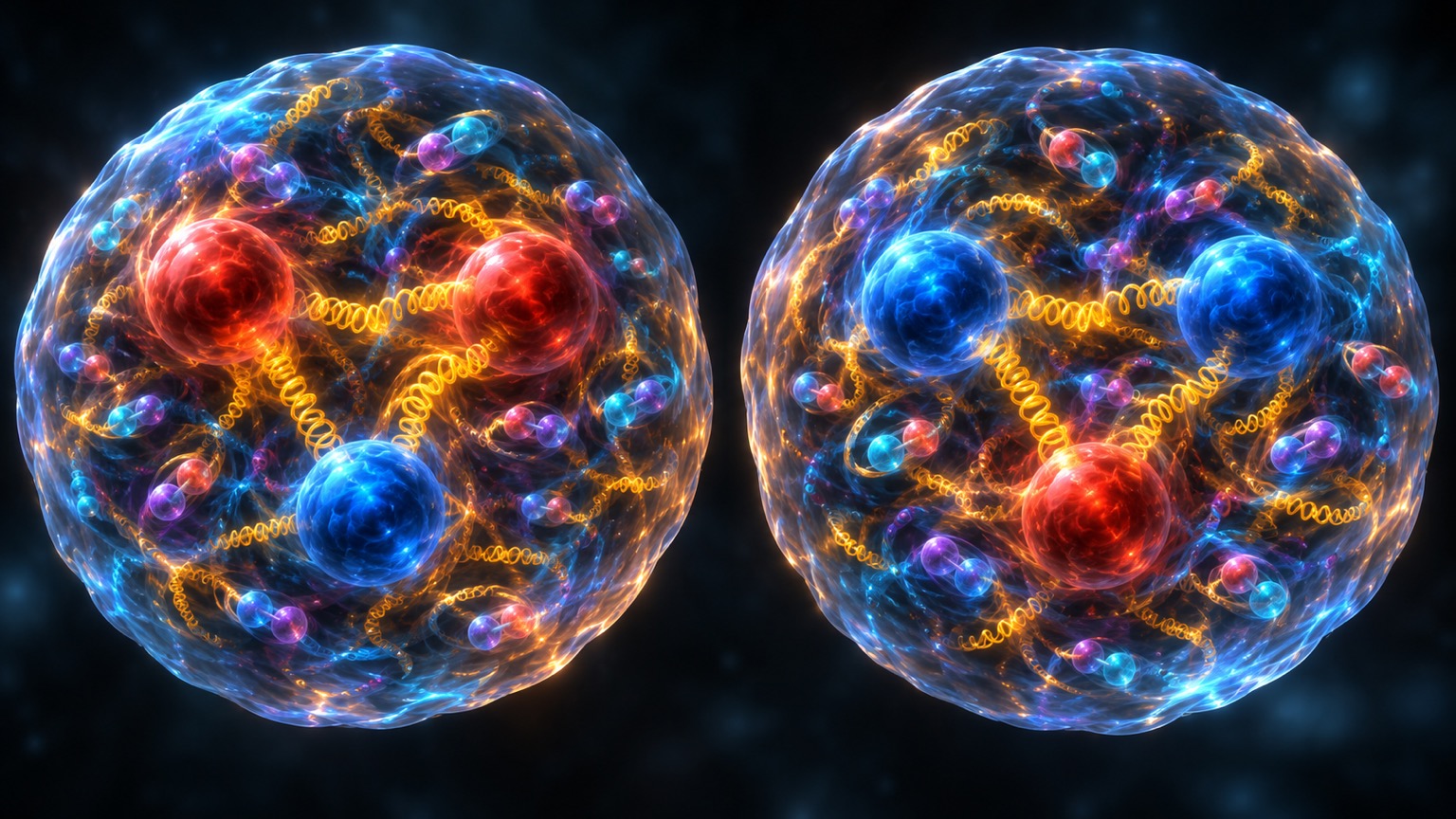
Each quark flavor is represented by a relativistic quantum field. Excitations of those fields carry spin one-half, electric charge, mass, and color charge. The flavor labels up, down, strange, charm, bottom, and top determine mass and weak-interaction behavior, while QCD treats the color coupling universally.
A quark field has three color components. Rotating those components together everywhere would merely change the mathematical basis. QCD makes the stronger demand that the rotation may differ from place to place without altering observable physics. Ordinary derivatives cannot compare neighboring fields under that rule, so a compensating gauge connection is needed.
Local Gauge Symmetry Requires Gluons
The compensating connection is the gluon field. Mathematically, QCD uses the group SU(3), whose structure supplies eight independent generators and therefore eight gluon states. The theory’s covariant derivative combines spatial change with the appropriate gluon contribution, preserving local color symmetry.
This is more than a decorative principle. Gauge symmetry restricts which terms may enter the QCD Lagrangian and enforces relationships among interaction strengths. A quark can emit or absorb a gluon while changing color, and the overall color charge is conserved at every vertex.
Because SU(3) is non-Abelian, the order of color rotations matters. That mathematical fact gives gluons color charge and permits three-gluon and four-gluon interactions. Photon fields in QED lack equivalent direct self-couplings at the basic level.
Amplitudes Convert Field Rules into Probabilities
To predict a collision, physicists identify initial and final states and calculate a quantum amplitude. Feynman diagrams organize contributions from possible exchanges, emissions, loops, and splittings. The lines are terms in a calculation, not photographs of tiny objects following hidden paths.
The observable probability depends on the coherent sum of amplitudes. Different contributions can reinforce or cancel one another. Color factors, spin correlations, momentum conservation, and the running coupling all enter before a theoretical rate can be compared with data.
At high energy, successive terms are often organized by powers of the strong coupling. Leading-order results capture the basic process, while higher orders add virtual loops and extra real radiation. Combining them consistently prevents double counting and cancels intermediate divergences in infrared-safe observables.
A calculation must also connect partons to a realistic experiment. Incoming proton structure is encoded in parton distribution functions, and outgoing radiation develops into showers and hadrons. Detector simulations then translate stable particles into reconstructed tracks, calorimeter deposits, and jets.
Renormalization Makes the Coupling Scale Dependent
Quantum loops probe arbitrarily short-distance fluctuations and generate divergent intermediate expressions. Renormalization absorbs the relevant dependence into measured parameters defined at a chosen scale. The procedure does not discard experimental content; it states how parameters inferred at one resolution predict results at another.
For QCD, the beta function makes the coupling decrease as the energy scale rises. Gluon antiscreening outweighs quark screening for the known number of flavors. This running is tested by extracting the coupling from many observables and evolving the results to a common reference scale.
Factorization Separates Short and Long Distances
Proton collisions mix a calculable hard interaction with nonperturbative proton structure. Factorization theorems separate these components under specified conditions. Universal parton distributions describe the likelihood of finding a parton with a given momentum fraction, while a process-specific hard coefficient describes the short-distance scattering.
The separation scale is arbitrary within a sensible range, so its dependence cancels when all orders are included. Finite calculations retain residual scale sensitivity, which physicists vary to estimate missing corrections. Factorization is powerful but not automatic for every observable or kinematic limit.
Similar logic applies to fragmentation and jet functions. A measurement designed to be insensitive to unresolved soft or collinear splitting can be predicted more reliably. Poorly defined observables may change dramatically when one unobservable parton splits into two nearly parallel ones.
Parton Showers Bridge Calculations and Jets
An energetic quark can radiate a gluon, and that gluon can radiate or split into a quark-antiquark pair. Repetition creates a branching cascade. Shower algorithms approximate the dominant emissions while preserving probabilities and momentum, then stop near the scale where perturbative QCD loses control.
Hadronization models take over at that boundary. Their parameters are tuned against broad experimental data, but the models must respect confinement and universal patterns. Comparing different models helps expose uncertainty in the conversion from partons to detector-level particles.
Jets gather related hadrons through a precisely defined clustering algorithm. Their energy and substructure allow tests of the initiating radiation. A jet is not identical to a quark or gluon, yet carefully chosen jet observables retain quantitative sensitivity to the underlying parton.
Radiation patterns also differ statistically between quark- and gluon-initiated jets, giving experiments another test of color factors.
Confinement Demands Nonperturbative Tools
The growth of the coupling at low energy prevents an expansion around weakly interacting fields. Confinement has overwhelming empirical and numerical support, although deriving every aspect analytically from the QCD Lagrangian remains challenging. Researchers instead use lattice calculations, effective field theories, symmetry arguments, and phenomenological models.
Effective theories preserve the relevant QCD symmetries while focusing on selected scales. Chiral perturbation theory describes low-energy interactions of light hadrons. Heavy-quark effective methods exploit the large mass of charm or bottom quarks. These frameworks do not replace QCD; they reorganize it for particular questions.
Lattice QCD Evaluates the Path Integral Numerically
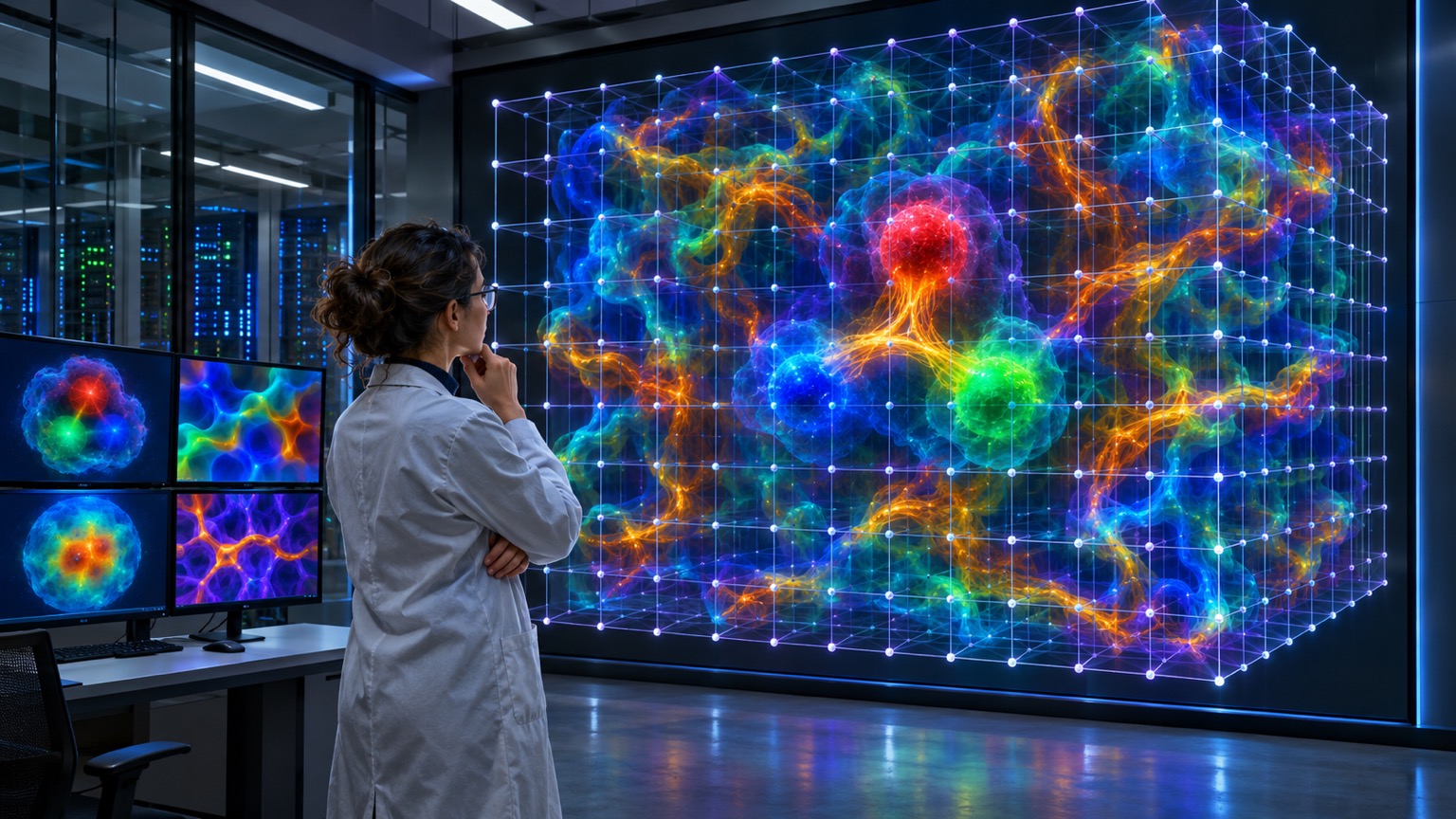
Lattice QCD rotates the calculation into Euclidean time and samples field configurations on a finite grid. Quark fields live on sites, while gauge links connect neighboring sites. Statistical averages of carefully chosen operators reveal masses, decay constants, matrix elements, and other physical quantities.
Several limits must be controlled. The lattice spacing approaches zero, the volume must be large enough, and quark masses must correspond to nature. Finite sampling and algorithmic choices add uncertainty. Independent calculations with different discretizations provide important cross-checks.
Some problems remain especially difficult. Real-time dynamics and dense baryonic matter resist standard sampling methods. Even so, lattice QCD has converted many once-qualitative statements into precision inputs for particle and nuclear physics.
The method also predicts thermodynamic behavior as hadronic matter changes into quark-gluon plasma. Comparing such results with heavy-ion collisions tests how an equilibrium theory relates to a rapidly expanding experimental fireball.
QCD Experiments Reconstruct Invisible Partons
Experiments never place a color meter beside a quark. They measure final-state particles and compare distributions with predictions. Electron-proton scattering maps parton structure; proton collisions test hard processes; heavy-ion collisions probe hot QCD matter; spectroscopy catalogues allowed and exotic hadrons.
Confidence comes from overconstraint. A set of parton distributions fitted to one collection of reactions must predict different reactions. A coupling measured from event shapes must evolve consistently with values from jets or decays. When tensions appear, researchers investigate experimental systematics, missing corrections, and possible new phenomena.
QCD works as a chain from symmetry to fields, amplitudes, scale evolution, hadronization, and measured distributions. Its equations are compact, but observable matter emerges only after dynamics across many scales are connected. That layered structure explains both the theory’s exceptional success and the continuing need for analytic insight, numerical computation, and precision experiments.
Running QCD in Practice Requires Coordinated Approximations
A real calculation starts by identifying a hard scale, such as a jet’s transverse momentum or a heavy particle’s mass. If that scale is far above the confinement scale, perturbation theory can describe the short-distance reaction. Physicists choose renormalization and factorization scales near the hard scale to avoid unnecessarily large logarithms, then vary them within a conventional range to test stability.
Proton structure enters through distributions obtained from global fits. Each fit combines experimental datasets, correlated systematic errors, parametrization choices, and QCD evolution. A prediction at the Large Hadron Collider therefore carries a family of parton-distribution replicas or eigenvector variations. Their spread quantifies how incomplete knowledge of the incoming proton affects the final rate.
When several physical scales are widely separated, fixed-order terms can contain large logarithms that undermine the expected hierarchy. Resummation collects entire families of those terms. Effective field theories often make the relevant scale separation explicit, allowing hard, collinear, and soft contributions to evolve independently before being recombined.
Parton showers pursue a related goal probabilistically. They generate emissions ordered by an evolution variable, enforce momentum conservation, and include Sudakov factors representing the probability of no resolvable emission between scales. Different shower choices agree on leading singular behavior but can differ in subleading details, creating a modeling uncertainty.
Matching combines an exact fixed-order calculation with a shower so the hardest emissions retain matrix-element accuracy while softer cascades are simulated efficiently. Merging extends the idea across samples with different jet multiplicities. Both procedures need subtraction rules to prevent one configuration from appearing twice.
Finally, simulated stable particles pass through a detector model and the same reconstruction used for data. Analysts may instead unfold detector effects from measurements to a particle-level definition. Either route requires a clearly documented observable, because QCD predicts distributions only after every practical definition is fixed.
Validation proceeds at several levels. Inclusive rates test normalization, differential spectra test shape, and correlations test radiation geometry. Control regions can isolate backgrounds or enhance a selected partonic channel. Agreement in one projection does not guarantee that the simulated event structure is correct everywhere, so analyses compare many distributions before using a model for a sensitive search.
When data disagree, researchers first examine calibration, acceptance, fitted proton inputs, shower choices, and missing perturbative terms. A discrepancy that follows a detector boundary suggests a different cause from one that grows smoothly with energy. Publishing detailed covariance information lets later global analyses combine results without pretending correlated errors are independent.
The practical operation of QCD is therefore collaborative. Formal symmetry determines the equations, analytic calculations isolate universal behavior, numerical codes evaluate complex amplitudes, lattice simulations tackle strong coupling, and experiments define finite observables. The theory succeeds because these separate techniques overlap and cross-check one another, not because any single picture captures every scale.
A beginner can keep one organizing map in mind. At short distance, calculate quark and gluon interactions perturbatively. Use evolution equations to connect scales and fitted distributions to describe incoming hadrons. Follow radiation toward lower virtuality, then hand the colored system to a confinement model or a nonperturbative calculation. Finally, define a color-neutral observable that a detector can measure. Each handoff has assumptions and uncertainty, but overlapping tests keep the chain accountable. This is how a compact gauge theory becomes a practical engine for predictions across scattering, spectroscopy, nuclear structure, and hot matter. Its workflow is layered because nature spans many scales, yet every layer remains tied to the same color symmetry, measured parameters, and demand for reproducible evidence across independent experiments and calculation methods worldwide.
Precision and experimental reach continue improving worldwide.