The Hidden Relationship That Makes Superposition Work
Phase is one of the easiest parts of quantum superposition to overlook because it is not a visible size, weight, color, or location. A superposition does not merely say that several outcomes are possible. It also says how the amplitudes for those alternatives are related. That relationship is phase, and it can decide whether alternatives later reinforce, cancel, or shift a measurement pattern. Without phase, superposition would collapse into ordinary uncertainty, like not knowing which card is face down on a table. With phase, the alternatives can meet again and change one another’s chances. This is why two quantum states can have the same basic probabilities while behaving differently in an interference experiment. The difference was not in the list of possible outcomes; it was in the relative phase between them. In laboratories, phase is controlled with path length, timing, magnetic fields, laser pulses, microwave drives, and careful isolation from environmental noise. In quantum computers, phase is part of the information gates reshape before readout. For beginners, the useful shortcut is simple: probability tells how much of each alternative is present, while phase tells how those alternatives are arranged to act together later.
A: It controls how alternatives combine when they are compared.
A: No. It is inferred through phase-sensitive measurement patterns.
A: No. Probability gives outcome weight; phase gives relationship.
A: Their relative phases may be different.
A: Interference usually fades or disappears.
A: Gates shift phase so later readout probabilities change.
A: Global phase often does not; relative phase often does.
A: Phase can accumulate during state evolution.
A: Isolation, stable controls, and careful calibration.
A: It is the hidden relationship that lets alternatives act together.
Why Phase Is Not Just a Detail
In ordinary language, a phase might sound like timing: two waves can be lined up, partly shifted, or opposite. Quantum phase is related to that idea, but it belongs to the quantum state rather than to a visible ripple in water. It describes how amplitude components are oriented relative to one another.
That relationship becomes powerful when alternatives are recombined. If two components arrive in step, they can make an outcome more likely. If they arrive out of step, they can make the same outcome less likely. A phase shift can therefore change a later measurement without changing what a beginner might first call the amount of each possibility.
This is why phase is not decoration added to the real state. It is part of the state. Remove it from the description, and many quantum effects no longer make sense.
The Difference Between Probability and Phase
Probability is what appears after measurements are repeated many times. If a state gives a fifty percent chance of one result and a fifty percent chance of another, that tells us something important. It does not tell us everything.
Two states can share those same measurement chances in one basis while carrying different phase relationships. A later operation can turn that phase difference into a changed probability. This is why quantum mechanics tracks amplitudes rather than just finished probabilities.
How Interference Reveals Phase
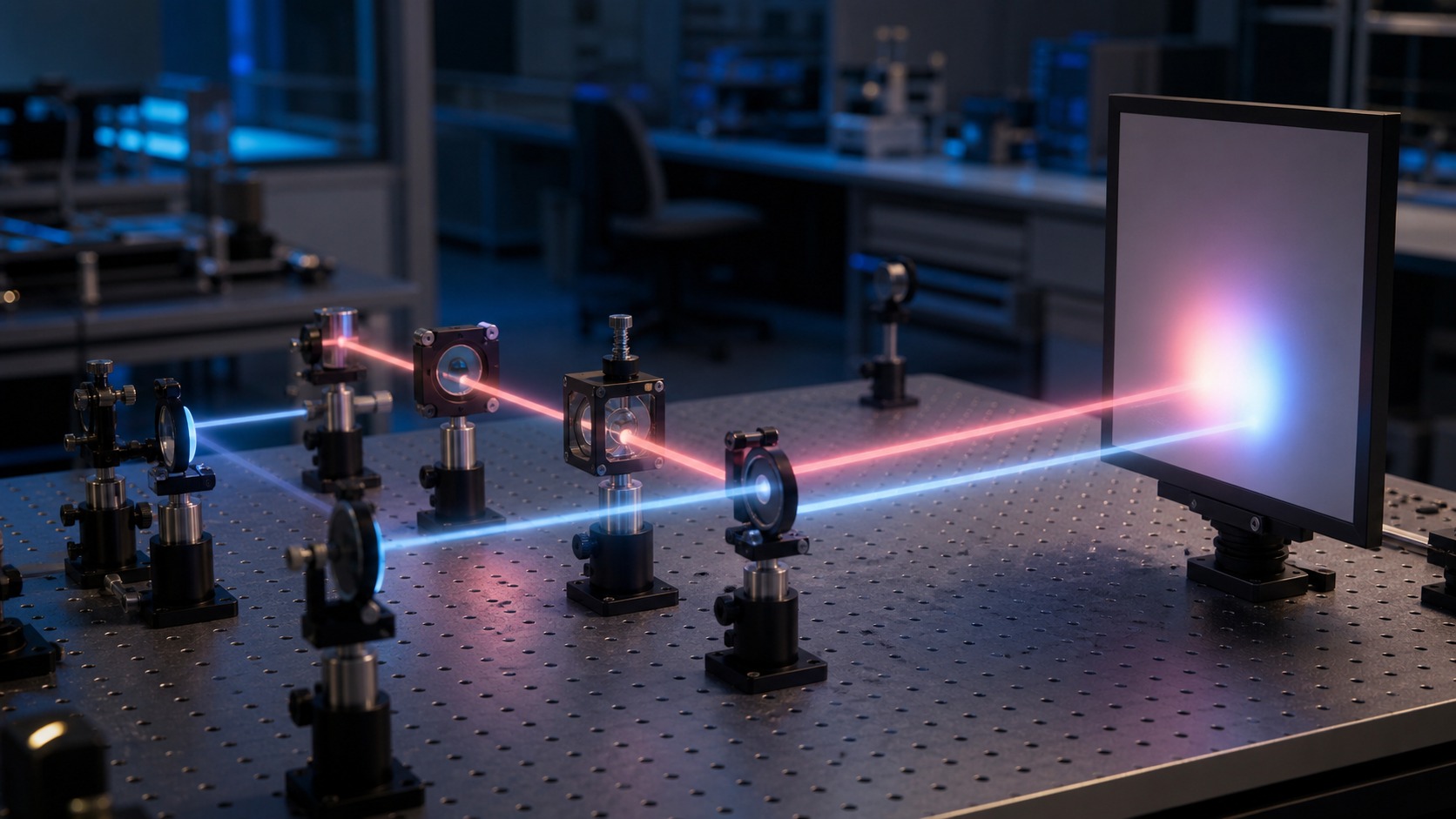
Interference is the cleanest way to see phase matter. In a two-path experiment, each path can contribute an amplitude to the final detector. The final result depends on how those contributions combine when the paths meet again.
If the relative phase is adjusted, the bright and dark parts of the pattern move. The particles still arrive as individual detections, but the distribution of many detections changes. The phase is not photographed directly. It is inferred from the way the pattern responds.
This turns phase into evidence. A pattern that shifts predictably when a path length or field changes shows that the alternatives stayed coherent long enough to be compared.
Why Relative Phase Is the Useful Part
Beginners sometimes hear that a quantum state has an overall phase and wonder where it appears. In many ordinary predictions, a single global phase does not change measurement probabilities. What matters most is the relative phase between components of a superposition.
Relative phase compares one part of the state with another. That comparison is what interference experiments and qubit operations can expose. The word relative is important because quantum predictions often depend on relationships, not on isolated labels.
Phase in Qubits
A qubit can be placed in a superposition of its two readout states. The probabilities for reading zero or one are part of the story, but the phase between those components is just as important. Gates can rotate or shift that phase before measurement.
This is why a qubit is not simply a tiny coin that is partly heads and partly tails. A coin with unknown orientation does not carry a phase that later gates can use. A qubit state does, and that extra structure is what makes quantum control different from ordinary hidden uncertainty.
In a circuit, small phase errors can accumulate. A pulse that is slightly mistimed may leave the qubit pointing in the wrong state direction. Engineers therefore spend enormous effort calibrating timing, drive phase, and environmental stability.
Phase is not a poetic extra in quantum computing. It is part of the information being protected.
Phase in Matter Waves
Atoms, electrons, neutrons, and even larger molecules can show wave-like behavior when their quantum states are prepared carefully. Their matter-wave phase can shift as they move through fields, travel along paths, or experience forces.
Atom interferometers use this sensitivity as a measuring tool. If gravity, acceleration, or rotation changes the relative phase between paths, the final interference pattern changes. The result is a way to measure motion and fields with extraordinary precision.
Why Environment Damages Phase
Phase relationships are fragile because the environment can carry away distinguishing information. A stray photon, gas collision, vibration, or thermal interaction can become correlated with one alternative rather than another. Once that happens, the alternatives are harder to recombine cleanly.
The state may still be described by quantum mechanics, but the useful phase relationship for the system alone becomes inaccessible. This is why decoherence is often described as the loss of phase coherence. The superposition has not simply been forgotten by a person; its relationships have leaked into surrounding degrees of freedom.
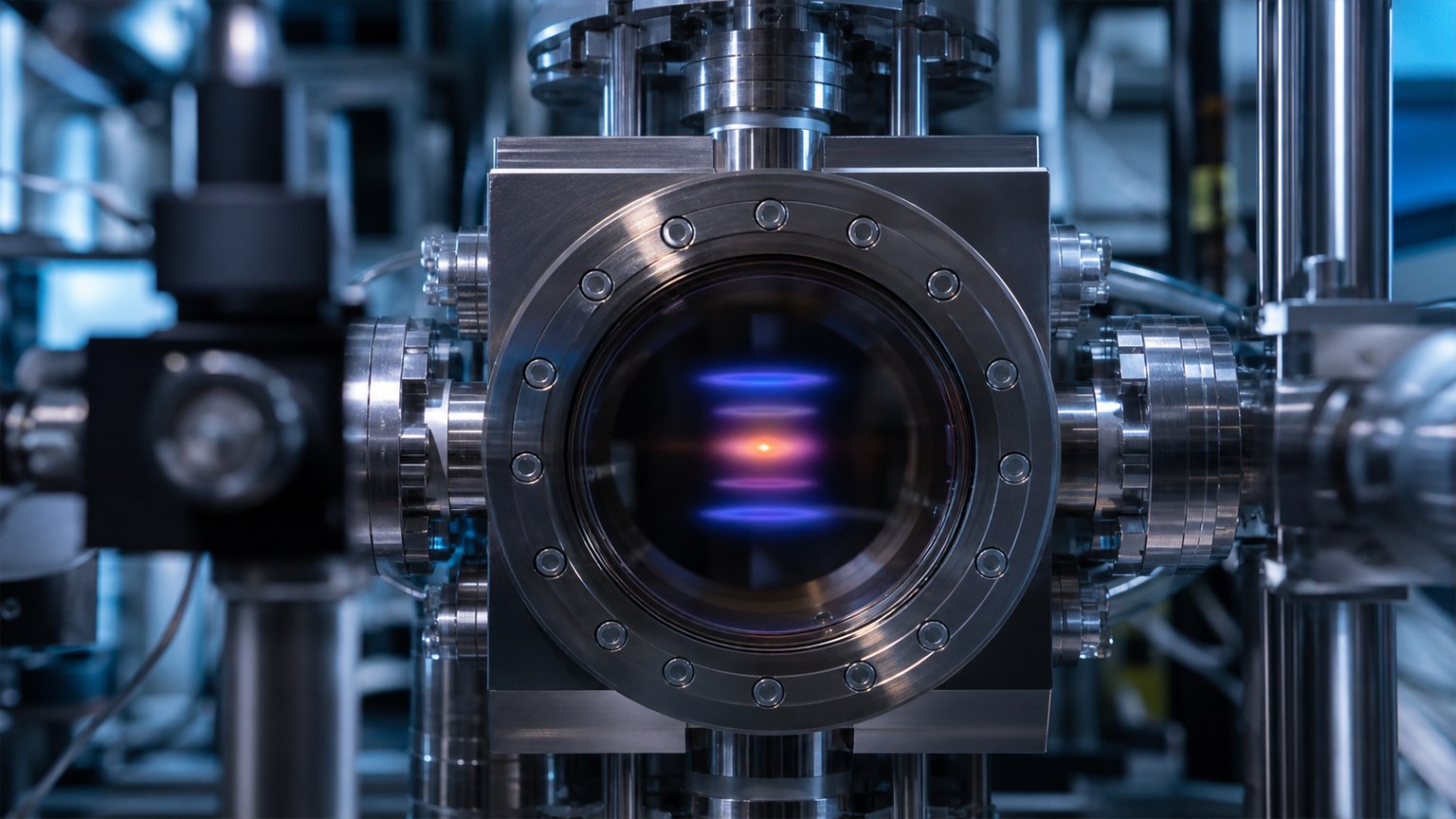
Laboratories protect phase with vacuum, cooling, shielding, stable lasers, and short timing windows. The protection is practical because phase is useful only when it survives long enough to affect a later measurement.
Why Phase Feels So Unintuitive
Phase feels strange because it is relational and indirect. We do not experience phase as a single visible object. We see its consequences after an experiment compares alternatives. That makes it easy to underestimate.
Everyday probability also trains the wrong instinct. If two ordinary options have the same chance, we tend to think their internal arrangement is irrelevant. Quantum mechanics says otherwise. How alternatives are arranged can change what happens when they are allowed to interact.
A good analogy is a pair of musicians playing the same note with different timing. The loudness at a point depends on how the waves meet. The analogy is imperfect, but it helps show why relationship matters, not just quantity.
The safe lesson is that phase is hidden only in the sense that it is not directly visible. It is not optional.
How Scientists Control Phase
Scientists control phase by controlling the physical conditions that determine state evolution. They may adjust the length of an interferometer arm, tune a laser pulse, shift a microwave drive, change a magnetic field, or choose a different wait time before measurement.
Those controls are tested through repeated trials. If the measured distribution changes in the predicted way, the phase control is working. If the pattern washes out, the state may have lost coherence or the apparatus may have drifted.
Phase control is therefore both delicate and measurable. It is delicate because tiny changes can matter. It is measurable because those changes show up in the statistics when the experiment is designed well.
Where Phase Appears Outside Textbooks
Phase appears in more places than the double-slit experiment. Atomic clocks compare extremely stable quantum oscillations. Interferometers measure tiny shifts caused by motion, gravity, or fields. Quantum computers track phase through gate sequences that would fail if the state relationship wandered randomly.
These examples matter because they turn phase from an abstract word into a working design variable. Engineers do not merely believe in phase. They tune it, stabilize it, measure its drift, and use it to decide whether a device is performing correctly.
That practical role helps beginners trust the concept. A quantity that can be calibrated and tested is not just a philosophical ornament.
Phase is strange, but it is also useful in the most ordinary engineering sense: devices either preserve it well enough, or they do not.
Why Phase Must Be Compared
Phase becomes meaningful when one part of a state is compared with another. A lone phase label does not always produce an observable effect. A relative phase can, because it changes what happens when alternatives are brought into the same measurement question.
This is why many phase experiments are built as comparisons. One path is measured against another, one clock transition against a reference, or one qubit orientation against a chosen basis. The comparison is where the hidden relationship becomes evidence.
How Phase Errors Accumulate
Small phase errors can be easy to miss in one step and damaging after many steps. A qubit gate that is slightly off may still look acceptable in a short test. A long sequence can magnify the error until the final result changes noticeably.
Interferometers face a similar problem. A tiny vibration, temperature change, or path-length drift can shift the phase enough to move the pattern. If the shift is not part of the intended signal, it becomes noise.
That is why precision experiments often look obsessively careful. The hardware is protecting a relationship that the eye cannot see but the statistics will reveal. Phase errors leave fingerprints in the data.
Phase errors also show why the idea is useful beyond metaphors. A tiny unwanted shift may be invisible in one step, then become obvious after several operations make the alternatives overlap again. Quantum control depends on spotting those hidden changes before they spoil the final pattern.
How to Learn Phase Without Equations
A beginner can learn phase by watching what changes when an experiment is adjusted. If a path length changes and the interference fringes move, phase is at work. If a qubit pulse timing changes and readout probabilities shift, phase is at work there too.
The mental goal is not to draw the phase perfectly. It is to remember that superposition contains relationships, and relationships can matter even when simple probabilities look unchanged.
Once that habit is in place, the equations become less mysterious. They are formal tools for tracking the same relational structure.
Why Phase Gives Superposition Its Memory
Phase gives a superposition a kind of memory of how it evolved. Two alternatives may begin together, separate through different conditions, and return with a changed relationship. The final measurement can reveal that history even if no ordinary path record was kept.
This is why phase is so important in precision work. It lets a quantum state carry information about fields, timing, motion, or distance through a relationship rather than through a visible mark.
Beginners can treat phase as the part of superposition that remembers relative evolution. The memory is fragile, but while it lasts it can be extraordinarily sensitive.
That sensitivity is what turns an abstract relationship into laboratory evidence.
The Phase Takeaway
Phase is the relationship inside superposition that lets alternatives act together rather than merely sit beside one another.
It is why superposition can produce interference, power qubit gates, and turn invisible state structure into visible experimental patterns.