A Puzzle at the Heart of Reality
Light streams through your window, bounces off your screen, and carries information from distant stars. It feels ordinary—until you ask what light actually is. For centuries, scientists assumed that every physical thing must be either a solid object or a moving ripple. Particles were tiny, localized bits of matter. Waves were spread-out disturbances, like ripples on water or vibrations in air. These categories seemed mutually exclusive, tidy, and complete. Then the universe refused to cooperate. Experiments revealed something deeply unsettling: light sometimes behaves like a wave and sometimes behaves like a particle. Even stranger, the same behavior appears in electrons, atoms, and entire molecules. The very building blocks of reality do not commit to being one thing or the other. They exist in a strange in-between state that defies everyday logic. This is the wave–particle mystery, one of the most profound discoveries in science. It reshaped physics, overturned intuition, and forced humanity to rethink what it means for something to “exist.”
A: Yes—experiments show it behaves as both, depending on how it’s measured.
A: No, it shows different properties in different situations.
A: Quantum effects are most noticeable at very small scales.
A: Yes, but they follow quantum rules unlike solid objects.
A: Not directly—special experiments are required.
A: No, electrons and atoms show similar behavior.
A: No, it refers to physical measurement, not awareness.
A: It explains how modern technology works.
A: No, it is still an active area of research.
A: Absolutely—at a conceptual level, it’s about behavior, not math.
The Classical World: Where Everything Had a Clear Identity
Before quantum physics, the world seemed conceptually clean. Objects had positions, speeds, and shapes. Waves had wavelengths, frequencies, and amplitudes. A thrown ball followed a path. A sound wave spread through air. There was no confusion between the two.
Isaac Newton famously described light as a stream of tiny particles. His theory explained reflection and refraction and matched observations of his time. Meanwhile, other scientists argued that light behaved more like a wave, pointing to interference patterns and bending effects that particles alone struggled to explain. For a long time, this disagreement looked like a technical debate that would eventually be resolved in favor of one model. No one imagined that both sides were right—and wrong—in ways that would challenge the foundations of reality.
When Light Drew Stripes
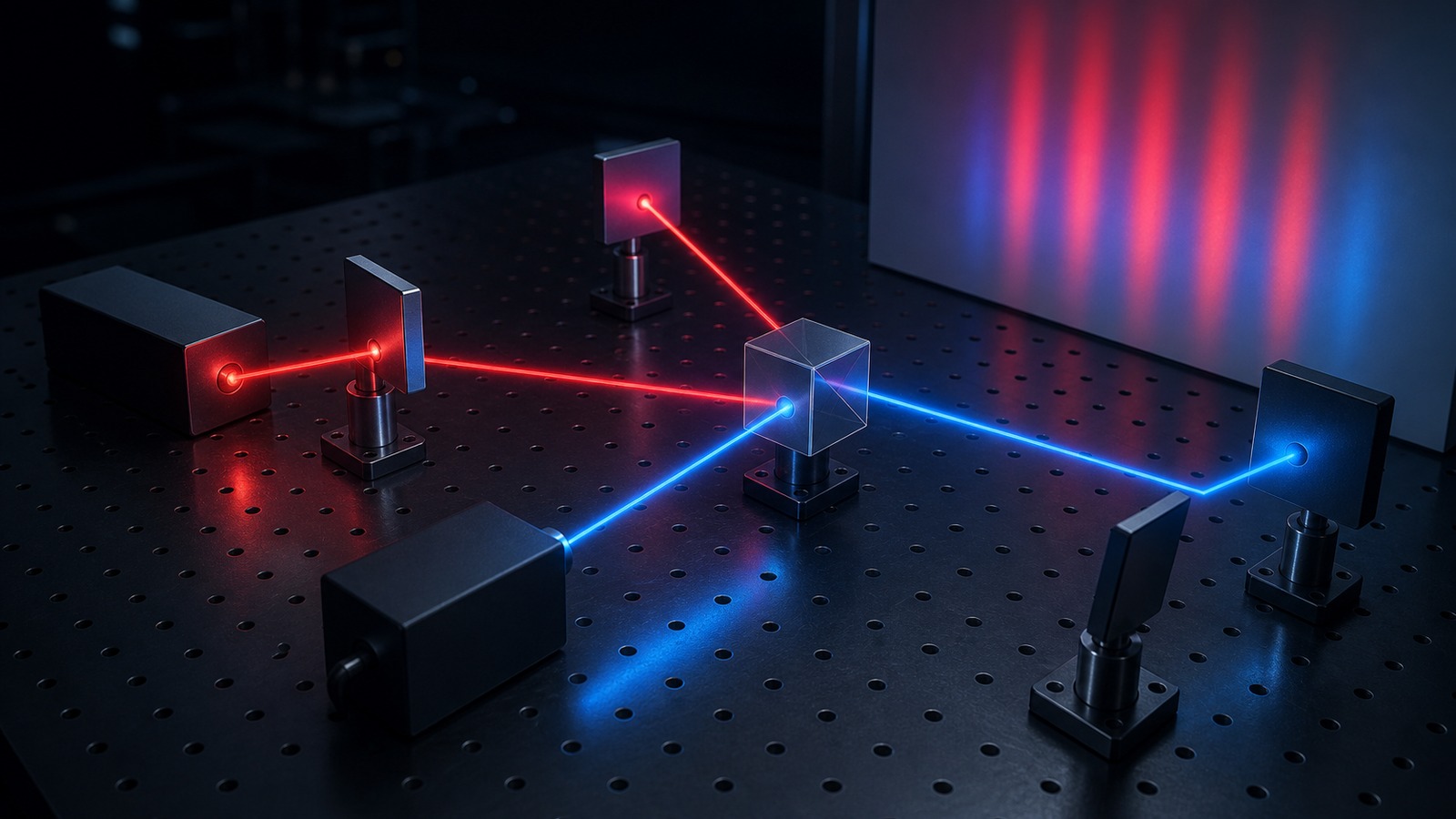
The turning point came with experiments that forced scientists to confront the impossible. One of the most famous is the double-slit experiment. When light passes through two narrow openings and hits a screen, it produces a pattern of bright and dark bands. This pattern is a hallmark of waves interfering with each other—peaks reinforcing peaks, troughs canceling troughs.
If light were only a stream of particles, it should produce two bright regions behind the slits, not a delicate striped pattern. Yet the stripes appear every time. Light behaves like a wave. Then comes the twist.
When scientists reduce the light so much that particles pass through one at a time, the pattern still builds up. Each individual particle somehow contributes to a wave-like interference pattern, even though it arrives at the screen as a single point. Light, it seems, travels like a wave and arrives like a particle.
The Photon: A Particle That Refuses to Stay Small
To make sense of these results, physicists introduced the concept of the photon—a packet of energy associated with light. Photons behave like particles when interacting with matter. They strike detectors, eject electrons, and transfer energy in discrete amounts.
But photons also spread out, interfere with themselves, and follow wave equations. They do not move through space like tiny billiard balls. Instead, they exist as probability distributions—clouds of potential outcomes rather than solid objects with fixed paths. This dual behavior is not a flaw in our measurements. It is how light actually behaves.
Electrons Join the Mystery
At first, wave–particle duality seemed like a quirk of light. After all, light had always been strange. But the mystery deepened when electrons—undeniably particles with mass and charge—were shown to behave like waves as well.
Electrons passing through a crystal or a double-slit setup create interference patterns just like light. Yet when detected, they appear as individual points. They can be counted, localized, and measured. An electron is not sometimes a wave and sometimes a particle. It is something that does not fit neatly into either category.
What “Wave” and “Particle” Really Mean
Part of the confusion comes from language. “Wave” and “particle” are human concepts borrowed from everyday experience. In the quantum world, these words are approximations—useful metaphors, not literal descriptions. A quantum object is best described by a wavefunction, a mathematical expression that encodes probabilities. This wavefunction spreads out through space and evolves over time like a wave. But when a measurement occurs, the outcome appears as a localized event—a particle-like result. The wave describes what can happen. The particle describes what did happen.
The Role of Observation
One of the most unsettling aspects of wave–particle behavior is the role of measurement. If an experiment is set up to detect which path a particle takes, the wave-like interference disappears. If the path is not observed, interference returns.
This does not mean that human consciousness magically controls reality. It means that interactions with measuring devices—any physical interaction capable of recording information—change the system. Observation is not passive. It is a physical process. In the quantum world, asking a question changes the answer.
Living in a World of Probabilities
Classical physics tells us what will happen. Quantum physics tells us what might happen and how likely each outcome is. The wave–particle mystery is really about probability replacing certainty at the deepest level of nature.
Before measurement, a quantum object exists in a superposition—a combination of possibilities. It does not have a single position or path. Instead, it has a range of potential outcomes, each with a probability. Measurement does not reveal a hidden answer. It creates one.
Why We Don’t Notice This in Everyday Life
If everything has wave–particle duality, why don’t we see chairs diffracting through doorways or cars interfering with themselves? The answer lies in scale and interaction. Large objects interact constantly with their environment. These interactions destroy delicate quantum effects through a process called decoherence. The wave-like aspects average out, leaving behind behavior that looks classical. Quantum weirdness is always there, but it is usually drowned out by noise.
Technology Born from Duality
Wave–particle duality is not just a philosophical puzzle. It is the foundation of modern technology. Semiconductors, lasers, MRI machines, solar panels, and quantum sensors all rely on quantum behavior.
Electrons behaving like waves allow them to tunnel through barriers, form energy bands, and carry information in ways impossible under classical rules. Light behaving like particles allows precise control over energy transfer and detection. The modern world runs on the very strangeness that once shocked scientists.
Competing Interpretations of Reality
Physicists agree on the mathematics of quantum theory, but they disagree on what it means. Some interpretations suggest that particles truly exist as waves until measured. Others propose that all possible outcomes occur in branching universes. Still others argue that quantum theory describes knowledge, not reality itself.
The wave–particle mystery does not have a single accepted explanation. It remains an open question at the heart of physics.
A New Way of Thinking About “Both”
The question “How can one thing be two at the same time?” assumes that nature must follow human categories. Quantum physics suggests otherwise. Reality does not choose between wave and particle. It operates on a deeper level where both concepts emerge depending on how we interact with the system. Light and matter are not confused. We are.
Why This Mystery Still Matters
The wave–particle mystery is not a historical curiosity. It continues to shape research in quantum computing, quantum communication, and fundamental physics. Understanding how quantum objects behave—and why—may unlock entirely new technologies and insights into the nature of reality.
More importantly, it reminds us that the universe is not obligated to match our intuition. Some truths are strange not because they are wrong, but because they are deeper than everyday experience.
Embracing the Strangeness
The wave–particle mystery invites humility. It shows that certainty can dissolve at the smallest scales, that observation matters, and that reality is richer than simple labels. Something can be spread out and localized, predictable and random, wave-like and particle-like—depending on how we look. In the end, the mystery is not a failure of science. It is a triumph. It reveals a universe more subtle, more creative, and more surprising than anyone once imagined. And it all begins with a simple beam of light, quietly refusing to be just one thing.