Why Entanglement Makes Separateness Hard to Defend
Our everyday picture of reality is built from separate things. A cup is here, a lamp is there, and each object seems to carry its own properties whether or not anyone looks. Entanglement challenges that picture at the quantum level.
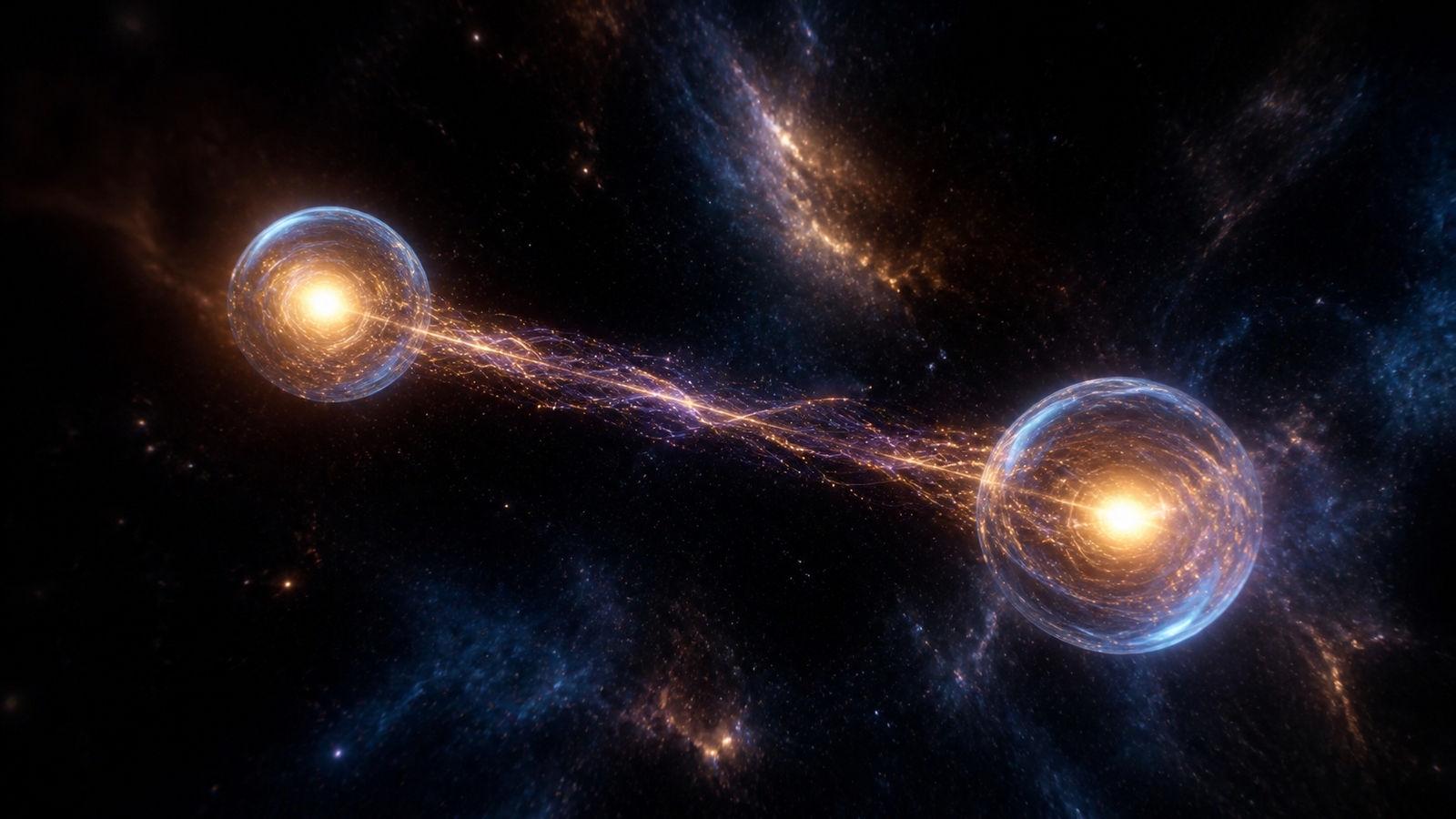
Two particles can be prepared so that the best description belongs to the pair as a whole, not to each particle separately.
Measure one particle, and the result is correlated with the result found for the other in a way that cannot be explained by simple hidden instructions written into each particle at the start. This does not mean the particles chat across space or that human thought creates reality.
It means the classical ideas of separability, locality, and preexisting properties cannot all survive unchanged.
Entanglement breaks our understanding of reality because it shows that the world is not always built from independent parts with complete private facts. The shock is not that the universe becomes vague or magical.
The shock is that a carefully prepared pair can have a real joint structure that outruns what either part seems to possess alone.
This is why entanglement feels more radical than ordinary uncertainty. It is not just that we do not know enough about two separate particles; it is that the separation itself is not the whole story.
The parts can be far apart in space while still refusing to behave like fully independent entries in a classical inventory.
That refusal is measured, not imagined. It is one of the clearest places where quantum theory forces a new intuition, and it does so experimentally.
A: No. It shows that classical separability and preexisting local values are not enough.
A: No. Their individual outcomes are random, and correlations appear after ordinary comparison.
A: He worried that quantum mechanics was incomplete or implied a kind of nonlocal connection.
A: Bell showed that local hidden-variable explanations obey testable statistical limits.
A: Yes. Modern experiments repeatedly support the quantum predictions.
A: No. Large separation helps rule out ordinary communication, while correlations remain.
A: No. Physical measurement arrangements and records are enough.
A: It is the idea that the whole is fully described by independently described parts.
A: The same correlations support quantum computing, communication, and sensing protocols.
A: Reality at the quantum level can be relational and joint before it is separate and local.
The Classical Assumption of Independent Parts
Classical physics is comfortable with separability. A system can usually be divided into parts, and the state of the whole is determined by the states of those parts plus their ordinary interactions.
If two objects are far apart and no signal passes between them, what happens to one should not instantly depend on what measurement is chosen for the other.
That assumption works well for planets, baseballs, machines, and most daily experience. It is the background of common sense. Entanglement does not destroy ordinary life, but it shows that common sense is not the deepest rule.
At small scales, the whole can have a definite quantum state while the individual parts do not have independent complete descriptions.
EPR and the Separability Challenge
Einstein, Podolsky, and Rosen sharpened the issue in 1935. They argued that if quantum mechanics allowed strong correlations between distant systems, then either the theory was incomplete or it involved a kind of spooky action at a distance.
Einstein preferred the idea that particles carried hidden facts not included in the wavefunction. That would preserve a more classical reality underneath the quantum description.
The EPR argument was not anti-science or anti-quantum. It was a serious challenge asking whether quantum mechanics could be the final word. If measurement on one distant particle lets you predict something about another, perhaps the second particle already had that property.
The question was whether those preexisting properties could explain all entangled correlations.
For decades, this looked philosophical. Then Bell’s theorem turned it into an experimental test. That transition is one of the great moments in modern physics: a debate about reality became something laboratories could measure.
Bell’s Theorem Changes the Stakes
Bell showed that any theory based on local hidden variables must obey certain statistical limits. Quantum mechanics predicts that entangled particles can violate those limits. Experiments have repeatedly found violations consistent with quantum predictions.
The result is not merely that quantum mechanics is strange. It is that a very natural classical repair strategy fails.
This does not prove every philosophical interpretation false except one. It does show that reality cannot be explained by particles carrying simple local answer sheets for all possible measurements. Either locality, separability, or the classical idea of preexisting values must be revised.
Different interpretations make different sacrifices, but none can return us to naive classical independence.
Why Distance Does Not Restore Classical Comfort
Entangled correlations persist even when measurement stations are far apart. Experiments have separated detectors by meters, kilometers, and more, while still observing correlations that violate Bell inequalities. Increasing the distance helps close loopholes and makes ordinary communication between measurement events less plausible.
Still, entanglement does not send usable information faster than light. Each local result looks random. Only after the two sides compare their records through a normal communication channel do the correlations appear. This is why entanglement can threaten simple separability without becoming a science-fiction messaging system.
The discomfort is subtle. Relativity’s speed limit survives, but the classical idea that distant systems have fully independent realities becomes harder to maintain. The world is connected in its state structure, not in a way that lets us transmit commands instantly.
What Separability Loses
Separability says the whole should be fully understandable by listing the properties of its parts. Entanglement says the whole can contain facts that are not reducible to separate local facts. The pair may have a definite joint property even when neither particle has a definite version of the corresponding individual property.
This is a deep shift. It means relationships can be fundamental rather than secondary. In an entangled state, the connection is not merely a later comparison between two independent objects. The shared state is the basic object quantum mechanics uses to make predictions.
Why This Is Not Mysticism
Because entanglement sounds dramatic, it is often pulled into vague claims about consciousness, telepathy, or the universe obeying wishes. Those claims do not follow from the physics. Entanglement is precise, fragile, mathematically defined, and experimentally tested. It appears under specific preparation conditions and disappears when decoherence destroys the shared quantum state.
The real lesson is more interesting than the mystical version. Entanglement shows that nature’s bookkeeping of possible outcomes is not arranged like a set of independent classical objects. It is not an excuse to abandon rigor. It is a demand for better rigor, because ordinary language becomes unreliable when describing nonclassical correlations.
Good explanations therefore keep two ideas together: entanglement is genuinely shocking, and it is not a license to say anything at all. The shock has a shape, and that shape is measured in experiments.
How Interpretations Respond
Different interpretations of quantum mechanics explain the broken classical picture in different ways. Many-Worlds keeps the universal wavefunction evolving and treats correlated outcomes as branching structure. Pilot-wave theory keeps definite particle positions but accepts nonlocal guidance. Copenhagen-style views emphasize measurement context and the limits of classical description.
These approaches disagree about what reality is like underneath, but they all take entanglement seriously. None can simply restore the old picture of isolated particles carrying every answer independently. Entanglement is one reason interpretation debates remain alive.
Why Everyday Objects Hide the Problem
If entanglement is so deep, it is fair to ask why chairs, planets, and people do not look entangled in obvious ways. The answer is decoherence. Large objects constantly interact with their environments.
Light bounces off them, air molecules collide with them, heat flows through them, and information about their position leaks everywhere.
These interactions make delicate quantum alternatives lose their ability to interfere, so macroscopic objects behave as though they have ordinary separate properties.
That everyday stability is useful, but it can mislead our intuition. We learn reality from objects whose quantum relationships have already been washed into classical records. Entanglement shows what becomes visible when systems are isolated well enough that those relationships survive.
It is not an exception pasted onto reality; it is a feature normally hidden by scale and environmental contact.
What Relationship-First Reality Means
Entanglement encourages a relationship-first view of the quantum world. Instead of imagining that the universe is built only from individual objects with private property lists, we have to allow that joint states can be basic.
A pair can have a well-defined relationship even when each partner lacks a complete independent description.
The relationship is not a later summary of two finished things; it is part of what the things are as a quantum system.
This does not mean everything is connected to everything in a useful way. Entanglement is specific, measurable, and often short-lived. But when it exists, it changes the order of explanation. The whole is not merely a pile of parts.
The state of the whole helps define what can be meaningfully said about the parts.
Why the Challenge Is Productive
The broken classical picture is not a dead end. It has produced sharper experiments, better theory, and new technologies. Bell tests became a way to ask whether local hidden variables can survive. Quantum information theory turned entanglement into a measurable resource.
Quantum computing and cryptography then turned that resource into a design goal. The challenge to reality became an engine for discovery.
That is why entanglement is worth learning carefully. It is not just “weird science” for dramatic effect. It is a pressure point where our deepest assumptions about objects, distance, and properties meet the precision of modern experiments. The discomfort is productive because it tells us exactly where our old categories stop working.
How the Broken Picture Gets Rebuilt
Once the old independent-object picture fails, the goal is not to give up on reality. The goal is to build a better picture. Quantum theory suggests that states, contexts, and correlations deserve a more central role.
It also suggests that some questions about individual parts cannot be answered without specifying the joint state and the measurement arrangement.
This rebuilt picture is less familiar, but it is not less scientific. It predicts patterns, rules out alternatives, and supports technologies. The world still has structure. Entanglement simply teaches that the structure is sometimes shared before it is local, and relational before it is reducible to separate objects.
The New Intuition
The best beginner intuition is not that entangled particles are secretly talking. It is that the pair must sometimes be treated as one quantum object, even when its parts are separated in space. Measurement reveals correlations built into the joint state, and those correlations are stronger than classical separability allows.
That intuition still feels strange because human experience is tuned to large objects whose quantum links have been washed out by the environment. At the microscopic level, reality is less like a collection of sealed boxes and more like a web of possible joint outcomes.
Why the Challenge Matters
Entanglement matters because it forces physics to refine the meaning of reality. It asks whether properties belong to objects independently, whether relations can be basic, and whether the state of the whole can outrank the state of the parts. Those questions are philosophical, but they are anchored in laboratory facts.
The result is a humbler and richer view of the universe. Reality is not whatever we imagine, and it is not the simple classical machine we inherited from everyday life.