Entanglement as a Practical Quantum Resource
Entanglement sounds like one of the strangest ideas in physics: two quantum systems can share a state so deeply that measuring one tells you something about the other, even when they are far apart.
Yet in modern quantum technology, entanglement is not merely a philosophical shock. It is a resource engineers try to create, preserve, distribute, and measure.
Quantum computers use entanglement to coordinate qubits in ways ordinary bits cannot imitate efficiently. Quantum cryptography uses entangled correlations to reveal eavesdropping and support secure key exchange. Quantum teleportation uses entanglement to transfer an unknown quantum state with the help of ordinary classical communication.
The power does not come from faster-than-light messaging or magic influence.
It comes from correlations that are stronger and more structured than anything classical physics can supply, and from the careful protocols that turn those correlations into useful work. This distinction matters because entanglement is useful only when it is handled with discipline. A vague claim that particles are connected is not enough.
Engineers need a state that can be generated on demand, protected from noise, verified by measurements, and converted into a computational step, security check, or network operation before the fragile correlation is lost.
In practice, the hardest part is often not proving entanglement is strange, but keeping it clean long enough to use. That practical struggle is where the future of quantum technology lives.
A: No. It is one essential resource, but useful speedups also need the right algorithm, gates, and measurement strategy.
A: No. The correlations are revealed only after ordinary communication compares measurement results.
A: It makes outside measurement attempts show up as changed statistics in the shared data.
A: It transfers a quantum state, not a physical object, and it requires a classical message.
A: The no-cloning theorem forbids perfect copying of an arbitrary unknown quantum state.
A: It measures error syndromes that reveal faults without exposing the protected logical information.
A: Yes in experiments, but loss, noise, and memory limits make long-distance distribution difficult.
A: They can violate Bell-type limits that any simple local hidden-variable model must obey.
A: No. Classical correlations can be strong, but entanglement has a specific quantum structure.
A: Entanglement is a usable shared quantum structure, not a magical communication line.
Why Entanglement Is More Than Correlation
Classical systems can be correlated in familiar ways. If a pair of gloves is split between two boxes, opening one box and finding the left glove tells you the other box contains the right glove. Nothing mysterious has happened; the gloves had definite identities before anyone looked.
Entanglement is different because the joint quantum state can be definite even when the individual parts do not have their own complete set of prewritten values.
That difference is what gives entanglement technological force. The whole system carries information that cannot be reduced to separate local descriptions. When qubits are entangled, their combined state can encode relationships that do not fit a simple list of independent bit values.
A quantum device can use those relationships during a computation, letting interference and measurement amplify useful answers while suppressing others.
Entanglement Inside Quantum Computers
A quantum computer begins with qubits, which can be placed in superpositions of zero and one. Superposition alone is not enough to explain quantum advantage. The qubits also need operations that link them, so the state of one qubit is no longer independent of the state of another.
Entangling gates create these links. They make the machine behave like a coordinated quantum system rather than a collection of isolated switches.
During an algorithm, entanglement helps distribute information across many qubits. The computer does not try every answer in the naive popular sense. Instead, it evolves a complex quantum state whose amplitudes can interfere.
Entanglement allows different parts of that state to depend on one another, which is essential for algorithms such as Shor’s factoring method, quantum simulation, and many error-correction schemes.
Entanglement is also fragile. Unwanted interaction with the environment can leak information and destroy the correlations the computation needs. This is why quantum processors require isolation, low temperatures, careful pulses, and error correction. The same feature that gives quantum computers power also makes them difficult to build.
Why Cryptography Cares About Measurement
Quantum cryptography often depends on a simple but profound fact: measuring a quantum system can disturb it. In entanglement-based key distribution, two parties share entangled particles and measure them in chosen ways. If no one has interfered, their results show the correlations predicted by quantum mechanics.
If an eavesdropper tries to gain information, that extra measurement changes the pattern and can be detected.
The security does not rest on hiding a clever code forever. It rests on physical laws. An attacker cannot copy unknown quantum states perfectly, and cannot observe the entangled systems without risking visible disturbance.
The communicating parties still need authentication, error correction, and privacy amplification, but entanglement gives them a way to test whether the channel behaved quantum mechanically and privately enough.
Quantum Teleportation Is a Protocol, Not a Portal
Quantum teleportation is often misunderstood. It does not beam matter across space, and it does not send a usable message faster than light. It transfers the state of one quantum system to another distant system using shared entanglement plus ordinary classical communication.
The original state is not copied; it is consumed by the measurement process, which respects the no-cloning theorem.
The protocol is important because it shows entanglement acting like a communication resource. Once two locations share an entangled pair, a local measurement and a classical message can complete the transfer of a quantum state.
This is a building block for future quantum networks, where fragile quantum information may need to move between processors, memories, and sensors.
The classical message is essential. Without it, the receiver cannot know which correction to apply. That requirement keeps teleportation consistent with relativity while still revealing how powerful shared quantum correlations can be.
Entanglement and Quantum Networks
A future quantum internet would not simply be a faster version of today’s internet. It would connect quantum devices that can share entanglement across distance. That shared entanglement could support secure communication, distributed quantum computing, clock synchronization, and linked sensors that measure weak signals more precisely than isolated devices.
The challenge is distribution. Entanglement is easily lost in optical fibers, air, imperfect memories, and noisy hardware. Researchers study repeaters, satellite links, photonic interfaces, and error-corrected memories to extend the range. The goal is not to make entanglement mystical, but to make it reliable enough for infrastructure.
Why Error Correction Needs Entanglement
Quantum error correction protects information without simply copying it, because unknown quantum states cannot be cloned. Instead, logical qubits are encoded across many physical qubits in entangled patterns. Carefully chosen measurements reveal errors without revealing the protected quantum information itself.
This is one of the most elegant uses of entanglement. The device learns whether a bit-flip, phase-flip, or other error has occurred, while avoiding a direct measurement that would collapse the encoded state. Entanglement spreads the information out so no single physical failure destroys the logical qubit.
Practical error correction requires many high-quality qubits, fast measurement, and precise control. It is difficult, but it is the path from small demonstrations to machines that can run long, useful calculations.
What Entanglement Does Not Do
Entanglement does not allow instant texting across the universe. It does not let one person choose a message by measuring a particle and force the other side to read it. The individual result of a quantum measurement is still random.
Only when the two sides later compare their data through ordinary communication do the correlations become visible.
This limitation is not a weakness. It is what keeps entanglement compatible with relativity while still making it useful. The value lies in correlations, verification, and shared structure, not in controllable faster-than-light signals.
How Engineers Certify the Resource
Because entanglement is fragile and invisible to ordinary inspection, engineers need ways to prove that they actually have it. They may perform tomography, measure correlations in several bases, or use special tests called entanglement witnesses.
In communication settings, they may use Bell-type statistics to certify that a source is producing correlations no classical device can fake under the stated assumptions.
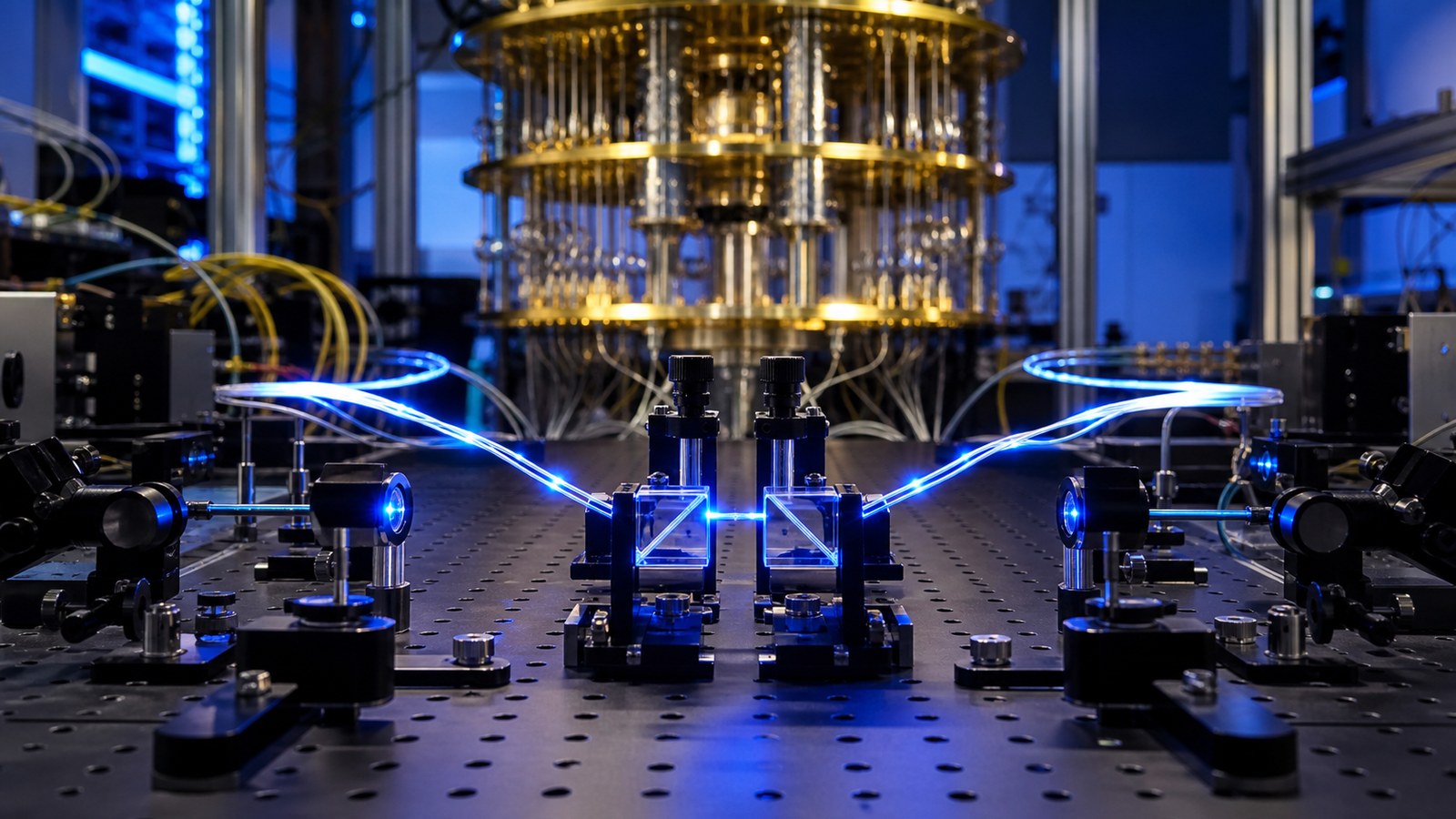
Certification is important because a beautiful optical table or a cold quantum chip does not automatically guarantee useful entanglement.
Certification also separates real quantum advantage from wishful language. A system can be complicated without being usefully entangled. It can contain noise that looks random but does not carry the needed joint structure.
Good experiments therefore ask practical questions: how strong is the entanglement, how long does it last, how often is it produced, and how reliably can it be measured? Those numbers decide whether the resource is ready for a protocol or still belongs in a demonstration.
Why Timing and Trust Matter
Entanglement is often useful only inside a narrow window. A quantum processor must create correlations, run gates, correct errors, and read out before decoherence erases the delicate state. A network node may have to store one entangled link while waiting for another.
A cryptographic protocol must decide which detections are trustworthy and which should be discarded as loss or noise. The resource is not a static treasure sitting in a box; it is a living condition that must be refreshed, protected, and checked.
Trust is equally important. In classical security, users often trust the hardware and the math. In quantum security, part of the trust can be shifted onto measured physical behavior. If a device produces the right entangled correlations, it can support stronger claims than a device that only promises to be honest.
That is one reason device-independent cryptography attracts attention, even though it is technically demanding.
The Bridge Between Foundations and Devices
Entanglement is unusual because it belongs equally to philosophical foundations and practical engineering. The same Bell-type correlations that unsettle classical realism can certify secure communication. The same joint states that make interpretation difficult can make quantum simulation powerful.
This is not a coincidence. The technological value comes from the very features that made entanglement seem impossible in the first place.
For beginners, that bridge is the most important idea to keep. Entanglement is not a decorative mystery added to quantum technology after the circuits are built. It is one of the reasons those technologies are quantum at all.
If engineers can control it, they can build tools that process, protect, and move information in ways classical systems cannot simply copy.
Where the Advantage Becomes Visible
The advantage of entanglement is easiest to see when a task depends on relationships rather than isolated values. Factoring large numbers, simulating molecules, distributing keys, and linking sensors all require more than a pile of separate bits.
They require structure across a system. Entanglement supplies that structure in a form that can be shaped by gates, tested by measurements, and consumed by protocols.
This is why the word “resource” is so common in quantum information. A resource is something useful but limited. Entanglement must be created at a cost, protected against noise, and spent wisely.
A careless measurement can destroy it; a well-timed measurement can turn it into a result, a key, or a verified link.
The Practical Takeaway
Entanglement powers quantum computing and cryptography because it creates relationships among systems that classical physics cannot reproduce. In computing, those relationships let qubits work as one coordinated state. In cryptography, they make interference and eavesdropping detectable.
In networks, they provide a resource that can move quantum states and link devices in new ways.