Turning Entanglement from Puzzle to Experiment
Entanglement once sounded like a problem too strange for the laboratory. How could scientists test whether two distant particles share correlations stronger than anything classical physics allows? The answer is patient experimental design.
Researchers create pairs of entangled particles, send them toward separated measurement stations, choose detector settings, record outcomes, and compare many trials statistically.
A single pair does not prove the point. The pattern across thousands or millions of pairs does. Bell-test experiments are especially important because they compare real data with limits that any local hidden-variable theory must obey.
When the data violates those limits, the experiment shows that nature is not following the simple classical script.
Entanglement experiments test the impossible by making the question precise enough for equipment, timing, random choices, and statistics to answer. The process is deliberately unromantic: align optics, choose settings, count events, close loopholes, and analyze uncertainty.
That ordinary discipline is exactly what makes the extraordinary conclusion believable. The experiment has to defeat many dull explanations before it earns the right to make a deep claim.
Bad alignment, detector bias, background counts, predictable settings, and accidental timing matches all have to be considered. The final result is not “the particles seemed spooky.” It is a measured violation of a specific classical bound after the ordinary failure modes have been constrained. That is why these experiments are so persuasive.
They do not ask us to admire a mysterious apparatus from a distance; they provide records, settings, counts, error bars, and a predeclared classical limit. The impossible-looking conclusion is carried by ordinary evidence.
The stronger the control of mundane details, the more confidently the experiment can point toward nonclassical reality. In that sense, the laboratory does not make entanglement less strange.
It makes the strangeness accountable, repeatable, and specific enough to challenge competing explanations. A good entanglement experiment is therefore both imaginative and stubbornly procedural. It has to be bold enough to test a deep idea and careful enough to survive skeptical inspection.
That combination is what makes the result durable. It is wonder with receipts and controls, not rumor.
A: It measures whether correlations between entangled systems exceed limits required by local hidden-variable theories.
A: The nonclassical pattern appears statistically, not in one isolated pair of outcomes.
A: Separation helps rule out ordinary communication between measurement stations.
A: Random choices make it harder for hidden instructions to anticipate the measurement arrangement.
A: It is a possible weakness that could allow a classical explanation of the observed data.
A: They close the major practical loopholes very strongly, though physics always states assumptions carefully.
A: Yes. Photon pairs are widely used, especially for optical and long-distance tests.
A: No. They also certify entanglement for communication and device-independent protocols.
A: No. They prove nonclassical correlations, not controllable instant signals.
A: Entanglement became convincing because experiments turned a strange claim into a repeatable statistical test.
What an Entanglement Experiment Needs
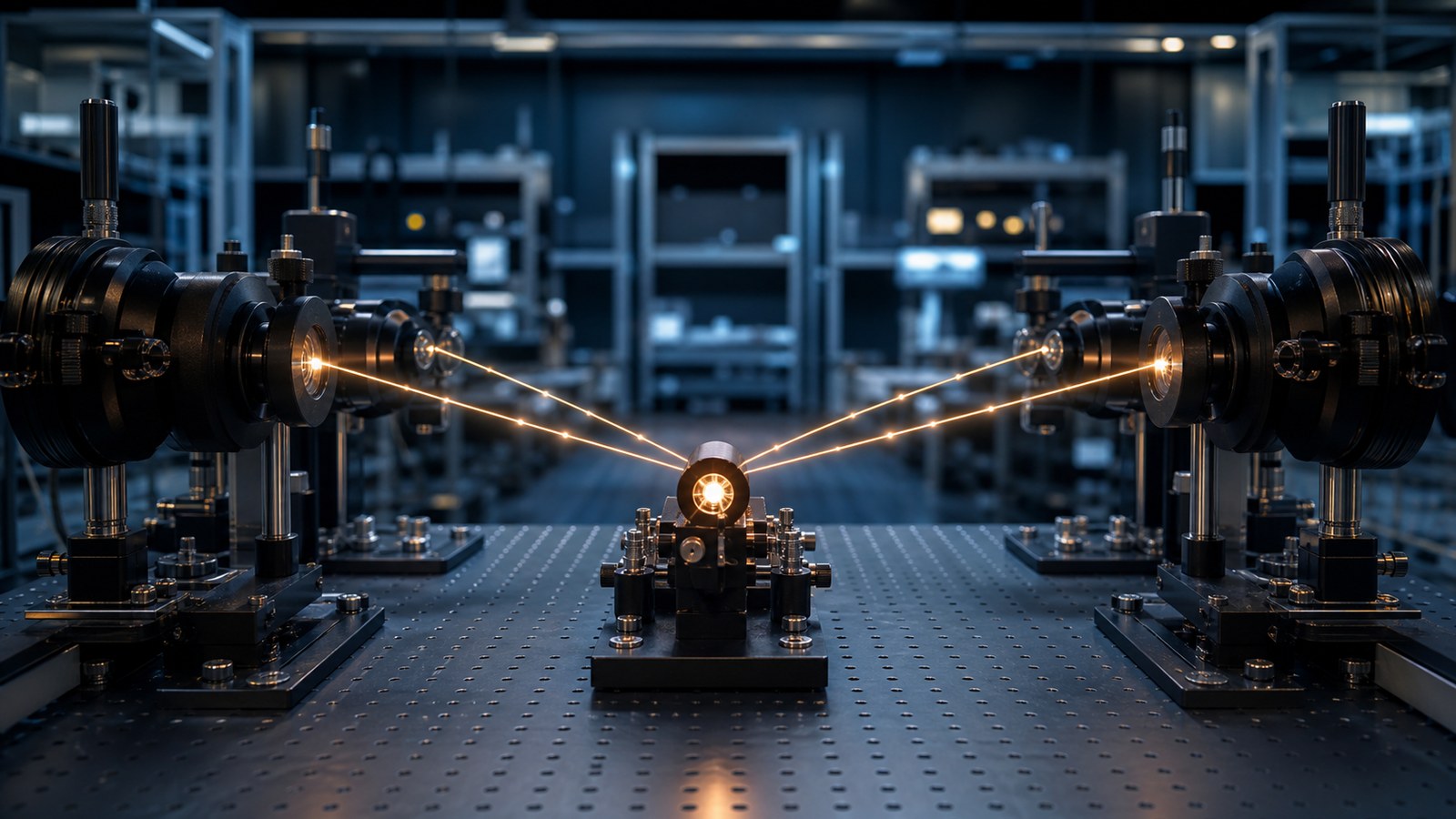
A basic entanglement experiment needs a source, two or more measurement stations, a way to choose measurement settings, and a reliable method for recording outcomes. In photon experiments, a crystal or other device can produce pairs of entangled photons.
The photons travel to separate analyzers, where their polarizations are measured along different orientations.
The important data are not just the individual results. Each side may see apparently random outcomes. The revealing part is how the outcomes line up when the two records are compared. Entanglement appears as a correlation pattern that depends on the measurement settings and exceeds classical limits.
Why Bell Tests Are Central
Bell tests are central because they do not merely ask whether particles are correlated. Classical systems can be correlated too. Bell tests ask whether the correlations can be explained by local hidden variables: preexisting instructions carried by each particle, unaffected by distant measurement choices.
Bell’s theorem shows that such theories must obey certain inequalities.
Quantum mechanics predicts violations of those inequalities for entangled systems. Experiments then test which pattern nature follows. When the measured correlations violate a Bell inequality, the classical local-instruction picture fails. The power of the test comes from comparing two clear possibilities, not from relying on vague weirdness.
Different Bell inequalities and experimental designs exist, but the logic is similar. Prepare entangled systems, measure them under varied settings, collect enough data, and see whether the statistical limits are broken.
Creating Entangled Pairs
Many optical experiments create entangled photon pairs through spontaneous parametric down-conversion. A pump laser enters a nonlinear crystal, and occasionally one photon is converted into two lower-energy photons whose properties are entangled. Other platforms use trapped ions, superconducting qubits, neutral atoms, quantum dots, or defects in diamond.
Each platform has strengths and weaknesses. Photons travel well and are useful for long-distance tests. Ions can be controlled and measured with high precision. Superconducting qubits integrate naturally with quantum processors. The choice depends on what loopholes the experiment is trying to close and what kind of entanglement is being studied.
Choosing Measurement Settings
Measurement settings matter because Bell tests compare correlations across different choices. If the settings were fixed or predictable in a suspicious way, a hidden-variable explanation might try to exploit that structure.
Modern experiments often use fast random number generators to choose settings while the particles are already in flight or while distant events are space-like separated.
The goal is to prevent ordinary communication or shared preparation details from explaining the result. The more independent and rapid the setting choices, the stronger the test. This is why timing, distance, and randomness are not decorative details. They are part of the experimental claim.
Even after the settings are chosen, the apparatus must be calibrated carefully. Detector angles, efficiencies, background noise, and timing windows can all affect the data. A convincing experiment is a whole system of controls.
Closing Loopholes
Early Bell tests were groundbreaking, but they left possible loopholes. The locality loophole asks whether one measurement station might have influenced the other through ordinary signals. The detection loophole asks whether missed particles biased the sample. The freedom-of-choice loophole asks whether measurement settings were genuinely independent of hidden variables.
Modern loophole-resistant experiments are designed to close several of these at once. They separate stations, choose settings quickly, improve detector efficiency, and analyze all relevant trials. No experiment is magically perfect, but the cumulative evidence has become extremely strong.
Why Statistics Decide the Result
Entanglement experiments are statistical. One pair of particles gives one pair of outcomes, and those outcomes may look random. The Bell violation appears only after many trials show a correlation pattern. Researchers calculate whether the observed pattern exceeds the classical bound by enough to rule out chance, noise, or bias.
This is why careful data analysis matters. Scientists must define the trial window, count detections consistently, subtract or model background events, and report uncertainty. The result is not a dramatic single click. It is a disciplined comparison between a measured distribution and a theoretical limit.
That statistical character does not weaken the conclusion. Many of the strongest facts in physics are statistical. What matters is whether the pattern is repeatable, controlled, and incompatible with the tested classical model.
Beyond Photons
Entanglement tests are not limited to photons. Trapped ions can be entangled and measured with high detection efficiency. Superconducting circuits can create entanglement on chips. Atomic ensembles and solid-state systems help explore how entanglement behaves in more complex environments.
These platforms expand the question. They test not only whether entanglement exists, but how it can be generated, scaled, preserved, and used. As experiments move from pairs to networks and many-body systems, entanglement becomes both a foundational test and a practical engineering target.
What the Experiments Do Not Prove
Bell experiments do not prove that particles send messages faster than light. They do not prove that consciousness causes outcomes. They do not choose one interpretation of quantum mechanics by themselves. What they do prove is narrower and stronger: nature violates constraints that local hidden-variable theories must satisfy.
That narrow result is enough to change physics. It eliminates a tempting classical explanation and forces any deeper theory to account for nonclassical correlations. Good experiments are powerful because they are precise about what they claim.
Why Randomness Must Be Engineered
Randomness in entanglement experiments is not casual. If the choice of measurement setting were predictable, a hidden-variable model might try to build that predictability into its explanation. Modern experiments therefore use physical random number generators, fast switching electronics, and strict timing constraints.
The setting choice is treated as part of the experiment’s protection against ordinary classical coordination.
This is one reason the laboratory version of entanglement is more demanding than the classroom sketch.
The sketch can say “measure each particle in different ways.” The real experiment must say when those ways were chosen, how independent the choices were, how quickly the settings changed, and whether any signal traveling at light speed could have connected the relevant events.
The impossible becomes testable only after the timing is made exact.
The Quiet Work of Calibration
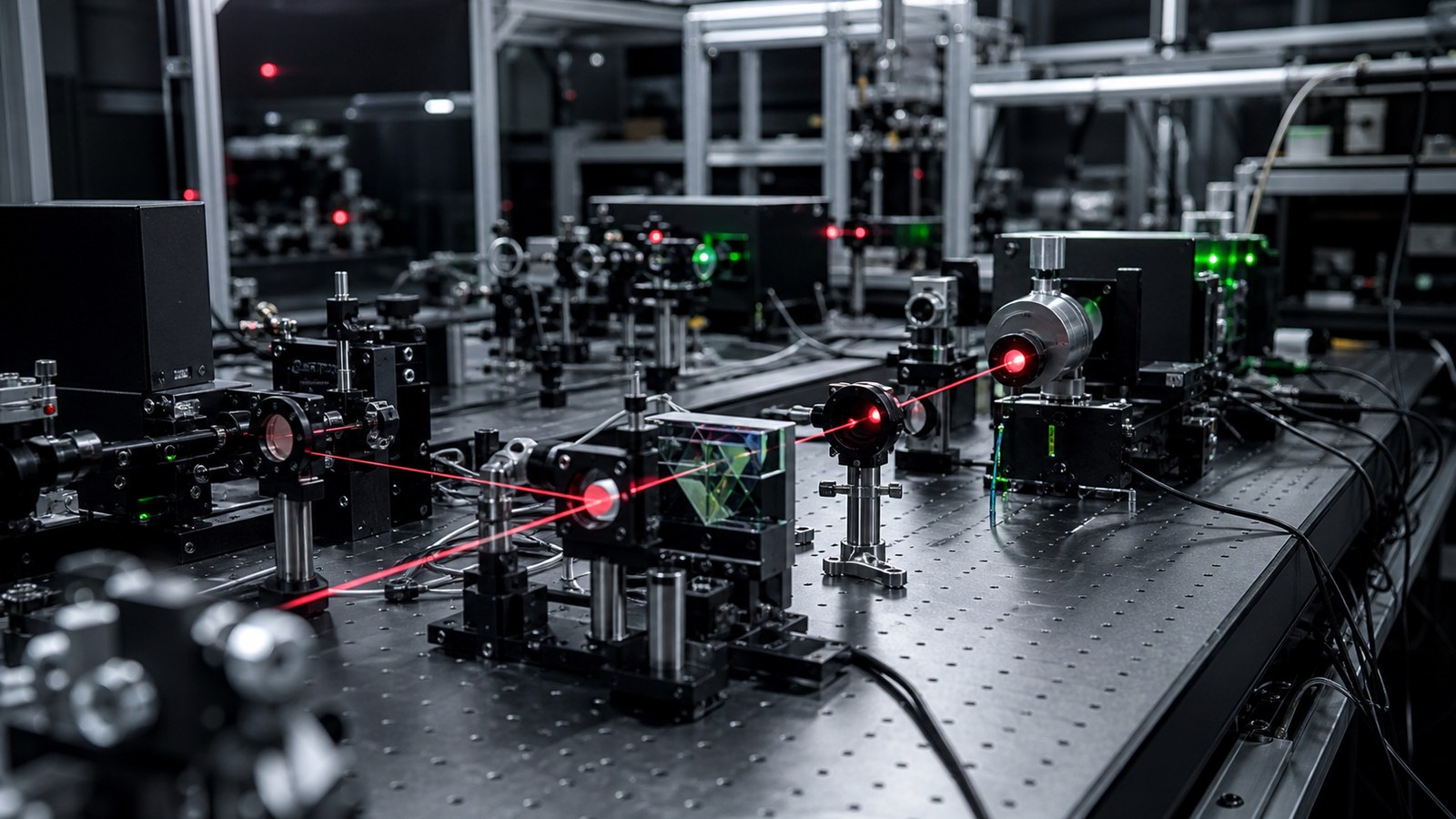
Calibration is less glamorous than the word entanglement, but it is what makes the conclusion trustworthy. Optical components must be aligned, detector efficiencies measured, timing electronics checked, and background events characterized. A small drift in an analyzer angle can weaken a correlation.
A biased detector can make one outcome look more common than it really is. A noisy source can add pairs that do not belong to the intended entangled state.
Scientists handle these problems by running controls, estimating uncertainty, documenting apparatus settings, and repeating the experiment. This is why a Bell violation is not merely a beautiful graph. It is a graph supported by a chain of practical checks. The more astonishing the claim, the more ordinary discipline it requires.
From Foundations to Certification
Entanglement experiments now do more than settle philosophical arguments. They can certify whether a device is producing genuine quantum correlations. In some security protocols, a Bell violation can support trust even when users do not fully trust the internal workings of the devices.
The experiment becomes a performance test: if the statistics exceed the classical limit, the source and detectors are doing something nonclassical together.
This is a remarkable reversal. What began as a challenge to the meaning of quantum mechanics now helps build practical quantum technologies. The same measurement logic that rules out local hidden-variable stories can become a tool for checking hardware, validating links, and supporting secure communication. The foundational test became an engineering diagnostic.
Why Repetition Does Not Make It Ordinary
Because Bell tests are repeated so often, it is easy to forget how bold the result is. Each run looks modest: prepare particles, choose settings, record outcomes, compare statistics. Yet the accumulated pattern rejects a natural classical story about how distant objects should behave.
The routine character of the lab work makes the conclusion stronger, not weaker, because the result survives ordinary controls and repetition.
This is one of the pleasures of modern physics. The most astonishing claims are not always announced by spectacular single events. Sometimes they arrive as stable patterns in careful data. Entanglement experiments are powerful because the impossible-looking conclusion is built from repeatable, inspectable steps.
The Takeaway from the Lab
Entanglement experiments show how a strange idea becomes a measurable fact. The work requires sources, detectors, random settings, timing control, calibration, statistical analysis, and skepticism about loopholes. The romance of the subject is real, but it is carried by careful apparatus.
The impossible becomes testable when the question is framed clearly. Do entangled systems obey classical local limits, or do they follow quantum predictions? Again and again, experiments answer in favor of quantum mechanics. That is why entanglement is no longer just a thought experiment.