A Particle Found Through the Patterns It Left Behind
The Higgs boson is a short-lived, electrically neutral, spin-zero particle discovered by the ATLAS and CMS experiments at CERN in 2012. It is the detectable quantum excitation of the Higgs field, and its discovery confirmed the central idea behind the Brout-Englert-Higgs mechanism. Physicists do not capture a persistent Higgs particle or watch it cross a detector. They create it in rare high-energy collisions and reconstruct its existence from photons, leptons, and jets produced when it decays. That indirect discovery completed the Standard Model’s predicted particle roster while opening a new program of precision measurements.
A: No. A statistically significant excess emerged across many collisions and channels.
A: Independent detectors reduced the chance of a shared instrumental mistake.
A: No. Its decay products are measured and reconstructed.
A: Excellent energy resolution creates a clear invariant-mass peak.
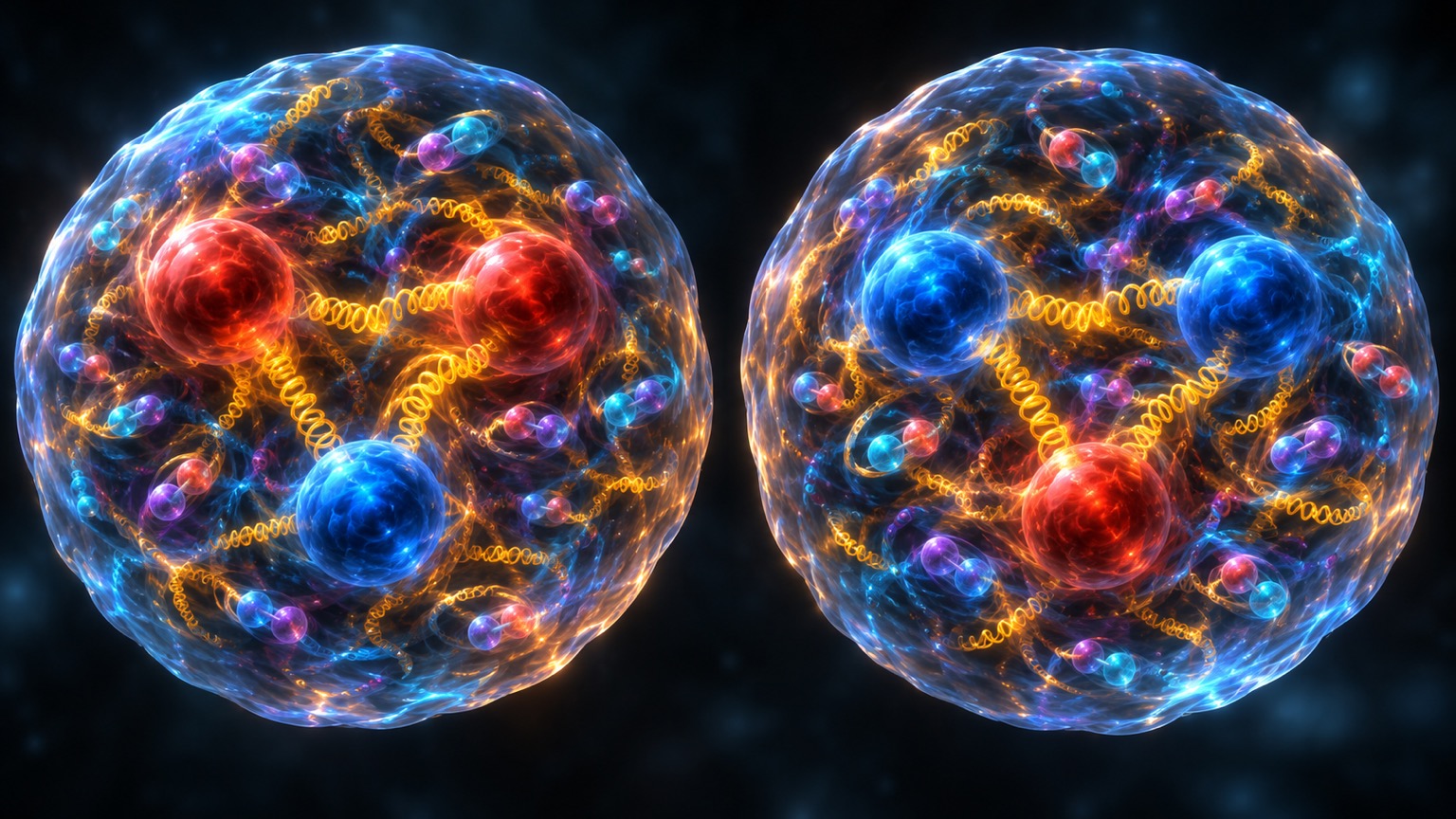
A: No. QCD field energy supplies most nucleon mass.
A: Decay angles and production correlations match scalar predictions.
A: Only uncommon hard parton interactions concentrate the required energy and couplings.
A: Yes. Extended theories predict additional scalars, but none is confirmed.
A: It can constrain the Higgs field’s self-interaction.
A: Small coupling deviations could reveal otherwise inaccessible new physics.
Why Physicists Expected a Higgs Particle
The electroweak theory describes electromagnetism and the weak interaction within one gauge framework. Its symmetry naturally treats the force carriers as massless, yet experiments had shown that the W and Z bosons are heavy while the photon is massless. The Brout-Englert-Higgs mechanism resolves the conflict by introducing a field with a nonzero value throughout empty space.
A quantum field has excitations. If the proposed Higgs field existed in the simple Standard Model form, collisions energetic enough to disturb it should produce a spin-zero particle with predictable relationships to other particles. Finding that excitation would not merely add one item to a chart; it would provide experimental access to the field responsible for electroweak symmetry breaking.
The theory did not initially specify the Higgs boson’s exact mass. Earlier accelerators searched broad ranges and ruled out many possibilities. Precision measurements and exclusion limits narrowed the hunt, but only the Large Hadron Collider supplied enough collision energy and event volume to explore the remaining region decisively.
How the Large Hadron Collider Produces Higgs Bosons
Protons circulating in opposite directions at the LHC collide at enormous energy. A proton is a composite object, so the hard interaction occurs between its quarks and gluons. The most common Higgs production route involves gluons coupling through a quantum loop dominated by heavy quarks. Other routes include fusion of weak bosons and production alongside a W, Z, or top-quark pair.
Even at the LHC, Higgs production is rare compared with ordinary strong-interaction events. The particle’s mass is about 125 billion electronvolts in energy units, and it survives for only a tiny fraction of a second. It decays before reaching any detector layer, so every analysis begins with the particles that emerge afterward.
Decay Channels Turn an Invisible Moment Into Evidence
The Higgs boson can decay in several ways, with probabilities tied to particle masses and the available phase space. The most common predicted decay is into a bottom quark and antiquark, but strong-interaction backgrounds make that channel challenging. Decays into two photons are much rarer yet form a clean, sharply measured energy signature. Four-lepton final states produced through two Z bosons offer another exceptionally precise channel.
Other analyses use pairs of W bosons, tau leptons, muons, or charm-related signatures. No single event can announce that a Higgs existed because known processes produce identical final particles. Researchers combine many events and reconstruct the invariant mass of candidate decay products. A true resonance appears as an excess clustered at one mass over a smoothly varying background.
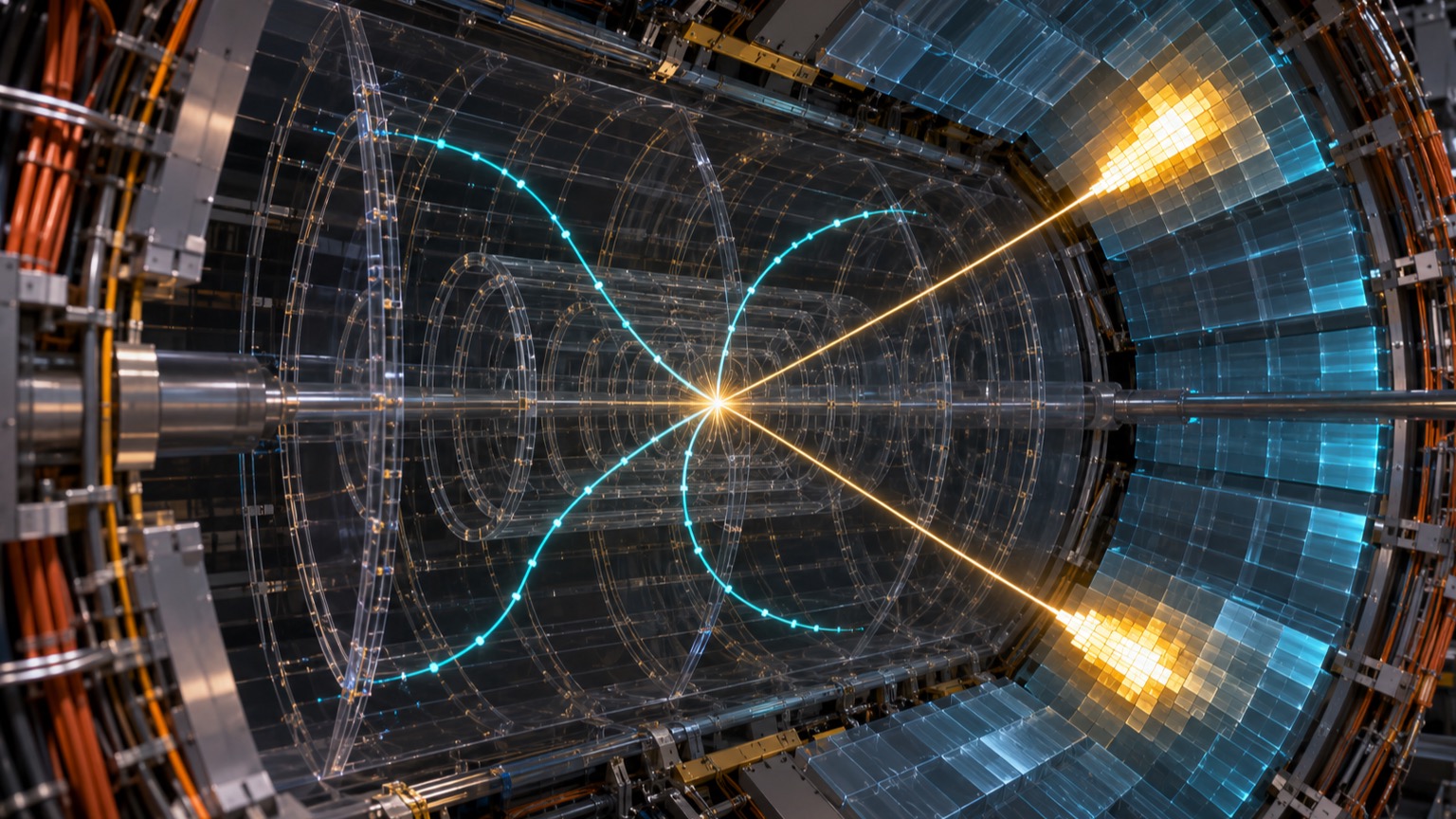
The two-photon channel illustrates the method. The Higgs has no electric charge, so it does not couple directly to photons in the simplest way. The decay proceeds through loops involving charged particles. Calorimeters measure the photons’ energies and directions; combining them reveals whether repeated pairs point back to the same parent mass.
In the four-lepton channel, detectors track electrons or muons with high precision. Their momenta reconstruct intermediate Z bosons and then the parent candidate. The low background and complete kinematic information make the channel visually memorable even though it accounts for a small fraction of Higgs decays.
The 2012 Announcement
ATLAS and CMS are independent multipurpose experiments using different detector designs and analysis teams. On July 4, 2012, both reported a new particle near 125 GeV with statistical significance meeting the conventional discovery threshold. Agreement between two experiments was crucial because it reduced the chance that an unknown detector effect or one analysis choice created the signal.
The first announcement cautiously described a new boson consistent with the Higgs. More data were needed to establish its spin, parity, production rates, and decay behavior. By studying angular correlations and relative channel strengths, researchers found the properties expected for a spin-zero Higgs boson. The Nobel Prize in Physics was awarded in 2013 to François Englert and Peter Higgs for the theoretical discovery of the mechanism, following the experimental confirmation.
What “Spin Zero” Makes Special
The Higgs is the only known elementary scalar particle: its spin is zero. Photons, gluons, and W and Z bosons have spin one, while elementary matter particles have spin one-half. A scalar field has the same value under rotations, which lets the Higgs field fill space without selecting a preferred direction.
Spin is tested through how the Higgs is produced and how its decay products are distributed. Alternative spin assignments predict different angular correlations. The data strongly favor the scalar behavior required by the Standard Model and rule out several simple impostor possibilities.
Being scalar also creates a theoretical puzzle. Quantum corrections tend to make an elementary scalar’s mass sensitive to physics at much higher energy scales. Why the Higgs mass remains near 125 GeV rather than being driven vastly higher is called the hierarchy or naturalness problem. Proposed solutions include new symmetries, compositeness, or additional dimensions, but none has been confirmed.
How Couplings Are Measured
The Higgs boson’s interaction strengths can be inferred from production and decay rates. In the Standard Model, couplings to elementary particles are related to their masses. Measurements involving W, Z, top, bottom, and tau particles broadly follow that pattern. The more difficult goal is testing lighter particles with enough precision to see whether the relationship continues across every generation.
Each measured rate combines a production probability, a decay probability, detector acceptance, and background modeling. Physicists therefore fit many channels together. A deviation in one route could reflect a changed production coupling, an altered decay, or an unseen decay channel. Global combinations disentangle these possibilities and compare them with a single Standard Model Higgs.
What the Discovery Did—and Did Not—Explain
The Higgs discovery confirmed that the electroweak vacuum contains the field required to give W and Z bosons mass without destroying the theory’s predictive structure. It also supports the mechanism by which charged leptons and quarks receive elementary masses through their Higgs couplings.
It did not explain why those couplings have their particular values. The electron, top quark, and other particles differ enormously in mass, and the Standard Model inserts the coupling strengths from measurement. The discovery also did not show that all mass comes from the Higgs. Most proton and neutron mass arises from strong-interaction energy inside nucleons.
Dark matter, gravity, neutrino mass origins, and the cosmic matter-antimatter imbalance remain outside the Higgs discovery’s solution. The particle completed a highly successful theory, but it did not turn that theory into a complete description of the universe.
The Higgs Boson as a Portal to New Physics
New particles too heavy to create directly could still affect Higgs production or decay through quantum loops. Invisible Higgs decays might reveal stable weakly interacting particles. Additional scalar particles could mix with the known Higgs and subtly change its couplings. Precision is therefore a discovery method, not merely bookkeeping.
Pair production of Higgs bosons offers a way to probe the field’s self-interaction and the shape of its potential. The process is much rarer than single-Higgs production, making it difficult at present colliders. Improved luminosity, analysis, and future facilities aim to measure it and test whether the Higgs field has exactly the Standard Model form.
The Higgs may also connect particle physics with the early universe. The field’s behavior influenced the electroweak phase transition, and its potential relates to questions about vacuum stability. Turning those connections into firm cosmological conclusions requires measurements beyond the particle’s mere existence.
Rare exclusive decays offer a complementary route. A channel that is nearly invisible today may become measurable after years of additional collisions and improved analysis. Each newly isolated mode tests whether the same particle consistently explains interactions with a different field.
Why the Higgs Changed Physics
The discovery closed a search that had shaped accelerator design and experimental strategy for decades. More importantly, it transformed the Higgs field from an elegant theoretical requirement into something scientists can interrogate experimentally. Every coupling measurement asks how the vacuum itself participates in the properties of elementary particles.
The particle did not end the story; it created a new instrument for asking sharper questions. Is it the only Higgs boson? Does it couple to every massive elementary particle exactly as predicted? Does it interact with dark matter or with itself in the expected way? The 2012 signal changed physics because those questions moved from speculation toward measurement.
How a Higgs Measurement Is Built
A collider result begins long before a statistical fit. Detectors must be aligned and calibrated so particle energies, momenta, and identification efficiencies are understood. Simulated events model how known processes pass through the apparatus, while data control regions test those models in samples where little Higgs signal is expected. Analysts define selection criteria before looking at the most sensitive region whenever possible, reducing the chance that random features guide the method.
Background uncertainty is as important as raw event count. A small error in the predicted shape beneath a mass peak can mimic or hide a signal. Teams compare alternative calculations, vary detector responses, and repeat analyses with different techniques. Modern machine-learning classifiers may separate signal-like from background-like events, but their outputs still require physical validation and uncertainty estimates.
Finally, likelihood fits combine categories and channels, accounting for correlated uncertainties. Results are expressed as signal strengths, coupling constraints, masses, or limits on unfamiliar decays. Independent internal reviews challenge every step before publication. The Higgs discovery was persuasive not because one image looked spectacular, but because a long chain of calibrated reasoning produced compatible answers in two experiments and several final states.
The Name and the People Behind the Theory
“Higgs boson” is convenient but historically incomplete. In 1964, several groups developed related ideas showing how spontaneous symmetry breaking could work in relativistic gauge theories. Robert Brout and François Englert published one influential treatment, Peter Higgs emphasized the remaining massive scalar excitation, and Gerald Guralnik, Carl Hagen, and Tom Kibble made further foundational contributions.
The fuller phrase Brout-Englert-Higgs mechanism recognizes part of that shared history, while everyday usage kept the shorter particle name. Understanding the collaboration matters because the discovery joined many layers of work: theorists who solved a consistency problem, engineers who built accelerators and detectors, and thousands of experimentalists who converted rare collision patterns into reliable evidence.
The story also corrects the lone-genius myth. No theorist predicted the final measured mass, and no single detector event settled the question. The result emerged from competing ideas, decades of excluded possibilities, shared technical standards, and reproducible statistical agreement. Its human scale is as collective as its physics is precise.
That collective process continues with every new Higgs data set.