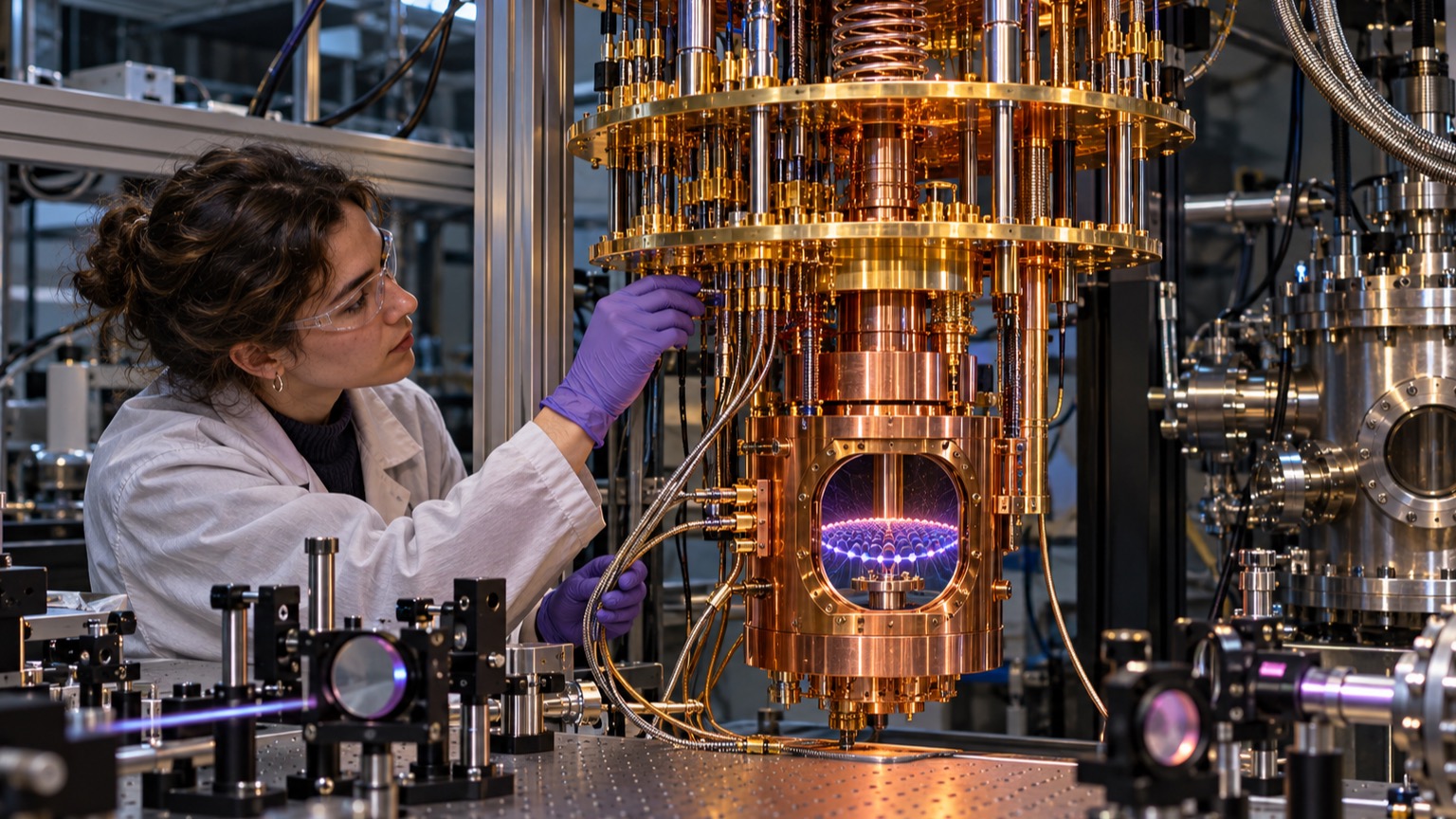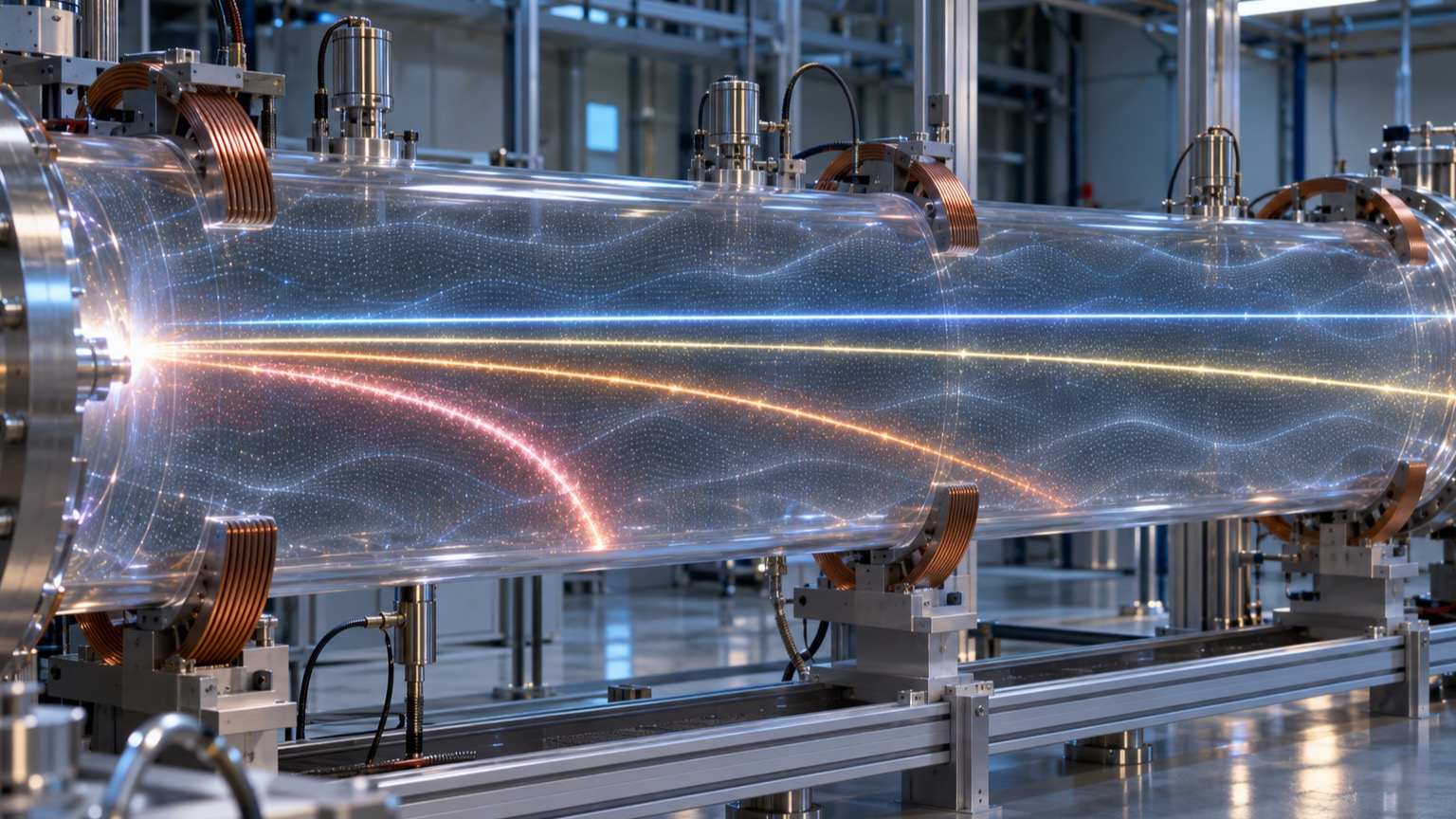
An Invisible Field With a Nonzero Value Everywhere
The Higgs field is a fundamental quantum field that fills space, including a perfect vacuum. Unlike familiar fields that fall to zero when their sources disappear, its lowest-energy state has a nonzero value. Elementary particles that couple to this background acquire mass terms, with stronger couplings producing larger masses. The photon does not couple in the required way and remains massless; W and Z bosons couple strongly and become heavy. The Higgs boson is a ripple of the field, not the field itself. Separating those ideas is the key to understanding what the Higgs field does and what it does not explain.
A: No. Bosons are quantized disturbances of the underlying field.
A: No. It changes their energy-momentum relation without ordinary friction.
A: It corresponds to the unbroken electromagnetic field combination.
A: Yes. Its vacuum value remains nonzero even without particles.
A: No. Strong-interaction energy dominates nucleon and everyday mass.
A: Its boson, couplings, and electroweak predictions provide connected evidence.
A: The hot early universe favored a different electroweak configuration.
A: Yes. Many extended theories predict a larger Higgs sector.
A: It may be metastable, with a lifetime vastly beyond cosmic age.
A: Producing Higgs pairs can constrain the self-coupling.
A Field Is More Fundamental Than Its Particles
Quantum field theory assigns a field to each elementary particle species. The electron field exists throughout space, and an electron is one quantum excitation of it. The electromagnetic field can carry waves whose quanta are photons. In the same language, the Higgs boson is an excitation around the settled background value of the Higgs field.
The field is not a material fluid layered on top of space. It is part of the mathematical and physical description used to predict interactions. Saying it “fills the universe” means the field has a value at every spacetime point. That value can be constant in the vacuum without selecting a physical direction or forming a detectable wind.
Particles do not continually lose energy by moving through the Higgs field. Uniform motion remains uniform, and special relativity remains intact. Mass changes the relationship among energy, momentum, and velocity; it is not ordinary drag. The common image of people struggling through a crowd can hint that couplings differ, but it gives the false impression of friction and a preferred rest frame.
The Vacuum Is Not the Zero-Field State
A field’s vacuum state is its lowest-energy configuration. For many simple fields, that minimum occurs when the field value is zero. The Higgs potential is different: the symmetric zero value is unstable at today’s low temperature, while a family of nonzero configurations has lower energy.
The field settles into one of those configurations. Its nonzero vacuum expectation value becomes a universal background. The equations retain electroweak gauge symmetry, but the chosen vacuum does not display it in the same way. This spontaneous symmetry breaking reorganizes the field degrees of freedom and allows the observed particle spectrum.
How Coupling Becomes Elementary Mass
A mass term in a field equation determines how energy and momentum relate for that particle. Directly inserting masses for electroweak gauge bosons would spoil the gauge structure that makes the theory consistent. Coupling the fields to the Higgs background generates effective mass terms while preserving the underlying gauge theory.
The W and Z bosons acquire mass through this electroweak reorganization. The photon corresponds to an unbroken combination of fields and remains massless. That difference explains why the weak interaction is extremely short-ranged while electromagnetic influence can extend indefinitely.
Quarks and charged leptons receive masses through Yukawa couplings to the Higgs field. Each particle type has its own coupling strength. The top quark couples strongly and is very heavy; the electron couples weakly and is light. The Standard Model does not explain why the coupling values span such a huge range. It uses measured parameters.
Neutrinos require special care. Their observed oscillations prove nonzero mass differences, but the simplest original Standard Model did not include suitable neutrino masses. Extensions may use tiny Higgs couplings, additional fields, or a seesaw-like mechanism. It is therefore too broad to say the known Higgs field has experimentally explained every particle mass.
Why the Field Does Not Explain Most Everyday Mass
The Higgs field gives elementary quarks intrinsic mass, yet the up and down quark masses account for only a small share of a proton or neutron. Most nucleon mass comes from the energy of confined quarks and gluon fields. Strong-interaction dynamics turn that energy into mass through the same mass-energy equivalence that applies elsewhere.
Ordinary objects contain nuclei, so QCD energy supplies most of their rest mass. The Higgs field remains indispensable: without quark and electron masses, atomic and nuclear stability would be profoundly different. Its role is foundational but not a universal reservoir that directly weighs every composite object.
Binding energy can either increase or decrease a system’s mass relative to separated components. A stable nucleus weighs less than its free nucleons because energy was released during binding. A hot object weighs slightly more than the same object when cooler. These examples show why composite mass must be calculated from total energy, not assigned solely to Higgs coupling.
The Higgs Boson Is a Local Disturbance
Once the Higgs field sits at its nonzero vacuum value, it can still oscillate around that value. The quantized oscillation is the Higgs boson. Producing one requires concentrating enough energy in a suitable particle collision, and the excitation decays almost immediately into other fields.
Discovering the boson in 2012 supplied strong evidence that the field and mechanism are real. Its measured mass describes the curvature of the potential near the vacuum minimum, while its production and decay rates reveal couplings. The boson is therefore an experimental probe of the otherwise invisible background.
What Happened as the Early Universe Cooled
At extremely high temperature, interactions with the hot plasma modify the effective Higgs potential. The symmetric configuration can be favored, and the electroweak force behaves differently. As the universe expanded and cooled, the Higgs field settled into its broken-symmetry phase with a nonzero value.
This transition changed which field combinations behaved as massive W and Z bosons and which remained the photon. Particle masses became meaningful in their present form. The phrase “particles gained mass” is a compressed description of this changing field environment, not a moment when material substance was poured into them.
The detailed nature of the electroweak transition matters for cosmology. In the minimal Standard Model at the measured Higgs mass, it is expected to be a smooth crossover rather than a strongly first-order transition. New particles or Higgs fields could change that behavior and possibly contribute to explanations of the matter-antimatter asymmetry.
How We Know an Everywhere Field Exists
The field’s background is not measured by placing a probe in empty space and reading a meter. Evidence comes from a network of predictions. W and Z masses, electroweak interaction rates, particle couplings, and the existence of a scalar boson all fit the symmetry-breaking framework.
The Higgs boson provides the most direct handle. Its decay to W, Z, tau, bottom, and other particles tests whether coupling strengths follow the mass-related pattern. Precision electroweak measurements made before 2012 also constrained the allowed Higgs mass indirectly through quantum corrections.
Scientific confidence grows because the same field hypothesis explains many results with one consistent structure. Alternative models remain possible, especially if they mimic the observed low-energy behavior. Increasing precision tests whether the simple single-field description is complete.
Production measurements add another dimension. Gluon fusion, vector-boson fusion, and associated production depend on different combinations of couplings. Agreement across them makes it harder for a modified field to imitate the Standard Model accidentally. Disagreement would help identify which sector needs revision.
Vacuum Stability and the Shape of the Potential
The Higgs field’s potential determines which vacuum configurations are stable. Quantum corrections from other particles, especially the top quark, affect its shape at very large field values. Using current measurements, calculations suggest our electroweak vacuum may be metastable rather than absolutely stable, although uncertainties and unknown high-energy physics matter.
Metastable does not mean an imminent catastrophe. Estimated decay times are vastly longer than the present age of the universe under the Standard Model assumptions. The subject is valuable because it connects measurable Higgs and top properties with the behavior of fields at inaccessible scales.
Misconceptions That Obscure the Real Idea
The Higgs field is not gravity. Gravity responds to total energy and momentum, including forms of mass not created directly by Higgs couplings. The field is not an ether that defines absolute motion, and it does not slow particles through collisions. It does not switch off inside empty regions, nor is it identical to a cloud of Higgs bosons.
Mass also does not measure how much field “sticks” to a particle in a mechanical sense. Coupling is a term in the quantum field equations. The analogy of resistance can suggest that stronger coupling means larger mass, but the accurate statement is that the background field changes the energy-momentum relation.
The best mental model is a universal quantum background whose settled value changes the allowed behavior of other fields. Its ripple is observable as the Higgs boson. Its full potential and possible connections to new physics remain open to experiment.
Why the Higgs Field Remains a Frontier
Physicists want to know whether the known field is elementary, whether additional Higgs fields exist, and how the field interacts with itself. Measuring double-Higgs production can constrain self-coupling, while rare decays can test light-particle couplings or invisible states.
The field may connect to cosmic inflation, dark matter, or the origin of matter, but no such connection is established. That uncertainty is precisely what makes Higgs research powerful: a field already proven central to the Standard Model may be the nearest experimental doorway to physics beyond it.
How the Higgs Field Differs From Familiar Fields
An electric field is sourced by electric charge and can be screened or redirected by matter. A gravitational field responds to energy and momentum and varies strongly near massive bodies. The Higgs vacuum value, by contrast, is essentially uniform across ordinary environments. Earth, interplanetary space, and a laboratory vacuum do not carry meaningfully different background values merely because their matter density differs.
The field is also unusual because its vacuum value is scalar. It does not point north, align with a laboratory axis, or distinguish one inertial direction. A vector field with a nonzero universal background could violate the observed symmetry of spacetime. The scalar Higgs configuration allows masses without creating that preferred direction.
Local Higgs excitations are difficult to create because the boson is heavy and couples most strongly to other heavy particles. Once produced, an excitation lasts only briefly. The calm, universal vacuum and the rare, energetic boson are thus two regimes of one field: a background that continuously shapes particle equations and a disturbance visible only through high-energy decay signatures.
Could the Field Vary Across the Universe?
Within observations, elementary masses and couplings appear stable across ordinary locations and times. A substantially different Higgs background would shift atomic spectra, nuclear thresholds, and particle masses, leaving widespread evidence. Astronomical spectroscopy and laboratory comparisons place strong limits on such variation, although those tests often constrain combinations of constants rather than the Higgs value alone.
Some speculative models allow the Higgs to interact with additional cosmological fields or change during extreme epochs. Any proposal must preserve the exceptional uniformity already measured and recover the successful Standard Model locally. The possibility is scientifically interesting precisely because the ordinary field is so consistent.
Future clocks, spectra, and collider comparisons will tighten those consistency tests across both distance and energy.
Uniformity itself is therefore a measurable property, not a casual assumption.